CVE-2026-11368
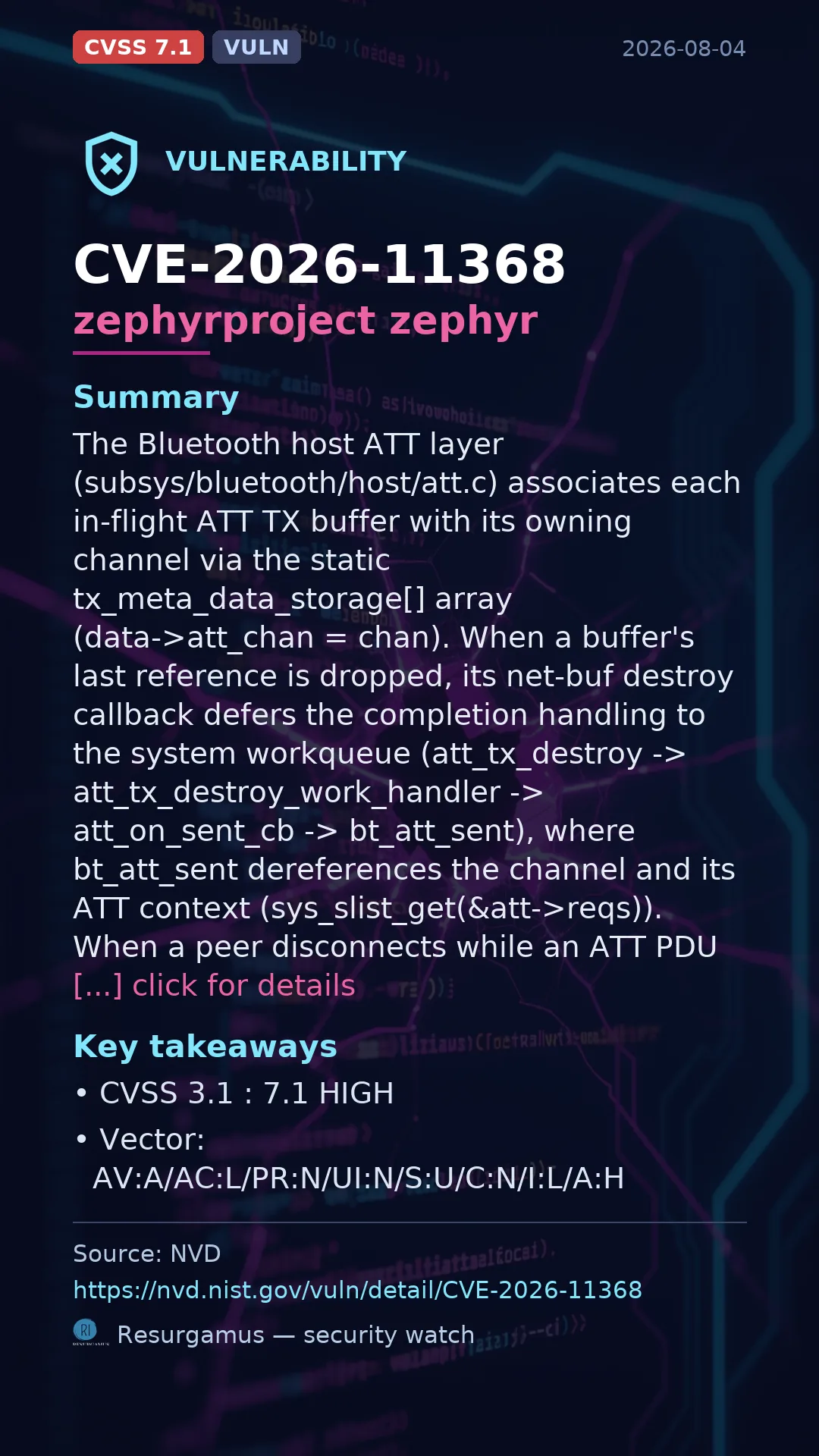
The Bluetooth host ATT layer (subsys/bluetooth/host/att.c) associates each in-flight ATT TX buffer with its owning channel via the static tx_meta_data_storage[] array (data->att_chan = chan). When a buffer's last reference is dropped, its net-buf destroy callback defers the completion handling to the system workqueue (att_tx_destroy -> att_tx_destroy_work_handler -> att_on_sent_cb -> bt_att_sent), where bt_att_sent dereferences the channel and its ATT context (sys_slist_get(&att->reqs)). When a peer disconnects while an ATT PDU (a server notification/indication or any response) is still in flight in the controller TX path, L2CAP tears the channel down in l2cap_chan_del(): it runs the disconnected callback and then the released callback (bt_att_released), which frees the channel slab slot. Because the in-flight buffer is held by the connection TX path rather than the channel's own queue, its deferred destroy work can run after the channel has been freed. The att_on_sent_cb guard intended to drop the stale callback itself dereferences meta->att_chan, which is now a dangling pointer into a freed (and possibly reused) slab slot. A remote peer with an ATT connection can drive this by
No public exploitation has been reported so far. No distribution fix is listed yet; apply vendor mitigations and monitor.
Recommended action: Track your distribution's security tracker and apply the fix as soon as it ships.
Severity metrics
CVSS 3.1 : 7.1 HIGH
Vector: AV:A/AC:L/PR:N/UI:N/S:U/C:N/I:L/A:H
Affected & fixed versions by distribution
Versions are the native distribution strings (backport-aware): RHEL/Debian/SUSE backport fixes, so compare with the distro version comparator (dpkg / rpm / vercmp), not the upstream version.
No affected package in the tracked watchlist yet (Debian, Ubuntu, Arch, SUSE, Red Hat...). Triage may still be pending.