CVE-2026-58662 — Apache Software Foundation Apache Thrift · CVSS 8.7 Improper Validation of Specified Quantity in Input, Out-of-bounds Read vulnerability in Apache Thrift C++ bindings. This issue affects Apache Thrift: before 0.24.0. Users are recommended to upgrade to version 0.24.0, which fixes the issue. | CVSS 4.0 : 8.7 HIGH | Vector: AV:N/AC:L/AT:N/PR:N/UI:N/VC:N/VI:N/VA:H/SC:N/SI:N/SA:N
CVE-2026-58389 — Apache Software Foundation Apache Thrift · CVSS 8.7 Allocation of Resources Without Limits or Throttling vulnerability in Apache Thrift Rust bindings. This issue affects Apache Thrift: before 0.24.0. Users are recommended to upgrade to version 0.24.0, which fixes the issue. | CVSS 4.0 : 8.7 HIGH | Vector: AV:N/AC:L/AT:N/PR:N/UI:N/VC:N/VI:N/VA:H/SC:N/SI:N/SA:N
CVE-2026-55971 — Apache Software Foundation Apache Thrift · CVSS 9.3 Heap-based Buffer Overflow vulnerability in Apache Thrift C++ bindings. This issue affects Apache Thrift: before 0.24.0. Users are recommended to upgrade to version 0.24.0, which fixes the issue. | CVSS 4.0 : 9.3 CRITICAL | Vector: AV:N/AC:L/AT:N/PR:N/UI:N/VC:H/VI:H/VA:H/SC:N/SI:N/SA:N
CVE-2026-55969 — Apache Software Foundation Apache Thrift · CVSS 8.7 Integer Overflow or Wraparound vulnerability in Apache Thrift C++, c_glib, Go, netstd, Delphi and Haxe bindings. This issue affects Apache Thrift: before 0.24.0. Users are recommended to upgrade to version 0.24.0, which fixes the issue. | CVSS 4.0 : 8.7 HIGH | Vector: AV:N/AC:L/AT:N/PR:N/UI:N/VC:N/VI:N/VA:H/SC:N/SI:N/SA:N
CVE-2026-55968 — Apache Software Foundation Apache Thrift · CVSS 8.7 Inefficient Algorithmic Complexity, Allocation of Resources Without Limits or Throttling vulnerability in Apache Thrift Node.js bindings. This issue affects Apache Thrift: before 0.24.0. Users are recommended to upgrade to version 0.24.0, which fixes the issue. | CVSS 4.0 : 8.7 HIGH | Vector: AV:N/AC:L/AT:N/PR:N/UI:N/VC:N/VI:N/VA:H/SC:N/SI:N/SA:N
CVE-2026-49158 — Apache Software Foundation Apache Thrift · CVSS 7.5 Improper Handling of Highly Compressed Data (Data Amplification) vulnerability in Apache Thrift Ruby bindings. This issue affects Apache Thrift: before 0.24.0. Users are recommended to upgrade to version 0.24.0, which fixes the issue. | CVSS 3.1 : 7.5 HIGH | Vector: AV:N/AC:L/PR:N/UI:N/S:U/C:N/I:N/A:H
CVE-2026-48586 — Apache Software Foundation Apache Thrift · CVSS 8.7 Improper Handling of Highly Compressed Data (Data Amplification) vulnerability in Apache Thrift C++, Java, Python, Go, D, C/GLib bindings. This issue affects Apache Thrift: before 0.24.0. Users are recommended to upgrade to version 0.24.0, which fixes the issue. | CVSS 4.0 : 8.7 HIGH | Vector: AV:N/AC:L/AT:N/PR:N/UI:N/VC:N/VI:N/VA:H/SC:N/SI:N/SA:N
CVE-2026-48145 — Apache Software Foundation Apache Thrift · CVSS 8.2 Improper Validation of Certificate with Host Mismatch vulnerability in Apache Thrift C++ bindings. This issue affects Apache Thrift: before 0.24.0. Users are recommended to upgrade to version 0.24.0, which fixes the issue. | CVSS 4.0 : 8.2 HIGH | Vector: AV:N/AC:H/AT:N/PR:N/UI:N/VC:H/VI:N/VA:N/SC:N/SI:N/SA:N
CVE-2026-48144 — Apache Software Foundation Apache Thrift · CVSS 9.1 Improper Validation of Certificate with Host Mismatch vulnerability in Apache Thrift c_glib bindings. This issue affects Apache Thrift: before 0.24.0. Users are recommended to upgrade to version 0.24.0, which fixes the issue. | CVSS 4.0 : 9.1 CRITICAL | Vector: AV:N/AC:H/AT:N/PR:N/UI:N/VC:H/VI:H/VA:N/SC:N/SI:N/SA:N
CVE-2026-43871 — Apache Software Foundation Apache Thrift · CVSS 8.7 Loop with Unreachable Exit Condition ('Infinite Loop') vulnerability in Apache Thrift Python, Go, PHP and Java bindings.This issue affects Apache Thrift: before 0.24.0. Users are recommended to upgrade to version 0.24.0, which fixes the issue. | CVSS 4.0 : 8.7 HIGH | Vector: AV:N/AC:L/AT:N/PR:N/UI:N/VC:N/VI:N/VA:H/SC:N/SI:N/SA:N
CVE-2026-41608 — Apache Software Foundation Apache Thrift Improper Handling of Highly Compressed Data (Data Amplification) vulnerability in Apache Thrift Python bindings. This issue affects Apache Thrift: before 0.24.0. Users are recommended to upgrade to version 0.24.0, which fixes the issue.
CVE-2026-12495 — Mercusys MB115-4G · CVSS 9.2 Denial-of-service (DoS) vulnerability due to a stack buffer overflow in the http_gdpr_decrypt function of the Mercusys MB115-4G device's web interface. An unauthenticated attacker could exploit this vulnerability by sending a specially crafted request to the /cgi/login endpoint, causing memory corruption and the httpd process to crash, resulting in a denial of service for the web administration service. | CVSS 4.0 : 9.2 CRITICAL | Vector: AV:N/AC:L/AT:P/PR:N/UI:N/VC:H/VI:H/VA:H/SC:N/SI:N/SA:N
CVE-2026-17527 — Red Hat OpenShift Virtualization 4 · CVSS 7.7 In containerized-data-importer (CDI), the aggregated cdi.kubevirt.io:view ClusterRole, intended to provide read-only access to CDI resources, includes a rule granting create on the datavolumes/source subresource. CDI's DataVolume clone authorization accepts this permission as sufficient to authorize cloning the contents of any PVC the caller can name, without requiring write access to the source namespace. A user or service account bound to the view role, commonly granted cluster-wide via ClusterRoleBinding, who also has ordinary write access (edit/admin) to any single namespace, can use this to exfiltrate the contents of any PVC in the cluster into a namespace they control, bypassing namespace isolation and the read-only guarantee of the view role. | CVSS 3.1 : 7.7 HIGH | Vector: AV:N/AC:L/PR:L/UI:N/S:C/C:H/I:N/A:N
CVE-2026-17523 — Red Hat Enterprise Linux 10 · CVSS 7.8 A flaw was found in the kernel. An unprivileged local user can exploit this vulnerability to execute arbitrary code within the kernel, which leads to a local privilege escalation (LPE). This allows the attacker to gain root privileges and take full control of the affected system. | CVSS 3.1 : 7.8 HIGH | Vector: AV:L/AC:L/PR:L/UI:N/S:U/C:H/I:H/A:H
CVE-2026-65894 — CP-Plus EZ-P21 IP Camera · CVSS 8.7 This vulnerability exists in CP PLUS EZ-P21 IP Camera due to improper authentication of HTTP endpoints. A remote attacker could exploit this vulnerability by conducting brute-force attacks against HTTP endpoint on the targeted device. Successful exploitation of this vulnerability could allow an attacker to gain unauthorized access to live video snapshots from the targeted device. | CVSS 4.0 : 8.7 HIGH | Vector: AV:N/AC:L/AT:N/PR:N/UI:N/VC:H/VI:N/VA:N/SC:N/SI:N/SA:N
CVE-2026-65893 — CP-Plus EZ-P21 IP Camera · CVSS 7 This vulnerability exists in CP PLUS EZ-P21 IP Camera due to an insecure debug feature enabled in the firmware. An attacker with physical access could exploit this vulnerability by placing arbitrary code on removable media and triggering their execution through the debug mechanism. Successful exploitation of this vulnerability could allow an attacker to execute arbitrary code with elevated privileges on the targeted device. | CVSS 4.0 : 7.0 HIGH | Vector: AV:P/AC:L/AT:N/PR:N/UI:N/VC:H/VI:H/VA:H/SC:N/SI:N/SA:N
CVE-2026-64536 — Linux In the Linux kernel, the following vulnerability has been resolved: staging: rtl8723bs: fix OOB reads in is_ap_in_tkip() IE loop The loop in is_ap_in_tkip() iterates over IEs without verifying that enough bytes remain before dereferencing the IE header or its payload: - pIE->element_id and pIE->length are read without checking that i + sizeof(*pIE) data + 12, which requires pIE->length >= 16. For WLAN_EID_RSN it compares pIE->data + 8, requiring pIE->length >= 12. Neither requirement is checked. Add the missing IE header and payload bounds checks and guard each data access with an explicit pIE->length minimum, matching the pattern established in update_beacon_info().
CVE-2026-64535 — Linux In the Linux kernel, the following vulnerability has been resolved: nvmet-tcp: Fix potential UAF when ddgst mismatch Shivam Kumar found via vulnerability testing: When data digest is enabled on an NVMe/TCP connection and a digest mismatch occurs on a non-final H2C_DATA PDU during an R2T-based data transfer, the digest error handler in nvmet_tcp_try_recv_ddgst() calls nvmet_req_uninit() — which performs percpu_ref_put() on the submission queue — but does NOT mark the command as completed. It does not set cqe->status, does not modify rbytes_done, and does not clear any flag. When the subsequent fatal error triggers queue teardown, nvmet_tcp_uninit_data_in_cmds() iterates all commands, checks nvmet_tcp_need_data_in() for each one, and finds that the already-uninited command still appears to need data (because rbytes_done status == 0). It therefore calls nvmet_req_uninit() a second time on the same command — a double percpu_ref_put against a single percpu_ref_get.
CVE-2026-64534 — Linux In the Linux kernel, the following vulnerability has been resolved: nvmet-tcp: check INIT_FAILED before nvmet_req_uninit in digest error path In nvmet_tcp_try_recv_ddgst(), when a data digest mismatch is detected, nvmet_req_uninit() is called unconditionally. However, if the command arrived via the nvmet_tcp_handle_req_failure() path, nvmet_req_init() had returned false and percpu_ref_tryget_live() was never executed. The unconditional percpu_ref_put() inside nvmet_req_uninit() then causes a refcount underflow, leading to a WARNING in percpu_ref_switch_to_atomic_rcu, a use-after-free diagnostic, and eventually a permanent workqueue deadlock. Check cmd->flags & NVMET_TCP_F_INIT_FAILED before calling nvmet_req_uninit(), matching the existing pattern in nvmet_tcp_execute_request().
CVE-2026-64533 — Linux In the Linux kernel, the following vulnerability has been resolved: fs/ntfs3: validate lcns_follow in log_replay conversion log_replay() converts DIR_PAGE_ENTRY_32 records into DIR_PAGE_ENTRY records when replaying version 0 restart tables. During this conversion, the memmove() length is derived directly from the on-disk lcns_follow field: memmove(&dp->vcn, &dp0->vcn_low, 2 * sizeof(u64) + le32_to_cpu(dp->lcns_follow) * sizeof(u64)); check_rstbl() validates restart table structure, but does not constrain per-entry lcns_follow values relative to the entry size. A malformed filesystem image can provide an oversized lcns_follow value, causing the conversion memmove() to access memory beyond the bounds of the allocated restart table buffer. The same field is later used to bound iteration over page_lcns[], so validating lcns_follow during conversion also prevents downstream out-of-bounds access from the same malformed metadata. Compute the maximum valid lcns_follow from the already-validated restart table entry size and reject entries that exceed this bound. Reuse the existing t16/t32 scratch variables already declared in log_replay() to avoid introducing new declarations.
CVE-2026-64532 — Linux In the Linux kernel, the following vulnerability has been resolved: fs/ntfs3: bound NTFS_DE view.data_off in UpdateRecordData{Root,Allocation} In do_action()'s UpdateRecordDataRoot (fslog.c:3489) and UpdateRecordDataAllocation (fslog.c:3697) cases, the memmove destination is `Add2Ptr(e, le16_to_cpu(e->view.data_off))`, where e->view.data_off comes from an on-disk NTFS_DE inside an INDEX_ROOT or INDEX_BUFFER. Neither case validates view.data_off + dlen against e->size; the existing check_if_index_root / check_if_alloc_index helpers walk the entry chain and validate the entry's offset, but not its internal view fields. The neighbouring read sites (e.g., fs/ntfs3/index.c when iterating view entries) check view.data_off + view.data_size size. Apply the same bound at the two memmove sites. Reproduced under UML+KASAN on mainline 8d90b09e6741 via pr_warn-only probe instrumentation: with view.data_off forced to 0xFFFC, the memmove writes 32 bytes past the end of the NTFS_DE. This is similar in shape to Pavitra Jha's 2026-05-02 patch "fs/ntfs3: prevent oob in case UpdateRecordDataRoot" ( ) which proposes calling ntfs3_bad_de_range(); that helper does not exist in mainline. This pat
CVE-2026-64531 — Linux In the Linux kernel, the following vulnerability has been resolved: net: openvswitch: reject oversized nested action attrs Open vSwitch stores generated flow actions as nlattrs, whose nla_len field is u16. Commit a1e64addf3ff ("net: openvswitch: remove misbehaving actions length check") allowed the total sw_flow_actions stream to grow beyond 64 KiB, which is valid, but also removed the last guard preventing a generated nested action attribute from exceeding U16_MAX. An oversized generated container can thus be closed with a truncated nla_len. A later dump or teardown then walks a structurally different stream than the one that was validated. In particular, an oversized nested CLONE/CT action may cause subsequent bytes in the generated stream to be interpreted as independent actions. Keep the larger total-action-stream behavior, but make nested action close reject generated containers that do not fit in nla_len, and return the error through all callers. For recursive SAMPLE, CLONE, DEC_TTL, and CHECK_PKT_LEN builders, trim resource-owning action-list tails in reverse construction order before discarding failed wrappers, so resources copied into the rejected tails are released be
CVE-2026-14837 — Lenze c430 · CVSS 8.5 Multiple Lenze products are affected by an improper signature verification vulnerability in the SSH enablement mechanism. A low-privileged local attacker can bypass verification of the SSH enable file signature and enable SSH access on the device. Successful exploitation may result in unauthorized administrative access and complete system compromise. | CVSS 4.0 : 8.5 HIGH | Vector: AV:L/AC:L/AT:N/PR:L/UI:N/VC:H/VI:H/VA:H/SC:N/SI:N/SA:N | CVSS 3.1 : 7.8 HIGH
CVE-2026-9830 — bookingpress-appointment-booking-pro The bookingpress-appointment-booking-pro WordPress plugin before 5.7.3 does not correctly invoke its REST permission callback, leaving every route in one of its API namespaces reachable without authentication and allowing unauthenticated attackers to read customer booking data and modify other users' bookings.
CVE-2026-66412 — Leantime · CVSS 7.1 Leantime 3.6.2 and prior contains a broken access control vulnerability that allows authenticated users to read milestone data from projects they are not assigned to by supplying arbitrary integer milestone IDs to the tickets.getMilestone JSON-RPC endpoint. Attackers can enumerate integer milestone IDs through the JSON-RPC API to access project planning information, milestone titles, descriptions, and timelines across all projects on the instance regardless of project membership. | CVSS 4.0 : 7.1 HIGH | Vector: AV:N/AC:L/AT:N/PR:L/UI:N/VC:H/VI:N/VA:N/SC:N/SI:N/SA:N | CVSS 3.1 : 6.5 MEDIUM
CVE-2026-14827 — Calendar The Calendar WordPress plugin before 1.3.18 does not properly escape a user-supplied event field before outputting it inside an HTML attribute on a public-facing page, allowing users with the Contributor role to inject arbitrary JavaScript that executes in the browser of anyone viewing the calendar.
CVE-2026-14820 — Quiz and Survey Master (QSM) The Quiz and Survey Master (QSM) WordPress plugin before 11.1.3 does not implement rate limiting or standard failed-login auditing on its front-end credential-check functionality and returns distinct responses for valid and invalid accounts, allowing unauthenticated attackers to enumerate valid usernames and to brute-force passwords while bypassing brute-force protection Quiz and Survey Master (QSM) WordPress plugin before 11.1.3.
CVE-2026-14568 — User Frontend: AI Powered Frontend Post The User Frontend: AI Powered Frontend Post Submission, User Directory, User Profile, Membership & User Registration WordPress plugin before 4.3.8 does not correctly verify ownership before deleting an attachment, allowing unauthenticated attackers to permanently delete author-less attachments such as guest uploads and User Frontend: AI Powered Frontend Post Submission, User Directory, User Profile, Membership & User Registration WordPress plugin before 4.3.8-installed placeholder media.
CVE-2026-14289 — FacturaONE para WooCommerce con VeriFact The FacturaONE para WooCommerce con VeriFactu WordPress plugin before 5.37 does not authenticate one of its request handlers, whose only protection is derived from a cryptographic key that is empty in the default, unconfigured state, allowing unauthenticated attackers to write an arbitrary file into a web-accessible directory and achieve remote code execution.
CVE-2026-14236 — Contact Form 7 The Contact Form 7 WordPress plugin before 2.5 does not validate the host of a user-supplied return URL before using it as the success and cancel redirect targets of a Stripe checkout, allowing an unauthenticated attacker to redirect a victim, via a crafted link, to an arbitrary external site after the checkout flow.
CVE-2026-14235 — Download Manager The Download Manager WordPress plugin before 3.3.62 does not bind its temporary download token to the requesting session nor expire it promptly, making the token a long-lived, multi-use, portable bearer token, so that an attacker who obtains one leaked download key can repeatedly download a role- or password-protected package file without authorization.
CVE-2026-14203 — Smart Manager The Smart Manager WordPress plugin before 8.92.0 does not properly encode a post field before rendering it into an HTML attribute in its management grid, allowing users with the Contributor role or above to inject JavaScript that executes in the browser session of an administrator who views the grid.
CVE-2026-14190 — Sina Extension for Elementor The Sina Extension for Elementor WordPress plugin before 3.10.2 does not escape a value reconstructed from request input in one of its unauthenticated AJAX handlers before reflecting it into the HTML response, allowing unauthenticated attackers to execute arbitrary JavaScript in the browser of anyone who triggers a crafted request.
CVE-2026-14189 — WPBot The WPBot WordPress plugin before 8.5.2 does not validate administrator-configured field identifiers before using them in a SQL query, allowing users with administrator access to perform SQL injection that executes when a visitor triggers a search.
CVE-2026-13726 — MPG The MPG WordPress plugin before 4.1.8 does not sanitise and escape a parameter before reflecting it back in the response, allowing unauthenticated attackers to perform Reflected Cross-Site Scripting against a victim who is induced to send a crafted request.
CVE-2026-13714 — Realtyna Organic IDX plugin + WPL Real E The Realtyna Organic IDX plugin + WPL Real Estate WordPress plugin before 5.3.0 does not validate the type of uploaded files, and its file upload functionality is gated only by an API that is enabled by default and authenticated with hardcoded credentials shipped identically across all installations. This makes it possible for unauthenticated attackers to upload arbitrary PHP files and achieve remote code execution.
CVE-2026-13597 — 微信二维码登陆 The 微信二维码登陆 WordPress plugin through 1.3 does not properly validate WeChat webhook requests, as its signature check always passes, and it discloses the generated login code in the webhook response. This allows an unauthenticated attacker to forge a login event for any existing username, read the login code, and redeem it through an unauthenticated AJAX action to log in as that user, including an administrator, without a password.
CVE-2026-13400 — Simply Schedule Appointments Simply Schedule Appointments is vulnerable to unauthenticated Stored Cross-Site Scripting in all versions up to and including 1.6.12.2. The root cause is a sanitization-ordering defect: the rendered notification content is decoded back into live HTML after it has already passed through the Simply Schedule Appointments WordPress plugin before 1.6.12.4's wp_kses_post() filter, so a double-encoded payload survives intake and is reintroduced as an executable element at render time.
CVE-2026-13390 — The Events Calendar The Events Calendar WordPress plugin before 6.16.5.1 does not perform an authorization check on one of its Event Aggregator import REST API routes and skips an integrity check for a particular status value, allowing unauthenticated attackers to mark existing import records as failed and to store arbitrary content in a hidden comment record.
CVE-2026-13332 — Masteriyo LMS The Masteriyo LMS WordPress plugin before 2.3.1 does not correctly verify authorization on an unauthenticated AJAX action used to clear user sessions, allowing unauthenticated attackers to terminate the active sessions (force-logout) of any user on the site, including administrators.
CVE-2026-13152 — Custom Fields Account Registration For W The Custom Fields Account Registration For Woocommerce WordPress plugin before 1.4 does not prevent its custom registration fields from writing to the user capabilities meta key on sites that use a non-default database table prefix, so an unauthenticated user who registers an account can be granted the administrator role when a correspondingly named field has been configured.
CVE-2026-12982 — Document Gallery The Document Gallery WordPress plugin before 5.1.1 does not properly sanitise and escape user input before reflecting it back in the response of an unauthenticated AJAX action, leading to a Reflected Cross-Site Scripting vulnerability which can be exploited against unauthenticated users.
CVE-2026-12493 — Clover Payment Gateway by Zaytech for Wo The Clover Payment Gateway by Zaytech for WooCommerce WordPress plugin before 1.3.6 does not verify that an approved external payment record actually belongs to the WooCommerce order being completed, nor that the paid amount matches the order total, allowing unauthenticated users to mark arbitrary orders as paid by replaying a single genuinely-approved payment reference (for example one obtained from their own minimal purchase).
CVE-2026-12394 — MemberGlut The MemberGlut WordPress plugin before 1.1.5 does not validate the role chosen during front-end registration, allowing unauthenticated users to register an account with an arbitrary role, including administrator, leading to full site compromise.
CVE-2026-12255 — MainWP Child The MainWP Child WordPress plugin before 6.1.2 does not verify the requester's identity in its site-registration request handler when password authentication has been disabled for the targeted account, allowing an unauthenticated attacker to obtain a valid authentication session as that account, including an administrator, by naming its login in a single registration request.
CVE-2026-10082 — Advanced Ads The Advanced Ads WordPress plugin before 2.0.23 does not sanitize and escape a shortcode parameter before outputting it in the page, allowing users with the Contributor role and above to inject arbitrary web scripts that execute when the affected content is viewed, including by higher-privileged users.
CVE-2025-15662 — Printcart Web to Print Product Designer The Printcart Web to Print Product Designer for WooCommerce WordPress plugin before 2.5.3 does not restrict a user-supplied URL before fetching it server-side and does not enforce a valid authorization check, allowing unauthenticated attackers to read arbitrary local files (including configuration files containing database credentials and secret keys) and to make server-side requests to internal resources.
CVE-2026-15928 — XMLRPC-C · CVSS 8.2 XMLRPC-C Library versions 1.07 through 1.67.01 are vulnerable to a reflected cross-site scripting (XSS) vulnerability in the error page component. | CVSS 4.0 : 8.2 HIGH | Vector: AV:N/AC:L/AT:N/PR:N/UI:A/VC:H/VI:N/VA:N/SC:H/SI:N/SA:N
CVE-2026-57990 — Microsoft Edge (Chromium-based) · CVSS 7.4 Files or directories accessible to external parties in Microsoft Edge (Chromium-based) allows an unauthorized attacker to disclose information over a network. | CVSS 3.1 : 7.4 HIGH | Vector: AV:N/AC:L/PR:N/UI:R/S:C/C:H/I:N/A:N
CVE-2026-57989 — Microsoft Edge (Chromium-based) · CVSS 7.4 Origin validation error in Microsoft Edge (Chromium-based) allows an unauthorized attacker to disclose information over a network. | CVSS 3.1 : 7.4 HIGH | Vector: AV:N/AC:L/PR:N/UI:R/S:C/C:H/I:N/A:N
CVE-2026-17497 — codexu NoteGen · CVSS 8.3 NoteGen before 0.32.0 grants the Tauri shell plugin shell:allow-execute capability for bash, python, and python3 with arbitrary arguments in the default desktop capabilities. JavaScript running in the application webview can therefore invoke plugin:shell|execute to run attacker-controlled operating system commands with the privileges of the NoteGen process. In combination with script execution in the webview (for example via chat XSS), this enables full remote code execution on the user's machine. | CVSS 3.1 : 8.3 HIGH | Vector: AV:N/AC:H/PR:N/UI:R/S:C/C:H/I:H/A:H
CVE-2026-17496 — codexu NoteGen · CVSS 8.1 NoteGen before 0.32.0 renders AI chat responses with markdown-it configured with html:true and injects the result into the DOM via dangerouslySetInnerHTML in chat-preview, without HTML sanitization and with CSP set to null. Attacker-controlled content that reaches the model prompt (for example a malicious skill REFERENCE.md that instructs the model to emit HTML) can cause the model response to include executable markup such as an img onerror handler. When the user views the chat response, that markup runs as JavaScript in the privileged Tauri webview, enabling arbitrary script execution in the application context (cross-site scripting). | CVSS 3.1 : 8.1 HIGH | Vector: AV:N/AC:L/PR:N/UI:R/S:U/C:H/I:H/A:N
CVE-2026-64530 — Linux · CVSS 9.8 In the Linux kernel, the following vulnerability has been resolved: net/sched: cls_api: Handle TC_ACT_CONSUMED in tcf_qevent_handle tcf_classify() can return TC_ACT_CONSUMED while the skb is held by the defragmentation engine (e.g. act_ct on out-of-order fragments). When that happens the skb is no longer owned by the caller and must not be touched again. tcf_qevent_handle() did not handle TC_ACT_CONSUMED: it fell through the switch and returned the skb to the caller as if classification had passed. The only qdisc that wires up qevents today is RED, via three call sites (qe_mark on RED_PROB_MARK/HARD_MARK, qe_early_drop on congestion_drop) red_enqueue() was continuing to operate on an skb it no longer owns in this case -- enqueueing it, dropping it, or updating statistics. Resulting in a UAF. tc qdisc add dev eth0 root handle 1: red ... qevent early_drop block 10 tc filter add block 10 ... action ct (with ct defrag enabled and traffic that produces out-of-order fragments, e.g. a fragmented UDP stream) Handle TC_ACT_CONSUMED in tcf_qevent_handle() the same way the ingress and egress fast paths do: treat it as stolen and return NULL without touching the skb. Unlike the | CVSS 3.1 : 9.8 CRITICAL | Vector: AV:N/AC:L/PR:N/UI:N/S:U/C:H/I:H/A:H
CVE-2024-14040 — Linux In the Linux kernel, the following vulnerability has been resolved: net: nexthop: Increase weight to u16 In CLOS networks, as link failures occur at various points in the network, ECMP weights of the involved nodes are adjusted to compensate. With high fan-out of the involved nodes, and overall high number of nodes, a (non-)ECMP weight ratio that we would like to configure does not fit into 8 bits. Instead of, say, 255:254, we might like to configure something like 1000:999. For these deployments, the 8-bit weight may not be enough. To that end, in this patch increase the next hop weight from u8 to u16. Increasing the width of an integral type can be tricky, because while the code still compiles, the types may not check out anymore, and numerical errors come up. To prevent this, the conversion was done in two steps. First the type was changed from u8 to a single-member structure, which invalidated all uses of the field. This allowed going through them one by one and audit for type correctness. Then the structure was replaced with a vanilla u16 again. This should ensure that no place was missed. The UAPI for configuring nexthop group members is that an attribute NHA_GROUP carri
CVE-2026-63720 — koxudaxi datamodel-code-generator · CVSS 7.5 datamodel-code-generator prior to version 0.70.0 contains a code injection vulnerability that allows attackers who control input schemas to achieve remote code execution by supplying a malicious customBasePath value containing embedded newlines and a dot-free Python expression. The crafted value is emitted verbatim into a generated 'from ... import ...' statement without identifier validation, causing arbitrary Python code to execute when the generated module is imported. | CVSS 4.0 : 7.5 HIGH | Vector: AV:N/AC:H/AT:N/PR:N/UI:A/VC:H/VI:H/VA:H/SC:N/SI:N/SA:N | CVSS 3.1 : 7.5 HIGH
CVE-2026-15962 — techjewel Fluent Forms Pro Add On Pack · CVSS 8.8 The Fluent Forms Pro Add On Pack plugin for WordPress is vulnerable to PHP Object Injection in all versions up to, and including, 6.2.6 via deserialization of untrusted input. This makes it possible for authenticated attackers, with Subscriber-level access and above, to inject a PHP Object. The additional presence of a POP chain allows attackers to change user passwords and potentially take over administrator accounts. Note: This can only be exploited if user update integration is enabled and a user meta field is mapped. | CVSS 3.1 : 8.8 HIGH | Vector: AV:N/AC:L/PR:L/UI:N/S:U/C:H/I:H/A:H
CVE-2026-66013 — openremote · CVSS 9.3 OpenRemote before 1.26.2 contains an authentication bypass vulnerability in the console registration API that allows unauthenticated attackers to update existing console assets by supplying a known asset identifier. Attackers can overwrite push notification tokens and console metadata without authentication or ownership validation, redirecting notifications or denying delivery to legitimate consoles. | CVSS 4.0 : 9.3 CRITICAL | Vector: AV:N/AC:L/AT:N/PR:N/UI:N/VC:H/VI:H/VA:L/SC:N/SI:N/SA:N
CVE-2026-66012 — siyuan-note siyuan · CVSS 10 SiYuan before v3.7.2 contains a missing authorization vulnerability in the POST /mcp kernel endpoint, which is gated only by a general auth check (model.CheckAuth) with no admin-role or read-only enforcement. This exposes 31 MCP tools, including a file tool with list/read/write/delete/rename/copy actions across the entire workspace. When the Publish server is enabled in anonymous mode (Conf.Publish.Enable=true and Conf.Publish.Auth.Enable=false), the Publish reverse proxy attaches an anonymous RoleReader JWT to proxied requests, allowing a remote unauthenticated attacker to reach /mcp. The attacker can read conf/conf.json to extract accessAuthCode, api.token, and cookieKey in plaintext, write arbitrary files in the workspace, and plant a plugin into data/plugins/ that executes with nodeIntegration:true and no contextIsolation on the next desktop launch, leading to administrator takeover. | CVSS 4.0 : 10.0 CRITICAL | Vector: AV:N/AC:L/AT:N/PR:N/UI:N/VC:H/VI:H/VA:H/SC:H/SI:H/SA:H | CVSS 3.1 : 10.0 CRITICAL
CVE-2026-64529 — Linux · CVSS 7.8 In the Linux kernel, the following vulnerability has been resolved: crypto: qat - remove unused character device and IOCTLs The QAT driver exposes a character device (qat_adf_ctl) with IOCTLs for device configuration, start, stop, status query and enumeration. These IOCTLs are not part of any public uAPI header and have no known in-tree or out-of-tree users. Device lifecycle is already managed via sysfs. The ioctl interface also increases the attack surface and is the subject of a number of bug reports. Remove the character device, the IOCTL definitions, and the related data structures (adf_dev_status_info, adf_user_cfg_key_val, adf_user_cfg_section, adf_user_cfg_ctl_data). Drop the now-unused adf_cfg_user.h header and strip adf_ctl_drv.c down to the minimal module_init/module_exit hooks for workqueue, AER, and crypto/compression algorithm registration. Clean up leftover dead code that was only reachable from the removed IOCTL paths: adf_cfg_del_all(), adf_devmgr_verify_id(), adf_devmgr_get_num_dev(), adf_devmgr_get_dev_by_id(), adf_get_vf_real_id() and the unused ADF_CFG macros. Additionally, drop the entry associated to QAT IOCTLs in ioctl-number.rst. | CVSS 3.1 : 7.8 HIGH | Vector: AV:L/AC:L/PR:L/UI:N/S:U/C:H/I:H/A:H
CVE-2026-64528 — Linux In the Linux kernel, the following vulnerability has been resolved: tty: serial: samsung: Remove redundant port lock acquisition in rx helpers Sashiko identified a deadlock when the console flow is engaged [1]. When console flow control is enabled (UPF_CONS_FLOW), s3c24xx_serial_stop_tx() calls s3c24xx_serial_rx_enable() and s3c24xx_serial_start_tx() calls s3c24xx_serial_rx_disable(). The serial core framework invokes the .stop_tx() and .start_tx() callbacks with the port->lock spinlock already held. Furthermore, all internal driver paths that invoke stop_tx (such as the DMA TX completion handler s3c24xx_serial_tx_dma_complete() or the PIO TX IRQ handler s3c24xx_serial_tx_irq()) also acquire port->lock prior to calling it. (Note that s3c24xx_serial_start_tx() is only invoked by the serial core). However, s3c24xx_serial_rx_enable() and s3c24xx_serial_rx_disable() unconditionally attempt to acquire port->lock again using uart_port_lock_irqsave(). Since spinlocks are not recursive, this causes a deadlock on the same CPU when console flow control is engaged. Remove the redundant lock acquisition from both rx helper functions.
CVE-2026-64527 — Linux In the Linux kernel, the following vulnerability has been resolved: drm/hyperv: validate VMBus packet size in receive callback hyperv_receive_sub() reads msg->vid_hdr.type and dispatches into one of four message-type branches without knowing how many bytes the host wrote into hv->recv_buf. The completion path then runs memcpy(hv->init_buf, msg, VMBUS_MAX_PACKET_SIZE), so the consumer that wakes on wait_for_completion_timeout() can read up to 16 KiB of residue from a prior message as if it were the response payload. Pass bytes_recvd into hyperv_receive_sub() and reject any packet that does not cover the pipe + synthvid header. A single switch on msg->vid_hdr.type then computes the type-specific payload size: the three completion-driving types (SYNTHVID_VERSION_RESPONSE, SYNTHVID_RESOLUTION_RESPONSE, SYNTHVID_VRAM_LOCATION_ACK) fall through to a shared exit that requires that size before memcpy/complete, while SYNTHVID_FEATURE_CHANGE validates its own payload and returns before reading is_dirt_needed. Unknown types are dropped. SYNTHVID_RESOLUTION_RESPONSE is variable length: the host fills resolution_count entries, not the full SYNTHVID_MAX_RESOLUTION_COUNT array. Validate the f
CVE-2026-64526 — Linux In the Linux kernel, the following vulnerability has been resolved: ethtool: tsconfig: fix missing ethnl_ops_complete() tsconfig_prepare_data() calls ethnl_ops_begin(), we need to call ethnl_ops_complete() before returning the error.
CVE-2026-64525 — Linux In the Linux kernel, the following vulnerability has been resolved: xfrm: move policy_bydst RCU sync from per-netns .exit to .pre_exit The struct pernet_operations docstring in include/net/net_namespace.h explicitly warns against blocking RCU primitives in .exit handlers: Exit methods using blocking RCU primitives, such as synchronize_rcu(), should be implemented via exit_batch. [...] Please, avoid synchronize_rcu() at all, where it's possible. Note that a combination of pre_exit() and exit() can be used, since a synchronize_rcu() is guaranteed between the calls. xfrm_policy_fini() violates this: it calls synchronize_rcu() before freeing the policy_bydst hash tables (so no RCU reader is mid- traversal at free time), but runs from xfrm_net_ops.exit -- once per namespace -- so a cleanup_net() of N namespaces pays N full RCU grace periods serially. Use the documented pre_exit/exit split. Move the policy flush (and the workqueue drains it depends on) into a new .pre_exit handler; xfrm_policy_fini() then runs in .exit and frees the hash tables after the synchronize_rcu_expedited() that cleanup_net() guarantees between the two phases. Providing O(1) RCU
CVE-2026-64524 — Linux · CVSS 7.7 In the Linux kernel, the following vulnerability has been resolved: drm/hyperv: validate resolution_count and fix WIN8 fallback A SYNTHVID_RESOLUTION_RESPONSE with resolution_count > 64 walks past the supported_resolution[SYNTHVID_MAX_RESOLUTION_COUNT] array in the parse loop. Bound resolution_count against the array size, folded into the existing zero-check. When the WIN10 resolution probe fails, the caller in hyperv_connect_vsp() left hv->screen_*_max / preferred_* unpopulated, which sets mode_config.max_width / max_height to 0 and makes drm_internal_framebuffer_create() reject every userspace framebuffer with -EINVAL. The pre-WIN10 branch had the same gap for preferred_width / preferred_height. Use a single post-probe fallback guarded by screen_width_max == 0 so both paths converge on the WIN8 defaults. | CVSS 3.1 : 7.7 HIGH | Vector: AV:L/AC:L/PR:N/UI:N/S:U/C:H/I:N/A:H
CVE-2026-64523 — Linux · CVSS 9.8 In the Linux kernel, the following vulnerability has been resolved: net/handshake: Take a long-lived file reference at submit handshake_nl_accept_doit() needs the file pointer backing req->hr_sk->sk_socket to survive the window between handshake_req_next() and the subsequent FD_PREPARE() and get_file(). The submit-side sock_hold() does not provide that. sk_refcnt keeps struct sock alive, but struct socket is owned by sock->file: when the consumer fputs the last file reference, sock_release() tears the socket down regardless of any sock_hold. Add an hr_file pointer to struct handshake_req and acquire an explicit reference on sock->file during handshake_req_submit(). handshake_complete() and handshake_req_cancel() release the reference on the completion-bit-winning path. The submit error path must also release the file reference, but after rhashtable insertion a concurrent handshake_req_cancel() can discover the request and race the error path. Gate the error-path cleanup -- sk_destruct restoration, fput, and request destruction -- with test_and_set_bit(HANDSHAKE_F_REQ_COMPLETED), the same serialization handshake_complete() and handshake_req_cancel() already use. When cancel h | CVSS 3.1 : 9.8 CRITICAL | Vector: AV:N/AC:L/PR:N/UI:N/S:U/C:H/I:H/A:H
CVE-2026-64522 — Linux · CVSS 8.8 In the Linux kernel, the following vulnerability has been resolved: net/mlx5e: Fix eswitch mode block underflow on IPsec acquire SA mlx5e_xfrm_add_state() handles acquire-flow temporary SAs by allocating software state and skipping hardware offload setup. That path jumps to the common success label before taking the eswitch mode block. After tunnel-mode validation was moved earlier, the common success label unconditionally calls mlx5_eswitch_unblock_mode(). For acquire SAs, this decrements esw->offloads.num_block_mode without a matching increment. Return directly after installing the acquire SA offload handle, so only the paths that successfully called mlx5_eswitch_block_mode() call the matching unblock. | CVSS 3.1 : 8.8 HIGH | Vector: AV:N/AC:L/PR:N/UI:R/S:U/C:H/I:H/A:H
CVE-2026-64521 — Linux In the Linux kernel, the following vulnerability has been resolved: pinctrl: meson: amlogic-a4: fix deadlock issue Accessing the pinconf-pins sysfs node may deadlock. pinconf_pins_show() holds pctldev->mutex, and the platform driver calls pinctrl_find_gpio_range_from_pin(), which tries to acquire the same mutex again, leading to a deadlock. Use pinctrl_find_gpio_range_from_pin_nolock() to fix this issue.
CVE-2026-64520 — Linux · CVSS 8.4 In the Linux kernel, the following vulnerability has been resolved: firmware: arm_ffa: Bound PARTITION_INFO_GET_REGS copies The register-based PARTITION_INFO_GET path trusted the firmware-provided indices when copying partition descriptors into the caller buffer. Reject inconsistent counts or index progressions so the copy loop cannot write past the allocated array. (fixed cur_idx when exactly one descriptor in the first fragment) | CVSS 3.1 : 8.4 HIGH | Vector: AV:L/AC:L/PR:N/UI:N/S:U/C:H/I:H/A:H
CVE-2026-64519 — Linux In the Linux kernel, the following vulnerability has been resolved: NFSD: Fix infinite loop in layout state revocation find_one_sb_stid() skips stids whose sc_status is non-zero, but the SC_TYPE_LAYOUT case in nfsd4_revoke_states() never sets sc_status before calling nfsd4_close_layout(). The retry loop therefore finds the same layout stid on every iteration, hanging the revoker indefinitely.
CVE-2026-64518 — Linux In the Linux kernel, the following vulnerability has been resolved: tcp: Fix out-of-bounds access for twsk in tcp_ao_established_key(). lockdep_sock_is_held() was added in tcp_ao_established_key() by the cited commit. It can be called from tcp_v[46]_timewait_ack() with twsk. Since it does not have sk->sk_lock, the lockdep annotation results in out-of-bound access. $ pahole -C tcp_timewait_sock vmlinux | grep size /* size: 288, cachelines: 5, members: 8 */ $ pahole -C sock vmlinux | grep sk_lock socket_lock_t sk_lock; /* 440 192 */ Let's not use lockdep_sock_is_held() for TCP_TIME_WAIT.
CVE-2026-64517 — Linux In the Linux kernel, the following vulnerability has been resolved: drm/xe/gsc: Fix double-free of managed BO in error path The error path in xe_gsc_init_post_hwconfig() explicitly frees a BO allocated with xe_managed_bo_create_pin_map() via xe_bo_unpin_map_no_vm(). Since the managed BO already has a devm cleanup action registered, this causes a double-free when devm unwinds during probe failure. Remove the explicit free and let devm handle it, consistent with all other xe_managed_bo_create_pin_map() callers. (cherry picked from commit 71d61e3e299a17139e47f980a4d6f425b2c59bf7)
CVE-2026-64516 — Linux · CVSS 8.8 In the Linux kernel, the following vulnerability has been resolved: drm/amdgpu/vce1: Fix VCE 1 firmware size and offsets The VCPU BO contains the actual FW at an offset, but it was not calculated into the VCPU BO size. Subtract this from the FW size to make sure there is no out of bounds access. Make sure the stack and data offsets are aligned to the 32K TLB size. Check that the FW microcode actually fits in the space that is reserved for it. (cherry picked from commit c16fe59f622a080fc457a57b3e8f14c780699449) | CVSS 3.1 : 8.8 HIGH | Vector: AV:L/AC:L/PR:L/UI:N/S:C/C:H/I:H/A:H
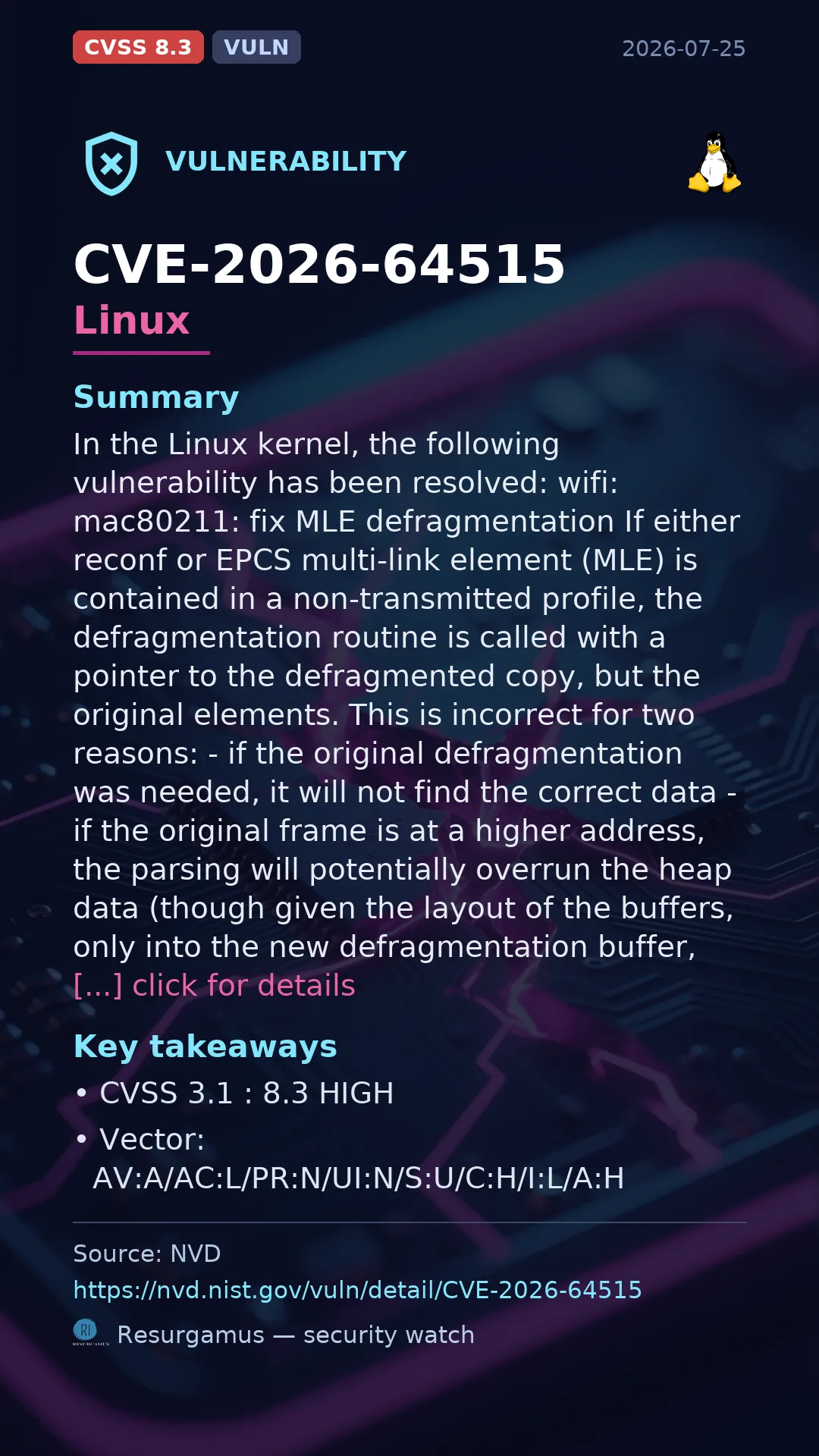
CVE-2026-64515 — Linux · CVSS 8.3 In the Linux kernel, the following vulnerability has been resolved: wifi: mac80211: fix MLE defragmentation If either reconf or EPCS multi-link element (MLE) is contained in a non-transmitted profile, the defragmentation routine is called with a pointer to the defragmented copy, but the original elements. This is incorrect for two reasons: - if the original defragmentation was needed, it will not find the correct data - if the original frame is at a higher address, the parsing will potentially overrun the heap data (though given the layout of the buffers, only into the new defragmentation buffer, and then it has to stop and fail once that's filled with copied data. Fix it by tracking the container along with the pointer and in doing so also unify the two almost identical defragmentation routines. | CVSS 3.1 : 8.3 HIGH | Vector: AV:A/AC:L/PR:N/UI:N/S:U/C:H/I:L/A:H
CVE-2026-64514 — Linux In the Linux kernel, the following vulnerability has been resolved: userfaultfd: gate must_wait writability check on pte_present() userfaultfd_must_wait() and userfaultfd_huge_must_wait() read the PTE without taking the page table lock and then apply pte_write() / huge_pte_write() to it. Those accessors decode bits from the present encoding only; on a swap or migration entry they read the offset bits that happen to share the same position and return an undefined result. The intent of the check is "is this fault still WP-blocked?". A non-marker swap entry means the page is in transit -- the userfault context the original fault delivered against is no longer the same, and the swap-in or migration completion path will re-deliver a fresh fault if userspace still needs to handle it. Worst case under the current code the garbage write bit says "wait", and the thread stays asleep until a UFFDIO_WAKE that may never arrive. Gate the writability check on pte_present() so the lockless re-check only inspects present-PTE bits when the entry is actually present. The non-present, non-marker case returns "don't wait" and lets the fault path retry.
CVE-2026-64513 — Linux In the Linux kernel, the following vulnerability has been resolved: KVM: x86: Unconditionally recompute CR8 intercept on PPR update The TPR_THRESHOLD field in the VMCS is used by VMX to induce VM exits when the guest's virtual TPR falls under the specified threshold, allowing KVM to inject previously masked interrupts. KVM handles these VM exits in handle_tpr_below_threshold(). Commit eb90f3417a0c ("KVM: vmx: speed up TPR below threshold vmexits") optimized this function by calling apic_update_ppr() instead of raising KVM_REQ_EVENT. apic_update_ppr() then raises KVM_REQ_EVENT if there is a pending, deliverable interrupt. However, if there are no new interrupts pending, apic_update_ppr() does not issue the request. Thus, kvm_lapic_update_cr8_intercept() and vmx_update_cr8_intercept() are not called before VM entry, which results in a high, stale TPR_THRESHOLD. This is problematic due to the following sentence in 28.2.1.1 "VM-Execution Control Fields" in the SDM: The following check is performed if the “use TPR shadow” VM-execution control is 1 and the “virtualize APIC accesses” and “virtual-interrupt delivery” VM-execution controls are both 0: the value of bits 3:0 of t
CVE-2026-64512 — Linux In the Linux kernel, the following vulnerability has been resolved: ACPI: CPPC: Suppress UBSAN warning caused by field misuse The definition of reg->access_width changes depending on the reg->space_id type. Type ACPI_ADR_SPACE_PLATFORM_COMM uses access_width to indicate the PCC region, which can result in a UBSAN if the value is greater than 4. For example: UBSAN: shift-out-of-bounds in drivers/acpi/cppc_acpi.c:1090:9 shift exponent 32 is too large for 32-bit type 'int' CPU: 61 UID: 0 PID: 1220 Comm: (udev-worker) Not tainted 7.0.10-201.fc44.aarch64 #1 PREEMPT(lazy) Hardware name: To be filled by O.E.M. Call trace: ...(trimming) ubsan_epilogue+0x10/0x48 __ubsan_handle_shift_out_of_bounds+0xdc/0x1e0 cpc_write+0x4d0/0x670 cppc_set_perf+0x18c/0x490 cppc_cpufreq_cpu_init+0x1c8/0x380 [cppc_cpufreq] ... (trimming) Lets fix this by validating the region type, as well as whether access_width has a value. Then since we are returning bit_width directly for ACPI_ADR_SPACE_PLATFORM_COMM, drop the code correcting the size.
CVE-2026-64511 — Linux In the Linux kernel, the following vulnerability has been resolved: ACPI: NFIT: core: Fix possible NULL pointer dereference After commit 9b311b7313d6 ("ACPI: NFIT: Install Notify() handler before getting NFIT table"), acpi_nfit_probe() installs an ACPI notify handler for the NFIT device before checking the presence of the NFIT table. If that table is not there, 0 is returned without allocating the acpi_desc object and setting the driver data pointer of the NFIT device. If the platform firmware triggers an NFIT_NOTIFY_UC_MEMORY_ERROR notification on the NFIT device at that point, acpi_nfit_uc_error_notify() will dereference a NULL pointer. Prevent that from occurring by adding an acpi_desc check against NULL to acpi_nfit_uc_error_notify().
CVE-2026-64510 — Linux · CVSS 7 In the Linux kernel, the following vulnerability has been resolved: ACPI: NFIT: core: Fix acpi_nfit_init() error cleanup If acpi_nfit_init() fails after adding the acpi_desc object to the acpi_descs list, that object is never removed from that list because the acpi_nfit_shutdown() devm action is not added for the NFIT device in that case. Next, the acpi_nfit_init() failure causes acpi_nfit_probe() to fail, the acpi_desc object is freed, and a dangling pointer is left behind in the acpi_descs. Any subsequent ACPI Machine Check Exception will trigger nfit_handle_mce() which iterates over acpi_descs and so a use-after-free will occur. Moreover, if acpi_nfit_probe() returns 0 after installing a notify handler for the NFIT device and without allocating the acpi_desc object and setting the NFIT device's driver data pointer, the acpi_desc object will be allocated by acpi_nfit_update_notify() and acpi_nfit_init() will be called to initialize it. Regardless of whether or not acpi_nfit_init() fails in that case, the acpi_nfit_shutdown() devm action is not added for the NFIT device and acpi_desc is never removed from the acpi_descs list. If the acpi_desc object is freed subsequently on | CVSS 3.1 : 7.0 HIGH | Vector: AV:L/AC:H/PR:L/UI:N/S:U/C:H/I:H/A:H
CVE-2026-64509 — Linux In the Linux kernel, the following vulnerability has been resolved: rust: block: fix GenDisk cleanup paths GenDiskBuilder::build() still has fallible work after __blk_mq_alloc_disk(), but its error path only recovers the foreign queue data. That leaks the temporary gendisk and request_queue until later teardown. If the caller moved the last Arc > into build(), the leaked queue can retain blk-mq state after the tag set is dropped. Fix the pre-registration failure path by dropping the temporary gendisk reference with put_disk() before recovering queue_data, so disk_release() can tear down the owned queue. Also pair GenDisk::drop() with put_disk() after del_gendisk(). Once a Rust GenDisk has been added with device_add_disk(), del_gendisk() only unregisters it; the final gendisk reference still has to be dropped to complete the release path.
CVE-2026-64508 — Linux In the Linux kernel, the following vulnerability has been resolved: bpf: Support for hardening against JIT spraying The BPF JIT allocator packs many small programs into larger executable allocations and reuses space within those allocations as programs are loaded and freed. When fresh code is written into space that a previous program occupied, an indirect jump into the new program can reuse a branch prediction left behind by the old one. Flush the indirect branch predictors before reusing JIT memory so that indirect jumps into a newly written program don't reuse predictions from an old program that occupied the same space. Introduce bpf_arch_pred_flush_enabled static key and bpf_arch_pred_flush static call for flushing the branch predictors on JIT memory reuse. Architectures that need a flush, can update it to a predictor flush function. By default, its a NOP and does not emit any CALL. Allocations larger than a pack are not covered by this flush. That is safe because cBPF programs (the unprivileged attack surface) are bounded well below a pack size. Issue a warning if this assumption is ever violated while the flush is active.
CVE-2026-64507 — Linux In the Linux kernel, the following vulnerability has been resolved: x86/bugs: Enable IBPB flush on BPF JIT allocation Enable hardening against JIT spraying when Spectre-v2 mitigations are in use. Specifically, issue an IBPB flush on BPF JIT memory reuse. Skip enabling the IBPB flush if the BPF dispatcher is already using a retpoline sequence. This hardening applies only when BPF-JIT is in use. Guard the enabling under CONFIG_BPF_JIT so that bugs.c still builds with CONFIG_BPF_JIT=n.
CVE-2026-64506 — Linux In the Linux kernel, the following vulnerability has been resolved: wifi: rtw89: correct drop logic for malformed AMPDU frames The previous commit aims to fix issue caused by malformed AMPDU frames. But the drop logic fails to deal with the first AMPDU packet paired with certain range of sequence number, and leads to unexpected packet drop. It is more likely to encounter this failure when there are busy traffic during rekey process and could lead to disconnection from the AP. Fix this by adding a initial state judgement and only reset status during pairwise rekey.
CVE-2026-64505 — Linux In the Linux kernel, the following vulnerability has been resolved: usb: gadget: function: rndis: add length check for header Add a length check for the rndis header in rndis_rm_hdr, to ensure that MessageType, MessageLength, DataOffset, and DataLength fields are present before they are accessed.
CVE-2026-64504 — Linux In the Linux kernel, the following vulnerability has been resolved: iio: accel: bmc150: clamp the device-reported FIFO frame count __bmc150_accel_fifo_flush() copies the number of samples the device reports in its hardware FIFO into an on-stack buffer u16 buffer[BMC150_ACCEL_FIFO_LENGTH * 3]; which is sized for at most BMC150_ACCEL_FIFO_LENGTH (32) samples. The frame count is read from the FIFO_STATUS register and only masked to its 7 valid bits: count = val & 0x7F; so it can be 0..127. The only other limit applied to it is the optional caller-supplied sample budget: if (samples && count > samples) count = samples; which does not constrain count on the flush-all path (samples == 0), and leaves it well above 32 whenever samples is larger. count samples are then transferred into buffer[]: bmc150_accel_fifo_transfer(data, (u8 *)buffer, count); bmc150_accel_fifo_transfer() reads count * 6 bytes through regmap, so a malfunctioning, malicious or counterfeit accelerometer (or an attacker tampering with the I2C/SPI bus) that reports up to 127 frames writes up to 762 bytes into the 192-byte buffer: a stack out-of-bounds write of up to 570 bytes that clobbers the stack canary
CVE-2026-64503 — Linux In the Linux kernel, the following vulnerability has been resolved: iio: accel: kxsd9: fix runtime PM imbalance on write_raw() error kxsd9_write_raw() takes a runtime PM reference with pm_runtime_get_sync() but returns -EINVAL directly when a scale with a non-zero integer part is requested, skipping the matching pm_runtime_put_autosuspend(). This leaks a runtime PM usage-counter reference on every such write, after which the device can no longer autosuspend. Set the error code and fall through to the existing put instead of returning early.
CVE-2026-64502 — Linux · CVSS 7.8 In the Linux kernel, the following vulnerability has been resolved: iio: adc: ad_sigma_delta: fix clear_pending_event for registerless devices ad_sigma_delta_clear_pending_event() falls through to the status register read path for devices with has_registers = false and no rdy_gpiod. For such devices, ad_sd_read_reg() skips the address byte entirely and clocks raw MISO bytes with no address phase — making it byte-for-byte identical to reading conversion data. If a pending conversion result is present, this partially consumes it and corrupts the data stream for the subsequent ad_sd_read_reg() call in ad_sigma_delta_single_conversion(). Furthermore, with num_resetclks = 0 on these devices, data_read_len evaluates to 0. If the clocked byte has bit 7 clear, pending_event is set and the code attempts memset(data + 2, 0xff, 0 - 1), overflowing to SIZE_MAX and corrupting the heap. Fix by returning 0 immediately when neither rdy_gpiod nor has_registers is set. This is safe for all current registerless devices: ad7191 and ad7780 (with powerdown GPIO) are reset between conversions by CS deassertion, so there is no stale result to drain; ad7780 (without powerdown GPIO) and max11205 are con | CVSS 3.1 : 7.8 HIGH | Vector: AV:L/AC:L/PR:L/UI:N/S:U/C:H/I:H/A:H
CVE-2026-64501 — Linux · CVSS 7.1 In the Linux kernel, the following vulnerability has been resolved: iio: adc: ad_sigma_delta: fix CS held asserted and state leaks In ad_sigma_delta_single_conversion(), set_mode(AD_SD_MODE_IDLE) and disable_one() were called from the out: block while keep_cs_asserted was still true. This caused any SPI transfer issued by those callbacks to carry cs_change=1, leaving CS permanently asserted after the conversion. Fix by moving both calls into the out_unlock: block, after keep_cs_asserted is cleared, matching the pattern already used in ad_sd_calibrate(). In the error path of ad_sd_buffer_postenable(), if an operation fails after set_mode(AD_SD_MODE_CONTINUOUS) has already succeeded (e.g. spi_offload_trigger_enable()), the device is left in continuous conversion mode with CS physically asserted. Additionally, bus_locked remaining true after spi_bus_unlock() causes subsequent SPI operations to call spi_sync_locked() without the bus lock actually held, allowing concurrent SPI access. Fix the error path by clearing keep_cs_asserted first, then calling set_mode(AD_SD_MODE_IDLE) to revert the device mode and deassert CS, then clearing bus_locked before releasing the bus. For devices | CVSS 3.1 : 7.1 HIGH | Vector: AV:L/AC:L/PR:L/UI:N/S:U/C:N/I:H/A:H
CVE-2026-64500 — Linux In the Linux kernel, the following vulnerability has been resolved: iio: adc: lpc32xx: Initialize completion before requesting IRQ In the report from Jaeyoung Chung: "lpc32xx_adc_probe() in drivers/iio/adc/lpc32xx_adc.c registers its interrupt handler with devm_request_irq() before it initializes st->completion with init_completion(). If an interrupt arrives after devm_request_irq() and before init_completion(), the handler calls complete() on an uninitialized completion, causing a kernel panic. The probe path, in lpc32xx_adc_probe(): iodev = devm_iio_device_alloc(&pdev->dev, sizeof(*st)); /* st kzalloc-zeroed */ ... retval = devm_request_irq(&pdev->dev, irq, lpc32xx_adc_isr, 0, LPC32XXAD_NAME, st); /* register handler */ ... init_completion(&st->completion); /* initialize completion */ lpc32xx_adc_isr() calls complete(): complete(&st->completion); If the device raises an interrupt before init_completion() runs, complete() acquires the uninitialized wait.lock and walks the zeroed task_list in swake_up_locked(). The zeroed task_list makes list_empty() return false, so swake_up_locked() dere
CVE-2026-64499 — Linux In the Linux kernel, the following vulnerability has been resolved: iio: adc: ti-ads1119: fix PM reference leak in buffer preenable ads1119_triggered_buffer_preenable() resumes the device with pm_runtime_resume_and_get() before starting a conversion. If i2c_smbus_write_byte() fails, the function returns the error directly and leaves the runtime PM usage counter elevated. The matching postdisable callback is not called when preenable fails, so the reference is leaked and the device may remain runtime-active indefinitely. Store the I2C transfer result in ret and drop the runtime PM reference on failure before returning the error.
CVE-2026-64498 — Linux In the Linux kernel, the following vulnerability has been resolved: iio: buffer: hw-consumer: free scan_mask on buffer release The scan_mask lifetime changed in commit 9a2e1233d38c ("iio: buffer: hw-consumer: remove redundant scan_mask flexible array"). Before that change, the scan mask storage was embedded in struct hw_consumer_buffer, so iio_hw_buf_release() could free the whole allocation with a single kfree(hw_buf). That commit moved the scan mask to a separate bitmap_zalloc() allocation stored in buffer.scan_mask, but left iio_hw_buf_release() unchanged. Free the scan mask in iio_hw_buf_release() before freeing the buffer wrapper.
CVE-2026-64497 — Linux In the Linux kernel, the following vulnerability has been resolved: iio: chemical: scd30: Cleanup initializations and fix sign-extension bug Include linux/bitfield.h for FIELD_GET(). Create new macros for bit manipulation in combination with manual bit manipulation being replaced with FIELD_GET(). The current variable declaration and initializations are barely readable and use comma separations across multiple lines. Refactor the initializations so that mantissa and exp have separate declarations and sign gets initialized later. In addition (and due to the nature of the cleanup), fix a sign-extension bug where, float32 would get bitwise anded with ~BIT(31) (which is 0xFFFFFFFF7FFFFFFF) which corrupted the exponent.
CVE-2026-64496 — Linux In the Linux kernel, the following vulnerability has been resolved: iio: event: Fix event FIFO reset race `iio_event_getfd()` creates the event file descriptor with `anon_inode_getfd()`, which allocates a new fd, creates the anonymous file and installs it in the process fd table before returning to the caller. The IIO code resets the event FIFO after `anon_inode_getfd()` has returned, but before `IIO_GET_EVENT_FD_IOCTL` has copied the fd number to userspace. But since fd tables are shared between threads, another thread can guess the newly allocated fd number and issue a `read()` on it as soon as the fd has been installed. This means the `kfifo_to_user()` in `iio_event_chrdev_read()` can run in parallel with the `kfifo_reset_out()` in `iio_event_getfd()`. The kfifo documentation says that `kfifo_reset_out()` is only safe when it is called from the reader thread and there is only one concurrent reader. Otherwise it is dangerous and must be handled in the same way as `kfifo_reset()`. If that happens, `kfifo_to_user()` can advance the FIFO `out` index based on state from before the reset, after the reset has already moved the `out` index to the current `in` index. That can leave
CVE-2026-64495 — Linux In the Linux kernel, the following vulnerability has been resolved: iio: gyro: bmg160: bail out when bandwidth/filter is not in table bmg160_get_filter() walks bmg160_samp_freq_table[] looking for the entry matching the bw_bits value read from the chip: for (i = 0; i < ARRAY_SIZE(bmg160_samp_freq_table); ++i) { if (bmg160_samp_freq_table[i].bw_bits == bw_bits) break; } *val = bmg160_samp_freq_table[i].filter; If no entry matches, i ends up equal to the array size and the next line reads one slot past the end. bmg160_set_filter() has the same shape, driven by 'val' instead of bw_bits. smatch flags both: drivers/iio/gyro/bmg160_core.c:204 bmg160_get_filter() error: buffer overflow 'bmg160_samp_freq_table' 7 <= 7 drivers/iio/gyro/bmg160_core.c:222 bmg160_set_filter() error: buffer overflow 'bmg160_samp_freq_table' 7 <= 7 Return -EINVAL when no entry matches. The set_filter() path is reachable from userspace via the sysfs in_anglvel_filter_low_pass_3db_frequency interface, so userspace can trivially trigger the out-of-bounds read with a value that is not in bmg160_samp_freq_table[].filter.
CVE-2026-64494 — Linux In the Linux kernel, the following vulnerability has been resolved: iio: light: gp2ap002: fix runtime PM leak on read error gp2ap002_read_raw() calls pm_runtime_get_sync() before reading the lux value, but if gp2ap002_get_lux() fails, it returns directly. This skips the pm_runtime_put_autosuspend() call at the "out" label, permanently leaking a runtime PM reference and preventing the device from autosuspending. Replace the direct return with a "goto out" to ensure the reference is properly dropped on the error path.
CVE-2026-64493 — Linux In the Linux kernel, the following vulnerability has been resolved: iio: pressure: mpl115: fix runtime PM leak on read error mpl115_read_raw() takes a runtime PM reference with pm_runtime_get_sync() before reading the processed pressure or raw temperature, but on the read error path it returns without calling pm_runtime_put_autosuspend(). Each failed read therefore leaks a runtime PM reference and prevents the device from autosuspending. Drop the reference before checking the return value so both the success and error paths are balanced.
CVE-2026-64492 — Linux In the Linux kernel, the following vulnerability has been resolved: iio: temperature: tmp006: use devm_iio_trigger_register tmp006_probe() allocates the DRDY trigger with devm_iio_trigger_alloc() but registers it with plain iio_trigger_register(). The driver has no .remove() callback, so on module unload the trigger stays in the global trigger list while its memory is freed by devm, leaving a dangling entry. Switch to devm_iio_trigger_register() so the registration is undone in the same devm scope as the allocation.
CVE-2026-64491 — Linux In the Linux kernel, the following vulnerability has been resolved: ALSA: usx2y: us144mkii: fix work UAF on disconnect tascam_disconnect() cancels capture_work and midi_in_work before usb_kill_anchored_urbs() kills the capture/MIDI-in URBs. Those URBs self-resubmit, and their completion handlers reschedule the work. A URB that completes in the small window between cancel_work_sync() and usb_kill_anchored_urbs() therefore re-arms the work after its only cancel. Nothing cancels it again before snd_card_free() frees the card-private tascam structure, so the work handler then runs on freed memory. Kill the anchored URBs before cancelling the work; once the work is cancelled no remaining URB can complete to re-arm it.
CVE-2026-64490 — Linux In the Linux kernel, the following vulnerability has been resolved: ALSA: virtio: Validate control metadata from the device virtio-snd control handling trusts the device-provided control type and value count returned by the device. That metadata is then used directly to index g_v2a_type_map[] in virtsnd_kctl_info(), and to size loops and memcpy() operations in virtsnd_kctl_get() and virtsnd_kctl_put() against fixed-size virtio_snd_ctl_value and snd_ctl_elem_value arrays. A buggy or malicious device can therefore trigger out-of-bounds access by advertising an invalid control type or an oversized value count. Validate control type and count once in virtsnd_kctl_parse_cfg(), before querying enumerated items or exposing the control to ALSA.
CVE-2026-64489 — Linux In the Linux kernel, the following vulnerability has been resolved: ALSA: ymfpci: check snd_ctl_new1() return value snd_ctl_new1() can return NULL when memory allocation fails. snd_ymfpci_create_spdif_controls() does not check the return value before dereferencing kctl->id.device, which can lead to a NULL pointer dereference. Add NULL checks after snd_ctl_new1() calls and return -ENOMEM if any fails.
CVE-2026-64488 — Linux In the Linux kernel, the following vulnerability has been resolved: ALSA: aoa: check snd_ctl_new1() return value snd_ctl_new1() can return NULL when memory allocation fails. In layout.c, the function does not check the return value before dereferencing ctl->id.name or passing to aoa_snd_ctl_add(), which can lead to a NULL pointer dereference. Add NULL checks after snd_ctl_new1() calls and return early if any fails.
CVE-2026-64487 — Linux In the Linux kernel, the following vulnerability has been resolved: ALSA: caiaq: fix out-of-bounds read in the Traktor Kontrol S4 input parser snd_usb_caiaq_tks4_dispatch() decodes the Traktor Kontrol S4 input stream in fixed 16-byte (TKS4_MSGBLOCK_SIZE) message blocks. On every iteration it advances buf and subtracts the block size while looping on "while (len)". len is urb->actual_length. That value is supplied by the device and is not guaranteed to be a multiple of 16. When a final short block leaves len between 1 and 15, the loop runs once more, reads up to buf[15], and then does "len -= TKS4_MSGBLOCK_SIZE". As len is unsigned this underflows to a huge value. The loop then keeps iterating and walking buf far past the end of the 512-byte ep4_in_buf, reading out of bounds until a bogus block id happens to be hit. Iterate only while a full message block is available. This stops the unsigned underflow and silently drops any trailing partial block, which carries no complete control value anyway. The sibling endpoint-4 parsers are not affected. The Traktor Kontrol X1 and Maschine arms in snd_usb_caiaq_ep4_reply_dispatch() floor urb->actual_length before dispatching.
CVE-2026-64486 — Linux In the Linux kernel, the following vulnerability has been resolved: ALSA: cmipci: check snd_ctl_new1() return value snd_ctl_new1() can return NULL when memory allocation fails. snd_cmipci_spdif_controls() does not check the return value before dereferencing kctl->id.device, which can lead to a NULL pointer dereference. Add NULL checks after snd_ctl_new1() calls and return -ENOMEM if any fails.
CVE-2026-64485 — Linux In the Linux kernel, the following vulnerability has been resolved: ALSA: compress: Fix task creation error unwind snd_compr_task_new() allocates the driver task before validating the returned DMA buffers and reserving file descriptors. When either of those later steps fails, the core frees its task wrapper and DMA-buffer references without calling the driver's task_free() callback. Any driver resources allocated by task_create() are therefore leaked. The dual-fd allocation path also jumps to cleanup without storing the negative get_unused_fd_flags() result in retval. Since retval still contains the successful task_create() return value, TASK_CREATE can incorrectly report success although the task was discarded. Preserve the fd allocation errors and call task_free() when failure occurs after a successful task_create() callback.
CVE-2026-64484 — Linux In the Linux kernel, the following vulnerability has been resolved: ALSA: es1938: check snd_ctl_new1() return value snd_ctl_new1() can return NULL when memory allocation fails. snd_es1938_mixer() does not check the return value before dereferencing the pointer, which can lead to a NULL pointer dereference. Add a NULL check after snd_ctl_new1() and return -ENOMEM if it fails.
CVE-2026-64483 — Linux In the Linux kernel, the following vulnerability has been resolved: ALSA: firewire: isight: bound the sample count to the packet payload isight_packet() takes the frame count from the device iso packet and checks it only against the device claimed iso length. count = be32_to_cpu(payload->sample_count); if (likely(count samples, count); length is the iso header data_length. It can be up to 0xffff. So the gate allows a count up to about 16379. isight_samples() then copies count frames out of payload->samples into the PCM DMA buffer. payload->samples holds only 2 * MAX_FRAMES_PER_PACKET values. The device multiplexes two samples per frame. A count past MAX_FRAMES_PER_PACKET reads past the payload. A count past the buffer size writes past runtime->dma_area. The smallest PCM buffer is larger than MAX_FRAMES_PER_PACKET. Bounding the count to MAX_FRAMES_PER_PACKET keeps both the read and the write in range. A malicious or faulty Apple iSight on the FireWire bus reaches this during a normal capture. Add the MAX_FRAMES_PER_PACKET bound to the gate.
CVE-2026-64482 — Linux In the Linux kernel, the following vulnerability has been resolved: ALSA: gus: check snd_ctl_new1() return value snd_ctl_new1() can return NULL when memory allocation fails. snd_gf1_pcm_volume_control() does not check the return value before dereferencing kctl->id.index, which can lead to a NULL pointer dereference. Add a NULL check after snd_ctl_new1() and return -ENOMEM if it fails.
CVE-2026-64481 — Linux In the Linux kernel, the following vulnerability has been resolved: ALSA: hda/cs35l41: Fix firmware load work teardown cs35l41_hda creates ALSA controls whose private data points at the cs35l41_hda object. The firmware load control can also queue fw_load_work. Those controls are not removed on component unbind, and device remove only cancels fw_load_work through cs35l41_remove_dsp(). That helper is skipped when halo_initialized is false. With firmware_autostart disabled, a firmware load can be requested before the DSP has been initialized. If the component or device is removed before the queued work runs, the worker can run after teardown and dereference driver state that is no longer valid. Track the created controls and remove them on unbind so no new control callback can reach the driver data or queue more work. Then cancel fw_load_work to drain any request that was already queued. Also cancel the work unconditionally during device remove before runtime PM teardown.
CVE-2026-64480 — Linux In the Linux kernel, the following vulnerability has been resolved: ALSA: ice1712: check snd_ctl_new1() return value snd_ctl_new1() can return NULL when memory allocation fails. The ice1712 driver calls snd_ctl_new1() without checking the return value before dereferencing the pointer in multiple places (ice1712.c, ice1724.c, aureon.c), which can lead to NULL pointer dereferences. Add NULL checks after snd_ctl_new1() calls and return -ENOMEM if any fails.
CVE-2026-64479 — Linux In the Linux kernel, the following vulnerability has been resolved: ALSA: seq: Fix uninitialised heap leak in snd_seq_event_dup() snd_seq_event_dup() copies an incoming event into a pool cell and, in the UMP-enabled build, clears the trailing cell->ump.raw.extra word that the memcpy() did not cover. The guard deciding whether to clear it compares the copied size against sizeof(cell->event): memcpy(&cell->ump, event, size); if (size event)) cell->ump.raw.extra = 0; For a legacy (non-UMP) event, size == sizeof(struct snd_seq_event) == sizeof(cell->event), so the condition is false and the extra word keeps stale data. The cell pool is allocated with kvmalloc() (not zeroed) and cells are reused via a free list, so that word holds uninitialised heap or leftover event data. When such a cell is delivered to a UMP client (client->midi_version > 0) that set SNDRV_SEQ_FILTER_NO_CONVERT -- so the legacy event reaches it unconverted -- snd_seq_read() reads it out as the larger struct snd_seq_ump_event and copies the stale word to user space, a 4-byte kernel heap infoleak to an unprivileged /dev/snd/seq client. Compare against sizeof(cell->ump) instead, so the trailing word is zero
CVE-2026-64478 — Linux In the Linux kernel, the following vulnerability has been resolved: ALSA: usb-audio: avoid kobject path lookup in DualSense match The DualSense jack-detection input handler verifies that a matching input device belongs to the same physical controller by building kobject path strings for both the input device and the USB audio device, then comparing the path prefix. This was observed when a weak physical connection caused the controller to rapidly disconnect and reconnect. During that repeated hotplug, snd_dualsense_ih_match() can run while the controller's USB device is being disconnected. kobject_get_path() walks ancestor kobjects and dereferences their names; if the USB device kobject name is no longer valid, this can fault in strlen(): RIP: 0010:strlen+0x10/0x30 Call Trace: kobject_get_path+0x34/0x150 snd_dualsense_ih_match+0x49/0xd0 [snd_usb_audio] input_register_device+0x566/0x6a0 ps_probe+0xb89/0x1590 [hid_playstation] The same ownership check can be done without building kobject path strings. The input device is parented below the HID device, USB interface and USB device, so walking the input device parent chain and comparing against the mixer USB device
CVE-2026-64477 — Linux In the Linux kernel, the following vulnerability has been resolved: x86,fs/resctrl: Prevent out-of-bounds access while offlining CPU when SNC enabled The architecture updates the cpu_mask in a domain's header to track which online CPUs are associated with the domain. When this mask becomes empty the architecture initiates offline of the domain that includes calling on resctrl fs to offline the domain. If it is a monitoring domain in which LLC occupancy is tracked resctrl fs forces the limbo handler to clear all busy RMID state associated with the domain. The limbo handler always reads the current event value associated with a busy RMID irrespective of it being checked as part of regular "is it still busy" check or whether it will be forced released anyway. When reading an RMID on a system with SNC enabled the "logical RMID" is converted to the "physical RMID" and this conversion requires the NUMA node ID of the resctrl monitoring domain that is in turn determined by querying the NUMA node ID of any CPU belonging to the monitoring domain. When the monitoring domain is going offline its cpu_mask is empty causing the NUMA node ID query via cpu_to_node() to be done with "nr_cpu_ids
CVE-2026-64476 — Linux In the Linux kernel, the following vulnerability has been resolved: vfio/pci: Latch disable_idle_d3 per device When disable_idle_d3 was introduced in vfio-pci, it directly manipulated the device power state with pci_set_power_state(). There were no refcounts to maintain or balanced operations, we could unconditionally bring the device to D0 and conditionally move it to D3hot. Therefore the module parameter was made writable. Later, in commit c61302aa48f7 ("vfio/pci: Move module parameters to vfio_pci.c"), as part of the vfio-pci-core split, the writable aspect of the module parameter was nullified. The parameter value could still be changed through sysfs, but the vfio-pci driver latched the values into vfio-pci-core globals at module init. Loading the vfio-pci module, or unloading and reloading, with non-default or different values could change the globals relative to existing devices bound to vfio-pci variant drivers. Runtime PM was introduced in commit 7ab5e10eda02 ("vfio/pci: Move the unused device into low power state with runtime PM"), which marks the point where power states became refcounted. PM get and put operations need to be balanced, but the same module operati
CVE-2026-64475 — Linux In the Linux kernel, the following vulnerability has been resolved: vfio/pci: Release the VGA arbiter client on register_device() failure The re-order in the Fixes commit below displaced vfio_pci_vga_init() as the last failure point of what is now vfio_pci_core_register_device() without introducing an unwind for the VGA arbiter registration. In current kernels this is mostly benign because vfio_pci_set_decode() only uses pci_dev state, but the original failure path could leave a callback with a freed vdev cookie. The stale registration also becomes unsafe again once the callback follows drvdata to the vfio device. Add the required VGA unwind callout.
CVE-2026-64474 — Linux In the Linux kernel, the following vulnerability has been resolved: vfio: prevent infinite loop in vfio_mig_get_next_state() on blocked arc vfio_mig_get_next_state() walks vfio_from_fsm_table[] one step at a time, looping to skip optional states the device does not support until *next_fsm is supported. A blocked transition is encoded as VFIO_DEVICE_STATE_ERROR, which the trailing return reports as -EINVAL. The skip loop does not account for the ERROR sentinel. state_flags_table[ERROR] is ~0U and vfio_from_fsm_table[ERROR][*] is ERROR, so once *next_fsm becomes ERROR the loop condition stays true and *next_fsm never changes. The blocked arcs STOP_COPY -> PRE_COPY and STOP_COPY -> PRE_COPY_P2P map to ERROR yet pass the support check on a precopy-capable device, causing the loop to spin forever while holding the driver state mutex. This can result in a soft lockup, and a panic with softlockup_panic set. Terminate the skip loop on the ERROR sentinel so a blocked transition falls through to the existing return and reports -EINVAL.
CVE-2026-64473 — Linux In the Linux kernel, the following vulnerability has been resolved: vfio: Remove device debugfs before releasing devres VFIO device debugfs files created with debugfs_create_devm_seqfile() store a devres allocated debugfs_devm_entry as inode private data. vfio_unregister_group_dev() currently calls vfio_device_del() before vfio_device_debugfs_exit(), but device_del() releases devres. This can leave debugfs entries visible with stale inode private data while unregister waits for userspace references to drain. Remove the per-device debugfs tree before vfio_device_del(). The debugfs view is diagnostic only, so losing it at the start of unregister is preferable to preserving entries whose backing storage may already have been released. Complete the teardown by clearing the per-device debugfs root after removal. This matches the global debugfs root cleanup and prevents future users from mistaking a removed dentry for a live debugfs tree during the remainder of unregister.
CVE-2026-64472 — Linux In the Linux kernel, the following vulnerability has been resolved: vfio/mlx5: Fix racy bitfields and tighten struct layout Bitfield operations are not atomic, they use a read-modify-write pattern, therefore we should be careful not to pack bitfields that can be concurrently updated into the same storage unit. This split takes a binary approach: flags that are only modified pre/post open/close remain bitfields, flags modified from user action, including actions that reach across to another device (ex. reset) use dedicated storage units. Note mlx5_vhca_page_tracker.status is relocated to fill the alignment hole this split exposes. Bitfield justifications: migrate_cap: written only in mlx5vf_cmd_set_migratable() at probe chunk_mode: written only in mlx5vf_cmd_set_migratable() at probe mig_state_cap: written only in mlx5vf_cmd_set_migratable() at probe Dedicated storage units: mdev_detach: written in the VF attach/detach event notifier mlx5fv_vf_event() at runtime log_active: written in mlx5vf_start_page_tracker()/ mlx5vf_stop_page_tracker() during runtime dirty tracking deferred_reset: written in mlx5vf_state_mutex_unlock()/
CVE-2026-64471 — Linux In the Linux kernel, the following vulnerability has been resolved: Bluetooth: btusb: fix use-after-free on registration failure Make sure to release the sibling interfaces in case controller registration fails to avoid use-after-free and double-free when they are eventually disconnected. This issue was reported by Sashiko while reviewing a fix for a wakeup source leak in the btusb probe errors paths.
CVE-2026-64470 — Linux In the Linux kernel, the following vulnerability has been resolved: Bluetooth: btusb: fix use-after-free on marvell probe failure Make sure to stop any TX URBs submitted during Marvell OOB wakeup configuration on later probe failures to avoid use-after-free in the completion callback. This issue was reported by Sashiko while reviewing a fix for a wakeup source leak in the btusb probe errors paths.
CVE-2026-64469 — Linux In the Linux kernel, the following vulnerability has been resolved: binder: fix UAF in binder_thread_release() When a thread exits, binder_thread_release() walks its transaction stack to clear the t->from and t->to_proc that correspond with the exiting thread. However, a process dying in parallel might attempt to kfree some of these transactions. And if one of them has no associated t->to_proc, the t->to_proc->inner_lock will not be acquired. This means that transaction accesses in binder_thread_release() after t->to_proc has been cleared might race with binder_free_transaction() and cause a use-after-free error as reported by KASAN: ================================================================== BUG: KASAN: slab-use-after-free in binder_thread_release+0x5d0/0x798 Write of size 8 at addr ffff000016627500 by task X/715 CPU: 17 UID: 0 PID: 715 Comm: X Not tainted 7.1.0-rc5-00149-g8fde5d1d47f6 #30 PREEMPT Hardware name: linux,dummy-virt (DT) Call trace: binder_thread_release+0x5d0/0x798 binder_ioctl+0x12c0/0x299c [...] Allocated by task 717 on cpu 18 at 67.267803s: __kasan_kmalloc+0xa0/0xbc __kmalloc_cache_noprof+0x174/0x444 binder_transaction+
CVE-2026-64468 — Linux In the Linux kernel, the following vulnerability has been resolved: binder: fix UAF in binder_free_transaction() In binder_free_transaction(), the t->to_proc is read under the t->lock. However, once the t->lock is dropped, the to_proc can die in parallel. This leads to a use-after-free error when we attempt to acquire its inner lock right afterwards: ================================================================== BUG: KASAN: slab-use-after-free in _raw_spin_lock+0xe4/0x1a0 Write of size 4 at addr ffff00001125da70 by task B/672 CPU: 20 UID: 0 PID: 672 Comm: B Not tainted 7.1.0-rc6-00284-g8e65320d91cd #4 PREEMPT Hardware name: linux,dummy-virt (DT) Call trace: _raw_spin_lock+0xe4/0x1a0 binder_free_transaction+0x8c/0x320 binder_send_failed_reply+0x21c/0x2f8 binder_thread_release+0x488/0x7e0 binder_ioctl+0x12c0/0x29a0 [...] Allocated by task 675: __kmalloc_cache_noprof+0x174/0x444 binder_open+0x118/0xb70 do_dentry_open+0x374/0x1040 vfs_open+0x58/0x3bc [...] Freed by task 212: __kasan_slab_free+0x58/0x80 kfree+0x1a0/0x4a4 binder_proc_dec_tmpref+0x32c/0x5e0 binder_deferred_func+0xc48/0x104c process_one_work+0x53c/0xbc
CVE-2026-64467 — Linux In the Linux kernel, the following vulnerability has been resolved: rust_binder: use a u64 stride when cleaning up the offsets array Allocation's Drop walks the offsets array (binder_size_t = u64 entries), cleaning up the objects, but it used usize instead of u64 for both the stride and the per-entry read. On 64-bit kernels (usize == u64) this is harmless, but on 32-bit kernels it walks the 8-byte entries in 4-byte steps, iterating an N-entry array 2N times, and reads the always-zero high word as offset 0, cleaning up the object at offset 0 N extra times. As a result the referenced node or handle ends up with a lower reference count than it actually has (a refcount over-decrement), and binder's reference accounting is corrupted; for example, the owner can be notified of a strong reference release (BR_RELEASE) even though references still remain. Change the stride to u64, and read each entry as a u64, narrowing it to usize with try_into(). On 32-bit ARM, when this over-decrement would drive a count below zero, the driver's existing refcount guard refuses it and fires: rust_binder: Failure: refcount underflow!
CVE-2026-64466 — Linux In the Linux kernel, the following vulnerability has been resolved: rust_binder: clear freeze listener on node removal Generally userspace is supposed to explicitly clear freeze listeners before they drop the refcount on the node ref to zero, but there's nothing forcing that. Currently, in this scenario the freeze listener remains in the freeze_listeners rbtree and in the remote node's freeze listener list, even though the ref for which the listener is registered is gone. This could potentially lead to a memory leak due to a refcount cycle. Thus, remove the freeze listener in this scenario.
CVE-2026-64465 — Linux In the Linux kernel, the following vulnerability has been resolved: usb: xhci: Fix sleep in atomic context in xhci_free_streams() When a USB device with active stream endpoints is disconnected, xhci_free_streams() is called from the hub_event workqueue to free the stream resources. It calls xhci_free_stream_info() while holding xhci->lock with irqs disabled. xhci_free_stream_info() invokes xhci_free_stream_ctx(), which calls dma_free_coherent() for large stream context arrays. dma_free_coherent() can sleep (e.g. via vunmap), triggering a BUG when called from atomic context. Call trace: dma_free_attrs+0x174/0x220 xhci_free_stream_info+0xd0/0x11c xhci_free_streams+0x278/0x37c usb_free_streams+0x98/0xc0 usb_unbind_interface+0x1b8/0x2f8 device_release_driver_internal+0x1d4/0x2cc device_release_driver+0x18/0x28 bus_remove_device+0x160/0x1a4 device_del+0x1ec/0x350 usb_disable_device+0x98/0x214 usb_disconnect+0xf0/0x35c hub_event+0xab4/0x19ec process_one_work+0x278/0x63c Fix this by saving the stream_info pointers and clearing the ep references under the lock, then calling xhci_free_stream_info() outside the lock where sleeping is allowed.
CVE-2026-64464 — Linux In the Linux kernel, the following vulnerability has been resolved: xhci: sideband: fix ring sg table pages leak xhci_ring_to_sgtable() allocates a temporary pages array and uses it to build the returned sg_table with sg_alloc_table_from_pages(). The error paths free the pages array, but the success path returns the sg_table without freeing it. This leaks the temporary array every time a sideband client gets an endpoint or event ring buffer. Free the pages array after sg_alloc_table_from_pages() succeeds. The returned sg_table has its own scatterlist entries and does not depend on the temporary array after construction.
CVE-2026-64463 — Linux In the Linux kernel, the following vulnerability has been resolved: usb: typec: tcpci_rt1711h: unregister TCPCI port with devres rt1711h_probe() registers the TCPCI port before requesting the interrupt and enabling alert interrupts. If either of those later steps fails, the probe function returns without unregistering the TCPCI port. The explicit unregister currently only happens from the remove callback. Register a devres action immediately after tcpci_register_port() succeeds, so tcpci_unregister_port() runs on later probe failures and on driver detach. Drop the remove callback to avoid unregistering the same port twice. This issue was identified during our ongoing static-analysis research while reviewing kernel code.
CVE-2026-64462 — Linux In the Linux kernel, the following vulnerability has been resolved: PCI: altera: Fix resource leaks on probe failure The chained IRQ handler is set during probe, but is only removed during the driver remove(). If pci_host_probe() fails, the handler and INTx IRQ domain remain set even though the devm-managed host bridge storage containing struct altera_pcie will be released, leaving the handler with a stale data pointer. Interrupts are also enabled before pci_host_probe() is called. If probe fails after that point, the controller interrupt source should be disabled before the chained handler and INTx domain are removed. So set the chained handler only after the INTx domain has been created. Disable controller interrupts during IRQ teardown, and tear the IRQ setup down if pci_host_probe() fails. [mani: commit log]
CVE-2026-64461 — Linux In the Linux kernel, the following vulnerability has been resolved: PCI: mediatek: Fix IRQ domain leak when port fails to enable When mtk_pcie_enable_port() fails, mtk_pcie_port_free() removes the port from pcie->ports and frees the port structure. However, the IRQ domains set up earlier by mtk_pcie_init_irq_domain() are never freed. Fix this by refactoring mtk_pcie_irq_teardown() into a per-port helper, mtk_pcie_irq_teardown_port(), and calling it from mtk_pcie_setup() when mtk_pcie_enable_port() fails. Since the IRQ teardown must only happen in the probe error path (during resume, child devices may have active MSI mappings and the NOIRQ context prohibits sleeping locks), mtk_pcie_enable_port() is changed to return an error code so callers can distinguish the two paths and act accordingly. This issue was reported by Sashiko while reviewing the EcoNet EN7528 SoC support series.
CVE-2026-64460 — Linux In the Linux kernel, the following vulnerability has been resolved: PCI/IOV: Skip VF Resizable BAR restore on read error sriov_restore_vf_rebar_state() uses the VF Resizable BAR Control register to decide how many VF BARs to restore (nbars) and which VF BAR each iteration addresses (bar_idx). bar_idx indexes into dev->sriov->barsz[], which has only PCI_SRIOV_NUM_BARS (6) entries. When a device does not respond, config reads typically return PCI_ERROR_RESPONSE (~0). Both fields are 3 bits wide, so nbars and bar_idx both evaluate to 7. The barsz[] access then goes out of bounds. UBSAN reports this as: UBSAN: array-index-out-of-bounds in drivers/pci/iov.c:948:51 index 7 is out of range for type 'resource_size_t [6]' Observed on an NVIDIA RTX PRO 1000 GPU (GB207GLM) that stopped responding during a failed GC6 power state exit. The subsequent pci_restore_state() invoked sriov_restore_vf_rebar_state() while config reads returned 0xffffffff, triggering the splat. Bail out if any VF Resizable BAR Control read returns PCI_ERROR_RESPONSE. No further VF BARs are touched, which is safe because a config read that returns PCI_ERROR_RESPONSE indicates the device is unreachable and resto
CVE-2026-64459 — Linux In the Linux kernel, the following vulnerability has been resolved: tcp: restore RCU grace period in tcp_ao_destroy_sock Commit 51e547e8c89c ("tcp: Free TCP-AO/TCP-MD5 info/keys without RCU") removed the call_rcu() callback from tcp_ao_destroy_sock(), arguing that "the destruction of info/keys is delayed until the socket destructor" and therefore "no one can discover it anymore". That argument does not hold for the call site in tcp_connect() (net/ipv4/tcp_output.c:4327-4332). At that point the socket is in TCP_SYN_SENT, has already been inserted into the inet ehash by inet_hash_connect() in tcp_v4_connect(), and is therefore very much discoverable: any softirq running tcp_v4_rcv() on another CPU can take the socket out of the ehash, walk into tcp_inbound_hash(), and load tp->ao_info via implicit RCU before bh_lock_sock_nested() is taken on the destroying CPU. The reader path then enters __tcp_ao_do_lookup() (net/ipv4/tcp_ao.c:208) which re-loads tp->ao_info via rcu_dereference_check(); the re-load can still observe the (about-to-be-freed) pointer because there is no synchronize_rcu() between rcu_assign_pointer(tp->ao_info, NULL) and tcp_ao_info_free() in tcp_ao_destroy_sock().
CVE-2026-64458 — Linux In the Linux kernel, the following vulnerability has been resolved: mm/damon/ops-common: handle extreme intervals in damon_hot_score() Fix three issues in damon_hot_score() that comes from wrong handling of extreme (zero or too high) monitoring intervals user setup. When the user sets sampling interval zero, damon_max_nr_accesses(), which is called from damon_hot_score(), causes a divide-by-zero. Needless to say, it is a problem. When the user sets the aggregation interval zero, the function returns zero. It is wrong, since the real maximum nr_acceses in the setup should be one. Worse yet, it can cause another divide-by-zero from its caller, damon_hot_score(), since it uses damon_max_nr_accesses() return value as a denominator. When the user sets the aggregation interval very high, damon_hot_score() could return a value out of [0, DAMOS_MAX_SCORE] range. Since the return value is used as an index to the regions_score_histogram array, which is DAMOS_MAX_SCORE+1 size, it causes out of bounds array access. The issues can be relatively easily reproduced like below. The sysfs write permission is required, though. # ./damo start --damos_action lru_prio --damos_quota_space
CVE-2026-64457 — Linux In the Linux kernel, the following vulnerability has been resolved: virtio_pci: fix vq info pointer lookup via wrong index Unbinding a virtio balloon device: echo virtio0 > /sys/bus/virtio/drivers/virtio_balloon/unbind triggers a NULL pointer dereference. The dmesg says: BUG: kernel NULL pointer dereference, address: 0000000000000008 [...] RIP: 0010:__list_del_entry_valid_or_report+0x5/0xf0 Call Trace: vp_del_vqs+0x121/0x230 remove_common+0x135/0x150 virtballoon_remove+0xee/0x100 virtio_dev_remove+0x3b/0x80 device_release_driver_internal+0x187/0x2c0 unbind_store+0xb9/0xe0 kernfs_fop_write_iter.llvm.11660790530567441834+0xf6/0x180 vfs_write+0x2a9/0x3b0 ksys_write+0x5c/0xd0 do_syscall_64+0x54/0x230 entry_SYSCALL_64_after_hwframe+0x29/0x31 [...] The virtio_balloon device registers 5 queues (inflate, deflate, stats, free_page, reporting) but only the first two are unconditional. The stats, free_page and reporting queues are each conditional on their respective feature bits. When any of these features are absent, the corresponding vqs_info entry has name == NULL, creating holes in the array. The root
CVE-2026-64456 — Linux In the Linux kernel, the following vulnerability has been resolved: hwrng: virtio: clamp device-reported used.len at copy_data() random_recv_done() stores the device-reported used.len directly into vi->data_avail. copy_data() then indexes vi->data[] using vi->data_idx (advanced by previous copy_data() calls) and issues a memcpy() without re-validating either value against the posted buffer size sizeof(vi->data) (SMP_CACHE_BYTES bytes, typically 32 or 64). A malicious or buggy virtio-rng backend can set used.len beyond sizeof(vi->data), steering the memcpy() past the end of the inline array into adjacent kmalloc-1k slab bytes. hwrng_fillfn() mixes those bytes into the guest RNG, and guest root can also observe them directly via /dev/hwrng. Concrete impact is inside the guest: - Memory-safety / hardening: any virtio-rng backend that over-reports used.len causes the driver to read past vi->data into unrelated slab contents. hwrng_fillfn() is a kernel thread that runs as soon as the device is probed; no guest userspace interaction is required to first-trigger the OOB. - Cross-boundary leak (confidential-compute threat model): a malicious hypervisor cooperating
CVE-2026-64455 — Linux In the Linux kernel, the following vulnerability has been resolved: USB: chaoskey: Fix slab-use-after-free in chaoskey_release() The chaoskey driver has a use-after-free bug in its release routine. If the user closes the device file after the USB device has been unplugged, a debugging log statement will try to access the usb_interface structure after it has been deallocated: BUG: KASAN: slab-use-after-free in dev_driver_string (drivers/base/core.c:2406) Read of size 8 at addr ffff888168e8a0b8 by task chaoskey_raw_re/10106 Hardware name: QEMU Ubuntu 24.04 PC v2 (i440FX + PIIX, arch_caps fix, 1996), BIOS 1.16.3-debian-1.16.3-2 04/01/2014 Call Trace: dump_stack_lvl (lib/dump_stack.c:94 lib/dump_stack.c:120) print_report (mm/kasan/report.c:378 mm/kasan/report.c:482) kasan_report (mm/kasan/report.c:595) dev_driver_string (drivers/base/core.c:2406) __dynamic_dev_dbg (lib/dynamic_debug.c:906) chaoskey_release (drivers/usb/misc/chaoskey.c:323) __fput (fs/file_table.c:510) fput_close_sync (fs/file_table.c:615) __x64_sys_close (fs/open.c:1507 fs/open.c:1492 fs/open.c:1492) do_syscall_64 (arch/x86/entry/syscall_64.c:63 arch/x86/entry/syscall_64.c:94) entry_SY
CVE-2026-64454 — Linux In the Linux kernel, the following vulnerability has been resolved: usb: dwc3: run gadget disconnect from sleepable suspend context dwc3_gadget_suspend() takes dwc->lock with IRQs disabled and then calls dwc3_disconnect_gadget(). For async callbacks that helper only uses plain spin_unlock()/spin_lock(), so the gadget ->disconnect() callback still runs with IRQs disabled and any sleepable callback trips Lockdep. This issue was found by our static analysis tool and then manually reviewed against the current tree. The grounded PoC kept the dwc3_gadget_suspend() -> dwc3_disconnect_gadget() -> gadget_driver->disconnect() chain, and Lockdep reported: BUG: sleeping function called from invalid context gadget_disconnect+0x21/0x39 [vuln_msv] dwc3_gadget_suspend.constprop.0+0x2b/0x42 [vuln_msv] Keep the disconnect callback selection in one common helper, but add a sleepable suspend-side wrapper which snapshots the callback under dwc->lock and then runs it after spin_unlock_irqrestore(). The regular event path still uses the existing spin_unlock()/spin_lock() window.
CVE-2026-64453 — Linux In the Linux kernel, the following vulnerability has been resolved: usb: misc: usbio: fix disconnect UAF in client teardown usbio_disconnect() walks usbio->cli_list in reverse and uninitializes each auxiliary device. auxiliary_device_uninit() drops the device reference, and for an unbound child that can run usbio_auxdev_release() and free the containing struct usbio_client. list_for_each_entry_reverse() advances after the loop body by reading client->link.prev. If the current client is freed by auxiliary_device_uninit(), the iterator dereferences freed memory. Use list_for_each_entry_safe_reverse() so the previous client is cached before the body can drop the final reference. This preserves reverse teardown order while keeping the next iterator cursor independent of the current client's lifetime. Validation reproduced this kernel report: BUG: KASAN: slab-use-after-free in usbio_disconnect+0x12e/0x150 Call Trace: dump_stack_lvl+0x66/0xa0 print_report+0xce/0x630 ? usbio_disconnect+0x12e/0x150 ? srso_alias_return_thunk+0x5/0xfbef5 ? __virt_addr_valid+0x188/0x320 ? usbio_disconnect+0x12e/0x150 kasan_report+0xe0/0x110 ? usbio_disconnect+0x12e/0x150 usbio_disconnect+0x1
CVE-2026-64452 — Linux In the Linux kernel, the following vulnerability has been resolved: 6lowpan: fix NHC entry use-after-free on error path lowpan_nhc_do_uncompression() looks up an NHC descriptor while holding lowpan_nhc_lock. If the descriptor has no uncompress callback, the error path drops the lock before printing nhc->name. lowpan_nhc_del() removes descriptors under the same lock and then relies on synchronize_net() before the owning module can be unloaded. That only waits for net RX RCU readers. lowpan_header_decompress() is also exported and can be reached from callers that are not necessarily covered by the net core RX critical section, for example the Bluetooth 6LoWPAN L2CAP receive path. This leaves a race where one task drops lowpan_nhc_lock in the error path, another task unregisters and frees the matching descriptor after synchronize_net() returns, and the first task then dereferences nhc->name for the warning. With the post-unlock window widened, KASAN reports: BUG: KASAN: slab-use-after-free in lowpan_nhc_do_uncompression+0x1f4/0x220 Read of size 8 lowpan_nhc_do_uncompression lowpan_header_decompress Fix this by printing the warning before dropping lowpan_nhc_lock, so
CVE-2026-64451 — Linux In the Linux kernel, the following vulnerability has been resolved: tracing: Fix NULL pointer dereference in func_set_flag() func_set_flag() dereferences tr->current_trace_flags before verifying that the current tracer is actually the function tracer. When the active tracer has been switched away from "function" (e.g., to "wakeup_rt"), tr->current_trace_flags can be NULL, leading to a NULL pointer dereference and kernel crash. The call chain that triggers this is: trace_options_write() -> __set_tracer_option() -> trace->set_flag() /* func_set_flag */ In func_set_flag(), the first operation is: if (!!set == !!(tr->current_trace_flags->val & bit)) This dereferences tr->current_trace_flags unconditionally. The safety check that guards against a non-function tracer: if (tr->current_trace != &function_trace) return 0; is placed *after* the dereference, which is too late. This was observed with the following crash dump: BUG: unable to handle page fault at 0000000000000000 RIP: func_set_flag+0xd Call Trace: __set_tracer_option+0x27 trace_options_write+0x75 vfs_write+0x12a ksys_write+0x66 do_syscall_64+0x5b RIP: ffffffff914
CVE-2026-64450 — Linux In the Linux kernel, the following vulnerability has been resolved: tipc: fix out-of-bounds read in broadcast Gap ACK blocks A broadcast PROTOCOL/STATE_MSG can carry a Gap ACK blocks record in its data area. tipc_get_gap_ack_blks() only verifies that the record's len field is self-consistent with its ugack_cnt/bgack_cnt counts (sz == struct_size(p, gacks, ugack_cnt + bgack_cnt)); it does not check that the record actually fits in the message data area, msg_data_sz(). The unicast caller tipc_link_proto_rcv() bounds it ("if (glen > dlen) break;"), but the broadcast caller tipc_bcast_sync_rcv() discards the returned size, so tipc_link_advance_transmq() copies the record off the receive skb with an attacker-controlled count: this_ga = kmemdup(ga, struct_size(ga, gacks, ga->bgack_cnt), GFP_ATOMIC); A TIPC neighbour that negotiated TIPC_GAP_ACK_BLOCK triggers it with one ordinary broadcast STATE_MSG (msg_bc_ack_invalid() clear), sized so its data area is short, carrying a Gap ACK record with len = 0x400, bgack_cnt = 0xff and ugack_cnt = 0. len then equals struct_size(p, gacks, 255), so the consistency check passes and ga is non-NULL; kmemdup() reads struct_size(ga, gacks, 255)
CVE-2026-64449 — Linux In the Linux kernel, the following vulnerability has been resolved: staging: vme_user: bound slave read/write to the kern_buf size The SLAVE-path helpers buffer_to_user() and buffer_from_user() copy 'count' bytes into/out of the fixed-size kern_buf (size_buf == PCI_BUF_SIZE == 0x20000, 128 KiB) using *ppos as the offset, without bounding *ppos + count against size_buf. vme_user_write()/vme_user_read() only clamp count to the VME window size (image_size = vme_get_size(resource)), which VME_SET_SLAVE sets from the user-supplied slave.size -- validated against the VME address space (up to VME_A32_MAX = 4 GiB), not against PCI_BUF_SIZE. When the window exceeds 128 KiB, a write()/read() copies past the kern_buf allocation. Clamp count against size_buf in both helpers, with an early return when *ppos is already at/after the buffer end. *ppos is >= 0 here (the caller rejects negative offsets), so size_buf - *ppos cannot wrap. This mirrors the existing clamp in the MASTER-path helpers resource_to_user() / resource_from_user(), and matches the read()/write() convention of a short transfer at end-of-buffer. Found by static analysis (CodeQL taint tracking + CBMC bounded model checking
CVE-2026-64448 — Linux In the Linux kernel, the following vulnerability has been resolved: smb: client: restrict implied bcc[0] exemption to responses without data area smb2_check_message() has a long-standing quirk that accepts a response whose calculated length is one byte larger than the bytes actually received ("server can return one byte more due to implied bcc[0]"). This was introduced to accommodate servers that omit the trailing bcc[0] overlap byte when no data area is present. However, the exemption is applied unconditionally, regardless of whether the command actually carries a data area (has_smb2_data_area[]). When a response with a data area is subject to the +1 exemption, the reported data can extend one byte beyond the bytes actually received, yet smb2_check_message() still accepts it. The subsequent decoder then reads past the end of the receive buffer. This is reachable during NEGOTIATE and SESSION_SETUP, before the session is established. The resulting out-of-bounds reads are visible under KASAN when mounting against a non-conforming server; both the SPNEGO/negTokenInit and the NTLMSSP challenge decoders are affected: BUG: KASAN: slab-out-of-bounds in asn1_ber_decoder+0x16a7/0x
CVE-2026-64447 — Linux In the Linux kernel, the following vulnerability has been resolved: staging: media: ipu7: fix double-free and use-after-free in error paths In both ipu7_isys_init() and ipu7_psys_init(), pdata is allocated and then passed to ipu7_bus_initialize_device(), which stores it in adev->pdata. The ipu7_bus_release() function frees adev->pdata when the device's reference count drops to zero. Two error paths incorrectly call kfree(pdata) after the device teardown has already freed it: 1. When ipu7_mmu_init() fails: put_device() is called, which drops the reference count to zero and triggers ipu7_bus_release() -> kfree(pdata). The subsequent kfree(pdata) is a double-free. 2. When ipu7_bus_add_device() fails: it calls auxiliary_device_uninit() internally, which calls put_device() -> ipu7_bus_release() -> kfree(pdata). The subsequent kfree(pdata) is again a double-free. Note that the kfree(pdata) when ipu7_bus_initialize_device() itself fails is correct, because in that case auxiliary_device_init() failed and the release function was never set up, so pdata must be freed manually. Additionally, the error code was not saved before calling put_device(), causing ERR_CAST() to der
CVE-2026-64446 — Linux In the Linux kernel, the following vulnerability has been resolved: staging: rtl8723bs: fix heap buffer overflow in rtw_cfg80211_set_wpa_ie() supplicant_ie is a 256-byte array in struct security_priv. The WPA and WPA2 IE copy paths use: memcpy(padapter->securitypriv.supplicant_ie, &pwpa[0], wpa_ielen + 2); where wpa_ielen is the raw IE length field (u8, 0-255). When a local user supplies a connect request via nl80211 with a crafted WPA IE of length 255, wpa_ielen + 2 equals 257, overflowing the 256-byte buffer by one byte into the adjacent last_mic_err_time field. rtw_parse_wpa_ie() does not prevent this: its length consistency check compares *(wpa_ie+1) against (u8)(wpa_ie_len-2), which is (u8)(255) == 255 when wpa_ie_len = 257, so the check passes silently. Add explicit bounds checks for both the WPA and WPA2 paths before the memcpy, rejecting any IE whose total size (wpa_ielen + 2) exceeds the supplicant_ie buffer.
CVE-2026-64445 — Linux In the Linux kernel, the following vulnerability has been resolved: staging: rtl8723bs: fix WEP length underflow and OOB read in OnAuth() OnAuth() has two bugs in the shared-key authentication path. When the Privacy bit is set, rtw_wep_decrypt() is called without verifying that the frame is long enough to contain a valid WEP IV and ICV. Inside rtw_wep_decrypt(), length is computed as: length = len - WLAN_HDR_A3_LEN - iv_len and then passed as (length - 4) to crc32_le(). If len is less than WLAN_HDR_A3_LEN + iv_len + icv_len (32 bytes), length - 4 is negative and, after the implicit cast to size_t, causes crc32_le() to read far beyond the frame buffer. Add a minimum length check before accessing the IV field and calling the decryption path. When processing a seq=3 response, rtw_get_ie() stores the Challenge Text IE length in ie_len, but the subsequent memcmp() always reads 128 bytes regardless of ie_len. IEEE 802.11 mandates a challenge text of exactly 128 bytes; reject any IE whose length field differs, matching the check already applied to OnAuthClient().
CVE-2026-64444 — Linux In the Linux kernel, the following vulnerability has been resolved: staging: rtl8723bs: fix OOB read in OnAssocRsp() IE loop The IE parsing loop in OnAssocRsp() advances by (pIE->length + 2) each iteration but only guards on i length from pframe[pkt_len], which is one byte past the allocated receive buffer. Additionally, even when the header bytes are in bounds, pIE->length itself can extend the data window beyond pkt_len, silently passing a truncated IE to the handler functions. Add two guards at the top of the loop body: 1. Break if fewer than sizeof(*pIE) bytes remain (can't read header). 2. Break if the IE's declared data extends past pkt_len.
CVE-2026-64443 — Linux In the Linux kernel, the following vulnerability has been resolved: staging: rtl8723bs: fix OOB read in update_beacon_info() IE loop The IE parsing loop in update_beacon_info() advances by (pIE->length + 2) each iteration but only guards on i length from one byte past the allocated receive buffer. Additionally, even when the header bytes are in bounds, pIE->length itself can extend the data window beyond len, passing a truncated IE to the handler functions. Add two guards at the top of the loop body: 1. Break if fewer than sizeof(*pIE) bytes remain (can't read header). 2. Break if the IE's declared data extends past len. Also replace i += (pIE->length + 2) with i += sizeof(*pIE) + pIE->length for consistency with the sizeof(*pIE) guards added above.
CVE-2026-64442 — Linux In the Linux kernel, the following vulnerability has been resolved: staging: rtl8723bs: fix OOB reads in IE loops in issue_assocreq() and join_cmd_hdl() Two IE parsing loops are missing the header bounds checks before they dereference pIE->length: - issue_assocreq() walks pmlmeinfo->network.ies to build the association request. If the stored IE data ends with only an element_id byte and no length byte, pIE->length is read one byte past the end of the buffer. - join_cmd_hdl() walks pnetwork->ies during station join and has the same problem under the same conditions. Both buffers are filled from AP beacon and probe-response frames, so a malicious AP that sends a truncated final IE can trigger the issue. Apply the two-guard pattern established in update_beacon_info(): 1. Break if fewer than sizeof(*pIE) bytes remain. 2. Break if the IE's declared data extends past the buffer end.
CVE-2026-64441 — Linux In the Linux kernel, the following vulnerability has been resolved: staging: rtl8723bs: fix OOB reads in rtw_get_sec_ie(), rtw_get_wapi_ie(), and rtw_get_wps_attr() Three IE/attribute parsing functions have missing bounds checks. rtw_get_sec_ie() and rtw_get_wapi_ie() iterate over a raw IE buffer without verifying that the header bytes (tag + length) are within the remaining buffer before reading them. Additionally, rtw_get_sec_ie() compares the 4-byte WPA OUI at cnt+2 without checking that at least 6 bytes remain, and rtw_get_wapi_ie() compares a 4-byte WAPI OUI at cnt+6 without checking that at least 10 bytes remain. rtw_get_wps_attr() reads wps_ie[0] and wps_ie+2 unconditionally at entry, before verifying that wps_ielen is large enough to contain the 6-byte WPS IE header (element_id + length + 4-byte OUI). Inside the attribute loop, get_unaligned_be16() is called on attr_ptr and attr_ptr+2 without checking that 4 bytes remain in the buffer. Add a cnt+2 bounds check before each loop body in rtw_get_sec_ie() and rtw_get_wapi_ie(), guard each multi-byte comparison with a minimum IE length requirement, add a wps_ielen < 6 early return in rtw_get_wps_attr(), and add a 4-byte b
CVE-2026-64440 — Linux In the Linux kernel, the following vulnerability has been resolved: staging: rtl8723bs: fix OOB write in HT_caps_handler() HT_caps_handler() iterates pIE->length bytes and writes into HT_caps.u.HT_cap[], which is a fixed 26-byte array (sizeof struct HT_caps_element). Because pIE->length is a raw u8 from an over-the-air 802.11 AssocResponse frame and is never validated, a malicious AP can set it up to 255, causing up to 229 bytes of out-of-bounds writes into adjacent fields of struct mlme_ext_info. Truncate the iteration count to the size of HT_caps.u.HT_cap using umin() so that data from a longer-than-expected IE is silently ignored rather than written out of bounds, preserving interoperability with APs that pad the element. An early return on oversized IEs was considered but rejected: it would bypass the pmlmeinfo->HT_caps_enable = 1 assignment that precedes the loop, silently disabling HT mode for APs that append extra bytes to the HT Capabilities IE.
CVE-2026-64439 — Linux In the Linux kernel, the following vulnerability has been resolved: crypto: krb5 - filter out async aead implementations at alloc krb5_aead_encrypt(), krb5_aead_decrypt() in rfc3961_simplified.c and rfc8009_encrypt(), rfc8009_decrypt() in rfc8009_aes2.c set a NULL completion callback and treat any negative return from crypto_aead_{encrypt,decrypt}() as terminal, falling through to kfree_sensitive(buffer). When the encrypt_name resolves to an async AEAD instance the request returns -EINPROGRESS, the buffer is freed while the backend's worker still holds a pointer, and the worker dereferences the freed slab on completion. KASAN report under UML+SLUB with a synthetic async aead backend bound to krb5->encrypt_name: BUG: KASAN: slab-use-after-free in t5_stub_complete+0x7d/0xc7 The helpers were written synchronously, so filter the async instances out at allocation time instead of plumbing crypto_wait_req() through every call site. Reachable via net/rxrpc/rxgk.c, fs/afs/cm_security.c and net/ceph/crypto.c on systems with an async AEAD provider bound to the krb5 enctype name.
CVE-2026-64438 — Linux In the Linux kernel, the following vulnerability has been resolved: crypto: qat - fix VF2PF work teardown race in adf_disable_sriov() The VF2PF interrupt handler queues PF-side response work that stores a raw pointer to per-VF state (struct adf_accel_vf_info). Currently, adf_disable_sriov() destroys per-VF mutexes and frees vf_info without stopping new VF2PF work or waiting for in-flight workers to complete. A concurrently scheduled or already queued worker can then dereference freed memory. This manifests as a use-after-free when KASAN is enabled: BUG: KASAN: null-ptr-deref in mutex_lock+0x76/0xe0 Write of size 8 at addr 0000000000000260 by task kworker/24:2/... Workqueue: qat_pf2vf_resp_wq adf_iov_send_resp [intel_qat] Call Trace: kasan_report+0x119/0x140 mutex_lock+0x76/0xe0 adf_gen4_pfvf_send+0xd4/0x1f0 [intel_qat] adf_recv_and_handle_vf2pf_msg+0x290/0x360 [intel_qat] adf_iov_send_resp+0x8c/0xe0 [intel_qat] process_one_work+0x6ac/0xfd0 worker_thread+0x4dd/0xd30 kthread+0x326/0x410 ret_from_fork+0x33b/0x670 Add a PF-local flag, vf2pf_disabled, that gates work queueing, worker processing, and interrupt re-enabling during teardown.
CVE-2026-64437 — Linux In the Linux kernel, the following vulnerability has been resolved: ksmbd: fix use-after-free of a deferred file_lock on SMB2_CLOSE then SMB2_CANCEL Commit f580d27e8928 ("ksmbd: fix use-after-free of a deferred file_lock on double SMB2_CANCEL") made smb2_cancel() skip a work whose state is KSMBD_WORK_CANCELLED, so its cancel_fn cannot be fired a second time. But KSMBD_WORK has three states (ACTIVE, CANCELLED, CLOSED), and the same freeing producer path is reached for CLOSED too: SMB2_CLOSE on the locking handle -> set_close_state_blocked_works() sets the deferred work's state to KSMBD_WORK_CLOSED and wakes the smb2_lock() worker. The worker takes the non-ACTIVE early-exit, locks_free_lock()s the file_lock and, because the state is not KSMBD_WORK_CANCELLED, takes the STATUS_RANGE_NOT_LOCKED branch with "goto out2" -- which, like the cancelled branch, skips release_async_work(). The work stays on conn->async_requests with a live cancel_fn = smb2_remove_blocked_lock pointing at the freed file_lock. A subsequent SMB2_CANCEL for the same AsyncId then passes the KSMBD_WORK_CANCELLED-only guard (its state is KSMBD_WORK_CLOSED), so smb2_cancel() fires cancel_fn again ov
CVE-2026-64436 — Linux In the Linux kernel, the following vulnerability has been resolved: net: af_key: initialize alg_key_len for IPComp states pfkey_msg2xfrm_state() handles the IPComp (SADB_X_SATYPE_IPCOMP) case by allocating x->calg and copying only the algorithm name: x->calg = kmalloc_obj(*x->calg); if (!x->calg) { err = -ENOMEM; goto out; } strcpy(x->calg->alg_name, a->name); x->props.calgo = sa->sadb_sa_encrypt; Unlike the authentication (x->aalg) and encryption (x->ealg) branches of the same function, the compression branch never initializes calg->alg_key_len. IPComp carries no key and the allocation only reserves sizeof(struct xfrm_algo) (i.e. no room for a key), so the field is left containing uninitialized slab data. calg->alg_key_len is later used as a length by xfrm_algo_clone() when an IPComp state is cloned during XFRM_MSG_MIGRATE: xfrm_state_migrate() xfrm_state_clone_and_setup() x->calg = xfrm_algo_clone(orig->calg); kmemdup(orig, xfrm_alg_len(orig)); where xfrm_alg_len() returns sizeof(*alg) + (alg_key_len + 7) / 8. With a non-zero garbage alg_key_len, kmemdup() reads past the end of the 68-byte calg object. Adding an IPComp SA via PF_KEY and then mig
CVE-2026-64435 — Linux In the Linux kernel, the following vulnerability has been resolved: audit: Fix data races of skb_queue_len() readers on audit_queue Multiple readers access audit_queue.qlen via skb_queue_len() without holding the queue lock or using READ_ONCE(), while kauditd writes to this field via the skb_dequeue() → __skb_unlink() path with WRITE_ONCE() protected by a spinlock. This constitutes data races. All affected skb_queue_len(&audit_queue) call sites: - kauditd_thread() wait_event_freezable() condition - audit_receive_msg() AUDIT_GET handler (s.backlog assignment) - audit_receive() backlog check - audit_log_start() backlog check and pr_warn() KCSAN reports the following conflicting access pattern (one example): ================================================================== BUG: KCSAN: data-race in audit_log_start / skb_dequeue write (marked) to 0xffffffff8512ee20 of 4 bytes by task 661 on cpu 57: skb_dequeue+0x70/0xf0 kauditd_send_queue+0x71/0x220 kauditd_thread+0x1cb/0x430 kthread+0x1c2/0x210 ret_from_fork+0x162/0x1a0 ret_from_fork_asm+0x1a/0x30 read to 0xffffffff8512ee20 of 4 bytes by task 36586 on cpu 1: audit_log_start+0x2a0/0x6b0 audit_core_dumps+0x64/0xa0
CVE-2026-64434 — Linux In the Linux kernel, the following vulnerability has been resolved: Bluetooth: L2CAP: Fix UAF in channel timeout by holding conn ref l2cap_chan_timeout() runs asynchronously and accesses chan->conn. If the connection is torn down while the timer is running or pending, chan->conn can be freed, leading to a use-after-free when the timer worker attempts to lock conn->lock: | BUG: KASAN: slab-use-after-free in instrument_atomic_read_write include/linux/instrumented.h:112 [inline] | BUG: KASAN: slab-use-after-free in atomic_long_try_cmpxchg_acquire include/linux/atomic/atomic-instrumented.h:4456 [inline] | BUG: KASAN: slab-use-after-free in __mutex_trylock_fast kernel/locking/mutex.c:161 [inline] | BUG: KASAN: slab-use-after-free in mutex_lock+0x4f/0xa0 kernel/locking/mutex.c:318 | Write of size 8 at addr ffff8881298d9550 by task kworker/2:1/83 | | CPU: 2 UID: 0 PID: 83 Comm: kworker/2:1 Not tainted 7.1.0-rc6-next-20260601-dirty #6 PREEMPT(full) | Hardware name: QEMU Standard PC (i440FX + PIIX, 1996), BIOS 1.17.0-debian-1.17.0-1 04/01/2014 | Workqueue: events l2cap_chan_timeout | Call Trace: | | instrument_atomic_read_write include/linux/instrumented.h:112 [inline] | atomic_long
CVE-2026-64433 — Linux In the Linux kernel, the following vulnerability has been resolved: Bluetooth: MGMT: Fix UAF of hci_conn_params in add_device_complete add_device_complete() runs from the hci_cmd_sync_work kworker, which holds only hci_req_sync_lock and *not* hci_dev_lock. It calls hci_conn_params_lookup() and then dereferences the returned object (params->flags) without taking hci_dev_lock: params = hci_conn_params_lookup(hdev, &cp->addr.bdaddr, le_addr_type(cp->addr.type)); ... device_flags_changed(NULL, hdev, &cp->addr.bdaddr, cp->addr.type, hdev->conn_flags, params ? params->flags : 0); hci_conn_params_lookup() walks hdev->le_conn_params and is documented to require hdev->lock. A concurrent MGMT_OP_REMOVE_DEVICE (remove_device()), which does run under hci_dev_lock, can call hci_conn_params_free() to list_del() and kfree() the very object the lookup returned, so the subsequent params->flags read touches freed memory [0]. Hold hci_dev_lock() across the hci_conn_params_lookup() and the read of params->flags (and the matching event emission) so the lookup result cannot be freed by a concurrent remove_device() before it is used, honouring the locking contract of hci_co
CVE-2026-64432 — Linux In the Linux kernel, the following vulnerability has been resolved: fs/ntfs3: validate Dirty Page Table capacity in log_replay copy_lcns In the analysis pass of $LogFile journal replay, log_replay() copies LCNs from each action log record into an existing Dirty Page Table (DPT) entry without bounding the destination index. A crafted NTFS image with DPT entry lcns_follow=1 and an action log record with lcns_follow=2 produces a kernel slab out-of-bounds write at mount time: BUG: KASAN: slab-out-of-bounds in log_replay+0x654c/0xdb60 Write of size 8 at addr ffff8880095e1040 by task mount Two attacker-controlled fields can drive j+i past the allocated page_lcns[] array: 1. dp->lcns_follow (capacity) can be smaller than lrh->lcns_follow. 2. lrh->target_vcn may be smaller than dp->vcn, making the u64 subtraction wrap to a huge size_t. Validate target VCN delta and per-record LCN count against the DPT entry capacity, bail via the existing out: cleanup label with -EINVAL. This mirrors the bounds-check pattern added in commit b2bc7c44ed17 ("fs/ntfs3: Fix slab-out-of-bounds read in DeleteIndexEntryRoot") and commit 0ca0485e4b2e ("fs/ntfs3: validate rec->used in journal-rep
CVE-2026-64431 — Linux In the Linux kernel, the following vulnerability has been resolved: ntfs: avoid calling post_write_mst_fixup() for invalid index_block ntfs_icx_ib_sync_write() calls post_write_mst_fixup() when ntfs_ib_write() returns an error, intending to restore the buffer after a failed write. However, ntfs_ib_write() returns an error immediately if pre_write_mst_fixup() validation fails. The caller, ntfs_icx_ib_sync_write(), interprets any error as a write failure requiring rollback. It does not differentiate between I/O errors and validation failures, and calls post_write_mst_fixup() anyway. Since post_write_mst_fixup() assumes that the index_block contents is correct, it doesn't perform the boundary checks, which results in out-of-bounds memory access. An attacker can craft a malicious NTFS image with: - large index_block.usa_ofs offset, pointing outside the ntfs_record - index_block.usa_count = 0, causing integer underflow - or index_block.usa_count larger than actual number of sectors in the ntfs_record, causing out-of-bounds access KASAN reports describing the memory corruption: ================================================================== BUG: KASAN: slab-out-of-
CVE-2026-64430 — Linux In the Linux kernel, the following vulnerability has been resolved: NTB: epf: Avoid calling pci_irq_vector() from hardirq context ntb_epf_vec_isr() calls pci_irq_vector() in hardirq context to derive the vector number. pci_irq_vector() calls msi_get_virq() that takes a mutex and can therefore trigger "scheduling while atomic" splats: BUG: scheduling while atomic: kworker/u33:0/55/0x00010001 ... Call trace: ... schedule+0x38/0x110 schedule_preempt_disabled+0x28/0x50 __mutex_lock.constprop.0+0x848/0x908 __mutex_lock_slowpath+0x18/0x30 mutex_lock+0x4c/0x60 msi_domain_get_virq+0xe8/0x138 pci_irq_vector+0x2c/0x60 ntb_epf_vec_isr+0x28/0x120 [ntb_hw_epf] __handle_irq_event_percpu+0x70/0x3a8 handle_irq_event+0x48/0x100 handle_edge_irq+0x100/0x1c8 ... Cache the Linux IRQ number for vector 0 when vectors are allocated and use it as a base in the ISR. Running the ISR in a threaded IRQ handler would also avoid the problem, but that would be unnecessary here.
CVE-2026-64429 — Linux In the Linux kernel, the following vulnerability has been resolved: gpio: eic-sprd: use raw_spinlock_t in the irq startup path sprd_eic_irq_unmask() enables the GPIO IRQ and then updates controller state through sprd_eic_update(), which takes sprd_eic->lock with spin_lock_irqsave(). The callback can be reached from irq_startup() while setting up a requested IRQ. That path is not sleepable, but on PREEMPT_RT a regular spinlock_t becomes a sleeping lock. This issue was found by our static analysis tool and then manually reviewed against the current tree. The grounded PoC kept the request_threaded_irq() -> __setup_irq() -> irq_startup() -> sprd_eic_irq_unmask() -> sprd_eic_update() carrier and used the original spin_lock_irqsave(&sprd_eic->lock) edge. Lockdep BUG: sleeping function called from invalid context hardirqs last disabled at ... __setup_irq.constprop.0 ... [vuln_msv] sprd_rt_spin_lock_irqsave+0x1c/0x30 [vuln_msv] sprd_eic_update.constprop.0+0x48/0x90 [vuln_msv] sprd_eic_irq_unmask.constprop.0+0x35/0x50 [vuln_msv] __setup_irq.constprop.0+0xd/0x30 [vuln_msv] Convert the Spreadtrum EIC controller lock to raw_spinlock_t. The locked section only serializes M
CVE-2026-64428 — Linux In the Linux kernel, the following vulnerability has been resolved: gpio: sch: use raw_spinlock_t in the irq startup path sch_irq_unmask() enables the GPIO IRQ and then updates the controller state through sch_irq_mask_unmask(), which takes sch->lock with spin_lock_irqsave(). The callback can be reached from irq_startup() while setting up a requested IRQ. That path is not sleepable, but on PREEMPT_RT a regular spinlock_t becomes a sleeping lock. This issue was found by our static analysis tool and then manually reviewed against the current tree. The grounded PoC kept the request_threaded_irq() -> __setup_irq() -> irq_startup() -> sch_irq_unmask() -> sch_irq_mask_unmask() carrier and used the original spin_lock_irqsave(&sch->lock) edge. Lockdep reported: BUG: sleeping function called from invalid context hardirqs last disabled at ... __setup_irq.constprop.0 ... [vuln_msv] sch_rt_spin_lock_irqsave+0x1c/0x30 [vuln_msv] sch_irq_mask_unmask.constprop.0+0x31/0x70 [vuln_msv] __setup_irq.constprop.0+0xd/0x30 [vuln_msv] Convert the SCH controller lock to raw_spinlock_t. The same lock is also used by the GPIO direction and value callbacks, but those critical sections only
CVE-2026-64427 — Linux In the Linux kernel, the following vulnerability has been resolved: HID: logitech-dj: Fix maxfield check in DJ short report validation Commit b6a57912854e ("HID: logitech-dj: Prevent REPORT_ID_DJ_SHORT related user initiated OOB write") added validation for the DJ short output report, but the error path dereferences rep->field[0] even when rep->maxfield is zero. Commit 8b9a097eb2fc ("HID: logitech-dj: fix wrong detection of bad DJ_SHORT output report") made the check conditional on rep being present, but a crafted descriptor can still create report ID 0x20 with only padding output items. hid-core registers the report, ignores the padding field, and leaves rep->maxfield as zero. In that case the validation enters the rep->maxfield field[0]->report_count while printing the error message, causing a NULL pointer dereference during probe. This is reproducible with uhid by emulating a Logitech receiver with a padding-only DJ short output report: BUG: KASAN: null-ptr-deref in logi_dj_probe+0xb1/0x754 [hid_logitech_dj] Read of size 4 at addr 0000000000000028 by task kworker/4:1/129 ... Call Trace: logi_dj_probe+0xb1/0x754 [hid_logitech_dj] hid_device_probe+0x329/0x3f0 [
CVE-2026-64426 — Linux In the Linux kernel, the following vulnerability has been resolved: io_uring/nop: fix file reference leak with IOSQE_FIXED_FILE NOP file-acquisition support choses between a fixed (registered) file and a normal fget()'d file based on its own IORING_NOP_FIXED_FILE flag in sqe->nop_flags. However, a request's REQ_F_FIXED_FILE is set independently from the generic IOSQE_FIXED_FILE sqe flag during request init, before the issue handler runs. If a NOP is submitted with IOSQE_FIXED_FILE set (so REQ_F_FIXED_FILE is set) but without IORING_NOP_FIXED_FILE, io_nop() takes the normal path and grabs a real reference via io_file_get_normal(). On completion, io_put_file() only drops the reference when REQ_F_FIXED_FILE is clear, so the fget()'d file is never released and leaks: BUG: memory leak unreferenced object 0xffff88800f42c240 (size 176): kmem_cache_alloc_noprof+0x358/0x440 alloc_empty_file+0x57/0x180 path_openat+0x44/0x1e50 do_file_open+0x121/0x200 do_sys_openat2+0xa7/0x150 __x64_sys_openat+0x82/0xf0 Decide between fixed and normal file acquisition from REQ_F_FIXED_FILE, the same way io_assign_file() does for every other opcode, and fold IORING_NOP_FIXED_FI
CVE-2026-64425 — Linux In the Linux kernel, the following vulnerability has been resolved: io_uring/io-wq: re-check IO_WQ_BIT_EXIT for each linked work item commit 10dc95939817 ("io_uring/io-wq: check IO_WQ_BIT_EXIT inside work run loop") fixed the obvious case where io_worker_handle_work() took one exit-bit snapshot before draining pending work, but the fix stops one level too early. io_worker_handle_work() now re-checks IO_WQ_BIT_EXIT in its outer work run loop, yet it still snapshots that bit once before processing a whole dependent linked-work chain. If io_wq_exit_start() sets IO_WQ_BIT_EXIT after the first linked item has started, the remaining linked items can still reuse stale do_kill = false, skip IO_WQ_WORK_CANCEL, and continue running after exit has begun. Move the check further inside, so it covers linked items too. Note: this is a syzbot special as it loves setting up tons of slow linked work on weird devices like msr that take forever to read, and immediately close the ring. Exit then takes a long time.
CVE-2026-64424 — Linux In the Linux kernel, the following vulnerability has been resolved: netpoll: fix a use-after-free on shutdown path There is a use-after-free error on netpoll, which is clearly detected by KASAN. BUG: KASAN: slab-use-after-free in _raw_spin_lock_irqsave+0x3b/0x80 Read of size 1 at addr ... by task kworker/9:1 Workqueue: events queue_process Call Trace: skb_dequeue+0x1e/0xb0 queue_process+0x2c/0x600 process_scheduled_works+0x4b6/0x850 worker_thread+0x414/0x5a0 Allocated by task 242: __netpoll_setup+0x201/0x4a0 netpoll_setup+0x249/0x550 enabled_store+0x32f/0x380 Freed by task 0: kfree+0x1b7/0x540 rcu_core+0x3f8/0x7a0 The problem happens when there is a pending TX worker running in parallel with the cleanup path. This is what happens on netpoll shutdown path: 1) __netpoll_cleanup() is called 2) set dev->npinfo to NULL 3) call_rcu() with rcu_cleanup_netpoll_info() 3.1) rcu_cleanup_netpoll_info() tries to cancel all workers with cancel_delayed_work(), but doesn't wait for the worker to finish 4) and kfree(npinfo); Because 3.1) doesn't really cancel the work, as the comment s
CVE-2026-64423 — Linux In the Linux kernel, the following vulnerability has been resolved: ipv4: igmp: remove multicast group from hash table on device destruction When a device is destroyed under RTNL, ip_mc_destroy_dev() iterates through the multicast list and calls ip_ma_put() on each membership, scheduling them for RCU reclamation. However, they are not unlinked from the device's multicast hash table (mc_hash). Since the device remains published in dev->ip_ptr until after ip_mc_destroy_dev() completes, concurrent RCU readers traversing mc_hash can still locate and access the multicast group after its refcount is decremented. If the RCU callback runs and frees the group while a reader is accessing it, a use-after-free occurs. Fix this by unlinking the multicast group from mc_hash using ip_mc_hash_remove() before scheduling it for reclamation. BUG: KASAN: slab-use-after-free in ip_check_mc_rcu+0x149/0x3f0 Read of size 4 at addr ffff888009bf1408 by task mausezahn/2276 Call Trace: dump_stack_lvl+0x67/0x90 print_report+0x175/0x7c0 kasan_report+0x147/0x180 ip_check_mc_rcu+0x149/0x3f0 udp_v4_early_demux+0x36d/0x12d0 ip_rcv_finish_core+0xb8b/0x1390 ip_rcv_finish+0x54/0x120 NF_HOOK+0x213/0x2b
CVE-2026-64422 — Linux In the Linux kernel, the following vulnerability has been resolved: net: ipv4: bound TCP reordering sysctl writes and MTU probe sizes Reject invalid `net.ipv4.tcp_reordering` values before they reach TCP socket state. The sysctl is stored as an `int` but copied into the `u32` `tp->reordering` field for new sockets, so negative writes wrap to large values. With `tcp_mtu_probing=2`, the wrapped value can overflow the `tcp_mtu_probe()` size calculation and drive the MTU probing path into an out-of-bounds read. Route `tcp_reordering` writes through `proc_dointvec_minmax()` and require it to be at least 1. Also require `tcp_max_reordering` to be at least 1 so the configured maximum cannot become negative either. When registering the table for a non-init network namespace, relocate `extra2` pointers that refer into `init_net.ipv4` so the `tcp_reordering` upper bound follows that namespace's `tcp_max_reordering`. Harden `tcp_mtu_probe()` itself by computing `size_needed` as `u64`. This keeps the send queue and window checks from being bypassed through signed integer overflow.
CVE-2026-64421 — Linux In the Linux kernel, the following vulnerability has been resolved: media: nxp: imx8-isi: Fix use-after-free on remove KASAN reports a slab-use-after-free in __media_entity_remove_link() during rmmod of imx8_isi: BUG: KASAN: slab-use-after-free in __media_entity_remove_link+0x608/0x650 Read of size 2 at addr ffff0000d47cb02a by task rmmod/724 Call trace: __media_entity_remove_link+0x608/0x650 __media_entity_remove_links+0x78/0x144 __media_device_unregister_entity+0x150/0x280 media_device_unregister_entity+0x48/0x68 v4l2_device_unregister_subdev+0x158/0x300 v4l2_async_unbind_subdev_one+0x22c/0x358 v4l2_async_nf_unbind_all_subdevs+0xfc/0x1c0 v4l2_async_nf_unregister+0x5c/0x14c mxc_isi_remove+0x124/0x2a0 [imx8_isi] Allocated by task 249: __kmalloc_noprof+0x27c/0x690 mxc_isi_crossbar_init+0x22c/0x560 [imx8_isi] Freed by task 724: kfree+0x1e4/0x5b0 mxc_isi_crossbar_cleanup+0x34/0x80 [imx8_isi] mxc_isi_remove+0x11c/0x2a0 [imx8_isi] The problem is that mxc_isi_remove() calls mxc_isi_crossbar_cleanup() before mxc_isi_v4l2_cleanup(). The crossbar cleanup frees the media entity pads, but the subsequent v4l2 cleanup still tries to rem
CVE-2026-64420 — Linux In the Linux kernel, the following vulnerability has been resolved: mfd: cros_ec: Delay dev_set_drvdata() until probe success If ec_device_probe() fails, cros_ec_class_release releases memory for the cros_ec_dev structure. However, because the drvdata was already set, sub-drivers like cros_ec_typec can still retrieve the stale pointer via the platform device. This leads to a use-after-free when cros_ec_typec attempts to access &typec->ec->ec->dev on a device that has already been released. Move dev_set_drvdata() to ensure that the pointer is only made available once all initialization steps have succeeded. sysfs: cannot create duplicate filename '/class/chromeos/cros_ec' Call trace: sysfs_do_create_link_sd+0x94/0xdc sysfs_create_link+0x30/0x44 device_add_class_symlinks+0x90/0x13c device_add+0xf0/0x50c ec_device_probe+0x150/0x4f0 platform_probe+0xa0/0xe0 ... BUG: KASAN: invalid-access in __memcpy+0x44/0x230 Write at addr f5ffff809e2d33ac by task kworker/u32:5/125 Pointer tag: [f5], memory tag: [fe] Tainted : [W]=WARN, [O]=OOT_MODULE Hardware name: Google Navi unprovisioned 0x7FFFFFFF/sku0 board/sku3 Workqueue: events_unbound deferred_probe_work_func Call tra
CVE-2026-64419 — Linux In the Linux kernel, the following vulnerability has been resolved: mm/shrinker: do not hold RCU lock in shrinker_debugfs_count_show() Reading the debugfs "count" file of a memcg-aware shrinker can sleep inside an RCU read-side critical section: BUG: sleeping function called from invalid context at kernel/cgroup/rstat.c:421 RCU nest depth: 1, expected: 0 css_rstat_flush mem_cgroup_flush_stats zswap_shrinker_count shrinker_debugfs_count_show shrinker_debugfs_count_show() invokes the ->count_objects() callback under rcu_read_lock(). The zswap callback flushes memcg stats via css_rstat_flush(), which may sleep, so it must not run under RCU. The RCU lock is not needed here. mem_cgroup_iter() takes RCU internally and returns a memcg holding a css reference (dropped on the next iteration or by mem_cgroup_iter_break()), so the memcg stays alive without it. The shrinker is kept alive by the open debugfs file: shrinker_free() removes the debugfs entries via debugfs_remove_recursive(), which waits for in-flight readers to drain, before call_rcu(..., shrinker_free_rcu_cb). The sibling "scan" handler already invokes the sleeping ->scan_objects() callback with no RCU se
CVE-2026-64418 — Linux In the Linux kernel, the following vulnerability has been resolved: mm: shrinker: fix shrinker_info teardown race with expansion expand_shrinker_info() iterates all visible memcgs under shrinker_mutex, including memcgs that have not finished ->css_online() yet. Once pn->shrinker_info has been published, teardown must stay serialized with expand_shrinker_info() until that memcg is either fully online or no longer visible to iteration. Today alloc_shrinker_info() breaks that rule by dropping shrinker_mutex before freeing a partially initialized shrinker_info array, which may cause the following race: CPU0 CPU1 ==== ==== css_create --> list_add_tail_rcu(&css->sibling, &parent_css->children); online_css --> mem_cgroup_css_online --> alloc_shrinker_info --> alloc node0 info rcu_assign_pointer(C->node0->shrinker_info, old0) alloc node1 info -> FAIL -> goto err mutex_unlock(shrinker_mutex) shrinker_alloc() --> shrinker_memcg_alloc --> mutex_lock(shrinker_mutex) expand_s
CVE-2026-64417 — Linux In the Linux kernel, the following vulnerability has been resolved: mm: shrinker: fix NULL pointer dereference in debugfs shrinker_debugfs_add() creates both "count" and "scan" debugfs files unconditionally. That assumes every shrinker implements both count_objects() and scan_objects(), which is not guaranteed. For example, the xen-backend shrinker sets count_objects() but leaves scan_objects() NULL, so writing to its scan file calls through a NULL function pointer and panics the kernel: BUG: kernel NULL pointer dereference, address: 0000000000000000 RIP: 0010:0x0 Code: Unable to access opcode bytes at 0xffffffffffffffd6. Call Trace: shrinker_debugfs_scan_write+0x12e/0x270 full_proxy_write+0x5f/0x90 vfs_write+0xde/0x420 ? filp_flush+0x75/0x90 ? filp_close+0x1d/0x30 ? do_dup2+0xb8/0x120 ksys_write+0x68/0xf0 ? filp_flush+0x75/0x90 do_syscall_64+0xb3/0x5b0 entry_SYSCALL_64_after_hwframe+0x76/0x7e The count path has the same issue in principle if a shrinker omits count_objects(). To fix it, only create "count" and "scan" debugfs files when the corresponding callbacks are present.
CVE-2026-64416 — Linux In the Linux kernel, the following vulnerability has been resolved: mm: swap_cgroup: fix NULL deref in lookup_swap_cgroup_id on swapless host lookup_swap_cgroup_id() passes swap_cgroup_ctrl[type].map to __swap_cgroup_id_lookup() without checking that the type was ever registered via swap_cgroup_swapon(). On a swapless host every ctrl->map is NULL, so __swap_cgroup_id_lookup() dereferences NULL + a scaled swp_offset(). Since commit bea67dcc5eea ("mm: attempt to batch free swap entries for zap_pte_range()"), zap_pte_range() -> swap_pte_batch() calls lookup_swap_cgroup_id() on any non-present, non-none PTE that decodes as a real swap entry, without first validating it against swap_info[]. A single PTE corrupted into a type-0 swap entry takes the host down at process exit. We hit this in production on a swapless 6.12.58 host: ~1s of "get_swap_device: Bad swap file entry 3f800204222bb" (do_swap_page() being correctly defensive about the same entry) followed by BUG: unable to handle page fault for address: 000003f800204220 RIP: 0010:lookup_swap_cgroup_id+0x2b/0x60 Call Trace: swap_pte_batch+0xbf/0x230 zap_pte_range+0x4c8/0x780 unmap_page_range+0x190/0x3e0 exit_mm
CVE-2026-64415 — Linux In the Linux kernel, the following vulnerability has been resolved: mm/swap: add cond_resched() in swap_reclaim_full_clusters to prevent softlockup We hit a real softlockup in an internal stress test environment. The workload was LTP memory/swap stress on a large arm64 machine, with 320 CPUs, about 1TB memory and an 8.6GB swap device. The system was under heavy load and the swap device had a large number of full clusters. The softlockup was triggered during a stress test after about 3 days. So, add periodic cond_resched() calls during large full_clusters reclaim operations to prevent softlockup issues. Detailed call trace as follow: PID: 3817773 TASK: ffff0883bb28b780 CPU: 48 COMMAND: "kworker/48:7" #0 [ffff800080183d10] __crash_kexec at ffffa4c1361e5de4 #1 [ffff800080183d90] panic at ffffa4c1360d5e9c #2 [ffff800080183e20] watchdog_timer_fn at ffffa4c136231fa8 ... #16 [ffff8000c4ad3cb0] swap_cache_del_folio at ffffa4c1363e1614 #17 [ffff8000c4ad3ce0] __try_to_reclaim_swap at ffffa4c1363e4bfc #18 [ffff8000c4ad3d40] swap_reclaim_full_clusters at ffffa4c1363e5474 #19 [ffff8000c4ad3da0] swap_reclaim_work at ffffa4c1363e550c #20 [ffff8000c4ad3dc0] proces
CVE-2026-64414 — Linux In the Linux kernel, the following vulnerability has been resolved: netfilter: handle unreadable frags sashiko reports: When an skb with unreadable fragments (such as from devmem TCP, where skb_frags_readable(skb) returns false) is processed by the u32 module, skb_copy_bits() will safely return a negative error code [..] xt_u32: bail out with hotdrop in this case. gather_frags: return -1, just as if we had no fragment header. nfnetlink_queue: restrict to the linear part. nfnetlink_log: restrict to the linear part. v2: - skb_zerocopy helpers don't copy readable flag, i.e. nfnetlink_queue is broken too xt_u32 shouldn't return true if hotdrop was set.
CVE-2026-64413 — Linux In the Linux kernel, the following vulnerability has been resolved: netfilter: ebtables: zero chainstack array sashiko reports: looking at ebtables table translation, could a sparse cpu_possible_mask lead to an uninitialized pointer free? If cpu_possible_mask is sparse (for example, CPU 0 and CPU 2 are possible, but CPU 1 is not), the allocation loop skips CPU 1. If vmalloc_node() fails at CPU 2, the cleanup loop will blindly decrement and call vfree() on newinfo->chainstack[1]. Not a real-world bug, such allocation isn't expected to fail in the first place.
CVE-2026-64412 — Linux In the Linux kernel, the following vulnerability has been resolved: netfilter: ebtables: module names must be null-terminated We need to explicitly check the length, else we may pass non-null terminated string to request_module().
CVE-2026-64411 — Linux In the Linux kernel, the following vulnerability has been resolved: netfilter: ebtables: terminate table name before find_table_lock() update_counters() and compat_update_counters() forward a user-supplied 32-byte table name to find_table_lock() without NUL-terminating it. On a lookup miss, find_inlist_lock() calls try_then_request_module(..., "%s%s", "ebtable_", name), and vsnprintf() reads past the name field and the stack object until it hits a zero byte. BUG: KASAN: stack-out-of-bounds in string (lib/vsprintf.c:648 lib/vsprintf.c:730) Read of size 1 at addr ffff8880119dfb20 by task exploit/147 Call Trace: ... string (lib/vsprintf.c:648 lib/vsprintf.c:730) vsnprintf (lib/vsprintf.c:2945) __request_module (kernel/module/kmod.c:150) do_update_counters.isra.0 (net/bridge/netfilter/ebtables.c:371 net/bridge/netfilter/ebtables.c:380) update_counters (net/bridge/netfilter/ebtables.c:1440) do_ebt_set_ctl (net/bridge/netfilter/ebtables.c:2573) nf_setsockopt (net/netfilter/nf_sockopt.c:101) ip_setsockopt (net/ipv4/ip_sockglue.c:1424) raw_setsockopt (net/ipv4/raw.c:847) __sys_setsockopt (net/socket.c:2393) ... compat_do_replace() shares the same
CVE-2026-64410 — Linux In the Linux kernel, the following vulnerability has been resolved: netfilter: flowtable: IPIP tunnel hardware offload is not yet support No driver supports for IPIP tunnels yet, give up early on setting up the hardware offload for this scenario. This patch adds a stub that can be enhanced to add more configuration that are currently not supported. As of now, the offload work is enqueued to the worker, then ignored if the hardware offload configuration is not supported. Check the NF_FLOW_HW flag to know if this entry was already tried once to be offloaded so this is not retried on refresh when unsupported. Move NF_FLOW_HW flag check to nf_flow_offload_add(). If this NF_FLOW_HW flag is unset the _del and _stats variants are never called. This can be updated later on to skip hardware offload work to be queued in case hardware offload does not support it.
CVE-2026-64409 — Linux In the Linux kernel, the following vulnerability has been resolved: Bluetooth: btmtksdio: fix infinite loop in btmtksdio_txrx_work() Every once in a while we see a hung btmtksdio_flush() task: INFO: task kworker/u17:0:189 blocked for more than 122 seconds. __cancel_work_timer+0x3f4/0x460 cancel_work_sync+0x1c/0x2c btmtksdio_flush+0x2c/0x40 hci_dev_open_sync+0x10c4/0x2190 [..] It all boils down to incorrect time_is_before_jiffies() usage in btmtksdio_txrx_work(). The btmtksdio_txrx_work() loop is expected to be terminated if running for longer than 5*HZ. However the timeout check is twisted: time_is_before_jiffies(old_jiffies + 5*HZ) evaluates to true when old_jiffies + 5*HZ is in the past i.e. when a timeout has occurred. Using OR with time_is_before_jiffies(txrx_timeout) means that: - before the 5-second timeout: the condition is `int_status || false`, so it loops as long as there are pending interrupts. - after the 5-second timeout: the condition becomes `int_status || true`, which is always true. When the loop becomes infinite btmtksdio_txrx_work() loop never terminates and never releases the SDIO host. Fix loop termination condition to actually enforce a 5*H
CVE-2026-64408 — Linux In the Linux kernel, the following vulnerability has been resolved: Bluetooth: bnep: pin L2CAP connection during netdev registration bnep_add_connection() reads the L2CAP connection without holding the channel lock, then passes its HCI device to register_netdev(). Controller teardown can clear and release that connection concurrently, leaving the network device registration path to dereference a freed parent device. Take a reference to the L2CAP connection while holding the channel lock. Retain it until register_netdev() has taken the parent device reference.
CVE-2026-64407 — Linux In the Linux kernel, the following vulnerability has been resolved: Bluetooth: btnxpuart: Fix out-of-bounds firmware read in nxp_recv_fw_req_v3() During the v3 firmware download the controller sends a v3_data_req with a 32 bit offset and a 16 bit len. nxp_recv_fw_req_v3() checks only the lower bound of the offset and then sends firmware from that offset. nxpdev->fw_dnld_v3_offset = offset - nxpdev->fw_v3_offset_correction; serdev_device_write_buf(nxpdev->serdev, nxpdev->fw->data + nxpdev->fw_dnld_v3_offset, len); Nothing checks that fw_dnld_v3_offset + len stays within nxpdev->fw->size, so a controller that asks for an offset or length past the firmware image makes the driver read past the end of nxpdev->fw->data and send that memory back over UART. nxp_recv_fw_req_v1() already bounds the same write. Add the equivalent check to the v3 path, reject the request when it falls outside the firmware image, and zero len on the error path so the fw_v3_prev_sent bookkeeping at free_skb stays consistent.
CVE-2026-64406 — Linux In the Linux kernel, the following vulnerability has been resolved: Bluetooth: fix UAF in bt_accept_dequeue() bt_accept_get() takes a temporary reference before dropping the accept queue lock. bt_accept_dequeue() currently drops that reference before bt_accept_unlink(), leaving only the queue reference. bt_accept_unlink() drops the queue reference. The subsequent sock_hold() therefore accesses freed memory if it was the final reference, as observed by KASAN during listening L2CAP socket cleanup. Retain the temporary queue-walk reference through unlink and hand it to the caller on success. Drop it explicitly on the closed and not-yet-connected paths.
CVE-2026-64405 — Linux In the Linux kernel, the following vulnerability has been resolved: Bluetooth: hci_conn: Fix null ptr deref in hci_abort_conn() hci_abort_conn() read hci_skb_event(hdev->sent_cmd) when a connection was pending, but hdev->sent_cmd can be NULL while req_status is still HCI_REQ_PEND, leading to a NULL pointer dereference and a general protection fault from the hci_rx_work() receive path. Instead of inspecting hdev->sent_cmd, track the in-flight create connection command with a new per-connection HCI_CONN_CREATE flag and route all cancellation through hci_cancel_connect_sync(), which dispatches to a dedicated per-type cancel function. The create command is in exactly one of two states: still queued, or in flight. The cancel function holds cmd_sync_work_lock across the whole decision: the worker takes this lock to dequeue every entry, so while it is held a queued command cannot start running and an in-flight command cannot complete and let the next command become pending. This keeps the flag test and hci_cmd_sync_cancel() atomic with respect to the worker, so a queued command is simply dequeued, and an in-flight command owned by this connection is cancelled without the risk of cancel
CVE-2026-64404 — Linux In the Linux kernel, the following vulnerability has been resolved: Bluetooth: ISO: avoid NULL deref of conn in iso_conn_big_sync() iso_conn_big_sync() drops the socket lock to call hci_get_route() and then re-acquires it, but dereferences iso_pi(sk)->conn->hcon afterwards without re-checking that conn is still valid. While the lock is dropped, the connection can be torn down under the same socket lock: iso_disconn_cfm() -> iso_conn_del() -> iso_chan_del() sets iso_pi(sk)->conn to NULL (and the broadcast teardown path can also clear conn->hcon on its own). When iso_conn_big_sync() re-acquires the lock and reads conn->hcon, conn may be NULL, causing a NULL pointer dereference (hcon is the first member of struct iso_conn). This path is reached from iso_sock_recvmsg() for a PA-sync broadcast sink socket (BT_SK_DEFER_SETUP | BT_SK_PA_SYNC), so the dropped-lock window can race with connection teardown driven by controller events. Re-validate iso_pi(sk)->conn and its hcon after re-acquiring the socket lock and bail out if the connection went away, as already done in the sibling iso_sock_rebind_bc().
CVE-2026-64403 — Linux In the Linux kernel, the following vulnerability has been resolved: Bluetooth: L2CAP: validate option length before reading conf opt value l2cap_get_conf_opt() derives the option length from the attacker-controlled opt->len field and immediately dereferences opt->val (as u8, get_unaligned_le16() or get_unaligned_le32(), or a raw pointer for the default case) before any caller has confirmed that opt->len bytes are present in the buffer. The callers (l2cap_parse_conf_req(), l2cap_parse_conf_rsp() and l2cap_conf_rfc_get()) only detect a malformed option afterwards, once the running length has gone negative, by which point the out-of-bounds read has already executed. An existing post-hoc length check keeps the garbage value from being consumed, so this is not a data leak in the current control flow. It is still a validate-after-use ordering bug: up to 4 bytes are read past the end of the buffer before it is known to contain them, and it is fragile to future changes in the callers. Fix it at the source. Pass the end of the buffer into l2cap_get_conf_opt() and refuse to touch opt->val unless the full option (header + value) fits. Each caller computes an end pointer once before the lo
CVE-2026-64402 — Linux In the Linux kernel, the following vulnerability has been resolved: coresight: ultrasoc-smb: Fix OOB write in smb_sync_perf_buffer() When the SMB sink is used as a perf AUX sink, smb_update_buffer() calls smb_sync_perf_buffer() to copy hardware trace data into the perf AUX ring buffer pages. It derives pg_idx = head >> PAGE_SHIFT from @head, which is handle->head, and indexes dst_pages[pg_idx]. The pg_idx %= nr_pages normalization is only applied after the first loop iteration. This leaves the initial page index underived from the buffer size, which can result in an out-of-bounds write past dst_pages[] when head exceeds the AUX buffer size. Normalize head modulo the AUX buffer size before deriving the page index and offset, mirroring tmc_etr_sync_perf_buffer().
CVE-2026-64401 — Linux In the Linux kernel, the following vulnerability has been resolved: smb: client: resolve SWN tcon from live registrations cifs_swn_notify() looks up a witness registration by id under cifs_swnreg_idr_mutex, drops the mutex, and then uses the registration's cached tcon pointer. That pointer is not a lifetime reference, and it is not a stable representative once cifs_get_swn_reg() lets multiple tcons for the same net/share name share one registration id. A same-share second mount can keep the cifs_swn_reg alive after the first tcon unregisters and is freed. The registration then still points at the freed first tcon, so taking tc_lock or incrementing tc_count through swnreg->tcon only moves the use-after-free earlier. Taking tc_lock while holding cifs_swnreg_idr_mutex also violates the documented CIFS lock order. Fix this by making the registration store only the stable witness identity: id, net name, share name, and notify flags. When a notify arrives, copy that identity under cifs_swnreg_idr_mutex, drop the mutex, then find and pin a live witness tcon that currently matches the net/share pair under the normal cifs_tcp_ses_lock -> tc_lock order. The notification path uses th
CVE-2026-64400 — Linux In the Linux kernel, the following vulnerability has been resolved: ksmbd: prevent path traversal bypass by restricting caseless retry ksmbd_vfs_path_lookup() enforces LOOKUP_BENEATH to restrict path resolution within the share root. When a crafted path attempts to escape the share boundary using parent-directory components ('..'), vfs_path_parent_lookup() detects this and immediately fails, returning -EXDEV. However, a bug exists in __ksmbd_vfs_kern_path() under caseless mode. The function fails to intercept the -EXDEV error and erroneously falls through to the caseless retry logic, which is intended only for genuinely missing files. During this retry process, the path is reconstructed, leading to an unintended LOOKUP_BENEATH bypass that allows write-capable users to create zero-length files or directories outside the exported share. Fix this by ensuring that the execution only proceeds to the caseless lookup retry when the error is specifically -ENOENT. Any other errors, such as -EXDEV from a path traversal attempt, must be returned immediately.
CVE-2026-64399 — Linux In the Linux kernel, the following vulnerability has been resolved: ksmbd: add permission checks for FSCTL_DUPLICATE_EXTENTS_TO_FILE The FSCTL_DUPLICATE_EXTENTS_TO_FILE arm of smb2_ioctl() overwrites the destination file's data via vfs_clone_file_range() with neither the share-level KSMBD_TREE_CONN_FLAG_WRITABLE check nor a per-handle fp->daccess check that the other write-bearing arms carry. A client can overwrite destination data on a read-only share, or from a handle opened with only FILE_WRITE_ATTRIBUTES (which still yields an FMODE_WRITE filp). FILE_WRITE_ATTRIBUTES-only destination handle overwrote the file's data via the clone. Add both checks, matching the FSCTL_SET_SPARSE permission fix; require FILE_WRITE_DATA since this writes data.
CVE-2026-64398 — Linux In the Linux kernel, the following vulnerability has been resolved: ksmbd: add a permission check for FSCTL_SET_ZERO_DATA FSCTL_SET_ZERO_DATA in smb2_ioctl() destroys file data via ksmbd_vfs_zero_data() -> vfs_fallocate(PUNCH_HOLE/ZERO_RANGE) after checking only the share-level KSMBD_TREE_CONN_FLAG_WRITABLE, with no per-handle access check. A handle opened with only FILE_WRITE_ATTRIBUTES still yields an FMODE_WRITE filp (FILE_WRITE_ATTRIBUTES is part of FILE_WRITE_DESIRE_ACCESS_LE, so smb2_create_open_flags() opens it O_WRONLY), so the vfs_fallocate FMODE_WRITE check does not stop it; only the missing fp->daccess gate would. Reproduced on mainline 7.1-rc7 with KASAN by an authenticated SMB client: a FILE_WRITE_ATTRIBUTES-only handle zeroed 4096 bytes of file data it had no FILE_WRITE_DATA right to (6/6; a FILE_READ_DATA-only handle was correctly denied). This is the unfixed sibling of commit cc57232cae23 ("ksmbd: fix FSCTL permission bypass by adding a permission check for FSCTL_SET_SPARSE"). Because SET_ZERO_DATA writes data (not an attribute), require FILE_WRITE_DATA.
CVE-2026-64397 — Linux In the Linux kernel, the following vulnerability has been resolved: ksmbd: serialize QUERY_DIRECTORY requests per file smb2_query_dir() stores a pointer to its stack-allocated private data in the ksmbd_file readdir_data. Concurrent QUERY_DIRECTORY requests using the same file handle can overwrite this pointer while an iterate_dir() callback is still using it, resulting in a stack use-after-free. Add a per-file mutex and hold it while accessing the shared directory enumeration state. The lock covers scan restart, dot entry state, readdir_data setup and iteration, and response construction. This prevents another request from replacing readdir_data.private before the current request has finished using it and also serializes the shared file position.
CVE-2026-64396 — Linux In the Linux kernel, the following vulnerability has been resolved: ksmbd: fix UAF of struct file_lock in SMB2_LOCK deferred-lock cancellation When a blocking byte-range lock request is deferred in the FILE_LOCK_DEFERRED path, ksmbd registers the asynchronous work into the connection's async_requests list via setup_async_work(). The cancel callback smb2_remove_blocked_lock() holds a reference to the flock. If the lock waiter is subsequently woken up but the work state is no longer KSMBD_WORK_ACTIVE (e.g., due to a concurrent cancellation), the cleanup path calls locks_free_lock(flock) without dequeuing the work from the async_requests list. Concurrently, smb2_cancel() walks the list under conn->request_lock and invokes the cancel callback, which then dereferences the already freed 'flock'. This leads to a slab-use-after-free inside __wake_up_common. Fix this by restructuring the cleanup logic after the worker returns from ksmbd_vfs_posix_lock_wait(). Move list_del(&smb_lock->llist) and release_async_work(work) to the top of the cleanup block. This guarantees that the async work is completely dequeued and serialized under conn->request_lock before locks_free_lock(flock) is calle
CVE-2026-64395 — Linux In the Linux kernel, the following vulnerability has been resolved: ksmbd: require source read access for duplicate extents FSCTL_DUPLICATE_EXTENTS_TO_FILE passes the source file directly to vfs_clone_file_range() or vfs_copy_file_range() without checking the SMB access mask granted to the source handle. A handle opened with attribute access can consequently be used to copy file contents into an attacker-readable destination. Require FILE_READ_DATA on the source handle before either VFS operation, matching other ksmbd data-copy paths.
CVE-2026-64394 — Linux In the Linux kernel, the following vulnerability has been resolved: ksmbd: add a WRITE_DAC/WRITE_OWNER check to SMB2 SET_INFO SECURITY commit cc57232cae23 ("ksmbd: fix FSCTL permission bypass by adding a permission check for FSCTL_SET_SPARSE") added a fp->daccess gate to fsctl_set_sparse and noted that "similar handle-level checks exist in other functions but are missing here." The SMB2 SET_INFO SECURITY arm is one of the missing ones, and the most security-relevant: smb2_set_info_sec() calls set_info_sec() with no per-handle access check. set_info_sec() (fs/smb/server/smbacl.c) re-permissions the file: it rewrites owner/group/mode via notify_change(), rewrites the POSIX ACL via set_posix_acl(), and on KSMBD_SHARE_FLAG_ACL_XATTR shares removes and rewrites the Windows security descriptor via ksmbd_vfs_set_sd_xattr(). Every other persistent-mutation arm of the sibling handler smb2_set_info_file() checks fp->daccess first (FILE_WRITE_DATA / FILE_DELETE / FILE_WRITE_EA / FILE_WRITE_ATTRIBUTES); the SECURITY arm — which mutates the access control itself — is the only one with no gate. A client can therefore open a handle with FILE_WRITE_ATTRIBUTES only (no FILE_WRITE_DAC / FILE_WRI
CVE-2026-64393 — Linux In the Linux kernel, the following vulnerability has been resolved: ksmbd: run set info with opener credentials SMB2 SET_INFO handlers call path-based VFS helpers after checking the access mask granted to the SMB handle. Those helpers perform their owner, inode permission and LSM checks using the current ksmbd worker credentials. Run the complete SET_INFO dispatch with the credentials captured when the handle was opened. This also removes the separate security information credential setup and keeps all SET_INFO classes under one credential scope. Direct override_creds() is used because it can nest with the request credential overrides already used by rename and link helpers.
CVE-2026-64392 — Linux In the Linux kernel, the following vulnerability has been resolved: ksmbd: use opener credentials for delete-on-close Delete-on-close can be completed by deferred or durable handle teardown, where no request work is available. Both the base-file unlink and the ADS xattr removal consequently run with the ksmbd worker credentials and can bypass filesystem permission checks. Run both operations with the credentials captured in struct file when the handle was opened. This preserves the authenticated user's fsuid, fsgid, supplementary groups and capability restrictions at final close.
CVE-2026-64391 — Linux In the Linux kernel, the following vulnerability has been resolved: ksmbd: use opener credentials for ADS I/O Alternate data streams are stored as xattrs. Unlike regular file I/O, their read and write paths therefore call VFS xattr helpers which recheck inode permissions and LSM policy using the current task credentials. Run ADS I/O with the credentials captured when the SMB handle was opened.
CVE-2026-64390 — Linux In the Linux kernel, the following vulnerability has been resolved: ksmbd: track the connection owning a byte-range lock SMB2_LOCK adds each granted byte-range lock to both the file lock list and the lock list of the connection which handled the request. The final close and durable handle paths, however, remove the connection list entry while holding fp->conn->llist_lock. With SMB3 multichannel, the connection handling the LOCK request can be different from the connection which opened the file. The entry can therefore be removed under a different spinlock from the one protecting the list it belongs to. A concurrent traversal can then access freed struct ksmbd_lock and struct file_lock objects. Record the connection owning each lock's clist entry and hold a reference to it while the entry is linked. Use that connection and its llist_lock for unlock, rollback, close, and durable preserve. Durable reconnect assigns the new connection as the owner when publishing the locks again.
CVE-2026-64389 — Linux In the Linux kernel, the following vulnerability has been resolved: ksmbd: validate NTLMv2 response before updating session key ksmbd_auth_ntlmv2() derives the NTLMv2 session key into sess->sess_key before it verifies the NTLMv2 response. ksmbd_decode_ntlmssp_auth_blob() then continues into KEY_XCH even when ksmbd_auth_ntlmv2() failed. With SMB3 multichannel binding, the failed authentication operates on an existing session and the session setup error path does not expire binding sessions. A client can send a binding session setup with a bad NT proof and KEY_XCH and still modify sess->sess_key before STATUS_LOGON_FAILURE is returned. Relevant path: smb2_sess_setup() -> conn->binding = true -> ntlm_authenticate() -> session_user() -> ksmbd_decode_ntlmssp_auth_blob() -> ksmbd_auth_ntlmv2() -> calc_ntlmv2_hash() -> hmac_md5_usingrawkey(..., sess->sess_key) -> crypto_memneq() returns mismatch -> KEY_XCH arc4_crypt(..., sess->sess_key, ...) -> out_err without expiring the binding session Derive the base session key into a local buffer and copy it to sess->sess_key only after the proof matches. R
CVE-2026-64388 — Linux In the Linux kernel, the following vulnerability has been resolved: smb/client: fix chown/chgrp with SMB3 POSIX Extensions Ownership (chown) and group (chgrp) modifications were being ignored when mounting with SMB3 POSIX Extensions unless CIFS_MOUNT_CIFS_ACL or CIFS_MOUNT_MODE_FROM_SID were also explicitly set. Fix this by checking for posix_extensions in cifs_setattr_nounix() when updating UID and GID, ensuring that id_mode_to_cifs_acl() is called to map and set the ownership/group information on the server.
CVE-2026-64387 — Linux In the Linux kernel, the following vulnerability has been resolved: smb: client: fix query directory replay double-free A response-bearing attempt can return a replayable error and free its response buffer. If SMB2_query_directory_init() fails before the next send, cleanup retains the previous buffer type and frees that response again. Reset response bookkeeping before each attempt to prevent the stale free.
CVE-2026-64386 — Linux In the Linux kernel, the following vulnerability has been resolved: smb: client: fix query_info() replay double-free A response-bearing attempt can return a replayable error and free its response buffer. If SMB2_query_info_init() fails before the next send, cleanup retains the previous buffer type and frees that response again. Reset response bookkeeping before each attempt to prevent the stale free.
CVE-2026-64385 — Linux In the Linux kernel, the following vulnerability has been resolved: smb: client: fix double-free in SMB2_ioctl() replay A response-bearing attempt can return a replayable error and free its response buffer. If SMB2_ioctl_init() fails before the next send, cleanup retains the previous buffer type and frees that response again. Reset response bookkeeping before each attempt to prevent the stale free.
CVE-2026-64384 — Linux In the Linux kernel, the following vulnerability has been resolved: smb: client: fix change notify replay double-free A response-bearing attempt can return a replayable error and free its response buffer. If SMB2_notify_init() fails before the next send, cleanup retains the previous buffer type and frees that response again. Reset response bookkeeping before each attempt to prevent the stale free.
CVE-2026-64383 — Linux In the Linux kernel, the following vulnerability has been resolved: smb: client: fix double-free in SMB2_flush() replay SMB2_flush() keeps its response buffer bookkeeping across replay attempts. If a replayable flush response is received and the retry then fails before cifs_send_recv() stores a replacement response, flush_exit will free the stale response pointer a second time. Reinitialize resp_buftype and rsp_iov at the top of the replay loop so cleanup only acts on response state produced by the current attempt. This fixes a double-free without changing replay handling for successful requests.
CVE-2026-64382 — Linux In the Linux kernel, the following vulnerability has been resolved: smb: client: fix double-free in SMB2_open() replay A response-bearing attempt can return a replayable error and free its response buffer. If SMB2_open_init() fails before the next send, cleanup retains the previous buffer type and frees that response again. Reset response bookkeeping before each attempt to prevent the stale free.
CVE-2026-64381 — Linux In the Linux kernel, the following vulnerability has been resolved: smb: client: Fix next buffer leak in receive_encrypted_standard() receive_encrypted_standard() allocates next_buffer before checking whether the number of compound PDUs already reached MAX_COMPOUND. If the limit check fails, the function returns immediately and the newly allocated next_buffer is not assigned to server->smallbuf/server->bigbuf, making it leaked. Move the MAX_COMPOUND check before allocating next_buffer.
CVE-2026-64380 — Linux In the Linux kernel, the following vulnerability has been resolved: smb: client: harden POSIX SID length parsing posix_info_sid_size() reads sid[1] to obtain the subauthority count, but its existing boundary check still accepts buffers with only one remaining byte. Require two bytes before reading sid[1] so all client paths that reuse the helper reject truncated POSIX SIDs safely.
CVE-2026-64379 — Linux In the Linux kernel, the following vulnerability has been resolved: smb: client: mask server-provided mode to 07777 in modefromsid When modefromsid is active, parse_dacl() applies the server-provided sub_auth[2] value from the NFS mode SID to cf_mode without masking to 07777. Apply the correct masking, same as in the read path.
CVE-2026-64378 — Linux In the Linux kernel, the following vulnerability has been resolved: writeback: fix race between cgroup_writeback_umount() and inode_switch_wbs() When a container exits, the following BUG_ON() is occasionally triggered: ================================================================== VFS: Busy inodes after unmount of sdb (ext4) ------------[ cut here ]------------ kernel BUG at fs/super.c:695! CPU: 3 PID: 6 Comm: containerd-shim Tainted: G OE K 6.6 #1 pstate: 63400009 (nZCv daif +PAN -UAO +TCO +DIT -SSBS BTYPE=--) pc : generic_shutdown_super+0xf0/0x100 lr : generic_shutdown_super+0xf0/0x100 Call trace: generic_shutdown_super+0xf0/0x100 kill_block_super+0x20/0x48 ext4_kill_sb+0x28/0x60 deactivate_locked_super+0x54/0x130 deactivate_super+0x84/0xa0 cleanup_mnt+0xa4/0x140 __cleanup_mnt+0x18/0x28 task_work_run+0x78/0xe0 do_notify_resume+0x204/0x240 ================================================================== The root cause is a race between cgroup_writeback_umount() and inode_switch_wbs()/cleanup_offline_cgwb(). There is a window between inode_prepare_wbs_switch() returning true and the subsequent wb_queue_isw() call. Following is the process that tr
CVE-2026-64377 — Linux In the Linux kernel, the following vulnerability has been resolved: cpufreq: qcom-cpufreq-hw: Fix possible double free qcom_cpufreq.data is allocated with devm_kzalloc() in probe() as an array of per-domain data. qcom_cpufreq_hw_cpu_init() stores a pointer to one element of this array in policy->driver_data. qcom_cpufreq_hw_cpu_exit() currently calls kfree() on policy->driver_data. This is not valid because the memory is devm-managed. For the first domain, this can free the devm-managed allocation while the devres entry is still active, leading to a possible double free when the platform device is later detached. For other domains, the pointer may refer to an element inside the array rather than the allocation base. Remove the kfree(data) call and let devres release qcom_cpufreq.data. This issue was found by a static analysis tool I am developing.
CVE-2026-64376 — Linux In the Linux kernel, the following vulnerability has been resolved: firmware_loader: fix device reference leak in firmware_upload_register() firmware_upload_register() -> fw_create_instance() -> device_initialize() After fw_create_instance() succeeds, the lifetime of the embedded struct device is expected to be managed through the device core reference counting, since fw_create_instance() has already called device_initialize(). In firmware_upload_register(), if alloc_lookup_fw_priv() fails after fw_create_instance() succeeds, the code reaches free_fw_sysfs and frees fw_sysfs directly instead of releasing the device reference with put_device(). This may leave the reference count of the embedded struct device unbalanced, resulting in a refcount leak. The issue was identified by a static analysis tool I developed and confirmed by manual review. Fix this by using put_device(fw_dev) in the failure path and letting fw_dev_release() handle the final cleanup, instead of freeing the instance directly from the error path.
CVE-2026-64375 — Linux In the Linux kernel, the following vulnerability has been resolved: proc: protect ptrace_may_access() with exec_update_lock (FD links) proc_pid_get_link() and proc_pid_readlink() currently look up the task from the pid once, then do the ptrace access check on that task, then look up the task from the pid a second time to do the actual access. That's racy in several ways. To fix it, pass the task to the ->proc_get_link() handler, and instead of proc_fd_access_allowed(), introduce a new helper call_proc_get_link() that looks up and locks the task, does the access check, and calls ->proc_get_link().
CVE-2026-64374 — Linux In the Linux kernel, the following vulnerability has been resolved: sched/rt: Have RT_PUSH_IPI be default off for non PREEMPT_RT RT migration is done aggressively. When a CPU schedules out a high priority RT task for a lower priority task, it will look to see if there's any RT tasks that are waiting to run on another CPU that is of higher priority than the task this CPU is about to run. If it finds one, it will pull that task over to the CPU and allow it to run there instead. Normally, this pulling is done by looking at the RT overloaded mask (rto) which contains all the CPUs in the scheduler domain with RT tasks that are waiting to run due to a higher priority RT task currently running on their CPU. The CPU that is about to schedule a lower priority task will grab the rq lock of the overloaded CPU and move the RT task from that CPU's runqueue to the local one and schedule the higher priority RT task. This caused issues when a lot of CPUs would schedule a lower priority task at the same time. They would all try to grab the same runqueue lock of the CPU with the overloaded RT tasks. Only the first CPU that got in will get that task. All the others would wait until they got the r
CVE-2026-64373 — Linux In the Linux kernel, the following vulnerability has been resolved: cpufreq: Fix hotplug-suspend race during reboot During system reboot, cpufreq_suspend() is called via the kernel_restart() -> device_shutdown() path. Unlike the normal system suspend path, the reboot path does not call freeze_processes(), so userspace processes and kernel threads remain active. This allows CPU hotplug operations to run concurrently with cpufreq_suspend(). The original code has no synchronization with CPU hotplug, leading to a race condition where governor_data can be freed by the hotplug path while cpufreq_suspend() is still accessing it, resulting in a null pointer dereference: Unable to handle kernel NULL pointer dereference Call Trace: do_kernel_fault+0x28/0x3c cpufreq_suspend+0xdc/0x160 device_shutdown+0x18/0x200 kernel_restart+0x40/0x80 arm64_sys_reboot+0x1b0/0x200 Fix this by adding cpus_read_lock()/cpus_read_unlock() to cpufreq_suspend() to block CPU hotplug operations while suspend is in progress. [ rjw: Changelog edits ]
CVE-2026-64372 — Linux In the Linux kernel, the following vulnerability has been resolved: cpufreq: pcc: fix use-after-free and double free in _OSC evaluation pcc_cpufreq_do_osc() calls acpi_evaluate_object() twice for the two-phase _OSC negotiation. Between the two calls it freed output.pointer but left output.length unchanged. Since acpi_evaluate_object() treats a non-zero length with a non-NULL pointer as an existing buffer to write into, the second call wrote into freed memory (use-after-free). The subsequent kfree(output.pointer) at out_free then freed the same pointer a second time (double free). Reset output.pointer to NULL and output.length to ACPI_ALLOCATE_BUFFER after freeing the first result, so ACPICA allocates a fresh buffer for each phase independently.
CVE-2026-64371 — Linux In the Linux kernel, the following vulnerability has been resolved: proc: protect ptrace_may_access() with exec_update_lock (part 1) Fix the easy cases where procfs currently calls ptrace_may_access() without exec_update_lock protection, where the fix is to simply add the extra lock or use mm_access(): - do_task_stat(): grab exec_update_lock - proc_pid_wchan(): grab exec_update_lock - proc_map_files_lookup(): use mm_access() instead of get_task_mm() - proc_map_files_readdir(): use mm_access() instead of get_task_mm() - proc_ns_get_link(): grab exec_update_lock - proc_ns_readlink(): grab exec_update_lock
CVE-2026-64370 — Linux In the Linux kernel, the following vulnerability has been resolved: posix-cpu-timers: Fix pid refcount leak in do_cpu_nanosleep() error path In do_cpu_nanosleep(), posix_cpu_timer_create() takes a pid reference via get_pid() and stores it in timer.it.cpu.pid. If the subsequent posix_cpu_timer_set() call fails, the function returns immediately without calling posix_cpu_timer_del() to release the pid reference, causing a leak. Fix it by calling posix_cpu_timer_del() before the unlock-and-return on the error path, consistent with the other exit paths in the same function.
CVE-2026-64369 — Linux In the Linux kernel, the following vulnerability has been resolved: s390: Revert support for DCACHE_WORD_ACCESS load_unaligned_zeropad() reads eight bytes from unaligned addresses and may cross page boundaries. It handles exceptions which may happen if reading from the second page results in an exception. For pages which are donated to the Ultravisor for secure execution purposes the do_secure_storage_access() exception handler however does not handle such exceptions correctly. Such an exception may result in an endless exception loop which will never be resolved. An attempt to fix this [1] turned out to be not sufficient. For now revert load_unaligned_zeropad() until this problem has been resolved in a proper way. Note that the implementation of load_unaligned_zeropad() itself is correct. The revert is just a temporary workaround until there is complete fix for secure storage access exceptions. [1] commit b00be77302d7 ("s390/mm: Add missing secure storage access fixups for donated memory")
CVE-2026-64368 — Linux In the Linux kernel, the following vulnerability has been resolved: mm/slab: do not limit zeroing to orig_size when only red zoning is enabled When init (zeroing) on allocation is requested, for kmalloc() we generally have to zero the full object size even if a smaller size is requested, in order to provide krealloc()'s __GFP_ZERO guarantees. But if we track the requested size, krealloc() uses that information to do the right thing, so we can zero only the requested size. With red zoning also enabled, any extra size became part of the red zone, so it must not be zeroed and thus we must zero only the requested size. However the current check is imprecise, and will trigger also when only SLAB_RED_ZONE is enabled without SLAB_STORE_USER (which enables tracking the requested size). This means enabling red zoning alone can compromise krealloc()'s __GFP_ZERO contract. Fix this by using slub_debug_orig_size() instead, which is the exact check for whether the requested size is tracked. We don't need to care if red zoning is also enabled or not. Also update and expand the comment accordingly.
CVE-2026-64367 — Linux In the Linux kernel, the following vulnerability has been resolved: HID: hid-goodix-spi: validate report size to prevent stack buffer overflow goodix_hid_set_raw_report() builds a protocol frame in a 128-byte stack buffer (tmp_buf), writing an 11-12 byte header followed by the caller-supplied report data. The HID core caps report size at HID_MAX_BUFFER_SIZE (16384) by default, while the driver does not set hid_ll_driver.max_buffer_size and performs no bounds checking before copying the payload: memcpy(tmp_buf + tx_len, buf, len); A hidraw SET_REPORT ioctl with a report larger than ~116 bytes overflows the stack buffer. Add a size check after constructing the header, rejecting reports that would exceed the buffer capacity. Discovered by Atuin - Automated Vulnerability Discovery Engine.
CVE-2026-64366 — Linux In the Linux kernel, the following vulnerability has been resolved: HID: wacom: fix slab-out-of-bounds write in wacom_wac_queue_insert wacom_wac_queue_insert() calls kfifo_skip() in a loop when the kfifo doesn't have enough space for the incoming report. If the kfifo is empty, kfifo_skip() reads stale data left in the kmalloc'd buffer via __kfifo_peek_n() and interprets it as a record length, advancing fifo->out by that garbage value. This corrupts the internal kfifo state, causing kfifo_unused() to return a value much larger than the actual buffer size, which bypasses __kfifo_in_r()'s guard: if (len + recsize > kfifo_unused(fifo)) return 0; kfifo_copy_in() then performs an out-of-bounds memcpy, writing up to 3842 bytes past the 256-byte buffer. Add a !kfifo_is_empty() condition to the while loop so kfifo_skip() is never called on an empty fifo, and check the return value of kfifo_in() to reject reports that are too large for the fifo.
CVE-2026-64365 — Linux In the Linux kernel, the following vulnerability has been resolved: HID: letsketch: fix UAF on inrange_timer at driver unbind letsketch_driver does not provide a .remove callback, but letsketch_probe() arms a per-device timer: timer_setup(&data->inrange_timer, letsketch_inrange_timeout, 0); The timer is re-armed from letsketch_raw_event() with a 100 ms timeout on every pen-in-range report, and its callback dereferences data->input_tablet to deliver a synthetic BTN_TOOL_PEN release. letsketch_data is allocated with devm_kzalloc(), and its input_dev fields are devm-allocated via letsketch_setup_input_tablet(). On device unbind (USB unplug or rmmod), the HID core runs its default teardown and devm cleanup frees both letsketch_data and the input devices. Because no .remove callback exists, nothing drains the timer first: if raw_event armed it within ~100 ms of the unbind, the pending timer fires on freed memory. This is a UAF read of data and of data->input_tablet, followed by input_report_key() / input_sync() into the freed input_dev. The same problem can occur on the probe error path: if hid_hw_start() enabled I/O on an always-poll-quirk device and then failed, raw_event
CVE-2026-64364 — Linux In the Linux kernel, the following vulnerability has been resolved: HID: multitouch: fix out-of-bounds bit access on mt_io_flags mt_io_flags is a single unsigned long, but mt_process_slot(), mt_release_pending_palms() and mt_release_contacts() use it as a per-slot bitmap indexed by the slot number. That slot number is only bounded by td->maxcontacts, which is taken from the device's ContactCountMaximum feature report and can be up to 255, not by BITS_PER_LONG. As a result, a multitouch device that advertises a large contact count makes set_bit()/clear_bit() operate past the mt_io_flags word and corrupt the adjacent members of struct mt_device. The sticky-fingers release timer is the easiest way to reach this. mt_release_contacts() runs for (i = 0; i num_slots; i++) clear_bit(i, &td->mt_io_flags); with num_slots == maxcontacts. For maxcontacts around 250 the loop clears the bits that overlap td->applications.next, zeroing that list head, and the list_for_each_entry() that immediately follows then dereferences NULL. The kernel panics from timer (softirq) context. On a KASAN build this shows up as a general protection fault in mt_release_contacts() with a null-ptr-deref at of
CVE-2026-64363 — Linux In the Linux kernel, the following vulnerability has been resolved: HID: appleir: fix UAF on pending key_up_timer in remove() appleir_remove() runs hid_hw_stop() before timer_delete_sync(). hid_hw_stop() synchronously unregisters the HID input device via hid_disconnect() -> hidinput_disconnect() -> input_unregister_device(), which drops the last reference and frees the underlying input_dev when no userspace handle holds it open. key_up_tick() reads appleir->input_dev and calls input_report_key() / input_sync() on it. The timer is armed from appleir_raw_event() with a HZ/8 (~125 ms) timeout on every keydown and key-repeat report. If a key was pressed shortly before the device is disconnected, the timer can fire after hid_hw_stop() has freed input_dev but before the teardown drains it. A simple reorder is not sufficient. Putting the timer drain first still leaves a window where a USB URB completion (raw_event) running during hid_hw_stop() can call mod_timer() and re-arm the timer, which then fires after hidinput_disconnect() has freed input_dev. The same URB-completion window also lets raw_event() reach key_up(), key_down() and battery_flat() directly, all of which dereferenc
CVE-2026-64362 — Linux In the Linux kernel, the following vulnerability has been resolved: HID: lg-g15: cancel pending work on remove to fix a use-after-free lg_g15_data is allocated with devm and holds a work item. The report handlers schedule that work straight from device input. lg_g15_event() and lg_g15_v2_event() do it on the backlight cycle key, and lg_g510_leds_event() does it too. The worker dereferences the lg_g15_data back through container_of. The driver had no remove callback and never cancelled the work. So if a report scheduled the work and the keyboard was then unplugged, devres freed lg_g15_data while the work was still pending or running, and the worker touched freed memory. This is a use-after-free. It is reachable as a race on device unplug. Add a remove callback that cancels the work before devres frees the state. g15->work is only initialized for the models that schedule it (G15, G15 v2, G510). The G13 and Z-10 leave it zeroed, so guard the cancel on g15->work.func to avoid cancelling a work that was never set up. The g15 NULL test mirrors the one already in lg_g15_raw_event().
CVE-2026-64361 — Linux In the Linux kernel, the following vulnerability has been resolved: hfs/hfsplus: fix u32 overflow in check_and_correct_requested_length check_and_correct_requested_length() compares (off + len) against node_size using u32 arithmetic. When the caller passes a large len value (e.g. from an underflowed subtraction in hfs_brec_remove()), off + len can wrap past 2^32 and produce a small result, causing the bounds check to pass when it should fail. For example, with off=14 and len=0xFFFFFFF2 (underflowed from data_off - keyoffset - size in hfs_brec_remove), off + len wraps to 6, which is less than a typical node_size of 512, so the check passes and the subsequent memmove reads ~4GB past the node buffer. Fix this by widening the addition to u64 before comparing against node_size. This prevents the u32 wrap while keeping the logic straightforward.
CVE-2026-64360 — Linux In the Linux kernel, the following vulnerability has been resolved: hfs/hfsplus: zero-initialize buffer in hfs_bnode_read hfs_bnode_read() can return early without writing to the output buffer when is_bnode_offset_valid() fails or when check_and_correct_requested_ length() corrects the length to zero. Callers such as hfs_bnode_read_ u16() and hfs_bnode_read_u8() pass stack-allocated buffers and use the result unconditionally, leading to KMSAN uninit-value reports. Rather than initializing at each individual call site, zero the buffer at the start of hfs_bnode_read() before any validation checks. This ensures all callers in both hfs and hfsplus get a deterministic zero value regardless of which early-return path is taken.
CVE-2026-64359 — Linux In the Linux kernel, the following vulnerability has been resolved: nilfs2: reject CLEAN_SEGMENTS ioctl with out-of-range segment numbers Syzbot reported a hung task in nilfs_transaction_begin() where multiple tasks performing chmod() on a nilfs2 mount blocked for over 143 seconds waiting to acquire ns_segctor_sem for read: INFO: task syz.0.17:5918 blocked for more than 143 seconds. Call Trace: schedule+0x164/0x360 rwsem_down_read_slowpath+0x6d9/0x940 down_read+0x99/0x2e0 nilfs_transaction_begin+0x364/0x710 fs/nilfs2/segment.c:221 nilfs_setattr+0x124/0x2c0 fs/nilfs2/inode.c:921 notify_change+0xc1a/0xf40 chmod_common+0x273/0x4a0 do_fchmodat+0x12d/0x230 The writer holding ns_segctor_sem was a concurrent NILFS_IOCTL_CLEAN_SEGMENTS caller, stuck inside printk while emitting per-element warnings from nilfs_sufile_updatev(): __nilfs_msg+0x373/0x450 fs/nilfs2/super.c:78 nilfs_sufile_updatev+0x21c/0x6d0 fs/nilfs2/sufile.c:186 nilfs_sufile_freev fs/nilfs2/sufile.h:93 [inline] nilfs_free_segments fs/nilfs2/segment.c:1140 [inline] nilfs_segctor_collect_blocks fs/nilfs2/segment.c:1261 [inline] nilfs_segctor_do_construct+0x1f55/0x76c0 nilfs_
CVE-2026-64358 — Linux In the Linux kernel, the following vulnerability has been resolved: media: mtk-jpeg: cancel workqueue on release for supported platforms only Since a recent fix the mtk_jpeg_release function cancels any pending or running work present in the driver workqueue using cancel_work_sync function. Currently, only the multicore based variants use this workqueue and they have the jpeg_worker platform data field initialized with a workqueue callback function. For the others, this field value remain NULL by default. The cancel_work_sync function is unconditionally called in mtk_jpeg_release function, even for the variants that do not use the workqueue. This call generates a WARN_ON print in __flush_work because the workqueue callback function presence check fails in __flush_work function (used by cancel_work_sync). So, to avoid these warnings, call cancel_work_sync only if a workqueue callback is defined in platform data.
CVE-2026-64357 — Linux In the Linux kernel, the following vulnerability has been resolved: xfs: fix exchmaps reservation limit check xfs_exchmaps_estimate_overhead() adds the bmbt and rmapbt overhead to a local resblks variable, but the final UINT_MAX check still tests req->resblks. That is the reservation value from before the overhead was added. The computed value is stored back in req->resblks and later passed to xfs_trans_alloc(), whose block reservation argument is unsigned int. Check the computed reservation so the existing limit applies to the value that will be used.
CVE-2026-64356 — Linux In the Linux kernel, the following vulnerability has been resolved: xfs: fix memory leak in xfs_dqinode_metadir_create() If xfs_metadir_create() fails in xfs_dqinode_metadir_create(), the current code returns directly, leaking the allocated update and transaction state. If the subsequent commit fails, the caller-owned inode reference is left behind. Fix this memory leak by routing the create failure path through xfs_metadir_cancel(). For both create and commit failures, finish and release any inode returned to the caller, mirroring the unwind pattern in xfs_metadir_mkdir(). The bug was first flagged by an experimental analysis tool we are developing for kernel memory-management bugs while analyzing v6.13-rc1. The tool is still under development and is not yet publicly available. Manual inspection confirms that the bug is still present in v7.1.1. An x86_64 allyesconfig build showed no new warnings. Runtime validation used kprobe fault injection during `mount -o uquota` on a metadir XFS image. Injecting xfs_metadir_create() reproduced the old active-update path that left mount stuck later in mount setup; after this change, the same injection reported cancel_hits=1 and irele_hit
CVE-2026-64355 — Linux In the Linux kernel, the following vulnerability has been resolved: bpf: Reject fragmented frames in devmap Devmap broadcast redirects clone the packet for all but the last destination. For native XDP, that clone path copies only the linear xdp_frame data, while fragmented frames keep skb_shared_info in tailroom outside the linear area. Cloning such a frame leaves XDP_FLAGS_HAS_FRAGS set but without valid frag metadata, and the later free path can interpret uninitialized tail data as skb_shared_info, leading to an out-of-bounds access during frame return. Reject fragmented native XDP frames in dev_map_enqueue_clone(). Add the same restriction to the generic XDP clone path in dev_map_redirect_clone(). Generic XDP represents fragmented packets as nonlinear skbs, and rejecting them here keeps clone-based broadcast support aligned between native and generic XDP.
CVE-2026-64354 — Linux In the Linux kernel, the following vulnerability has been resolved: bpf: Validate BTF repeated field counts before expansion btf_parse_struct_metas() walks user-supplied BTF during BPF_BTF_LOAD, and btf_repeat_fields() expands repeatable fields from array elements into the fixed BTF_FIELDS_MAX scratch array used by btf_parse_fields(). The remaining-capacity check performs the expanded field count calculation in u32. A malformed BTF can wrap that calculation, causing the check to pass even when the expanded field count exceeds the scratch array capacity. The following memcpy() can then write past the end of the array. Use checked addition and multiplication before copying repeated fields and reject impossible counts.
CVE-2026-64353 — Linux In the Linux kernel, the following vulnerability has been resolved: bpf: Keep dynamic inner array lookups nullable An ARRAY_OF_MAPS can use an array created with BPF_F_INNER_MAP as its inner map template. A concrete inner array with a different max_entries value can then replace the template. After a successful outer map lookup, the verifier represents the resulting map pointer using the inner map template. Const-key lookup nullness elision consequently uses the template max_entries even though the runtime helper uses the concrete inner map max_entries. Do not elide lookup result nullness for maps marked with BPF_F_INNER_MAP, because the template max_entries does not prove that the key is in bounds for the concrete runtime map.
CVE-2026-64352 — Linux In the Linux kernel, the following vulnerability has been resolved: bpf: Allow LPM map access from sleepable BPF programs trie_lookup_elem() annotates its rcu_dereference_check() walks with only rcu_read_lock_bh_held(). Because rcu_dereference_check(p, c) resolves to "c || rcu_read_lock_held()", this passes for XDP/NAPI and classic RCU readers but fails for sleepable BPF programs, which enter via __bpf_prog_enter_sleepable() and hold only rcu_read_lock_trace(). trie_update_elem() and trie_delete_elem() have the same problem in a different form: they walk the trie with plain rcu_dereference(), which asserts rcu_read_lock_held() unconditionally. Both are reachable from sleepable BPF programs via the bpf_map_update_elem / bpf_map_delete_elem helpers, and from the syscall path under classic rcu_read_lock(). In the writer paths the trie is actually protected by trie->lock (an rqspinlock taken across the walk); we never relied on the RCU read-side lock to keep nodes alive there. A sleepable LSM hook that ends up touching an LPM trie therefore triggers lockdep on debug kernels: ============================= WARNING: suspicious RCU usage 7.1.0-... Tainted: G E --
CVE-2026-64351 — Linux In the Linux kernel, the following vulnerability has been resolved: net: usb: kalmia: bound RX frame length in kalmia_rx_fixup() kalmia_rx_fixup() computes usb_packet_length = skb->len - (2 * KALMIA_HEADER_LENGTH) as a u16, guarded only by a pre-loop check that skb->len is at least KALMIA_HEADER_LENGTH, which is 6. A device can deliver a short bulk-IN frame with skb->len in the 6 to 11 range, or leave a short trailing remainder on a later loop iteration. Either case underflows usb_packet_length to about 65530. That bypasses the usb_packet_length < ether_packet_length truncation path. The device-supplied ether_packet_length, a le16 up to 65535 read from header_start[2], then drives a memcmp() and the following skb_trim() and skb_pull() past the end of the rx buffer. The rx buffer is hard_mtu * 10, which is 14000 bytes. That is an out of bounds read. Require both the start and end framing headers to be present before subtracting them, on every loop iteration.
CVE-2026-64350 — Linux In the Linux kernel, the following vulnerability has been resolved: usb: cdnsp: fix stream context array leak in cdnsp_alloc_stream_info() cdnsp_alloc_stream_info() allocates stream_info->stream_ctx_array with cdnsp_alloc_stream_ctx(). If a later stream ring allocation or stream mapping update fails, the error path frees the allocated stream rings and stream_rings array, but leaves stream_ctx_array allocated. Free the stream context array before falling through to the stream_rings cleanup path.
CVE-2026-64349 — Linux In the Linux kernel, the following vulnerability has been resolved: usb: dwc3: fix dwc3_readl() and dwc3_writel() calls in dwc3_ulpi_setup() The dwc3_ulpi_setup() calls the register read and write calls with dwc3->regs when both these calls take the dwc3 structure directly. Chnage these two calls to fix the following sparse warning, and possibly a nasty bug in the dwc3_ulpi_setup() code: drivers/usb/dwc3/core.c:796:45: warning: incorrect type in argument 1 (different address spaces) drivers/usb/dwc3/core.c:796:45: expected struct dwc3 *dwc drivers/usb/dwc3/core.c:796:45: got void [noderef] __iomem *regs drivers/usb/dwc3/core.c:798:40: warning: incorrect type in argument 1 (different address spaces) drivers/usb/dwc3/core.c:798:40: expected struct dwc3 *dwc drivers/usb/dwc3/core.c:798:40: got void [noderef] __iomem *regs
CVE-2026-64348 — Linux In the Linux kernel, the following vulnerability has been resolved: usb: free iso schedules on failed submit EHCI and FOTG210 isochronous submits build an ehci_iso_sched before linking the URB to the endpoint queue, and keep the staged schedule in urb->hcpriv until iso_stream_schedule() and the link helpers consume it. If the controller is no longer accessible, or usb_hcd_link_urb_to_ep() fails, submit jumps to done_not_linked before that handoff happens and leaks the staged schedule still attached to urb->hcpriv. Free the staged schedule from done_not_linked when submit fails before the URB is linked and clear urb->hcpriv after the free. The bug was first flagged by an experimental analysis tool we are developing for kernel memory-management bugs while analyzing v6.13-rc1. The tool is still under development and is not yet publicly available. Manual inspection confirms that the bug is still present in v7.1.1. An x86_64 allyesconfig build showed no new warnings. As we do not have an EHCI host controller with a USB isochronous device to test with, no runtime testing was able to be performed.
CVE-2026-64347 — Linux In the Linux kernel, the following vulnerability has been resolved: usb: gadget: composite: fix dead empty check in the USB_DT_OTG handler The OTG branch of composite_setup() falls back to the first configuration when none is selected: if (cdev->config) config = cdev->config; else config = list_first_entry(&cdev->configs, struct usb_configuration, list); if (!config) goto done; ... memcpy(req->buf, config->descriptors[0], value); list_first_entry() never returns NULL. On an empty list it returns container_of() of the list head. So the "if (!config)" check is dead. When cdev->configs is empty, config points at the head inside struct usb_composite_dev. config->descriptors[0] reads whatever sits at that offset. The memcpy copies up to w_length bytes of it into the response buffer. cdev->configs can be empty in two cases. One is a teardown race on gadget unbind with a control transfer in flight. The other is a driver that sets is_otg before it adds a config. A reproducer that holds cdev->configs empty triggers a KASAN fault in this branch. Use list_first_entry_or_null() so the existing check does its job.
CVE-2026-64346 — Linux In the Linux kernel, the following vulnerability has been resolved: usb: gadget: udc: Fix use-after-free in gadget_match_driver The udc structure acts as the management structure for the gadget, but their lifecycles are decoupled. A race condition exists where usb_del_gadget() frees the udc memory (e.g., via mode-switch work) while gadget_match_driver() concurrently accesses the freed udc memory (e.g., via configfs), causing a Use-After-Free (UAF) that triggers a NULL pointer dereference when the freed memory is zeroed: [39430.908615][ T1171] Unable to handle kernel NULL pointer dereference at virtual address 0000000000000000 [39430.911397][ T1171] pc : __pi_strcmp+0x20/0x140 [39430.911441][ T1171] lr : gadget_match_driver+0x34/0x60 ... [39430.911890][ T1171] usb_gadget_register_driver_owner+0x50/0xf8 [39430.911910][ T1171] gadget_dev_desc_UDC_store+0xf4/0x140 [39430.931308][ T1171] configfs_write_iter+0xec/0x134 [39430.957058][ T1171] Workqueue: events_freezable __dwc3_set_mode [39430.957287][ T1171] dwc3_gadget_exit+0x34/0x8c [39430.957304][ T1171] __dwc3_set_mode+0xc0/0x664 Fix this by ensuring the udc structure remains allocated until the gadget is released. To achiev
CVE-2026-64345 — Linux In the Linux kernel, the following vulnerability has been resolved: usb: gadget: f_printer: take kref only for successful open printer_open() returns -EBUSY when the character device is already open, but it increments dev->kref regardless of the return value. VFS does not call ->release() for a failed open, so every rejected second open permanently leaks one reference. Move kref_get() into the successful-open branch.
CVE-2026-64344 — Linux In the Linux kernel, the following vulnerability has been resolved: USB: idmouse: fix use-after-free on disconnect race mutex_unlock() may access the mutex structure after releasing the lock and therefore cannot be used to manage lifetime of objects directly (unlike spinlocks and refcounts). [1][2] Use a kref to release the driver data to avoid use-after-free in mutex_unlock() when release() races with disconnect(). [1] a51749ab34d9 ("locking/mutex: Document that mutex_unlock() is non-atomic") [2] 2b9d9e0a9ba0 ("locking/mutex: Clarify that mutex_unlock(), and most other sleeping locks, can still use the lock object after it's unlocked")
CVE-2026-64343 — Linux In the Linux kernel, the following vulnerability has been resolved: USB: ldusb: fix use-after-free on disconnect race mutex_unlock() may access the mutex structure after releasing the lock and therefore cannot be used to manage lifetime of objects directly (unlike spinlocks and refcounts). [1][2] Use a kref to release the driver data to avoid use-after-free in mutex_unlock() when release() races with disconnect(). [1] a51749ab34d9 ("locking/mutex: Document that mutex_unlock() is non-atomic") [2] 2b9d9e0a9ba0 ("locking/mutex: Clarify that mutex_unlock(), and most other sleeping locks, can still use the lock object after it's unlocked")
CVE-2026-64342 — Linux In the Linux kernel, the following vulnerability has been resolved: USB: iowarrior: fix use-after-free on disconnect Submitted write URBs are not stopped on close() and therefore need to be stopped unconditionally on disconnect() to avoid use-after-free in the completion handler.
CVE-2026-64341 — Linux In the Linux kernel, the following vulnerability has been resolved: USB: iowarrior: fix use-after-free on disconnect race mutex_unlock() may access the mutex structure after releasing the lock and therefore cannot be used to manage lifetime of objects directly (unlike spinlocks and refcounts). [1][2] Use a kref to release the driver data to avoid use-after-free in mutex_unlock() when release() races with disconnect(). [1] a51749ab34d9 ("locking/mutex: Document that mutex_unlock() is non-atomic") [2] 2b9d9e0a9ba0 ("locking/mutex: Clarify that mutex_unlock(), and most other sleeping locks, can still use the lock object after it's unlocked")
CVE-2026-64340 — Linux In the Linux kernel, the following vulnerability has been resolved: USB: legousbtower: fix use-after-free on disconnect race mutex_unlock() may access the mutex structure after releasing the lock and therefore cannot be used to manage lifetime of objects directly (unlike spinlocks and refcounts). [1][2] Use a kref to release the driver data to avoid use-after-free in mutex_unlock() when release() races with disconnect(). [1] a51749ab34d9 ("locking/mutex: Document that mutex_unlock() is non-atomic") [2] 2b9d9e0a9ba0 ("locking/mutex: Clarify that mutex_unlock(), and most other sleeping locks, can still use the lock object after it's unlocked")
CVE-2026-64339 — Linux In the Linux kernel, the following vulnerability has been resolved: usb: misc: usbio: bound bulk IN response length to the received transfer usbio_bulk_msg() copies bpkt_len = le16_to_cpu(bpkt->len) bytes out of the bulk IN buffer (usbio->rxbuf, allocated with size usbio->rxbuf_len) into the caller's buffer. bpkt_len is fully controlled by the device and is only checked against ibuf_len; ibuf_len in turn is checked against usbio->txbuf_len, not against rxbuf_len: if ((obuf_len > (usbio->txbuf_len - sizeof(*bpkt))) || (ibuf_len > (usbio->txbuf_len - sizeof(*bpkt)))) return -EMSGSIZE; txbuf_len and rxbuf_len are taken independently from the bulk OUT and bulk IN endpoint wMaxPacketSize in usbio_probe(). A malicious or malfunctioning device that advertises a large bulk OUT endpoint and a small bulk IN endpoint (e.g. by claiming one of the quirk-free IDs such as the Lattice NX33U, 0x2ac1:0x20cb) therefore makes ibuf_len, and hence the device-supplied bpkt_len, exceed rxbuf_len. memcpy() then reads up to txbuf_len - rxbuf_len bytes past the end of the rxbuf slab object. The over-read bytes are handed back to the i2c layer and on to user space through i2c-dev, disclosing a
CVE-2026-64338 — Linux In the Linux kernel, the following vulnerability has been resolved: USB: misc: uss720: unregister parport on probe failure uss720_probe() registers a parport before reading the 1284 register used to detect unsupported Belkin F5U002 adapters. If get_1284_register() fails, the error path drops the driver private data and the USB device reference, but leaves the parport device registered. Leaving the port registered is more than a private allocation leak: parport_register_port() has already reserved a parport number and registered the parport bus device, while pp->private_data still points at the private data that the common error path is about to release. Undo the pre-announce registration in the get_1284_register() failure branch before jumping to the common private-data cleanup path. Clear priv->pp first, matching the disconnect path and avoiding a stale pointer in the private data. This issue was identified during our ongoing static-analysis research while reviewing kernel code.
CVE-2026-64337 — Linux In the Linux kernel, the following vulnerability has been resolved: usb: mtu3: unmap request DMA on queue failure mtu3_gadget_queue() maps the request before checking whether the QMU GPD ring can accept another transfer. the request is returned with -EAGAIN before it is linked on the endpoint request list if mtu3_prepare_transfer() fails. Normal completion and dequeue paths unmap requests from mtu3_req_complete(), but this error path never reaches that helper, so the DMA mapping is left active. Unmap the request before returning from the failed queue path.
CVE-2026-64336 — Linux In the Linux kernel, the following vulnerability has been resolved: USB: serial: keyspan_pda: fix information leak The write() callback is supposed to return the number of characters accepted or a negative errno. Since the addition of write fifo support the keyspan_pda implementation will however return the number characters submitted to the device if the write urb is not already in use. If this number is larger than the number of characters passed to write(), the line discipline continues writing data from beyond the tty write buffer. Fix the information leak by making sure that keyspan_pda_write_start() returns zero on success as intended.
CVE-2026-64335 — Linux In the Linux kernel, the following vulnerability has been resolved: USB: serial: digi_acceleport: fix broken rx after throttle If the port is closed while throttled, the read urb is never resubmitted and the port will not receive any further data until the device is reconnected (or the driver is rebound). Clear the throttle flags and submit the urb if needed when opening the port.
CVE-2026-64334 — Linux In the Linux kernel, the following vulnerability has been resolved: USB: serial: digi_acceleport: fix hard lockup on disconnect If submitting the OOB write urb fails persistently (e.g if the device is being disconnected) the driver would loop indefinitely with interrupts disabled. Check for urb submission errors when sending OOB commands to avoid hanging if, for example, open(), set_termios() or close() races with a physical disconnect. This is issue was flagged by Sashiko when reviewing an unrelated change to the driver.
CVE-2026-64333 — Linux In the Linux kernel, the following vulnerability has been resolved: USB: serial: digi_acceleport: fix write buffer corruption The digi_write_inb_command() is supposed to wait for the write urb to become available or return an error, but instead it updates the transfer buffer and tries to resubmit the urb on timeout. To make things worse, for commands like break control where no timeout is used, the driver would corrupt the urb immediately due to a broken jiffies comparison (on 32-bit machines this takes five minutes of uptime to trigger due to INITIAL_JIFFIES). Fix this by adding the missing return on timeout and waiting indefinitely when no timeout has been specified as intended. This issue was (sort of) flagged by Sashiko when reviewing an unrelated change to the driver.
CVE-2026-64332 — Linux In the Linux kernel, the following vulnerability has been resolved: USB: ulpi: fix memory leak on registration failure The allocated device name is never freed on early ULPI device registration failures. Fix this by initialising the device structure earlier and releasing the initial reference whenever registration fails.
CVE-2026-64331 — Linux In the Linux kernel, the following vulnerability has been resolved: usbip: vudc: fix NULL deref in vep_dequeue() vep_alloc_request() wasn't initializing vrequest->udc, so cancellations on the FunctionFS AIO path were arriving in vep_dequeue without a valid UDC reference. Since vrequest->udc is never actually properly used anywhere, we opt to remove it, and update vep_dequeue to obtain a reference to the udc with ep_to_vudc(), consistent with the other vep_ ops. AFAICT this bug has existed for ~10 years. Seems that nobody has really stressed the FunctionFS AIO path on usbip's vudc. I tested this fix in a QEMU aarch64 guest driving FunctionFS endpoints via AIO. Before the fix, running `usbip attach` from the host would cause the guest to oops with the following backtrace: Call trace: vep_dequeue+0x1c/0xe4 (P) usb_ep_dequeue+0x14/0x20 ffs_aio_cancel+0x24/0x34 __arm64_sys_io_cancel+0xb0/0x124 do_el0_svc+0x68/0x100 el0_svc+0x18/0x5c el0t_64_sync_handler+0x98/0xdc el0t_64_sync+0x154/0x158
CVE-2026-64330 — Linux In the Linux kernel, the following vulnerability has been resolved: usb: typec: tcpm: Validate SVID index in svdm_consume_modes() In svdm_consume_modes(), the SVID value is read from pmdata->svids using pmdata->svid_index as an array index without bounds validation: paltmode->svid = pmdata->svids[pmdata->svid_index]; If pmdata->svid_index is driven beyond SVID_DISCOVERY_MAX (16), it results in an out-of-bounds read of the pmdata->svids array. Because pd_mode_data is embedded inside struct tcpm_port, indexing past svids reads into adjacent fields. In particular: - At index 16, it reads the altmodes count. - At index 18 and beyond, it reads into altmode_desc[], which contains partner-supplied SVDM Discovery Modes VDOs. By injecting a chosen SVID into altmode_desc[0].vdo and driving svid_index to 20, the partner can force paltmode->svid to be loaded with an arbitrary, partner- chosen SVID, which is then registered via typec_partner_register_altmode(). Fix this by validating that pmdata->svid_index is non-negative and strictly less than pmdata->nsvids before accessing the pmdata->svids array inside svdm_consume_modes().
CVE-2026-64329 — Linux In the Linux kernel, the following vulnerability has been resolved: usb: typec: ucsi: ccg: Fix use-after-free of ucsi on remove The threaded IRQ handler ccg_irq_handler() calls ucsi_notify_common(), which on a connector-change event calls ucsi_connector_change() and schedules connector work. In ucsi_ccg_remove(), ucsi_destroy() frees uc->ucsi (kfree) before free_irq() is called, so a handler invocation already in flight may access the freed object after ucsi_destroy(). CPU 0 (remove) | CPU 1 (threaded IRQ) ucsi_destroy(uc->ucsi) | ccg_irq_handler() kfree(ucsi) // FREE | ucsi_notify_common(uc->ucsi) // USE Move free_irq() before ucsi_destroy() in the remove path. It is kept after ucsi_unregister(): ucsi_unregister() cancels connector work whose handler issues GET_CONNECTOR_STATUS through ucsi_send_command_common(), which waits for a completion that is signalled from the IRQ handler, so the IRQ must stay active until that work has been cancelled. The probe error path already orders free_irq() before ucsi_destroy(). This bug was found by static analysis.
CVE-2026-64328 — Linux In the Linux kernel, the following vulnerability has been resolved: usb: gadget: f_fs: Fix DMA fence leak In ffs_dmabuf_transfer(), a ffs_dma_fence object is kmalloc'd, with the underlying dma_fence later initialized by dma_fence_init(), which sets its kref counter to 1. Then, dma_resv_add_fence() gets a second reference, and a pointer to the ffs_dma_fence is passed as the usb_request's "context" field. The dma-resv mechanism will manage the second reference, but the first reference is never properly released; the ffs_dmabuf_cleanup() function decreases the reference count, but only to balance with the reference grab in ffs_dmabuf_signal_done(). The code will then slowly leak memory as more ffs_dma_fence objects are created without being ever freed. Address this issue by transferring ownership of the fence to the DMA reservation object, by calling dma_fence_put() right after dma_resv_add_fence(). The ffs_dma_fence then gets properly discarded after being signalled.
CVE-2026-64327 — Linux In the Linux kernel, the following vulnerability has been resolved: usb: gadget: f_fs: Initialize epfile->in early to fix endpoint direction checks When parsing endpoint descriptors, ffs_data_got_descs() generates the eps_addrmap which contains the endpoint direction. However, epfile->in was previously only populated in ffs_func_eps_enable() which executes upon USB host connection. As a result, early userspace ioctls like FUNCTIONFS_DMABUF_ATTACH that run before the host connects would see epfile->in as 0, leading to incorrect DMA directions. By moving the initialization to ffs_epfiles_create(), epfile->in is accurate before userspace opens the endpoint files.
CVE-2026-64326 — Linux In the Linux kernel, the following vulnerability has been resolved: block: skip sync_blockdev() on surprise removal in bdev_mark_dead() bdev_mark_dead()'s @surprise == true means the device is already gone. The filesystem callback fs_bdev_mark_dead() honours this and skips sync_filesystem(), but the bare block device path (no ->mark_dead op) lost its !surprise guard when the holder ->mark_dead callback was wired up (see Fixes), and now calls sync_blockdev() unconditionally, which can hang forever waiting on writeback that can no longer complete. syzkaller hit this via nvme_reset_work()'s "I/O queues lost" path: nvme_mark_namespaces_dead() -> blk_mark_disk_dead() -> bdev_mark_dead(bdev, true) -> sync_blockdev() blocks in folio_wait_writeback(), wedging the reset worker and every task waiting on it. Skip the sync on surprise removal, matching fs_bdev_mark_dead(); invalidate_bdev() still runs. Orderly removal (surprise == false) is unchanged. Found by FuzzNvme(Syzkaller with FEMU fuzzing framework).
CVE-2026-64325 — Linux In the Linux kernel, the following vulnerability has been resolved: wifi: mt76: mt7921/mt7925: fix NULL dereference in CSA beacon This patch is based on a BUG as reported by Bongani Hlope at https://lore.kernel.org/all/20260502125824.425d7159@bongani-mini.home.org.za/ When a channel-switch announcement (CSA) beacon is received, cfg80211 queues a wiphy work item that eventually calls mt7921_channel_switch_rx_beacon(). If the station disconnects (or the channel context is otherwise torn down) between the time the work is queued and the time it runs, the driver's dev->new_ctx pointer can already have been cleared to NULL. mt7921_channel_switch_rx_beacon() then dereferences new_ctx unconditionally, triggering a NULL pointer dereference at address 0x0: BUG: kernel NULL pointer dereference, address: 0000000000000000 RIP: 0010:mt7921_channel_switch_rx_beacon+0x1f/0x100 [mt7921_common] The same missing guard exists in mt7925_channel_switch_rx_beacon(), which shares the same code pattern introduced by the same commit. Add an early-return NULL check for dev->new_ctx in both mt7921_channel_switch_rx_beacon() and mt7925_channel_switch_rx_beacon(). When new_ctx is NULL there is no pen
CVE-2026-64324 — Linux In the Linux kernel, the following vulnerability has been resolved: udf: validate free block extents against the partition length udf_free_blocks() checks the logical block number and count against the partition length, but drops the extent offset from that final bound. A crafted extent can pass the guard while logicalBlockNum + offset + count points past the partition, which later indexes past the space bitmap array. A single ftruncate(2) on a file backed by such an extent reliably panics the kernel. This is a local availability issue. On desktop systems where UDisks/polkit allows the active user to mount removable UDF media without CAP_SYS_ADMIN, an unprivileged local user can supply the crafted filesystem and trigger the panic by truncating a writable file on it. Systems that require root or CAP_SYS_ADMIN to mount the image have a higher prerequisite. No confidentiality or integrity impact is claimed: the reproduced primitive is an out-of-bounds read of a bitmap pointer slot followed by a kernel panic. Use the already computed logicalBlockNum + offset + count value for the partition length check. Also make load_block_bitmap() reject an out-of-range block group before i
CVE-2026-64323 — Linux In the Linux kernel, the following vulnerability has been resolved: udf: validate VAT header length against the VAT inode size udf_load_vat() takes the virtual partition's start offset straight from the on-disk VAT 2.0 header without checking it against the VAT inode size: map->s_type_specific.s_virtual.s_start_offset = le16_to_cpu(vat20->lengthHeader); map->s_type_specific.s_virtual.s_num_entries = (sbi->s_vat_inode->i_size - map->s_type_specific.s_virtual.s_start_offset) >> 2; lengthHeader is a fully attacker-controlled 16-bit value. If it exceeds the VAT inode size, the s_num_entries subtraction underflows to a huge count, which defeats the "block > s_num_entries" bound in udf_get_pblock_virt15(); and on the ICB-inline path that function reads ((__le32 *)(iinfo->i_data + s_start_offset))[block] so a large s_start_offset indexes past the inode's in-ICB data. Mounting a crafted UDF image with a virtual (VAT) partition then triggers an out-of-bounds read. Reject a VAT whose header length does not leave room for at least one entry within the VAT inode.
CVE-2026-64322 — Linux In the Linux kernel, the following vulnerability has been resolved: udf: validate sparing table length as an entry count, not a byte count udf_load_sparable_map() accepts a sparing table when sizeof(*st) + le16_to_cpu(st->reallocationTableLen) > sb->s_blocksize is false, i.e. it treats reallocationTableLen as a number of BYTES that must fit in the block. But the table is walked as an array of 8-byte sparingEntry elements: for (i = 0; i reallocationTableLen); i++) { struct sparingEntry *entry = &st->mapEntry[i]; ... entry->origLocation ... } in udf_get_pblock_spar15() and udf_relocate_blocks(). A reallocationTableLen of N therefore passes the check whenever sizeof(*st) + N mapEntry[] is an out-of-bounds write. Validate reallocationTableLen as the entry count it is, with struct_size().
CVE-2026-64321 — Linux In the Linux kernel, the following vulnerability has been resolved: nvme: target: rdma: fix ndev refcount leak on queue connect nvmet_rdma_queue_connect() calls nvmet_rdma_find_get_device() which acquires a reference on the returned ndev via kref_get(). On the path where the host queue backlog is exceeded and the function returns NVME_SC_CONNECT_CTRL_BUSY, reference of ndev is not released, leaking the kref. Fix this by adding a goto to the existing put_device label before the early return.
CVE-2026-64320 — Linux In the Linux kernel, the following vulnerability has been resolved: nvmet: fix pre-auth out-of-bounds heap read in Discovery Get Log Page nvmet_execute_disc_get_log_page() validates only the dword alignment of the host-supplied Log Page Offset (lpo). The 64-bit offset is then added to a small kzalloc'd buffer that holds the discovery log page and the result is passed straight to nvmet_copy_to_sgl(), which memcpy()s data_len bytes out to the host with no source-side bound check: u64 offset = nvmet_get_log_page_offset(req->cmd); /* 64-bit host */ size_t data_len = nvmet_get_log_page_len(req->cmd); /* 32-bit host */ ... if (offset & 0x3) { ... } /* only check */ ... alloc_len = sizeof(*hdr) + entry_size * discovery_log_entries(req); buffer = kzalloc(alloc_len, GFP_KERNEL); ... status = nvmet_copy_to_sgl(req, 0, buffer + offset, data_len); The Discovery controller is unauthenticated -- nvmet_host_allowed() returns true unconditionally for the discovery subsystem -- so the call is reachable pre-authentication by any TCP/RDMA/FC peer that can reach the nvmet target. With a discovery log page of ~1 KiB, an a
CVE-2026-64319 — Linux In the Linux kernel, the following vulnerability has been resolved: nvmet-auth: validate reply message payload bounds against transfer length nvmet_auth_reply() accesses the variable-length rval[] array using attacker-controlled hl (hash length) and dhvlen (DH value length) fields without verifying they fit within the allocated buffer of tl bytes. A malicious NVMe-oF initiator can craft a DHCHAP_REPLY message with a small transfer length but large hl/dhvlen values, causing out-of-bounds heap reads when the target processes the DH public key (rval + 2*hl) or performs the host response memcmp. With DH authentication configured, the OOB pointer is passed directly to sg_init_one() and read by crypto_kpp_compute_shared_secret(), reaching up to 526 bytes past the buffer. This is exploitable pre-authentication. Add bounds validation ensuring sizeof(*data) + 2*hl + dhvlen <= tl before any access to the variable-length fields. Discovered by Atuin - Automated Vulnerability Discovery Engine.
CVE-2026-64318 — Linux In the Linux kernel, the following vulnerability has been resolved: partitions: aix: bound the pp_count scan to the ppe array aix_partition() reads the physical volume descriptor into a fixed-size struct pvd and then scans its physical-partition-extent array: int numpps = be16_to_cpu(pvd->pp_count); ... for (i = 0; i ppe + i; ... lp_ix = be16_to_cpu(p->lp_ix); pvd points at a single kmalloc()'d struct pvd whose ppe[] member holds a fixed ARRAY_SIZE(pvd->ppe) (1016) entries, but the loop runs up to the on-disk pp_count. pp_count is an unvalidated __be16 read straight from the descriptor, so a crafted AIX image with pp_count larger than 1016 drives the loop to read pvd->ppe[i] past the end of the allocation (up to 65535 entries, ~2 MB out of bounds). The partition scan runs without mounting anything, when a block device with a crafted AIX/IBM partition table appears (an attacker-supplied image attached with losetup -P, or a device auto-scanned by udev), via msdos_partition() -> aix_partition(). Clamp the scan to the number of entries the ppe[] array can hold.
CVE-2026-64317 — Linux In the Linux kernel, the following vulnerability has been resolved: isofs: bound Rock Ridge symlink components to the SL record get_symlink_chunk() and the SL handling in parse_rock_ridge_inode_internal() walk the variable-length components of a Rock Ridge "SL" (symbolic link) record. Each component is a two-byte header (flags, len) followed by len bytes of text, so it occupies slp->len + 2 bytes. Both loops read slp->len and advance to the next component, and get_symlink_chunk() additionally does memcpy(rpnt, slp->text, slp->len), but neither checks that the component lies within the SL record before dereferencing it. A crafted SL record whose component declares a len that runs past the record (rr->len) therefore triggers an out-of-bounds read of up to 255 bytes. When the record sits at the tail of its backing buffer - for example a small kmalloc()ed continuation block reached through a CE record - the read crosses the allocation; get_symlink_chunk() then copies the out-of-bounds bytes into the symlink body returned to user space by readlink(), disclosing adjacent kernel memory. ISO 9660 images are routinely mounted from untrusted removable media - desktop environments auto
CVE-2026-64316 — Linux In the Linux kernel, the following vulnerability has been resolved: crypto: caam - use print_hex_dump_devel to guard key hex dumps Use print_hex_dump_devel() for dumping sensitive key material in *_setkey() and gen_split_key() to avoid leaking secrets at runtime when CONFIG_DYNAMIC_DEBUG is enabled.
CVE-2026-64315 — Linux In the Linux kernel, the following vulnerability has been resolved: crypto: caam - use print_hex_dump_devel to guard key hex dumps Use print_hex_dump_devel() for dumping sensitive key material in *_setkey() to avoid leaking secrets at runtime when CONFIG_DYNAMIC_DEBUG is enabled.
CVE-2026-64314 — Linux In the Linux kernel, the following vulnerability has been resolved: crypto: chacha20poly1305 - validate poly1305 template argument chachapoly_create() still accepts the compatibility poly1305 parameter in the template name, but it assumes the second template argument is always present and immediately passes it to strcmp(). When the argument is missing, crypto_attr_alg_name() returns an error pointer. Check for that before comparing the name so malformed template instantiations fail with an error instead of dereferencing the error pointer in strcmp(). This matches the surrounding Crypto API template pattern where crypto_attr_alg_name() results are validated before string-specific use.
CVE-2026-64313 — Linux In the Linux kernel, the following vulnerability has been resolved: crypto: ecc - Fix carry overflow in vli multiplication The carry flag calculation fails when r01.m_high is saturated (0xFFFFFFFFFFFFFFFF) and addition of lower bits overflows. The condition (r01.m_high < product.m_high) doesn't handle the case where r01.m_high == product.m_high and an additional carry exists from lower-bit overflow. When commit 3c4b23901a0c ("crypto: ecdh - Add ECDH software support") introduced crypto/ecc.c, it split the muladd() function in the micro-ecc library into separate mul_64_64() and add_128_128() helpers. It seems the check got lost in translation. Add proper handling for this boundary by accounting for the carry from the lower addition.
CVE-2026-64312 — Linux In the Linux kernel, the following vulnerability has been resolved: crypto: pcrypt - restore callback for non-parallel fallback pcrypt installs pcrypt_aead_done() on the child AEAD request before trying to submit it through padata. If padata_do_parallel() returns -EBUSY, pcrypt falls back to calling the child AEAD directly. That fallback must not keep the padata completion callback. Otherwise an asynchronous completion runs pcrypt_aead_done() even though the request was never enrolled in padata. Restore the original request callback and callback data before calling the child AEAD directly. This keeps the fallback path aligned with a direct AEAD request while leaving the parallel path unchanged.
CVE-2026-64311 — Linux In the Linux kernel, the following vulnerability has been resolved: crypto: loongson - Remove broken and unused loongson-rng The loongson-rng rng_alg has several vulnerabilities, including not providing forward security, and a use-after-free bug due to the use of wait_for_completion_interruptible(). Meanwhile, the rng_alg framework doesn't really have any purpose in the first place other than to access the software algorithms crypto/drbg.c and crypto/jitterentropy.c. Hardware-specific rng_algs have no in-kernel user, and unlike hwrng there's no feed into the actual Linux RNG. As such, there's really no point to this code. There are of course other rng_alg drivers that are similarly unused, but they're similarly in the process of being phased out, e.g. https://lore.kernel.org/r/20260529193648.18172-1-ebiggers@kernel.org and https://lore.kernel.org/r/20260529220430.34135-1-ebiggers@kernel.org Given that, there's no point in fixing forward these vulnerabilities, and it makes much more sense to simply roll back the addition of this driver. If this platform provides TRNG (not PRNG) functionality, it could make sense to add a hwrng driver, but it would be quite different.
CVE-2026-64310 — Linux In the Linux kernel, the following vulnerability has been resolved: crypto: ccp - Do not initialize SNP for SEV ioctls Sashiko notes: > if SEV initialization fails and KVM is actively running normal VMs, could a > userspace process trigger this code path via /dev/sev ioctls (e.g., > SEV_PDH_GEN) and zero out MSR_VM_HSAVE_PA globally? Would the next VMRUN > execution for an active VM trigger a general protection fault and crash the > host? sev_move_to_init_state() is called for ioctls requiring only SEV firmware: SEV_PEK_GEN, SEV_PDH_GEN, SEV_PEK_CSR, SEV_PEK_CERT_IMPORT, and SEV_PDH_CERT_EXPORT. After the firmware command, it does SEV_SHUTDOWN on the SEV firmware. Since these commands do not require SNP to be initialized, skip it by calling __sev_platform_init_locked() which only initializes the SEV firmware. This way SNP is not Initialized at all, and HSAVE_PA is not cleared. The previous code saved any SEV initialization firmware error to init_args.error and then threw it away and hardcoded the return value of INVALID_PLATFORM_STATE regardless of the real firmware error. This patch changes it to surface the underlying error, which is hopefully both more useful and doesn't ca
CVE-2026-64309 — Linux In the Linux kernel, the following vulnerability has been resolved: crypto: ccp - Do not initialize SNP for ioctl(SNP_COMMIT) Sashiko notes: > if SEV initialization fails and KVM is actively running normal VMs, could a > userspace process trigger this code path via /dev/sev ioctls (e.g., > SEV_PDH_GEN) and zero out MSR_VM_HSAVE_PA globally? Would the next VMRUN > execution for an active VM trigger a general protection fault and crash the > host? The SNP_COMMIT command does not require the firmware to be in any particular state. Skip initializing it if it was previously uninitialized. The SEV-SNP firmware specification doc 56860 does not mention SNP_COMMIT in Table 5 as a command that is allowed in the UNINIT state, but it is in fact allowed and a future documentation update will reflect that.
CVE-2026-64308 — Linux In the Linux kernel, the following vulnerability has been resolved: crypto: ccp - Do not initialize SNP for ioctl(SNP_VLEK_LOAD) Sashiko notes: > if SEV initialization fails and KVM is actively running normal VMs, could a > userspace process trigger this code path via /dev/sev ioctls (e.g., > SEV_PDH_GEN) and zero out MSR_VM_HSAVE_PA globally? Would the next VMRUN > execution for an active VM trigger a general protection fault and crash the > host? The SEV firmware docs for SNP_VLEK_LOAD note: > On SNP_SHUTDOWN, the VLEK is deleted. That is, the initialization/shutdown wrapper here is pointless, because the firmware immediately throws away the key anyway. Instead, refuse to do anything if SNP has not been previously initialized. This is an ABI break: before, this was a no-op and almost certainly a mistake by userspace, and now it returns -ENODEV. ABI compatibility could be maintained here by simply returning 0 in the check instead.
CVE-2026-64307 — Linux In the Linux kernel, the following vulnerability has been resolved: crypto: ccp - Do not initialize SNP for ioctl(SNP_CONFIG) Sashiko notes: > if SEV initialization fails and KVM is actively running normal VMs, could a > userspace process trigger this code path via /dev/sev ioctls (e.g., > SEV_PDH_GEN) and zero out MSR_VM_HSAVE_PA globally? Would the next VMRUN > execution for an active VM trigger a general protection fault and crash the > host? Refuse to re-try initialization if SNP is not already initialized for SNP_CONFIG. This is technically an ABI break: before if SNP initialization failed it could be transparently retriggered by this ioctl, and if no VMs were running, everything worked fine. Hopefully this is enough of a corner case that nobody will notice, but someone does, there are a few options: * do something like symbol_get() for kvm and refuse to initialize if KVM is loaded * check each cpu's HSAVE_PA for non-zero data before re-initializing * once initialization has failed, continue to refuse to initialize until the ccp module is unloaded
CVE-2026-64306 — Linux In the Linux kernel, the following vulnerability has been resolved: crypto: drbg - Fix returning success on failure in CTR_DRBG drbg_ctr_generate() sometimes returns success when it fails, leaving the output buffer uninitialized. Fix it.
CVE-2026-64305 — Linux In the Linux kernel, the following vulnerability has been resolved: crypto: qat - protect service table iterations with service_lock The service_table list is protected by service_lock when entries are added or removed (in adf_service_add() and adf_service_remove()), but several functions iterate over the list without holding this lock. A concurrent adf_service_register() or adf_service_unregister() call could modify the list during traversal, leading to list corruption or a use-after-free. Fix this by holding service_lock across all list_for_each_entry() iterations of service_table in adf_dev_init(), adf_dev_start(), adf_dev_stop(), adf_dev_shutdown(), adf_dev_restarting_notify(), adf_dev_restarted_notify(), and adf_error_notifier(). The lock ordering is safe: callers of the static helpers (adf_dev_up() and adf_dev_down()) acquire state_lock before service_lock, and no event_hld callback or service_lock holder ever acquires state_lock in the reverse order.
CVE-2026-64304 — Linux In the Linux kernel, the following vulnerability has been resolved: crypto: qat - validate RSA CRT component lengths The generic RSA key parser (rsa_helper.c) bounds each CRT component (p, q, dp, dq, qinv) by the modulus size n_sz, but qat_rsa_setkey_crt() allocates half-size DMA buffers (key_sz / 2) and right-aligns each component with: memcpy(dst + half_key_sz - len, src, len) When a CRT component is larger than half_key_sz the subtraction underflows and memcpy writes past the DMA buffer, causing memory corruption. Add a len > half_key_sz check next to the existing !len check for each of the five CRT components so the driver falls back to the non-CRT path instead of writing out of bounds.
CVE-2026-64303 — Linux In the Linux kernel, the following vulnerability has been resolved: spi: fsl-lpspi: terminate the RX channel on TX prepare failure path When dmaengine_prep_slave_sg() fails for the TX channel, the error path terminates the TX DMA channel but leaves the RX channel running. Since the RX channel was already submitted and issued prior to preparing the TX descriptor, returning -EINVAL causes the SPI core to unmap the DMA buffers while the RX DMA engine continues writing to them, leading to potential memory corruption or use-after-free. Terminate the RX channel before returning on the TX prepare failure path.
CVE-2026-64302 — Linux In the Linux kernel, the following vulnerability has been resolved: x86/mm: Fix freeing of PMD-sized vmemmap pages Commit bf9e4e30f353 ("x86/mm: use pagetable_free()"), switched from freeing non-boot page tables through __free_pages() to pagetable_free(). However, the function is also called to free vmemmap pages. Given that vmemmap pages are not page tables, already the page_ptdesc(page) is wrong. But worse, pagetable_free() calls: __free_pages(page, compound_order(page)); Since vmemmap pages are not compound pages (see vmemmap_alloc_block()) -- except for HVO, which doesn't apply here -- only first page of a PMD-sized vmemmap page is freed, leaking the other ones. Fix it by properly decoupling pagetable and vmemmap freeing. free_pagetable() no longer has to mess with SECTION_INFO, as only the vmemmap is marked like that in register_page_bootmem_memmap(). The indentation in remove_pmd_table() is messed up. Fix that while touching it. Bootmem info handling will soon be fixed up. For now, handle it similar to free_pagetable(), just avoiding the ifdef. [ dhansen: changelog munging. More imperative voice ]
CVE-2026-64301 — Linux In the Linux kernel, the following vulnerability has been resolved: regulator: scmi: fix of_node refcount leak in scmi_regulator_probe() scmi_regulator_probe() calls of_find_node_by_name() which takes a reference on the returned device node. On the error path where process_scmi_regulator_of_node() fails, the function returns without calling of_node_put() on the child node, leaking the reference. Add of_node_put(np) on the error path to properly release the reference.
CVE-2026-64300 — Linux In the Linux kernel, the following vulnerability has been resolved: perf/aux: Fix page UAF in map_range() map_range() reads rb->aux_pages[], rb->aux_nr_pages and rb->aux_pgoff via perf_mmap_to_page() while holding only event->mmap_mutex. Those fields are serialized by rb->aux_mutex, and mmap_mutex is per event. Thus, two events sharing one rb via PERF_EVENT_IOC_SET_OUTPUT can race rb_alloc_aux() with map_range(), leading to a page-UAF scenario as follows: CPU 0 CPU 1 ===== ===== rb_alloc_aux() map_range() [1]: allocate rb->aux_pages[0] [2]: rb->aux_nr_pages++ [3]: perf_mmap_to_page() returns rb->aux_pages[0] [4]: map it as VM_PFNMAP [5]: rb->aux_pgoff = 1 munmap the page [6]: free rb->aux_pages[0] Pages mapped as VM_PFNMAP have no refcount protection, so CPU 1 holds a mapping to a freed physical frame. Fix this by taking rb->aux_mutex across the page walk in map_range().
CVE-2026-64299 — Linux In the Linux kernel, the following vulnerability has been resolved: tracing: Prevent out-of-bounds read in glob matching String event fields are not necessarily NUL-terminated, so the filter predicate functions (filter_pred_string(), filter_pred_strloc() and filter_pred_strrelloc()) pass the field length to the regex match callbacks, and the length-aware matchers honour it. regex_match_glob() was the exception: it ignored the length and called glob_match(), which scans the string until it hits a NUL byte. Some string fields are not NUL-terminated. One example is the dynamic char array of the xfs_* namespace tracepoints, which is copied without a trailing NUL. For such a field, glob matching reads past the end of the event field, causing a KASAN slab-out-of-bounds read in glob_match(), reached via regex_match_glob() and filter_match_preds() from the xfs_lookup tracepoint. Add a length-bounded glob_match_len() and use it from regex_match_glob() so glob matching always stops at the field boundary. The matching loop is factored into a shared helper so glob_match() keeps its behaviour.
CVE-2026-64298 — Linux In the Linux kernel, the following vulnerability has been resolved: NFSv4: include MAY_WRITE in open permission mask for O_TRUNC POSIX requires write permission to truncate a file, so an open() that specifies O_TRUNC must be authorized for write access regardless of the O_ACCMODE access mode. nfs_open_permission_mask() builds the access mask passed to nfs_may_open(), which is the local authorization gate for OPENs the client serves itself from a cached write delegation via the can_open_delegated() path in nfs4_try_open_cached(). The mask is derived from O_ACCMODE alone, so an open(O_RDONLY | O_TRUNC) against a file the caller cannot write requests only MAY_READ and passes the local check. The OPEN is then satisfied locally and the truncation is issued to the server as a SETATTR(size=0) over the delegation stateid, which the server accepts under standard write-delegation semantics. POSIX requires that this open fail with EACCES. Include MAY_WRITE in the mask whenever O_TRUNC is set so the local check matches the access the server would have enforced.
CVE-2026-64297 — Linux In the Linux kernel, the following vulnerability has been resolved: module: decompress: check return value of module_extend_max_pages() module_extend_max_pages() calls kvrealloc() internally and returns -ENOMEM on allocation failure. The return value is never checked. If the initial allocation fails, info->pages remains NULL and info->max_pages remains 0. Subsequent calls to module_get_next_page() will attempt to dynamically grow the array by calling module_extend_max_pages(info, 0) since info->used_pages is 0. This results in kvrealloc(NULL, 0) returning ZERO_SIZE_PTR, which is treated as a success, leading to a dereference of ZERO_SIZE_PTR and a kernel oops. Fix: add the missing error check after module_extend_max_pages() and return immediately on failure. This matches the pattern used by every other kvrealloc() caller in the module loading path. [Sami: Corrected the analysis in the commit message.]
CVE-2026-64296 — Linux In the Linux kernel, the following vulnerability has been resolved: exfat: bound uniname advance in exfat_find_dir_entry() In exfat_find_dir_entry(), each TYPE_EXTEND (file name) entry advances the output pointer by a fixed amount while the loop guard only tracks the accumulated name length: if (++order == 2) uniname = p_uniname->name; else uniname += EXFAT_FILE_NAME_LEN; len = exfat_extract_uni_name(ep, entry_uniname); name_len += len; unichar = *(uniname+len); *(uniname+len) = 0x0; uniname grows by EXFAT_FILE_NAME_LEN (15) per name entry, but name_len grows only by the actual extracted length, which is shorter when a name fragment contains an early NUL. The only guard is `name_len >= MAX_NAME_LENGTH`, so a crafted directory with many short name fragments lets uniname run far past the p_uniname->name[MAX_NAME_LENGTH + 3] buffer while name_len stays small, causing an out-of-bounds read and write at *(uniname+len). The sibling extractor exfat_get_uniname_from_ext_entry() already stops on a short fragment (the lockstep `len != EXFAT_FILE_NAME_LEN` guard added in commit d42334578eba ("exfat: check if filename entries exceeds max filename length")); exfat_find_dir_entry
CVE-2026-64295 — Linux In the Linux kernel, the following vulnerability has been resolved: mm: page_ext: add count limit to page_ext_iter_next to prevent invalid PFN access The page_ext iteration API does not validate if the PFN still belongs to a valid section while advancing the iterator. When dynamically adding memory in the hotplug path, it can lead to a NULL pointer dereference during page_ext_lookup at the boundary of the last valid section when iterator count equals __pgcount. The for_each_page_ext() macro calls page_ext_iter_next() as its loop increment. for_each_page_ext() does a "__page_ext = page_ext_iter_next(&__iter)" at the end. This causes page_ext_iter_next() to increment iter->index past __pgcount and call page_ext_lookup(start_pfn + __pgcount). During memory hotplug (online), the PFN at start_pfn + __pgcount may belong to a section that has not yet been initialized, causing page_ext_lookup() to trigger a NULL pointer dereference. [ 14.555124][ T846] Call trace: [ 14.555125][ T846] lookup_page_ext+0x6c/0x108 (P) [ 14.555127][ T846] page_ext_lookup+0x30/0x3c [ 14.555129][ T846] __reset_page_owner+0x11c/0x260 [ 14.571201][ T846] __free_pages_ok+0x5e8/0x8e0 [ 14
CVE-2026-64294 — Linux In the Linux kernel, the following vulnerability has been resolved: mm: do file ownership checks with the proper mount idmap Ever since idmapped mounts were introduced, inode ownership checks (for side-channel protection) in mincore() and madvise(MADV_PAGEOUT) were done against the nop_mnt_idmap, which completely ignores the file's mount's idmap. This results in odd edgecases like: 1) mount/bind-mount with an idmap userA:userB:1 2) userB runs an owner_or_capable() check on file that is owned by userA on-disk/in-memory, but owned by userB after idmap translation 3) owner_or_capable() mysteriously fails as the correct idmap wasn't supplied In the case of mincore/madvise MADV_PAGEOUT, this is usually benign, because file_permission(file, MAY_WRITE) will probably succeed, as it uses the proper idmap internally, but it does not need to be the case on e.g a 0444 file where even the owner itself doesn't have permissions to write to it. Since this is clearly not trivial to get right, introduce a file_owner_or_capable() that can carry the correct semantics, and switch the various users in mm to it. The issue was found by manual code inspection & an off-list discussion with Jan Kara.
CVE-2026-64293 — Linux In the Linux kernel, the following vulnerability has been resolved: iommufd: Use sizeof(*hdr) instead of sizeof(hdr) in veventq read The bound-check in iommufd_veventq_fops_read() for the normal vEVENT path uses sizeof(hdr) where the surrounding code uses sizeof(*hdr): if (!vevent_for_lost_events_header(cur) && sizeof(hdr) + cur->data_len > count - done) { hdr is declared as struct iommufd_vevent_header *, so sizeof(hdr) evaluates to the size of the pointer. Surrounding code uses sizeof(*hdr) consistently: if (done >= count || sizeof(*hdr) > count - done) { ... if (copy_to_user(buf + done, hdr, sizeof(*hdr))) { ... done += sizeof(*hdr); struct iommufd_vevent_header is currently 8 bytes (two __u32 fields, flags and sequence), so on 64-bit (sizeof(void *) == 8) the two expressions happen to be equal and the check works as intended. On 32-bit (sizeof(void *) == 4) the check under-counts the header by 4 bytes: a vEVENT whose data_len causes 8 + cur->data_len to exceed count - done while 4 + cur->data_len does not will pass the check, then the loop will copy_to_user 8 bytes of header followed by data_len bytes of payload, writing past the user-supplied buffer. It is
CVE-2026-64292 — Linux In the Linux kernel, the following vulnerability has been resolved: iommufd: Move vevent memory allocation outside spinlock The veventq memory allocation happens inside the spinlock. Given its depth is decided by the user space, this leaves a vulnerability, where userspace can allocate large queues to exhaust atomic memory reserves. Move the allocation outside the spinlock and use GFP_NOWAIT, which can fail fast under memory pressure without dipping into the GFP_ATOMIC reserves or direct-reclaiming from the threaded IRQ handler. On allocation failure, queue the lost_events_header (so userspace learns of the drop) and return -ENOMEM so the caller learns of the kernel-side memory pressure. This is intentionally distinct from the queue-overflow path, which also queues the lost_events_header but returns 0: a full queue is an expected userspace-pacing condition rather than a kernel error. A subsequent change will cap the upper bound of the veventq_depth.
CVE-2026-64291 — Linux In the Linux kernel, the following vulnerability has been resolved: iommufd: Set veventq_depth upper bound iommufd_veventq_alloc() accepts any !0 veventq_depth from userspace, with an upper bound at U32_MAX. This leaves a vulnerability where userspace can allocate excessively large queues to exhaust kernel memory reserves. Cap the veventq_depth (maximum number of entries) to 1 << 19, matching the maximum number of entries in the SMMUv3 EVTQ (the largest use case today).
CVE-2026-64290 — Linux In the Linux kernel, the following vulnerability has been resolved: iommufd: Break the loop on failure in iommufd_fault_fops_read() On a copy_to_user() failure inside the inner list_for_each_entry, only the inner loop breaks; the outer while re-fetches the just-restored fault group and retries the failing copy_to_user() forever, spinning the reader at 100% CPU with fault->mutex held. Check rc after the inner loop and break the outer while as well.
CVE-2026-64289 — Linux In the Linux kernel, the following vulnerability has been resolved: iommufd: Set upper bounds on cache invalidation entry_num and entry_len iommufd_hwpt_invalidate() takes a user-controlled entry_num and entry_len, each bounded only by U32_MAX. An entry_len beyond the kernel's struct size makes the copy helper verify the extra bytes are zero, scanning that excess in one uninterruptible pass; a multi-gigabyte value over zeroed user memory trips the soft-lockup watchdog. A large entry_num is the other half, driving the backend invalidation loop with no reschedule. The VT-d nested handler, for one, copies each entry and flushes caches per iteration, pinning the CPU on a non-preemptible kernel. Cap both in the ioctl. entry_len is held under PAGE_SIZE, above any request struct, and entry_num under 1 << 19, the order of a hardware invalidation queue and well beyond any real batch, bounding the per-call loop length.
CVE-2026-64288 — Linux In the Linux kernel, the following vulnerability has been resolved: KVM: arm64: nv: Avoid dereferencing NULL VNCR pseudo-TLB VNCR TLB invalidation occurs from MMU notifiers or TLBI instructions, and either can race against a vcpu not being onlined yet (no pseudo-TLB allocated). Similarly, the TLB might be invalid, and the invalidation should be skipped in this case. Both kvm_invalidate_vncr_ipa() and kvm_invalidate_vncr_va() are expected to perform the same checks, except that the latter doesn't check for the allocation and blindly dereferences the pointer. Solve this by introducing a new iterator built on top of the usual kvm_for_each_vcpu() that checks for both of the above conditions, and convert the two users to it.
CVE-2026-64287 — Linux In the Linux kernel, the following vulnerability has been resolved: KVM: arm64: Bound used_lrs when flushing the pKVM hyp vCPU flush_hyp_vcpu() copies the host vGIC state into the hyp's private vCPU on every run. The vGIC list register save and restore use used_lrs as their loop bound and expect it to stay within the number of implemented list registers. While this is generally the case, flush_hyp_vcpu() copies vgic_v3 verbatim and does not enforce this, so a value provided by the host is used at EL2 to index vgic_lr[] and access ICH_LR _EL2 (host -> EL2). Fix by clamping used_lrs to the number of implemented list registers after the copy, as the trusted path already does in vgic_flush_lr_state(). The number of implemented list registers is constant after init, so it is replicated once from kvm_vgic_global_state.nr_lr into hyp_gicv3_nr_lr rather than read on every entry.
CVE-2026-64286 — Linux In the Linux kernel, the following vulnerability has been resolved: KVM: arm64: Clear __hyp_running_vcpu when flushing the pKVM hyp vCPU flush_hyp_vcpu() copies the host vCPU context into the hyp's private vCPU on every run. ctxt_to_vcpu() expects a guest context to have a NULL __hyp_running_vcpu, which is only ever set on the host context, so that it resolves the vCPU via container_of(). While this is generally the case, flush_hyp_vcpu() copies the context verbatim and does not enforce this, so a value provided by the host is dereferenced at EL2 (host -> EL2). Fix by clearing __hyp_running_vcpu after the copy.
CVE-2026-64285 — Linux In the Linux kernel, the following vulnerability has been resolved: KVM: SEV: Pin source page for write when adding CPUID data for SNP guest When populating a guest_memfd instance with the initial CPUID data for an SNP guest, acquire a writable pin on the source page as KVM will write back the "correct" CPUID information if the userspace provided data is rejected by trusted firmware. Because KVM writes to the source page using a kernel mapping, pinning for read could result in KVM clobbering read-only memory. Note, well-behaved VMMs are unlikely to be affected, as CPUID information is almost always dynamically generated by userspace, i.e. it's unlikely for the CPUID information to be backed by a read-only mapping. [sean: rewrite shortlog and changelog, tag for stable@]
CVE-2026-64284 — Linux In the Linux kernel, the following vulnerability has been resolved: KVM: x86: Ensure vendor's exit handler runs before fastpath userspace exits Move the handling of fastpath userspace exits into vendor code to ensure KVM runs vendor specific operations that need to run before userspace gains control of the vCPU. E.g. for VMX (and soon to be for SVM as well), KVM needs to flush the PML buffer prior to exiting to userspace, otherwise any memory written by the final KVM_RUN might never be flagged as dirty. Note, waiting to snapshot CR0 and CR3 until svm_handle_exit() is flawed in general, as that risks consuming stale state in a fastpath handler. That will be addressed in a future change.
CVE-2026-64283 — Linux In the Linux kernel, the following vulnerability has been resolved: KVM: guest_memfd: Treat memslot binding offset+size as unsigned values When binding a memslot to a guest_memfd file, treat the offset and size as unsigned values to fix a bug where the sum of the two can result in a false negative when checking for overflow against the size of the file. Passing unsigned values also avoids relying on somewhat obscure checks in other flows for safety, and tracks the offset and size as they are intended to be tracked, as unsigned values. On 64-bit kernels, the number of pages a memslot contains and thus the size (and offset) of its guest_memfd binding are unsigned 64-bit values. Taking the offset+size as an loff_t instead of a uoff_t inadvertently converts the unsigned value to a signed value if the offset and/or size is massive. Locally storing the offset and size as signed values is benign in and of itself (though even that is *extremely* difficult to discern), but operating on their sum is not. For the offset, KVM explicitly checks against a negative value, which might seem like a bug as KVM could incorrectly reject a legitimate binding, but that's not actually the case as K
CVE-2026-64282 — Linux In the Linux kernel, the following vulnerability has been resolved: KVM: arm64: Don't leak PFN when kvm_translate_vncr() races MMU notifier In the case that kvm_translate_vncr() races with an MMU notifier the early return does not release a reference on the faulted in PFN. Add the necessary call to kvm_release_faultin_page() for the unused PFN.
CVE-2026-64281 — Linux In the Linux kernel, the following vulnerability has been resolved: svcrdma: wake sq waiters when the transport closes Threads parked in svc_rdma_sq_wait() on sc_sq_ticket_wait or sc_send_wait can hang indefinitely in TASK_UNINTERRUPTIBLE state across transport teardown, pinning svc_xprt references and blocking svc_rdma_free(). The close path sets XPT_CLOSE before invoking xpo_detach and both wait_event predicates include an XPT_CLOSE term, but the predicates are re-evaluated only on wakeup. sc_sq_ticket_wait has no completion-driven wake path; it is advanced solely by the chained ticket handoff inside svc_rdma_sq_wait() itself. Without an explicit wake at close, parked threads never observe XPT_CLOSE, hold their svc_xprt_get reference forever, and svc_rdma_free() blocks on xpt_ref dropping to zero. Two close entry points reach this transport. Local teardown runs svc_rdma_detach() from svc_handle_xprt() -> svc_delete_xprt() -> xpo_detach() on a worker thread. A remote disconnect arrives at svc_rdma_cma_handler(), which calls svc_xprt_deferred_close(): that sets XPT_CLOSE and enqueues the transport but does not access either RDMA waitqueue, so a worker already parked in svc_rdma
CVE-2026-64280 — Linux In the Linux kernel, the following vulnerability has been resolved: fpga: dfl-afu: validate DMA mapping length in afu_dma_map_region() afu_ioctl_dma_map() accepts a 64-bit length from userspace via DFL_FPGA_PORT_DMA_MAP ioctl without an upper bound check. The value is passed to afu_dma_pin_pages() where npages is derived as length >> PAGE_SHIFT and passed to pin_user_pages_fast() which takes int nr_pages, causing implicit truncation if length is very large. Validate map.length at the ioctl entry point before calling afu_dma_map_region(), rejecting values whose page count exceeds INT_MAX.
CVE-2026-64279 — Linux In the Linux kernel, the following vulnerability has been resolved: i2c: core: fix adapter deregistration race Adapters can be looked up by their id using i2c_get_adapter() which takes a reference to the embedded struct device. Remove the adapter from the IDR before tearing it down during deregistration (and on registration failure) to make sure its resources are not accessed after having been freed (e.g. the device name).
CVE-2026-64278 — Linux In the Linux kernel, the following vulnerability has been resolved: i2c: imx-lpi2c: mark I2C adapter when hardware is powered down On some i.MX platforms, certain I2C client drivers keep a periodic workqueue which continues to trigger I2C transfers. During system suspend/resume, there exists a time window between: - suspend_noirq and the system entering suspend - the system starting to resume and resume_noirq In this window, the I2C controller resources such as clock and pinctrl may already be disabled or not yet restored. If a workqueue triggers an I2C transfer in this period, the driver attempts to access I2C registers while the hardware resources are unavailable, which may lead to system hang. Mark the I2C adapter as suspended during noirq suspend and block new transfers until resume, ensuring that I2C transfers are only issued when hardware resources are available.
CVE-2026-64277 — Linux In the Linux kernel, the following vulnerability has been resolved: Input: synaptics-rmi4 - bound the F3A keymap to the GPIO count rmi_f3a_initialize() takes the GPIO count from the device query register (f3a->gpio_count = buf & RMI_F3A_GPIO_COUNT, range 0..127). rmi_f3a_map_gpios() then allocates gpio_key_map with min(gpio_count, TRACKSTICK_RANGE_END) == at most 6 entries, but rmi_f3a_attention() iterates the full gpio_count and dereferences gpio_key_map[i], and input->keycodemax is set to the full gpio_count while input->keycode points at the 6-entry allocation. A device that reports gpio_count > 6 therefore causes an out-of-bounds read of gpio_key_map[] on every attention interrupt, and out-of-bounds accesses through the input core's default keymap ioctls: EVIOCGKEYCODE reads past the buffer (leaking adjacent slab memory to user space) and EVIOCSKEYCODE writes a caller-controlled value past it, for any process able to open the evdev node, since input_default_getkeycode() and input_default_setkeycode() only bound the index against keycodemax. Size the keymap for the full gpio_count. The mapping loop is unchanged: it still assigns only the first min(gpio_count, TRACKSTICK_RANG
CVE-2026-64276 — Linux In the Linux kernel, the following vulnerability has been resolved: Input: synaptics-rmi4 - bound the F30 keymap to the GPIO/LED count rmi_f30_map_gpios() allocates gpioled_key_map with min(gpioled_count, TRACKSTICK_RANGE_END) == at most 6 entries, but rmi_f30_attention() iterates the full f30->gpioled_count (device query register, range 0..31) and dereferences gpioled_key_map[i], and input->keycodemax is set to the full gpioled_count while input->keycode points at the 6-entry allocation. A device that reports gpioled_count > 6 with GPIO support enabled therefore causes an out-of-bounds read on the attention interrupt and out-of-bounds read/write through the EVIOCGKEYCODE/EVIOCSKEYCODE ioctls, which bound the index only against keycodemax. This is the same defect as the F3A handler, which was copied from F30. Size the keymap for the full gpioled_count; the mapping loop still assigns only the first min(gpioled_count, TRACKSTICK_RANGE_END) entries.
CVE-2026-64275 — Linux In the Linux kernel, the following vulnerability has been resolved: Input: elan_i2c - prevent division by zero and arithmetic underflow The Elan I2C touchpad driver queries the device for its physical dimensions and trace counts to calculate the device resolution and width. However, if the device firmware or device tree provides invalid zero values for x_traces or y_traces, it results in a fatal division-by-zero exception leading to a kernel panic during device probe. Add checks to ensure these parameters are non-zero before performing the division. If invalid trace values are detected, fall back to a safe default of 1. Additionally, prevent an arithmetic underflow in the touch reporting logic. Previously, if the calculated or fallback width was smaller than ETP_FWIDTH_REDUCE (90), the subtraction would underflow, resulting in a massive unsigned integer being reported to userspace. Clamp the adjusted width to a minimum of 0 to safely handle small physical dimensions and fallback scenarios. Completing the probe with safe fallback values ensures the sysfs nodes are created, keeping the firmware update path intact so a recovery firmware can be flashed to the device.
CVE-2026-64274 — Linux In the Linux kernel, the following vulnerability has been resolved: Input: goodix - clamp the device-reported contact count goodix_ts_read_input_report() copies the number of touch points reported by the device into an on-stack buffer u8 point_data[2 + GOODIX_MAX_CONTACT_SIZE * GOODIX_MAX_CONTACTS]; which is sized for at most GOODIX_MAX_CONTACTS (10) contacts. The only runtime check bounds the per-interrupt count against ts->max_touch_num, but that value is taken verbatim from a 4-bit field of the device configuration block and is never clamped: ts->max_touch_num = ts->config[MAX_CONTACTS_LOC] & 0x0f; The nibble can be 0..15, so a malfunctioning, malicious or counterfeit controller (or an attacker tampering with the I2C bus) can advertise up to 15 contacts. goodix_ts_read_input_report() then accepts a touch_num of up to 15 and the second goodix_i2c_read() writes ts->contact_size * (touch_num - 1) bytes past the one-contact header into point_data - up to 30 bytes (45 with the 9-byte report format) beyond the 92-byte buffer: a stack out-of-bounds write. Clamp max_touch_num to GOODIX_MAX_CONTACTS, the number of contacts point_data[] is sized for, when reading it from the conf
CVE-2026-64273 — Linux In the Linux kernel, the following vulnerability has been resolved: Input: iforce - bound the device-reported force-feedback effect index iforce_process_packet() handles a status report (packet id 0x02) by taking a force-feedback effect index straight from the device wire and using it to address the per-effect state array: i = data[1] & 0x7f; if (data[1] & 0x80) { if (!test_and_set_bit(FF_CORE_IS_PLAYED, iforce->core_effects[i].flags)) ... } else if (test_and_clear_bit(FF_CORE_IS_PLAYED, iforce->core_effects[i].flags)) { ... } The index is masked only with 0x7f, so it ranges 0..127, but core_effects[] holds only IFORCE_EFFECTS_MAX (32) entries. For an index of 32..127 the test_and_set_bit()/test_and_clear_bit() is an out-of-bounds single-bit read-modify-write past the array. core_effects[] is the second-to-last member of struct iforce, so the write lands in the trailing members and beyond the embedding kzalloc()'d iforce_serio / iforce_usb object. data[1] is unvalidated device payload on both transports (the USB interrupt endpoint and serio), and the status path is not gated on force feedback being present, so a malicious or counterfeit device
CVE-2026-64272 — Linux In the Linux kernel, the following vulnerability has been resolved: Input: mms114 - fix touch indexing for MMS134S and MMS136 The MMS134S and MMS136 touch controllers have an event size of 6 bytes rather than 8 bytes. When __mms114_read_reg() reads the touch data packet from the device into the touch buffer, the events are packed tightly at 6-byte intervals. However, the driver iterates through the events using standard C array indexing (touch[index]), where each element is sizeof(struct mms114_touch) (8 bytes) apart. As a result, any touch events beyond the first one are read from incorrect offsets and parsed improperly. Fix this by explicitly calculating the byte offset for each touch event based on the device's specific event size.
CVE-2026-64271 — Linux In the Linux kernel, the following vulnerability has been resolved: Input: touchwin - reset the packet index on every complete packet tw_interrupt() accumulates each non-zero serial byte into a fixed three-byte buffer with a running index that is only reset once a full packet has been received *and* the device's two Y bytes agree: tw->data[tw->idx++] = data; if (tw->idx == TW_LENGTH && tw->data[1] == tw->data[2]) { ... tw->idx = 0; } The reset is gated on tw->data[1] == tw->data[2], a value the device controls. A malicious, malfunctioning or counterfeit Touchwindow peripheral can stream non-zero bytes whose 2nd and 3rd bytes differ: the index reaches TW_LENGTH without the equality holding, is never reset, and keeps growing, so tw->data[tw->idx++] walks off the end of the three-byte array and the rest of the heap-allocated struct tw, one attacker-chosen byte at a time -- an unbounded, device-driven heap out-of-bounds write. Reset the index on every completed packet and report an event only when the two Y bytes match, like the other serio touchscreen drivers do.
CVE-2026-64270 — Linux In the Linux kernel, the following vulnerability has been resolved: Input: mms114 - reject an oversized device packet size mms114_interrupt() reads a packet of touch data from the device into a fixed-size on-stack buffer struct mms114_touch touch[MMS114_MAX_TOUCH]; which holds MMS114_MAX_TOUCH (10) events of MMS114_EVENT_SIZE (8) bytes, i.e. 80 bytes. The length of the I2C read into it is taken verbatim from the device: packet_size = mms114_read_reg(data, MMS114_PACKET_SIZE); if (packet_size <= 0) goto out; ... error = __mms114_read_reg(data, MMS114_INFORMATION, packet_size, (u8 *)touch); packet_size is a single device register byte (0x0F) and the only check is the lower bound packet_size <= 0; it is never bounded against the size of touch[]. A malfunctioning, malicious or counterfeit controller (or an attacker tampering with the I2C bus) can report a packet_size of up to 255, so __mms114_read_reg() writes up to 175 bytes past the end of touch[] on the IRQ-thread stack: a stack out-of-bounds write that can overwrite the stack canary, saved registers and the return address. A well-formed device never reports more than the buffer holds, so reject an oversized packet
CVE-2026-64269 — Linux In the Linux kernel, the following vulnerability has been resolved: RDMA/rtrs-srv: Bound RDMA-Write length to chunk size in rdma_write_sg When the server answers an RTRS READ, rdma_write_sg() builds the source scatter/gather entry for the IB_WR_RDMA_WRITE that returns data to the peer. Its length is taken directly from the wire descriptor: plist->length = le32_to_cpu(id->rd_msg->desc[0].len); rd_msg points into the chunk buffer that the remote peer filled via RDMA-WRITE-WITH-IMM (rtrs_srv_rdma_done() -> process_io_req() -> process_read()), so desc[0].len is attacker-controlled and, before this change, was only rejected when zero. The source address is the fixed chunk start (dma_addr[msg_id]) and the source lkey is the PD-wide local_dma_lkey, which is not tied to the chunk's MR mapping, so the verbs layer does not constrain the transfer length to max_chunk_size. msg_id and off are bounded against queue_depth and max_chunk_size in rtrs_srv_rdma_done(), but desc[0].len is a separate field that was not checked against the chunk size. A peer that advertises desc[0].len larger than max_chunk_size can make the posted RDMA write read past the chunk's mapped region. The resulting beh
CVE-2026-64268 — Linux In the Linux kernel, the following vulnerability has been resolved: RDMA/siw: bound Read Response placement to the RREAD length In drivers/infiniband/sw/siw/siw_qp_rx.c, siw_proc_rresp() places each inbound Read Response DDP segment at sge->laddr + wqe->processed and then accumulates wqe->processed, but it never checks the running total against the sink buffer length on continuation segments. siw_check_sge() resolves and validates the sink memory only on the first fragment (the if (!*mem) branch), and siw_rresp_check_ntoh() compares the cumulative length against wqe->bytes only on the final segment (the !frx->more_ddp_segs guard). A connected siw peer that answers an outstanding RREAD with Read Response segments that keep the DDP Last flag clear, carrying more total payload than the RREAD requested, drives wqe->processed past the validated sink buffer; the next siw_rx_data() call writes out of bounds at sge->laddr + wqe->processed. siw runs iWARP over ordinary routable TCP, so the peer is the remote end of an established RDMA connection and needs no local privilege. Bound every segment before placement, exactly as siw_proc_send() and siw_proc_write() already do for their tagged
CVE-2026-64267 — Linux In the Linux kernel, the following vulnerability has been resolved: fuse: avoid 32-bit prune notification count wrap FUSE_NOTIFY_PRUNE validates the nodeid payload length with: size - sizeof(outarg) != outarg.count * sizeof(u64) On 32-bit kernels, size_t is also 32 bits, so the daemon-controlled count multiplication can wrap. A prune notification with count 0x20000000 and no nodeid payload passes the check, enters the copy loop, and asks the device copy path to read nodeids that are not present in the userspace write buffer. In QEMU this reaches the fuse_copy_fill() BUG_ON(!err) path. Validate the payload length with array_size() instead. That accepts exactly the same valid messages, but avoids wrapping arithmetic before the copy loop consumes the count.
CVE-2026-64266 — Linux In the Linux kernel, the following vulnerability has been resolved: fuse: re-lock request before returning from fuse_ref_folio() fuse_ref_folio() unlocks the request but does not re-lock it before returning. fuse_chan_abort() can end the request and the async end callback (eg fuse_writepage_free()) can free the args while the subsequent copy chain logic after fuse_ref_folio() accesses them, leading to use-after-free issues. Fix this by locking the request in fuse_ref_folio() before returning.
CVE-2026-64265 — Linux In the Linux kernel, the following vulnerability has been resolved: fuse: clear intr_entry in fuse_resend and fuse_remove_pending_req When fuse_resend() moves a request from fpq->processing back to fiq->pending, it sets FR_PENDING and clears FR_SENT but does not remove the requests intr_entry from fiq->interrupts. If the request had FR_INTERRUPTED set from a prior signal, intr_entry remains dangling on fiq->interrupts. When the requesting task then receives a fatal signal, fuse_remove_pending_req() sees FR_PENDING=1, removes the request from fiq->pending and frees it via the refcount path, also without cleaning intr_entry. The stale intr_entry causes use-after-free when fuse_read_interrupt() iterates fiq->interrupts: - list_del_init(&req->intr_entry) -> UAF write on freed slab - req->in.h.unique -> UAF read, data leaked to userspace Remove intr_entry from fiq->interrupts in fuse_resend() for interrupted requests before they are placed back on fiq->pending. Add a WARN_ON if the intr_entry is not empty on request destruction.
CVE-2026-64264 — Linux In the Linux kernel, the following vulnerability has been resolved: fuse-uring: fix EFAULT clobber in fuse_uring_commit copy_from_user() returns the number of bytes not copied as an unsigned residual on failure (1..sizeof(struct fuse_out_header)). fuse_uring_commit stores that residual in ssize_t err, sets req->out.h.error to -EFAULT, then jumps to out: with err still holding the positive residual. err = copy_from_user(&req->out.h, &ent->headers->in_out, sizeof(req->out.h)); if (err) { req->out.h.error = -EFAULT; goto out; /* err is the positive residual */ } ... out: fuse_uring_req_end(ent, req, err); fuse_uring_req_end() then runs if (error) req->out.h.error = error; which overwrites the just-assigned -EFAULT with the positive residual. FUSE callers such as fuse_simple_request() test err out.args. Fix by assigning err = -EFAULT in the failure branch before jumping to out, so fuse_uring_req_end() receives a negative errno and sets req->out.h.error to -EFAULT.
CVE-2026-64263 — Linux In the Linux kernel, the following vulnerability has been resolved: fuse-uring: fix moving cancelled entry to ent_in_userspace list fuse_uring_cancel() moves entries that are available (these have no reqs attached) to the ent_in_userspace list. ent_list_request_expired() checks the first entry on ent_in_userspace and dereferences ent->fuse_req unconditionally, which will crash on a cancelled entry that was moved to this list. Fix this by freeing the entry and dropping queue_refs directly in fuse_uring_cancel(). This is safe because cancel is the cancel handler itself - after io_uring_cmd_done(), no more cancels will be dispatched for this command, and teardown serializes with cancel via queue->lock. Since cancel now decrements queue_refs, fuse_uring_abort() must no longer gate fuse_uring_abort_end_requests() on queue_refs > 0, as cancelled entries may have already dropped queue_refs while requests are still queued. Remove the gate so abort always flushes requests and stops queues.
CVE-2026-64262 — Linux In the Linux kernel, the following vulnerability has been resolved: fuse-uring: end fuse_req on io-uring cancel task work When io_uring delivers task work with tw.cancel set (PF_EXITING, PF_KTHREAD fallback, or percpu_ref_is_dying on the ring context), fuse_uring_send_in_task() takes the cancel branch, assigns -ECANCELED, and falls through to fuse_uring_send(). That path only flips the entry to FRRS_USERSPACE and completes the io_uring cmd; it never discharges the ring entry's owning reference to the fuse_req that fuse_uring_add_req_to_ring_ent() handed it at dispatch time. fuse_uring_send_in_task() tw.cancel == true err = -ECANCELED fuse_uring_send(ent, cmd, err, issue_flags) ent->state = FRRS_USERSPACE list_move(&ent->list, &queue->ent_in_userspace) ent->cmd = NULL io_uring_cmd_done(-ECANCELED) /* ent->fuse_req still set, req still hashed */ The fuse_req stays linked on fpq->processing[hash] and fuse_request_end() is never invoked. The originating syscall thread blocks in D-state in request_wait_answer() until fuse_abort_conn() runs, which can be the entire connection lifetime. For FR_BACKGROUND requests fc->num_
CVE-2026-64261 — Linux In the Linux kernel, the following vulnerability has been resolved: fuse-uring: Avoid use-after-free in fuse_uring_async_stop_queues fuse_uring_async_stop_queues() might run when the last reference on ring->queue_refs was already dropped. In order to avoid an early destruction a reference on struct fuse_conn is now taken before starting fuse_uring_async_stop_queues() and that reference is only released when that delayed work queue terminates.
CVE-2026-64260 — Linux In the Linux kernel, the following vulnerability has been resolved: fuse-uring: Avoid queue->stopped races and set/read that value under lock There are several readers of queue->stopped that check the value under lock, but fuse_uring_commit_fetch() did not and actually the value was not set under the lock in fuse_uring_abort_end_requests() either. Especially in fuse_uring_commit_fetch it is important to check under a lock, because due to races 'struct fuse_req' might be freed with fuse_request_end, but another thread/cpu might already do teardown work.
CVE-2026-64259 — Linux In the Linux kernel, the following vulnerability has been resolved: fuse-uring: make a fuse_req on SQE commit only findable after memcpy Bad userspace might try to trick us and send commit SQEs request unique / commit-id of requests that are not even send to fuse-server (io_uring_cmd_done() not called) yet. fuse_uring_commit_fetch() ends the fuse request when the ring entry has a wrong state, but that could have caused a use-after-free with the memcpy operations in fuse_uring_send_in_task(). In order to avoid such races the call of fuse_uring_add_to_pq() is moved after the copy operations and just before completing the io-uring request - malicious userspace cannot find the request anymore until all prepration work in fuse-client/kernel is completed. This also moves fuse_uring_add_to_pq() a bit up in the code to avoid a forward declaration. Also not with a preparation commit, to make it easier to back port to older kernels.
CVE-2026-64258 — Linux In the Linux kernel, the following vulnerability has been resolved: fuse-uring: remove request-less entries from ent_w_req_queue to fix NULL deref If a copy into the userspace ring buffer fails, a request will be terminated and fuse_uring_req_end() will set ent->fuse_req to NULL but it will leave the entry on ent_w_req_queue in FRRS_FUSE_REQ state. This can lead to a NULL deref if the request expiration logic scans ent_w_req_queue in the window before the entry is moved off it. Fix this by taking the entry off ent_w_req_queue and changing its state from FRRS_FUSE_REQ to FRRS_INVALID before terminating the request.
CVE-2026-64257 — Linux In the Linux kernel, the following vulnerability has been resolved: smb: client: reject overlapping data areas in SMB2 responses Commit 53b7c271f06b ("smb: client: restrict implied bcc[0] exemption to responses without data area") restricted the implied bcc[0] length exception to responses without a data area. However, the overlap handling in __smb2_calc_size() clears data_length, which can make an invalid response appear to have no data area and so qualify for the exception. Track data area overlap separately and reject such responses before applying the length compatibility exceptions.
CVE-2026-64256 — Linux In the Linux kernel, the following vulnerability has been resolved: xfs: don't wrap around quota ids in dqiterate LOLLM noticed that q_id is an unsigned 32-bit variable. If it happens to be set to XFS_DQ_ID_MAX due to a filesystem that actually has a dquot for ID_MAX, then this addition will truncate to zero and the iteration starts over. Fix this by casting to u64.
CVE-2026-16766 — RRWO Catalyst::View::Wkhtmltopdf Catalyst::View::Wkhtmltopdf versions before 0.6.1 for Perl allow shell command injection (RCE) via PDF render options. Options are passed directly to the wkhtmltopdf command without sanitization. Any web application that passes user-controlled options such as the page_size, orientation or margins without validation allows shell command injection. Version 0.6.0 was released with an incomplete fix for this issue. Note that the wkhtmltopdf project is no longer being developed, and users of this package should migrate to alternative solutions.
CVE-2026-10818 — WPForms Pro · CVSS 8.1 The WPForms Pro plugin for WordPress is vulnerable to Arbitrary File Upload in all versions up to, and including, 1.10.1.1 via the ajax_chunk_upload_finalize function. This is due to the file type validation occurring after chunk metadata and file contents have already been written to disk, and the assembled file not being deleted upon validation failure. This makes it possible for unauthenticated attackers to upload files that may be executable, which makes remote code execution possible. | CVSS 3.1 : 8.1 HIGH | Vector: AV:N/AC:H/PR:N/UI:N/S:U/C:H/I:H/A:H
CVE-2026-66374 — nic Knot Resolver · CVSS 8.1 Knot Resolver before 6.4.1 allows remote code execution via a heap-based buffer overflow in the DoQ (DNS-over-QUIC) receive path. | CVSS 3.1 : 8.1 HIGH | Vector: AV:N/AC:H/PR:N/UI:N/S:C/C:L/I:H/A:L
CVE-2026-66373 — Redis · CVSS 7.5 Redis before 8.8.0, in the unusual case where an authenticated attacker can execute RESTORE, allows remote code execution via a RESTORE payload where the same NACK (pending entry) is referenced by more than one consumer, because deleting both consumers via XGROUP DELCONSUMER leads to a double free. NOTE: this issue exists because of an incomplete fix for CVE-2026-25243. | CVSS 3.1 : 7.5 HIGH | Vector: AV:N/AC:H/PR:L/UI:N/S:U/C:H/I:H/A:H
CVE-2026-61892 — Weintek cMT3092X firmware · CVSS 8.7 Weintek cMT3092X HMI allows a non-privileged user to modify tokens to escalate privileges. | CVSS 4.0 : 8.7 HIGH | Vector: AV:N/AC:L/AT:N/PR:L/UI:N/VC:H/VI:H/VA:H/SC:N/SI:N/SA:N | CVSS 3.1 : 8.8 HIGH
CVE-2026-61886 — Weintek cMT3092X firmware · CVSS 7.1 Weintek cMT3092X HMI stores user account passwords in plaintext. | CVSS 4.0 : 7.1 HIGH | Vector: AV:N/AC:L/AT:N/PR:L/UI:N/VC:H/VI:N/VA:N/SC:N/SI:N/SA:N | CVSS 3.1 : 6.5 MEDIUM
CVE-2026-60135 — Weintek cMT3092X firmware · CVSS 7.1 An attacker can modify data that should be restricted to read‑only access. | CVSS 4.0 : 7.1 HIGH | Vector: AV:N/AC:L/AT:N/PR:L/UI:N/VC:N/VI:H/VA:N/SC:N/SI:N/SA:N | CVSS 3.1 : 6.5 MEDIUM
CVE-2026-60134 — Weintek cMT3092X firmware · CVSS 8.7 Weintek cMT3092X HMI allows a non-privileged user to modify cookies to gain elevated privileges. | CVSS 4.0 : 8.7 HIGH | Vector: AV:N/AC:L/AT:N/PR:L/UI:N/VC:H/VI:H/VA:H/SC:N/SI:N/SA:N | CVSS 3.1 : 8.8 HIGH

CVE-2026-16280 — Imagination Technologies Graphics DDK An integer overflow when calculating physical offsets for sparse PMRs may result in 32-bit truncation of address computations for PMRs larger than 4 GB. This can lead to incorrect GPU MMU mappings and may allow a non-privileged user to trigger access to unintended physical memory, resulting in memory corruption or information disclosure.
CVE-2026-61884 — Tycon Systems TPDIN-Monitor-WEB2 · CVSS 9.3 The web management interface of Tycon Systems TPDIN-Monitor-WEB2 does not perform server-side validation of credentials during the login process. By submitting empty values for both credential fields, an unauthenticated remote attacker can bypass the authentication check and establish a valid administrative session. This grants full access to device controls including power relay management, device reboot, remote access service configuration, and network settings, which could allow an attacker to disrupt connected infrastructure or cause physical damage to equipment. | CVSS 4.0 : 9.3 CRITICAL | Vector: AV:N/AC:L/AT:N/PR:N/UI:N/VC:H/VI:H/VA:H/SC:N/SI:N/SA:N | CVSS 3.1 : 9.8 CRITICAL
CVE-2025-71408 — ntlk · CVSS 8.5 NLTK (Natural Language Toolkit) before version 3.9.3 contains an eval injection vulnerability in the nltk.collocations module that allows an attacker who controls command-line arguments to execute arbitrary Python code. When collocations.py is invoked directly, the __main__ block passes command-line arguments directly to eval() as suffixes of BigramAssocMeasures without allowlist validation or sanitization, enabling an attacker to supply a Python expression that escapes the intended attribute lookup and executes arbitrary code including OS commands via the os module. | CVSS 4.0 : 8.5 HIGH | Vector: AV:L/AC:L/AT:N/PR:L/UI:N/VC:H/VI:H/VA:H/SC:N/SI:N/SA:N | CVSS 3.1 : 7.8 HIGH
CVE-2026-66041 — FFmpeg · CVSS 7.7 FFmpeg 7.0 through 8.1.2, fixed in commit 4da9812, contains a heap out-of-bounds write vulnerability in the vf_quirc filter that allows an attacker to corrupt heap memory by supplying a crafted PGS/SUP subtitle file with mismatched frame dimensions. Attackers can provide a subtitle file whose second presentation has larger dimensions than its first, causing av_image_copy_plane() to copy data exceeding the initial allocation size into the undersized libquirc grayscale image buffer, resulting in heap corruption and process crash with potential for code execution. | CVSS 4.0 : 7.7 HIGH | Vector: AV:N/AC:L/AT:P/PR:N/UI:P/VC:H/VI:H/VA:H/SC:N/SI:N/SA:N | CVSS 3.1 : 8.8 HIGH
CVE-2026-66040 — FFmpeg · CVSS 8.7 FFmpeg through 8.1.2, fixed in commit b506faf, contains a heap out-of-bounds write vulnerability in the native PNG and APNG encoders that allows remote attackers to corrupt heap memory by supplying a crafted PNG image with a malicious eXIf chunk. Attackers can craft an eXIf chunk where multiple IFD entries reference the same large value payload, causing canonical serialization to expand the output far beyond the undersized allocation estimated by add_exif_profile_size(), resulting in png_write_chunk() writing tens of thousands of bytes past the buffer boundary, leading to deterministic heap corruption, process crash, and potentially arbitrary code execution. | CVSS 4.0 : 8.7 HIGH | Vector: AV:N/AC:L/AT:N/PR:N/UI:P/VC:H/VI:H/VA:H/SC:N/SI:N/SA:N | CVSS 3.1 : 8.8 HIGH
CVE-2026-66039 — FFmpeg · CVSS 8.7 FFmpeg through 8.1.2, fixed in commit aafb5c6, contains a signed integer overflow vulnerability in the MACE6 audio decoder that allows attackers to corrupt heap memory by supplying a crafted CAF file with a malicious bytes_per_packet value. Attackers can craft a CAF file with oversized bytes_per_packet and frames_per_packet values in the desc chunk to trigger an integer overflow in mace_decode_frame() during output sample count computation, resulting in an undersized buffer allocation and heap out-of-bounds write that could enable code execution. | CVSS 4.0 : 8.7 HIGH | Vector: AV:N/AC:L/AT:N/PR:N/UI:P/VC:H/VI:H/VA:H/SC:N/SI:N/SA:N | CVSS 3.1 : 8.8 HIGH
CVE-2026-66038 — FFmpeg · CVSS 7.1 FFmpeg through 8.1.2, fixed in commit 8670835, contains an information disclosure vulnerability in the LCL/ZLIB video decoder that allows attackers to expose uninitialized heap memory by supplying a valid zlib stream that inflates to fewer bytes than the expected frame size. The zlib_decomp() function in lcldec.c treats short decompression as non-fatal and continues to the RGB24 conversion path, which copies a full frame's worth of rows from the allocation buffer using original frame dimensions, causing uninitialized heap contents including pointer-derived allocator bytes to be copied into the attacker-observable AVFrame output and potentially defeating ASLR in long-lived media processing services. | CVSS 4.0 : 7.1 HIGH | Vector: AV:N/AC:L/AT:N/PR:N/UI:P/VC:H/VI:N/VA:N/SC:N/SI:N/SA:N | CVSS 3.1 : 6.5 MEDIUM
CVE-2026-66037 — FFmpeg · CVSS 7.1 FFmpeg through 8.1.2, fixed in commit 5d7112c, contains an uncontrolled resource consumption vulnerability in the IAMF demuxer that allows an unauthenticated attacker to cause multi-gigabyte memory allocation from a 17-byte input file by supplying a crafted count_label field. The mix_presentation_obu() function in libavformat/iamf_parse.c calls av_calloc(count_label, sizeof(*language_label)) with an attacker-controlled value before validating available OBU data, enabling an allocation amplification of approximately 126 million bytes per input byte that exhausts process memory or triggers an OOM-kill during format probing. | CVSS 4.0 : 7.1 HIGH | Vector: AV:N/AC:L/AT:N/PR:N/UI:P/VC:N/VI:N/VA:H/SC:N/SI:N/SA:N | CVSS 3.1 : 6.5 MEDIUM
CVE-2026-66036 — FFmpeg · CVSS 7.7 FFmpeg through 8.1.2, fixed in commit 5d7112c, contains a heap out-of-bounds write vulnerability in the vf_hqdn3d filter that allows attackers to corrupt heap memory by supplying a crafted video whose frame resolution increases between frames when filtergraph reinitialization is disabled via the -reinit_filter 0 option. Attackers can provide a malicious video input where vf_hqdn3d.config_input() allocates undersized per-plane line-history buffers based on the initial frame width, and subsequent larger frames cause denoise_spatial() to write beyond the allocation boundary, resulting in heap memory corruption. | CVSS 4.0 : 7.7 HIGH | Vector: AV:N/AC:L/AT:P/PR:N/UI:P/VC:H/VI:H/VA:H/SC:N/SI:N/SA:N | CVSS 3.1 : 8.8 HIGH
CVE-2026-62835 — Microsoft Azure Portal · CVSS 9.3 Improper authorization in Azure Portal allows an unauthorized attacker to disclose information over a network. | CVSS 3.1 : 9.3 CRITICAL | Vector: AV:N/AC:L/PR:N/UI:N/S:C/C:H/I:N/A:L
CVE-2026-54342 — med-united epa4all · CVSS 8.1 In epa4all, prior to version 2026-05-20, an attacker on the network path between epa4all and any backend (ePA Aktensystem, Konnektor, IDP, TSS) can present a self-signed TLS certificate and intercept the connection. For non-VAU connections (Konnektor, IDP), this allows direct read and modification of the inner traffic, including smartcard operations and OIDC authentication exchanges. For the ePA backend, the disabled TLS verification is the transport-level enabler for the VAU MITM described in GHSA-vvh7-x6c7-46gh. This issue has been patched in version 2026-05-20. | CVSS 3.1 : 8.1 HIGH | Vector: AV:A/AC:L/PR:N/UI:N/S:U/C:H/I:H/A:N
CVE-2026-48036 — kerberosmansour hulumi · CVSS 8.4 Hulumi is an open-source toolkit that ships secure-by-default cloud and platform infrastructure components for Pulumi. Prior to version 1.4.0, consumers running drift detection in CI / cron could see transient adapter failures silently cached as "all clear" — masking real attacks for up to six hours — or see ordinary provider-version churn falsely promoted to incident severity. Either way, the verdict source was unreliable for downstream incident workflows that gate on it. This issue has been patched in version 1.4.0. | CVSS 4.0 : 8.4 HIGH | Vector: AV:N/AC:L/AT:N/PR:N/UI:P/VC:N/VI:H/VA:L/SC:N/SI:H/SA:L
CVE-2026-48035 — kerberosmansour hulumi · CVSS 7.1 Hulumi is an open-source toolkit that ships secure-by-default cloud and platform infrastructure components for Pulumi. Prior to version 1.4.0, consumers using AccountFoundation could ship an AWS account whose CloudTrail / Config audit logs were deletable by any S3-delete-capable principal — while believing the startup-hardened tier guaranteed tamper-resistance. Sandbox-tier deployments had no audit immutability at all (defects 1 and 3 compounded). This issue has been patched in version 1.4.0. | CVSS 4.0 : 7.1 HIGH | Vector: AV:N/AC:L/AT:N/PR:L/UI:N/VC:N/VI:H/VA:N/SC:N/SI:N/SA:N
CVE-2026-48034 — kerberosmansour hulumi · CVSS 8.5 Hulumi is an open-source toolkit that ships secure-by-default cloud and platform infrastructure components for Pulumi. Prior to version 1.4.0, there is a bypass via decoy sibling resources targeting a different bucket. This issue has been patched in version 1.4.0. | CVSS 4.0 : 8.5 HIGH | Vector: AV:N/AC:L/AT:N/PR:L/UI:N/VC:N/VI:H/VA:N/SC:H/SI:H/SA:L
CVE-2026-48033 — kerberosmansour hulumi · CVSS 8.4 Hulumi is an open-source toolkit that ships secure-by-default cloud and platform infrastructure components for Pulumi. Prior to version 1.4.0, policy packs can be bypassed by a forged Pulumi-URN logical name. This issue has been patched in version 1.4.0. | CVSS 4.0 : 8.4 HIGH | Vector: AV:N/AC:L/AT:N/PR:L/UI:N/VC:N/VI:H/VA:N/SC:H/SI:H/SA:N
CVE-2026-48032 — kerberosmansour hulumi · CVSS 8.3 Hulumi is an open-source toolkit that ships secure-by-default cloud and platform infrastructure components for Pulumi. Prior to version 1.4.0, IAM-role policy checks can be bypassed when the role trusts multiple OIDC providers. This issue has been patched in version 1.4.0. | CVSS 4.0 : 8.3 HIGH | Vector: AV:N/AC:L/AT:P/PR:N/UI:N/VC:N/VI:H/VA:L/SC:N/SI:N/SA:N
CVE-2026-48021 — med-united epa4all · CVSS 9.1 In epa4all, prior to version 2026-05-20, an attacker who can intercept the TLS connection between epa4all and the ePA backend can complete the VAU handshake with attacker-controlled keys and obtain the session encryption keys. All inner HTTP traffic (patient consent decisions, medication data, document operations, authorization tokens, and entitlement queries) becomes readable and modifiable. The attacker can also inject arbitrary requests through the hijacked channel. This issue has been patched in version 2026-05-20. | CVSS 3.1 : 9.1 CRITICAL | Vector: AV:N/AC:L/PR:N/UI:N/S:U/C:H/I:H/A:N
CVE-2026-17107 — Multicluster Engine for Kubernetes · CVSS 8.5 A flaw was found in the cluster-proxy service-proxy component used in Red Hat Advanced Cluster Management for Kubernetes (RHACM) and multicluster-engine (MCE). The service-proxy appends impersonation group headers to proxied requests without first removing caller-supplied values, and the spoke ServiceAccount holds unrestricted impersonation permissions. An authenticated hub principal can inject an Impersonate-Group header to escalate to cluster-admin on every managed cluster. | CVSS 3.1 : 8.5 HIGH | Vector: AV:N/AC:H/PR:L/UI:N/S:C/C:H/I:H/A:H
CVE-2026-66035 — libssh2 · CVSS 7.7 libssh2 through 1.11.1, fixed in commit 42e33d8, contains a pre-authentication heap buffer overflow vulnerability that allows a malicious SSH server to corrupt heap metadata in any connecting client by sending a packet with a packet_length smaller than the cipher's block size during Encrypt-then-MAC cipher negotiation. In the fullpacket() function in src/transport.c, the ETM path allocates a buffer of packet_length bytes but copies blocksize minus one bytes via memcpy, causing an overflow that on 32-bit glibc writes attacker-controlled bytes into an adjacent chunk's SIZE field, enabling tcache bin confusion, overlapping live objects, and function pointer overwrite during the session handshake before authentication. | CVSS 4.0 : 7.7 HIGH | Vector: AV:N/AC:H/AT:N/PR:N/UI:P/VC:H/VI:H/VA:H/SC:N/SI:N/SA:N | CVSS 3.1 : 7.5 HIGH
CVE-2026-66034 — libssh2 · CVSS 7.7 libssh2 through 1.11.1, fixed in commit a13bb6c, contains a missing bounds check vulnerability that allows a malicious SSH server to trigger an arbitrary-length heap out-of-bounds read and a free of an uninitialized pointer via the publickey subsystem. In libssh2_publickey_list_fetch(), the version 1 response parser reads a server-controlled comment_len value and advances the parse pointer without verifying sufficient bytes remain in the buffer, causing the out-of-bounds read to leak heap pointers from adjacent allocations defeating ASLR, followed by heap allocator state corruption when the error cleanup path frees an uninitialized pointer from a non-zeroed realloc() region. | CVSS 4.0 : 7.7 HIGH | Vector: AV:N/AC:H/AT:N/PR:N/UI:P/VC:H/VI:H/VA:H/SC:N/SI:N/SA:N | CVSS 3.1 : 7.5 HIGH
CVE-2026-66033 — libssh2 · CVSS 8.7 libssh2 through 1.11.1, fixed in commit a2ed82d, contains a pre-authentication integer underflow vulnerability in the ssh2_cipher_crypt() function in src/openssl.c that allows a malicious SSH server to crash any connecting client by negotiating AES-GCM ciphers during handshake. Attackers can exploit the underflow in the expression computing blocksize minus aadlen minus authentication tag length to trigger an out-of-bounds read and a memcpy call with a near-SIZE_MAX length argument, causing immediate process crash before any authentication occurs. | CVSS 4.0 : 8.7 HIGH | Vector: AV:N/AC:L/AT:N/PR:N/UI:N/VC:N/VI:N/VA:H/SC:N/SI:N/SA:N | CVSS 3.1 : 7.5 HIGH
CVE-2026-66032 — libssh2 · CVSS 8.7 libssh2 through 1.11.1, fixed in commit 5e47761, contains a double-free vulnerability in the sftp_open() function in src/sftp.c that allows a malicious SSH server to corrupt the heap of any authenticated client opening an SFTP session. When a server responds to SSH_FXP_OPEN with SSH_FXP_STATUS containing FX_OK, the response data buffer is freed, and if a subsequent sftp_packet_require() call returns a specific error such as LIBSSH2_ERROR_CHANNEL_PACKET_EXCEEDED, the same pointer is freed a second time, enabling tcache dup conditions on glibc systems that allow overlapping allocations and function pointer overwrites. | CVSS 4.0 : 8.7 HIGH | Vector: AV:N/AC:L/AT:N/PR:N/UI:P/VC:H/VI:H/VA:H/SC:N/SI:N/SA:N | CVSS 3.1 : 8.8 HIGH
CVE-2026-65711 — nuxsmin sysPass · CVSS 8.6 sysPass through version 3.2.11 contains an OS command injection vulnerability that allows authenticated administrators to execute arbitrary commands as the web server process user by setting a malicious backup path and triggering a backup. The FileBackupService builds a tar shell command via string concatenation, inserting the admin-configurable siteBackupPath setting without escapeshellarg() or equivalent sanitization before passing it to exec(), causing injected commands to persist and execute on every subsequent backup trigger. | CVSS 4.0 : 8.6 HIGH | Vector: AV:N/AC:L/AT:N/PR:H/UI:N/VC:H/VI:H/VA:H/SC:N/SI:N/SA:N | CVSS 3.1 : 7.2 HIGH
CVE-2026-65710 — nuxsmin sysPass · CVSS 7.1 sysPass through version 3.2.11 contains a missing authorization vulnerability that allows authenticated users with the PUBLICLINK_CREATE profile flag to trigger unauthorized decryption and persistent storage of any vault account's password by exploiting the absence of AccountAcl checks in the public link creation flow. Attackers can invoke the saveCreateFromAccountAction endpoint to cause AccountService::getDataForLink to load arbitrary target accounts without AccountFilterUser restrictions, decrypt credentials using the session master key, and serialize cleartext passwords into Vault storage on the PublicLink database row, enabling subsequent unauthenticated retrieval if the generated link hash is recovered. | CVSS 4.0 : 7.1 HIGH | Vector: AV:N/AC:L/AT:N/PR:L/UI:N/VC:H/VI:L/VA:N/SC:N/SI:N/SA:N | CVSS 3.1 : 7.1 HIGH
CVE-2026-65709 — nuxsmin sysPass · CVSS 8.7 sysPass through version 3.2.11 contains a missing object-level authorization vulnerability in the JSON-RPC API that allows API token holders to enumerate account metadata, overwrite passwords, and delete accounts across the entire vault without per-account access control. Attackers can invoke AccountController methods such as viewAction, editAction, deleteAction, and editPassAction without AccountFilterUser checks to modify or delete accounts beyond the scope of their assigned token permissions. | CVSS 4.0 : 8.7 HIGH | Vector: AV:N/AC:L/AT:N/PR:L/UI:N/VC:H/VI:H/VA:L/SC:N/SI:N/SA:N | CVSS 3.1 : 8.3 HIGH
CVE-2026-65708 — nuxsmin sysPass · CVSS 8.6 sysPass through version 3.2.11 contains an insecure direct object reference vulnerability that allows any authenticated attacker to access account file attachments belonging to accounts they do not have ACL permissions for by exploiting missing authorization checks in AccountFileController. Attackers can supply arbitrary numeric file IDs through the download, view, delete, upload, and list actions to enumerate and manipulate any attachment in the vault, bypassing account-level access controls entirely. | CVSS 4.0 : 8.6 HIGH | Vector: AV:N/AC:L/AT:N/PR:L/UI:N/VC:H/VI:H/VA:N/SC:N/SI:N/SA:N | CVSS 3.1 : 8.1 HIGH
CVE-2026-65707 — likeadmin-likeshop likeshop · CVSS 8.5 Likeshop through 3.0.5 contains an authenticated SQL injection vulnerability that allows admin-level users to extract arbitrary database contents by submitting unsanitized POST parameters to the adjustAccount endpoint. The adjustAccount method in UserLogic.php concatenates the money, integral, growth, and earnings parameters directly into Db::raw() SQL fragments without type casting, numeric validation, or parameter binding, enabling boolean-based binary-search extraction of credentials, PII, and session tokens via distinct success and failure response messages. | CVSS 4.0 : 8.5 HIGH | Vector: AV:N/AC:L/AT:N/PR:H/UI:N/VC:H/VI:H/VA:N/SC:N/SI:N/SA:N | CVSS 3.1 : 6.5 MEDIUM
CVE-2026-65623 — mtrudel bandit · CVSS 8.7 Inefficient Algorithmic Complexity vulnerability in mtrudel bandit allows unauthenticated remote denial of service via CPU exhaustion during WebSocket fragment reassembly. The size guard 'Elixir.Bandit.WebSocket.Connection':oversize_message?/2 called from handle_frame/3 in lib/bandit/websocket/connection.ex appends each non-final continuation frame to a left-nested iolist and then re-measures the entire accumulated buffer with IO.iodata_length/1 on every frame. Because the buffer grows by one element per frame and is fully re-traversed each time, reassembly work is quadratic (O(n^2)) in the number of continuation frames. The max_fragmented_message_size limit (default 8 MB) bounds total bytes but not frame count, and each frame can carry as little as one payload byte, so an attacker can send millions of tiny continuation frames using modest bandwidth to pin a CPU core for minutes to hours. Many concurrent connections can starve the whole server of CPU, denying service to legitimate users. The WebSocket read timeout does not help, because it is an idle timeout evaluated between reads and cannot preempt the synchronous reassembly work spent inside a single callback. This issue affe | CVSS 4.0 : 8.7 HIGH | Vector: AV:N/AC:L/AT:N/PR:N/UI:N/VC:N/VI:N/VA:H/SC:N/SI:N/SA:N
CVE-2026-66027 — kortix-ai suna · CVSS 8.7 Suna before 0.9.102 contains a broken access control vulnerability in the message queue API that allows authenticated attackers to access and manipulate queue resources belonging to other users by exploiting missing ownership and account isolation checks. Attackers can read pending prompt queues of all users, read or delete individual sessions, and inject arbitrary prompts into another user's session queue, causing the background drainer to forward malicious messages to the victim's running AI agent with the victim's credentials and permissions. | CVSS 4.0 : 8.7 HIGH | Vector: AV:N/AC:L/AT:N/PR:L/UI:N/VC:H/VI:H/VA:L/SC:N/SI:N/SA:N | CVSS 3.1 : 8.3 HIGH
CVE-2026-65693 — microweber · CVSS 8.6 Microweber CMS through 2.0.20 contains a server-side template injection vulnerability that allows authenticated administrators to achieve arbitrary OS command execution by injecting Twig expressions into mail templates. Attackers can exploit the unsandboxed Twig environment in TwigView::render(), which lacks SandboxExtension or a SecurityPolicy, to inject malicious expressions such as filter('system') into mail template bodies stored unsanitized in the database, causing automatic payload execution on each subsequent application event that triggers a mail dispatch. | CVSS 4.0 : 8.6 HIGH | Vector: AV:N/AC:L/AT:N/PR:H/UI:N/VC:H/VI:H/VA:H/SC:N/SI:N/SA:N | CVSS 3.1 : 7.2 HIGH
CVE-2026-64255 — Linux In the Linux kernel, the following vulnerability has been resolved: wifi: iwlwifi: mld: validate sta_mask before ffs() in BA session handlers Three BA session handlers use ffs(ba_data->sta_mask) - 1 to derive a station ID without checking that sta_mask is non-zero. When sta_mask is zero, ffs() returns 0 and the subtraction wraps to 0xFFFFFFFF, causing an out-of-bounds access on fw_id_to_link_sta[]. Add WARN_ON_ONCE(!ba_data->sta_mask) guards before each ffs() call, consistent with the existing check in iwl_mld_ampdu_rx_start().
CVE-2026-64254 — Linux In the Linux kernel, the following vulnerability has been resolved: NTB: epf: Avoid pci_iounmap() with offset when PEER_SPAD and CONFIG share BAR When BAR_PEER_SPAD and BAR_CONFIG share one PCI BAR, the module teardown path ends up calling pci_iounmap() on the same iomem with some offset, which is unnecessary and triggers a kernel warning like the following: Trying to vunmap() nonexistent vm area (0000000069a5ffe8) WARNING: mm/vmalloc.c:3470 at vunmap+0x58/0x68, CPU#5: modprobe/2937 [...] Call trace: vunmap+0x58/0x68 (P) iounmap+0x34/0x48 pci_iounmap+0x2c/0x40 ntb_epf_pci_remove+0x44/0x80 [ntb_hw_epf] pci_device_remove+0x48/0xf8 device_remove+0x50/0x88 device_release_driver_internal+0x1c8/0x228 driver_detach+0x50/0xb0 bus_remove_driver+0x74/0x100 driver_unregister+0x34/0x68 pci_unregister_driver+0x34/0xa0 ntb_epf_pci_driver_exit+0x14/0xfe0 [ntb_hw_epf] [...] Fix it by unmapping only when PEER_SPAD and CONFIG use difference bars.
CVE-2026-64253 — Linux In the Linux kernel, the following vulnerability has been resolved: kernel/fork: clear PF_BLOCK_TS in copy_process() PF_BLOCK_TS is only set in blk_time_get_ns() when current->plug is non-NULL, and blk_finish_plug() clears it via __blk_flush_plug() before NULLing the plug pointer. copy_process() breaks the invariant by inheriting PF_BLOCK_TS from the parent while resetting the child's plug to NULL. Clear PF_BLOCK_TS alongside that assignment so callers can rely on "PF_BLOCK_TS set implies current->plug != NULL" and dereference current->plug unguarded.
CVE-2026-64252 — Linux In the Linux kernel, the following vulnerability has been resolved: MIPS: DEC: Prevent initial console buffer from landing in XKPHYS In 64-bit configurations calling the initial console output handler from a kernel thread other than the initial one will result in a situation where the stack has been placed in the XKPHYS 64-bit memory segment and consequently so has been the buffer allocated there that is used as the argument corresponding to the `%s' output conversion specifier for the firmware's printf() entry point. This 64-bit address will then be truncated by 32-bit firmware, resulting in an attempt to access the wrong memory location, which in turn will cause all kinds of unpredictable behaviour, such as a kernel crash: Console: colour dummy device 160x64 Calibrating delay loop... 49.36 BogoMIPS (lpj=192512) pid_max: default: 32768 minimum: 301 CPU 0 Unable to handle kernel paging request at virtual address 000000000203bd00, epc == ffffffffbfc08364, ra == ffffffffbfc08800 Oops[#1]: CPU: 0 PID: 0 Comm: swapper Not tainted 5.18.0-rc2-00254-gfb649bda6f56-dirty #121 $ 0 : 0000000000000000 0000000000000001 0000000000000023 ffffffff80684ba0 $ 4 : 000000000203
CVE-2026-64251 — Linux · CVSS 7.8 In the Linux kernel, the following vulnerability has been resolved: pwrseq: core: fix use-after-free in pwrseq_debugfs_seq_next() pwrseq_debugfs_seq_next() declares 'next' with __free(put_device), which causes put_device() to be called on the returned pointer when the variable goes out of scope. This results in a use-after-free since the seq_file framework receives a pointer whose reference has already been dropped. Simply removing __free(put_device) would fix the UAF but would leak the reference acquired by bus_find_next_device(), as stop() only calls up_read(&pwrseq_sem) and never releases the device reference. Fix this by making the reference counting consistent across all seq_file callbacks, matching the standard pattern used by PCI and SCSI: - start(): use get_device() so it returns a referenced pointer. - next(): explicitly put_device(curr) to release the previous device's reference (no NULL check needed - the seq_file framework only calls next() while the previous return was non-NULL). - stop(): put_device(data) to release the last iterated device's reference, with a NULL guard since stop() may be called with NULL when start() returned NULL or next() reached en | CVSS 3.1 : 7.8 HIGH | Vector: AV:L/AC:L/PR:L/UI:N/S:U/C:H/I:H/A:H
CVE-2026-64250 — Linux In the Linux kernel, the following vulnerability has been resolved: LoongArch: Report dying CPU to RCU in stop_this_cpu() This is a port of MIPS commit 9f3f3bdc6d9dac1 ("MIPS: smp: report dying CPU to RCU in stop_this_cpu()"). smp_send_stop() parks all secondary CPUs in stop_this_cpu(). And the function marks the CPU offline for the scheduler via set_cpu_online(false) but never informs RCU, so RCU keeps expecting a quiescent state from CPUs that are now spinning forever with interrupts disabled. As long as nothing waits for an RCU grace period after smp_send_stop() this is harmless, which is why it went unnoticed. However, since commit 91840be8f710370 ("irq_work: Fix use-after-free in irq_work_single() on PREEMPT_RT"), irq_work_sync() calls synchronize_rcu() on architectures without an irq_work self-IPI, i.e. where arch_irq_work_has_interrupt() returns false. Any irq_work_sync() issued in the reboot/shutdown/halt path after smp_send_stop() then blocks on a grace period that can never complete, hanging the reboot: WARNING: CPU: 0 PID: 15 at kernel/irq_work.c:144 irq_work_queue_on ... rcu: INFO: rcu_sched detected stalls on CPUs/tasks: rcu: Offline CPU 1 blocking current
CVE-2026-64249 — Linux In the Linux kernel, the following vulnerability has been resolved: fpga: region: fix use-after-free in child_regions_with_firmware() Move of_node_put(child_region) after the error print to avoid accessing freed memory when pr_err() references child_region. [ Yilun: Fix the Fixes tag ]
CVE-2026-64248 — Linux In the Linux kernel, the following vulnerability has been resolved: MIPS: smp: report dying CPU to RCU in stop_this_cpu() smp_send_stop() parks all secondary CPUs in stop_this_cpu(). The function marks the CPU offline for the scheduler via set_cpu_online(false) but never informs RCU, so RCU keeps expecting a quiescent state from CPUs that are now spinning forever with interrupts disabled. As long as nothing waits for an RCU grace period after smp_send_stop() this is harmless, which is why it went unnoticed. Since commit 91840be8f710 ("irq_work: Fix use-after-free in irq_work_single() on PREEMPT_RT") however, irq_work_sync() calls synchronize_rcu() on architectures without an irq_work self-IPI, i.e. where arch_irq_work_has_interrupt() returns false. That is the asm-generic default used by MIPS. Any irq_work_sync() issued in the reboot/shutdown path after smp_send_stop() then blocks on a grace period that can never complete, hanging the reboot: WARNING: CPU: 0 PID: 15 at kernel/irq_work.c:144 irq_work_queue_on ... rcu: INFO: rcu_sched detected stalls on CPUs/tasks: rcu: Offline CPU 1 blocking current GP. rcu: Offline CPU 2 blocking current GP. rcu: Offline CPU 3 block
CVE-2026-64247 — Linux · CVSS 8.4 In the Linux kernel, the following vulnerability has been resolved: KVM: x86: hyper-v: Bound the bank index when querying sparse banks When checking if a VP ID is included in a sparse bank set, explicitly check that the ID can actually be contained in a sparse bank (the TLFS allows for a maximum of 64 banks of 64 vCPUs each). When handling a paravirtual TLB flush for L2, the VP ID is copied verbatim from the enlightened VMCS, without any bounds check, i.e. isn't guaranteed to be under the limit of 4096. Failure to check the bounds of the VP ID leads to an out-of-bounds read when testing the sparse bank, and super strictly speaking could lead to KVM performing an unnecessary TLB flush for an L2 vCPU. ================================================================== BUG: KASAN: use-after-free in hv_is_vp_in_sparse_set+0x85/0x100 [kvm] Read of size 8 at addr ffff88811ba5f598 by task hyperv_evmcs/2802 CPU: 12 UID: 1000 PID: 2802 Comm: hyperv_evmcs Not tainted 7.1.0-rc2 #7 PREEMPT Hardware name: QEMU Standard PC (Q35 + ICH9, 2009), BIOS 0.0.0 02/06/2015 Call Trace: dump_stack_lvl+0x51/0x60 print_report+0xcb/0x5d0 kasan_report+0xb4/0xe0 kasan_check_ran | CVSS 3.1 : 8.4 HIGH | Vector: AV:L/AC:L/PR:L/UI:N/S:C/C:H/I:N/A:H
CVE-2026-64246 — Linux In the Linux kernel, the following vulnerability has been resolved: power: reset: linkstation-poweroff: fix use-after-free in the linkstation_poweroff_init() Move of_node_put(dn) after the of_match_node() call, which still needs the node pointer. The node reference is correctly released after use.
CVE-2026-64245 — Linux In the Linux kernel, the following vulnerability has been resolved: fbdev: modedb: fix a possible UAF in fb_find_mode() If mode_option is NULL, it is assigned from mode_option_buf: if (!mode_option) { fb_get_options(NULL, &mode_option_buf); mode_option = mode_option_buf; } Later, name is assigned from mode_option: const char *name = mode_option; However, mode_option_buf is freed before name is no longer used: kfree(mode_option_buf); while name is still accessed by: if ((name_matches(db[i], name, namelen) || Since name aliases mode_option_buf, this may result in a use-after-free. Fix this by extending the lifetime of mode_option_buf until the end of the function by using scope-based resource management for cleanup.
CVE-2026-64244 — Linux In the Linux kernel, the following vulnerability has been resolved: drivers/base/memory: set mem->altmap after successful device registration If __add_memory_block() fails at xa_store() (under memory pressure for example), device_unregister() is called, which eventually triggers memory_block_release() with mem->altmap still set, causing a WARN_ON(mem->altmap). This was triggered by modifying virtio-mem driver. Fix this by delaying the assignment of mem->altmap until after __add_memory_block() has succeeded.
CVE-2026-64243 — Linux · CVSS 7.1 In the Linux kernel, the following vulnerability has been resolved: ASoC: codecs: simple-mux: Fix enum control bounds check simple_mux_control_put() rejects values greater than e->items, but enum control values are zero based. For the two-entry mux used by this driver, valid values are 0 and 1, so value 2 must be rejected as well. Accepting e->items can store an invalid mux state, pass it to the GPIO setter, and pass it on to the DAPM mux update path where it is used as an index into the enum text array. Use the same >= e->items check used by the ASoC enum helpers. | CVSS 3.1 : 7.1 HIGH | Vector: AV:L/AC:L/PR:L/UI:N/S:U/C:H/I:N/A:H
CVE-2026-64242 — Linux In the Linux kernel, the following vulnerability has been resolved: usb: gadget: net2280: Fix double free in probe error path usb_initialize_gadget() installs gadget_release() as the release callback for the embedded gadget device. The struct net2280 instance is therefore released through gadget_release() when the gadget device's last reference is dropped. The probe error path calls net2280_remove(), which tears down the partially initialized device and drops the gadget reference with usb_put_gadget(). Calling kfree(dev) afterwards can free the same object again. Drop the explicit kfree() and let the gadget device release callback handle the final free. This issue was found by a static analysis tool I am developing.
CVE-2026-64241 — Linux In the Linux kernel, the following vulnerability has been resolved: gpio: rockchip: teardown bugs and resource leaks Address several teardown issues and resource leaks in the driver's remove path and error handling: 1. Debounce clock reference leak: The debounce clock (bank->db_clk) is obtained using of_clk_get() which increments the clock's reference count, but clk_put() is never called. Register a devm action to cleanly release it on unbind. Note that of_clk_get(..., 1) remains necessary over devm_clk_get() because the DT binding does not define clock-names, precluding name-based lookup. 2. Unregistered chained IRQ handler: The chained IRQ handler is not disconnected in remove(). If a stray interrupt fires after the driver is removed, the kernel attempts to execute a stale handler, leading to a panic. Fix this by clearing the handler in remove(). 3. IRQ domain leak: The linear IRQ domain and its generic chips are allocated manually during probe but never removed. Remove the IRQ domain during driver teardown to free the associated generic chips and mappings. [Bartosz: don't emit an error message on devres allocation failure]
CVE-2026-64240 — Linux In the Linux kernel, the following vulnerability has been resolved: media: rc: igorplugusb: fix control request setup packet Commit eac69475b01f ("media: rc: igorplugusb: heed coherency rules") changed the control request storage from an embedded struct to an allocated pointer so it can obey DMA coherency rules. However, the driver still passes &ir->request to usb_fill_control_urb(). That points the URB setup packet at the pointer field itself rather than at the allocated struct usb_ctrlrequest. USB core then interprets pointer bytes as the setup packet. This can produce an invalid bRequestType and trigger the control direction warning reported by syzbot: usb 2-1: BOGUS control dir, pipe 80003580 doesn't match bRequestType 0 Pass ir->request itself as the setup packet.
CVE-2026-64239 — Linux In the Linux kernel, the following vulnerability has been resolved: mm/damon/sysfs-schemes: delete tried region in regions_rmdirs() DAMON sysfs maintains the DAMOS tried region directory objects via a linked list. When the user requests refresh of the directories, DAMON sysfs removes all the region directories first, and then generate updated regions directory on the empty space. The removal function (damon_sysfs_scheme_regions_rm_dirs()) only puts the kobj objects. Deletion of the container region object from the linked list is done inside the kobj release callback function. If somehow the callback invocation is delayed, the list will contain regions list that gonna be freed. If the updated region directories creation is started in this situation, the list can be corrupted and use-after-free can happen. Because the kobj objects are managed by only DAMON sysfs, the issue cannot happen in normal situation. But, such delays can be made on kernels that built with CONFIG_DEBUG_KOBJECT_RELEASE. On the kernel, the issue can indeed be reproduced like below. # damo start --damos_action stat # cd /sys/kernel/mm/damon/admin/kdamonds/0/ # for i in {1..10}; do echo updat
CVE-2026-64238 — Linux In the Linux kernel, the following vulnerability has been resolved: gpio: shared: fix deadlock on shared proxy's parent removal Commit 710abda58055 ("gpio: shared: call gpio_chip::of_xlate() if set") used the mutex embedded in struct gpio_shared_entry to protect the offset field which now can be modified after assignment. The critical section however is too wide and introduced a potential deadlock on the removal of the shared GPIO proxy's parent. Make the critical section shorter - only protect the offset when it's being read. While at it: mention the fact that the entry lock is now also used to protect against concurrent access to the offset field in the structure's documentation.
CVE-2026-64237 — Linux In the Linux kernel, the following vulnerability has been resolved: Input: elan_i2c - validate firmware size before use Ensure that the firmware file is large enough to contain the expected number of pages and the signature (which resides at the end of the firmware blob) before accessing them to prevent potential out-of-bounds reads.
CVE-2026-64236 — Linux In the Linux kernel, the following vulnerability has been resolved: i2c: davinci: fix division by zero on missing clock-frequency When the 'clock-frequency' property is missing from the device tree, the driver falls back to DAVINCI_I2C_DEFAULT_BUS_FREQ. However, this macro was defined in kHz (100), whereas the device tree property is expected in Hz. The probe function divided the fallback value by 1000, causing integer truncation that resulted in dev->bus_freq = 0. This triggered a deterministic division-by-zero kernel panic when calculating clock dividers later in the probe sequence. Fix this by redefining DAVINCI_I2C_DEFAULT_BUS_FREQ in Hz (100000) to match the expected device tree property unit, allowing the existing division logic to work correctly for both cases.
CVE-2026-64235 — Linux In the Linux kernel, the following vulnerability has been resolved: x86/ftrace: Relocate %rip-relative percpu refs in dynamic trampolines With CONFIG_CALL_DEPTH_TRACKING enabled on an x86 retbleed-affected platform (eg: Skylake), with retbleed=stuff, registering a dynamic ftrace trampoline crashes on the first call into the traced function: BUG: unable to handle page fault for address: ffff88817ae18880 #PF: supervisor write access in kernel mode #PF: error_code(0x0002) - not-present page PGD 4b53067 P4D 4b53067 PUD 0 Oops: Oops: 0002 [#1] SMP PTI CPU: 3 UID: 0 PID: 187 Comm: usleep Not tainted 7.0.10 #243 PREEMPT(full) Hardware name: QEMU Standard PC (i440FX + PIIX, 1996), BIOS Arch Linux 1.17.0-2-2 04/01/2014 Code: 24 78 00 00 00 00 48 89 ea 48 89 54 24 20 48 8b b4 24 b8 00 00 00 48 8b bc 24 b0 00 00 00 48 89 bc 24 80 00 00 00 48 83 ef 05 48 c1 3d 1f a8 b6 02 05 48 8b 15 f6 00 00 00 4c 89 3c 24 4c 89 Call Trace: ? find_held_lock ? exc_page_fault ? lock_release ? __x64_sys_clock_nanosleep ? lockdep_hardirqs_on_prepare ? trace_hardirqs_on __x64_sys_clock_nanosleep do_syscall_64 ? exc_page_fault ? call_depth_return_thunk en
CVE-2026-64234 — Linux In the Linux kernel, the following vulnerability has been resolved: tty: serial: pch_uart: add check for dma_alloc_coherent() Add a check for dma_alloc_coherent() failure to prevent a potential NULL pointer dereference in dma_handle_rx(). Properly release DMA channels and the PCI device reference using a goto ladder if the allocation fails.
CVE-2026-64233 — Linux In the Linux kernel, the following vulnerability has been resolved: usb: gadget: uvc: hold opts->lock across XU walks in uvc_function_bind uvc_function_bind() walks &opts->extension_units twice without holding opts->lock: - directly, for the iExtension string-descriptor fixup loop; - indirectly, four times via uvc_copy_descriptors() (once per speed), where the helper iterates uvc->desc.extension_units (which aliases &opts->extension_units) to size and emit XU descriptors. The configfs side (uvcg_extension_make / uvcg_extension_drop, in drivers/usb/gadget/function/uvc_configfs.c) takes opts->lock around its list_add_tail / list_del operations. A privileged userspace process that holds the configfs subtree open and writes the gadget UDC name to bind the function while concurrently rmdir()'ing an extensions subdir can race uvcg_extension_drop() against the bind-time list walks and dereference a freed struct uvcg_extension. Hold opts->lock from the start of the XU string-descriptor fixup through the last uvc_copy_descriptors() call, releasing on the descriptor-error path via a new error_unlock label that drops the lock before falling through to the existing error labe
CVE-2026-64232 — Linux In the Linux kernel, the following vulnerability has been resolved: block: recompute nr_integrity_segments in blk_insert_cloned_request blk_insert_cloned_request() already recomputes nr_phys_segments against the bottom queue, because "the queue settings related to segment counting may differ from the original queue." The exact same reasoning applies to integrity segments: a stacked driver's underlying queue can have tighter virt_boundary_mask, seg_boundary_mask, or max_segment_size than the top queue, in which case blk_rq_count_integrity_sg() against the bottom queue produces a different count than the cached rq->nr_integrity_segments inherited from the source request by blk_rq_prep_clone(). When the cached count is lower than the bottom queue's actual count, blk_rq_map_integrity_sg() trips BUG_ON(segments > rq->nr_integrity_segments); on dispatch. The same families of stacked setups that motivated the existing nr_phys_segments recompute -- dm-multipath fanning out to nvme-rdma in particular -- can produce this. Mirror the nr_phys_segments handling: when the request carries integrity, recompute nr_integrity_segments against the bottom queue and reject the request if it excee
CVE-2026-64231 — Linux In the Linux kernel, the following vulnerability has been resolved: drm/msm/dsi: don't dump registers past the mapped region On DSI 6G platforms the IO address space is internally adjusted by io_offset. Later this adjusted address might be used for memory dumping. However the size that is used for memory dumping isn't adjusted to account for the io_offset, leading to the potential access to the unmapped region. Lower ctrl_size by the io_offset value to prevent access past the mapped area. msm_disp_snapshot_add_block+0x1d4/0x3c8 [msm] (P) msm_dsi_host_snapshot+0x4c/0x78 [msm] msm_dsi_snapshot+0x28/0x50 [msm] msm_disp_snapshot_capture_state+0x74/0x140 [msm] msm_disp_snapshot_state_sync+0x60/0x90 [msm] _msm_disp_snapshot_work+0x30/0x90 [msm] kthread_worker_fn+0xdc/0x460 kthread+0x120/0x140 Patchwork: https://patchwork.freedesktop.org/patch/721747/
CVE-2026-64230 — Linux In the Linux kernel, the following vulnerability has been resolved: regulator: tps65219: fix irq_data.rdev not being assigned Commit 64a6b577490c ("regulator: tps65219: Remove debugging helper function") removed the tps65219_get_rdev_by_name() helper along with the irq_data.rdev assignment that depended on it. This left irq_data.rdev uninitialized for all IRQs, causing undefined behavior when regulator_notifier_call_chain() is called from the IRQ handler: Internal error: Oops: 0000000096000004 pc : regulator_notifier_call_chain lr : tps65219_regulator_irq_handler Call trace: regulator_notifier_call_chain tps65219_regulator_irq_handler handle_nested_irq regmap_irq_thread irq_thread_fn irq_thread kthread ret_from_fork Instead of restoring a dedicated lookup array, restructure the probe function to combine regulator registration with IRQ registration in the same loop. This way the rdev returned by devm_regulator_register() is naturally available for assigning to irq_data.rdev without any auxiliary data structure. Non-regulator IRQs (SENSOR, TIMEOUT) that don't correspond to any registered regulator are registered with rdev=NULL, and the IRQ handler
CVE-2026-64229 — Linux In the Linux kernel, the following vulnerability has been resolved: x86/mm: Disable broadcast TLB flush when PCID is disabled Booting with "nopcid" clears X86_FEATURE_PCID and keeps CR4.PCIDE from being set to one. On AMD CPUs that support INVLPGB, broadcast TLB flushing remains enabled. There are two checks that decide whether the global ASID code runs, mm_global_asid() and consider_global_asid(), that key off of the X86_FEATURE_INVLPGB feature. Once an mm becomes active on more than three CPUs, consider_global_asid() assigns it a global ASID, after which flush_tlb_mm_range() takes the broadcast_tlb_flush() path using a non-zero PCID. Issuing an INVLPGB with a non-zero PCID while CR4.PCIDE is not set results in a #GP: Oops: general protection fault, kernel NULL pointer dereference 0x1: 0000 [#1] SMP NOPTI CPU: 158 UID: 0 PID: 3119 Comm: snap Not tainted 7.1.0-rc3 #1 PREEMPT(full) Hardware name: ... RIP: 0010:broadcast_tlb_flush Code: ... 89 da 48 83 c8 07 01 fe eb 08 cc cc cc ... Call Trace: flush_tlb_mm_range ptep_clear_flush wp_page_copy ? _raw_spin_unlock __handle_mm_fault handle_mm_fault do_user_addr_fault exc_page_fault asm_ex
CVE-2026-64228 — Linux In the Linux kernel, the following vulnerability has been resolved: net: ethtool: phy: avoid NULL deref when PHY driver is unbound phydev->drv can become NULL while the phy_device is still attached to its net_device, namely after the PHY driver is unbound via sysfs: echo > /sys/bus/mdio_bus/drivers/ /unbind phy_remove() clears phydev->drv but doesn't call phy_detach(), so the phy_device stays in the link topology xarray and ethnl_req_get_phydev() still hands it back. ETHTOOL_MSG_PHY_GET then oopses on: rep_data->drvname = kstrdup(phydev->drv->name, GFP_KERNEL); drvname is already treated as optional by phy_reply_size(), phy_fill_reply() and phy_cleanup_data(), so just skip the allocation when there is no driver bound.
CVE-2026-64227 — Linux In the Linux kernel, the following vulnerability has been resolved: ACPI: driver: Check ACPI_COMPANION() against NULL during probe Since every platform driver can be forced to match a device that doesn't match its list of device IDs because of device_match_driver_override(), platform drivers that rely on the existence of a device's ACPI companion object should verify its presence. Accordingly, add requisite ACPI_COMPANION() or ACPI_HANDLE() checks against NULL to 13 platform drivers handling core ACPI devices. Also change the value returned by the ACPI thermal zone driver when the device's ACPI companion is not present to -ENODEV for consistency with the other drivers.
CVE-2026-64226 — Linux In the Linux kernel, the following vulnerability has been resolved: sched_ext: Avoid UAF in scx_root_enable_workfn() init failure path In scx_root_enable_workfn(), put_task_struct(p) is called before scx_error() dereferences p->comm and p->pid. If the iterator's reference is the last drop, the task is freed synchronously and the deref becomes a UAF. Move put_task_struct() past scx_error().
CVE-2026-64225 — Linux In the Linux kernel, the following vulnerability has been resolved: octeontx2-af: CGX: add bounds check to cgx_speed_mbps index cgx_speed_mbps has 13 elements but RESP_LINKSTAT_SPEED can yield values 0-15. If it returns a value >= 13, this causes an out-of-bounds array access. Add a bounds check and default to speed 0 if the index is out of range.
CVE-2026-64224 — Linux In the Linux kernel, the following vulnerability has been resolved: octeontx2-pf: fix double free in rvu_rep_rsrc_init() rvu_rep_rsrc_init() allocates queue memory before calling otx2_init_hw_resources(). When hardware resource setup fails, otx2_init_hw_resources() already unwinds the partially initialized SQ, CQ, and aura state before returning an error. The representor error path then calls otx2_free_hw_resources() again and can free the same resources a second time. Fix this by splitting the cleanup labels so that a failure from otx2_init_hw_resources() only releases queue memory. Keep the otx2_free_hw_resources() call for failures that happen after hardware resource initialization completed successfully. The bug was first flagged by an experimental analysis tool we are developing for kernel memory-management bugs while analyzing v6.13-rc1. The tool is still under development and is not yet publicly available. Manual inspection confirms that the bug is still present in v7.1-rc3. Runtime validation was not performed because reproducing this path requires OcteonTX2 representor hardware.
CVE-2026-64223 — Linux In the Linux kernel, the following vulnerability has been resolved: wifi: mac80211: consume only present negotiated TTLM maps ieee80211_tid_to_link_map_size_ok() validates negotiated TTLM elements against the number of link-map entries indicated by link_map_presence. ieee80211_parse_neg_ttlm() must consume the same layout. The parser advanced its cursor for every TID, including TIDs whose presence bit is clear and therefore have no map bytes in the element. A sparse map can then make a later present TID read past the validated element. The bad bytes land in neg_ttlm->{up,down}link[tid] but are gated by valid_links before being applied to driver state, so a peer cannot turn the read into a policy change. Under KUnit + KASAN with an exact-sized element allocation the OOB read is reported as a slab-out-of-bounds; whether the same trigger fires under the production RX path depends on surrounding allocator state. Advance the cursor only when the current TID has a map present.
CVE-2026-64222 — Linux In the Linux kernel, the following vulnerability has been resolved: octeontx2-pf: avoid double free of pool->stack on AQ init failure otx2_pool_aq_init() frees pool->stack when mailbox sync or retry allocation fails, but leaves the pointer unchanged. Later, otx2_sq_aura_pool_init() unwinds the partial setup through otx2_aura_pool_free(), which frees pool->stack again. The CN20K-specific cn20k_pool_aq_init() implementation has the same bug in its corresponding error path. Set pool->stack to NULL immediately after the local free so the shared cleanup path does not free the same stack again while cleaning up partially initialized pool state. The bug was first flagged by an experimental analysis tool we are developing for kernel memory-management bugs while analyzing v6.13-rc1. The tool is still under development and is not yet publicly available. Manual inspection confirms that the bug is still present in v7.1-rc3. Runtime validation was not performed because reproducing this path requires OcteonTX2/CN20K hardware.
CVE-2026-64221 — Linux In the Linux kernel, the following vulnerability has been resolved: spi: ti-qspi: fix use-after-free after DMA setup failure The driver falls back to PIO mode if DMA setup fails during probe. Make sure to clear the DMA channel pointer also if buffer allocation fails to avoid passing a pointer to the released channel to the DMA engine (or trying to free the channel a second time on late probe errors or driver unbind). This issue was flagged by Sashiko when reviewing a devres allocation conversion patch.
CVE-2026-64220 — Linux In the Linux kernel, the following vulnerability has been resolved: device property: set fwnode->secondary to NULL in fwnode_init() If a firmware node is allocated on the stack (for instance: temporary software node whose life-time we control) or on the heap - but using a non-zeroing allocation function - and initialized using fwnode_init(), its secondary pointer will contain uninitalized memory which likely will be neither NULL nor IS_ERR() and so may end up being dereferenced (for example: in dev_to_swnode()). Set fwnode->secondary to NULL on initialization.
CVE-2026-64219 — Linux In the Linux kernel, the following vulnerability has been resolved: drm/amd/display: Validate payload length and link_index in dc_process_dmub_aux_transfer_async [Why&How] dc_process_dmub_aux_transfer_async() copies payload->length bytes into a 16-byte stack buffer (dpaux.data[16]) guarded only by an ASSERT(), which is a no-op in release builds. If a caller ever passes length > 16 this results in a stack buffer overflow via memcpy. Additionally, link_index is used to dereference dc->links[] without bounds checking against dc->link_count, risking an out-of-bounds access. Replace the ASSERT with a hard runtime check that returns false when payload->length exceeds the destination buffer size, and add a bounds check for link_index before it is used. (cherry picked from commit ba4caa9fecdf7a38f98c878ad05a8a64148b6881)
CVE-2026-64218 — Linux In the Linux kernel, the following vulnerability has been resolved: batman-adv: bla: fix report_work leak on backbone_gw purge batadv_bla_purge_backbone_gw() removes stale backbone gateway entries, but fails to properly handle their associated report_work: - If report_work is running, the purge must wait for it to finish before freeing the backbone_gw, otherwise the worker may access freed memory (e.g. bat_priv). - If report_work is pending, the purge must cancel it and release the reference held for that pending work item. The previous implementation called hlist_for_each_entry_safe() inside a spin_lock_bh() section, but cancel_work_sync() may sleep and therefore cannot be called from within a spinlock-protected region. Restructure the loop to handle one entry per spinlock critical section: acquire the lock, find the next entry to purge, remove it from the hash list, then release the lock before calling cancel_work_sync() and dropping the hash_entry reference. Repeat until no more entries require purging.
CVE-2026-64217 — Linux In the Linux kernel, the following vulnerability has been resolved: netfs: Fix overrun check in netfs_extract_user_iter() Fix netfs_extract_user_iter() so that if iov_iter_extract_pages() overfills pages[], then those pages don't get included in the iterator constructed at the end of the function. If there was an overfill, memory corruption has already happened.
CVE-2026-64216 — Linux In the Linux kernel, the following vulnerability has been resolved: netfs: Fix potential UAF in netfs_unlock_abandoned_read_pages() netfs_unlock_abandoned_read_pages(rreq) accesses the index of the folios it is wanting to unlock and compares that to rreq->no_unlock_folio so that it doesn't unlock a folio being read for netfs_perform_write() or netfs_write_begin(). However, given that netfs_unlock_abandoned_read_pages() is called _after_ NETFS_RREQ_IN_PROGRESS is cleared, the one folio that it's not allowed to dereference is the one specified by ->no_unlock_folio as ownership immediately reverts to the caller. Fix this by storing the folio pointer instead and using that rather than the index. Also fix netfs_unlock_read_folio() where the same applies.
CVE-2026-64215 — Linux In the Linux kernel, the following vulnerability has been resolved: drm/msm/a6xx: Check kzalloc return in a8xx_hfi_send_perf_table Check the return value of kzalloc() to prevent a NULL pointer dereference on allocation failure. Patchwork: https://patchwork.freedesktop.org/patch/721342/
CVE-2026-64214 — Linux In the Linux kernel, the following vulnerability has been resolved: powerpc/time: Remove redundant preempt_disable|enable() calls from arch_irq_work_raise() A kernel panic is observed when handling machine check exceptions from real mode. BUG: Unable to handle kernel data access on read at 0xc00000006be21300 Oops: Kernel access of bad area, sig: 11 [#1] MSR: 8000000000001003 CR: 88222248 XER: 00000005 CFAR: c00000000003ffc4 DAR: c00000006be21300 DSISR: 40000000 IRQMASK: 0 NIP [c000000000029e40] arch_irq_work_raise+0x10/0x70 LR [c00000000003ffc8] machine_check_queue_event+0xa8/0x150 Call Trace: [c0000000179d3c70] [c00000000003ff64] machine_check_queue_event+0x44/0x150 [c0000000179d3d30] [c0000000000084e0] machine_check_early_common+0x1f0/0x2c0 The crash occurs because arch_irq_work_raise() calls preempt_disable() from machine check exception (MCE) handlers running in real mode. In this context, accessing the preempt_count can fault, leading to the panic. The preempt_disable()/preempt_enable() pair in arch_irq_work_raise() was originally added by commit 0fe1ac48bef0 ("powerpc/perf_event: Fix oops due to perf_event_do_pending call") to avoid races while rai
CVE-2026-64213 — Linux In the Linux kernel, the following vulnerability has been resolved: hwmon: (lm90) Add lock protection to lm90_alert Sashiko reports: lm90_alert() executes in the smbus alert context and calls lm90_update_confreg() to disable the hardware alert line, without acquiring hwmon_lock. Concurrently, sysfs write operations (such as lm90_write_convrate) hold the hwmon_lock, temporarily modify data->config, and then restore it. If an alert interrupt occurs concurrently with a sysfs write, the sysfs path will overwrite the alert handler's modifications to data->config and the hardware register. This unintentionally re-enables the hardware alert line while the alarm is still active, causing an interrupt storm. Add the missing lock to lm90_alert() to solve the problem.
CVE-2026-64212 — Linux In the Linux kernel, the following vulnerability has been resolved: wifi: iwlwifi: mld: don't dereference a pointer before NULL checking it In iwl_mld_remove_link, the link->fw_id is saved at the beginning of the function so we have it after we freed the link. But the link pointer can be NULL, and is not checked when the fw_id is stored. Fix it by simply freeing the link at the end of the function. fFixes: 0e66a39f4f0e ("wifi: iwlwifi: fix potential use after free in iwl_mld_remove_link()")
CVE-2026-64211 — Linux In the Linux kernel, the following vulnerability has been resolved: srcu: Don't queue workqueue handlers to never-online CPUs While an srcu_struct structure is in the midst of switching from CPU-0 to all-CPUs state, it can attempt to invoke callbacks for CPUs that have never been online. Worse yet, it can attempt in invoke callbacks for CPUs that never will be online, even including imaginary CPUs not in cpu_possible_mask. This can cause hangs on s390, which is not set up to deal with workqueue handlers being scheduled on such CPUs. This commit therefore causes Tree SRCU to refrain from queueing workqueue handlers on CPUs that have not yet (and might never) come online. Because callbacks are not invoked on CPUs that have not been online, it is an error to invoke call_srcu(), synchronize_srcu(), or synchronize_srcu_expedited() on a CPU that is not yet fully online. However, it turns out to be less code to redirect the callbacks from too-early invocations of call_srcu() than to warn about such invocations. This commit therefore also redirects callbacks queued on not-yet-fully-online CPUs to the boot CPU.
CVE-2026-64210 — Linux In the Linux kernel, the following vulnerability has been resolved: net/mlx5e: xsk: Fix unlocked writing to ICOSQ During napi poll, when the affinity changes and there's still XSK work to be done, we trigger an ICOSQ interrupt on the new CPU. However, this triggering on the ICOSQ is done unprotected. There are 2 such races: A) mlx5e_trigger_irq() is called while mlx5e_xsk_alloc_rx_mpwqe() is running from a different CPU due to affinity change. This can happen because IRQ triggering is done after napi_complete_done(). At this point the NAPI can be scheduled on a different CPU. Like this: CPU A (old affinity, NAPI tail) CPU B (new affinity, fresh NAPI) ------------------------------- -------------------------------- napi_complete_done() clears SCHED mlx5e_cq_arm(...) napi_schedule_prep() sets SCHED mlx5e_napi_poll() mlx5e_xsk_alloc_rx_mpwqe() mlx5e_icosq_sync_lock() // noop memcpy 640 B UMR body advance sq->pc by 10 mlx5e_trigger_
CVE-2026-64209 — Linux In the Linux kernel, the following vulnerability has been resolved: phy: qcom: qmp-usbc: Fix out-of-bounds array access in dp swing config swing_tbl and pre_emphasis_tbl are 4x4 arrays (valid indices 0-3), but the boundary check uses "> 4" instead of ">= 4", allowing index 4 to cause an out-of-bounds access.
CVE-2026-64208 — Linux In the Linux kernel, the following vulnerability has been resolved: crypto/krb5, rxrpc: Fix lack of pre-decrypt/pre-verify length checks Change the krb5 crypto library to provide facilities to precheck the length of the message about to be decrypted or verified. Fix AF_RXRPC to make use of this to validate DATA packets secured with RxGK.
CVE-2026-8789 — easyappointments Easy Appointments · CVSS 8.1 The Easy Appointments plugin for WordPress is vulnerable to unauthorized modification of data due to a missing capability check and missing nonce verification on the `ea_delete_multiple_connections` AJAX action in all versions up to, and including, 3.12.27. This makes it possible for authenticated attackers, with Contributor-level access and above, to delete arbitrary connection records from the `wp_ea_connections` table, disrupting the plugin's core booking functionality. | CVSS 3.1 : 8.1 HIGH | Vector: AV:N/AC:L/PR:L/UI:N/S:U/C:N/I:H/A:H
CVE-2026-58630 — Microsoft Azure App Service for Linux · CVSS 10 Improper access control in Azure App Service allows an unauthorized attacker to elevate privileges over a network. | CVSS 3.1 : 10.0 CRITICAL | Vector: AV:N/AC:L/PR:N/UI:N/S:C/C:H/I:H/A:N
CVE-2026-58586 — ZAPAD Image::WebP Image::WebP versions through 0.2 for Perl bundle a vulnerable version of libwebp. Image::WebP does not link to the system libwebp. Instead, it uses a bundled copy of libwebp 0.3.0 (released 2013-03-20). That version has multiple known vulnerabilities, including CVE-2023-4863. Any caller that decodes an untrusted WebP image reaches the bundled decoder. Because the library is compiled into the module, upgrading the system libwebp does not remediate this.
CVE-2026-57106 — Microsoft Purview Data Governance · CVSS 10 Server-side request forgery (ssrf) in Data Quality allows an unauthorized attacker to elevate privileges over a network. | CVSS 3.1 : 10.0 CRITICAL | Vector: AV:N/AC:L/PR:N/UI:N/S:C/C:H/I:H/A:H
CVE-2026-56163 — Microsoft Azure Kubernetes Service · CVSS 10 Missing authentication for critical function in Microsoft Azure Kubernetes Service allows an unauthorized attacker to elevate privileges over a network. | CVSS 3.1 : 10.0 CRITICAL | Vector: AV:N/AC:L/PR:N/UI:N/S:C/C:H/I:H/A:H
CVE-2026-55732 — Loytec LIP-ME20xC · CVSS 8.7 Out-of-bounds Read (CWE-125) in BACnet packet parsing (`bacdt_datetime_to_tod`) in Loytec LIP-ME201C, L-INX, L-GATE, L-ROC, L-IOB, L-DALI, L-VIS and L-PAD through 8.4.18 on LINX-A64 allows an unauthenticated remote attacker to crash `linx_a64.exe` and ultimately reboot the device via a malformed BACnet TimeSynchronization or UTC-TimeSynchronization packet with an invalid month value. The same vulnerability affects multiple other Loytec products. | CVSS 4.0 : 8.7 HIGH | Vector: AV:N/AC:L/AT:N/PR:N/UI:N/VC:N/VI:N/VA:H/SC:N/SI:N/SA:N
CVE-2026-55730 — Loytec LWEB-802 · CVSS 8.7 Reflected Cross-Site Scripting (CWE-79) in LWEB802 in Loytec LWEB-802 before 5.0.8 on all platforms allows an unauthenticated remote attacker to execute arbitrary JavaScript in a victim's browser and perform actions with the victim's privileges via a crafted link containing a malicious `project` or `mspParams` parameter. | CVSS 4.0 : 8.7 HIGH | Vector: AV:N/AC:L/AT:N/PR:N/UI:P/VC:H/VI:H/VA:H/SC:N/SI:N/SA:N
CVE-2026-55729 — Loytec LWEB-802 · CVSS 7.7 Exposure of Sensitive Information (CWE-200) in LWEB802 browser `localStorage` in Loytec LWEB-802 before 5.0.8 on all platforms allows an unauthenticated remote attacker to leak stored management credentials via a crafted link. | CVSS 4.0 : 7.7 HIGH | Vector: AV:N/AC:L/AT:P/PR:N/UI:P/VC:H/VI:H/VA:H/SC:N/SI:N/SA:N
CVE-2026-49326 — Apache Software Foundation Apache HBase · CVSS 6.5 Missing Authorization vulnerability in Apache HBase thrift and rest delegation service. A scan operation in thrift/rest service has 3 steps, open, fetch(possible multiple times), close. The open step will return an id which will be passed back to server for identifying the scanner instances stored at server side. We missed the owner check in fetch and close steps which means a user can fetch rows from the scanner which is opened by other users, and close scanners which belongs to other users. This issue affects Apache HBase:from 3.0.0-alpha-1 through 3.0.0-beta-1, from 2.6.0 through 2.6.5, from 2.5.0 through 2.5.14, through 2.4.*. Users are recommended to upgrade to version 3.0.0-beta-2, 2.6.6 and 2.5.15, which fixes the issue. | CVSS 3.1 : 6.5 MEDIUM | Vector: AV:N/AC:L/PR:L/UI:N/S:U/C:H/I:N/A:N
CVE-2026-16802 — Devolutions PowerShell Universal · CVSS 6.5 Cleartext storage of sensitive information in the variables feature in Devolutions PowerShell Universal 2026.2.2 and earlier allows a local actor with file system access to read secret values via secret variables stored in cleartext on disk when no vault is selected. | CVSS 3.1 : 6.5 MEDIUM | Vector: AV:L/AC:L/PR:L/UI:N/S:C/C:H/I:N/A:N
CVE-2026-16801 — Devolutions PowerShell Universal · CVSS 8.8 Improper control of generation of code ('Code Injection') in the variables feature in Devolutions PowerShell Universal 2026.2.2 and earlier allows an authenticated user with variable write permission to execute arbitrary PowerShell code via a crafted variable value that is not properly escaped when written to the variables configuration file. | CVSS 3.1 : 8.8 HIGH | Vector: AV:N/AC:L/PR:L/UI:N/S:U/C:H/I:H/A:H
CVE-2026-16800 — Devolutions PowerShell Universal · CVSS 8.8 Improper control of generation of code ('Code Injection') in the schedule feature in Devolutions PowerShell Universal 2026.2.2 and earlier allows an authenticated user with schedule creation permission to execute arbitrary PowerShell code via crafted schedule parameter names concatenated into a script invocation. | CVSS 3.1 : 8.8 HIGH | Vector: AV:N/AC:L/PR:L/UI:N/S:U/C:H/I:H/A:H
CVE-2026-16799 — Devolutions PowerShell Universal · CVSS 5 Improper access control in the automation tests and workflows features in Devolutions PowerShell Universal 2026.2.2 and earlier allows an authenticated user with only the Reader role to execute automation tests and modify workflow properties via missing server-side authorization checks. | CVSS 3.1 : 5.0 MEDIUM | Vector: AV:N/AC:L/PR:L/UI:N/S:C/C:N/I:L/A:N
CVE-2026-16798 — Devolutions PowerShell Universal · CVSS 6.5 Insertion of sensitive information into sent data in the automation jobs API in Devolutions PowerShell Universal 2026.2.2 and earlier allows an authenticated user with scoped job or script read permission to obtain another user's stored OAuth refresh token via job read responses that fail to strip the refresh token. | CVSS 3.1 : 6.5 MEDIUM | Vector: AV:N/AC:L/PR:L/UI:N/S:U/C:H/I:N/A:N
CVE-2026-12504 — Loytec LIP-ME20xC · CVSS 8.4 Improper Authentication (CWE-287) in the PAM configuration in Loytec LIP-ME201C, L-INX, L-GATE, L-ROC, L-IOB, L-DALI, L-VIS and L-PAD through 8.4.16 on LINX-A64 allows a local attacker to authenticate as a uid=0 account without a password and obtain a root shell via an `/etc/passwd` entry with an empty password field. | CVSS 4.0 : 8.4 HIGH | Vector: AV:L/AC:L/AT:N/PR:H/UI:N/VC:H/VI:H/VA:H/SC:N/SI:N/SA:N
CVE-2026-12503 — Loytec LIP-ME20xC · CVSS 9.2 Improper Link Resolution (CWE-59) in `/usr/bin/larm_starter` in Loytec L-INX, L-GATE, L-ROC, L-IOB, L-DALI, L-VIS and L-PAD through 8.4.16 on LINX-A64 allows an authenticated `larmapp` attacker to make `/etc/passwd` writable by the `larmapp` group (leading to root privilege escalation) via a symlink attack on `/etc/lighttpd/ssl/server.pem`. | CVSS 4.0 : 9.2 CRITICAL | Vector: AV:L/AC:L/AT:N/PR:H/UI:N/VC:H/VI:H/VA:H/SC:N/SI:H/SA:N
CVE-2026-12502 — Loytec LIP-ME20xC · CVSS 8.4 Improper Privilege Management (CWE-269) in `/usr/bin/ltsudo` in Loytec LIP-ME201C, L-INX, L-GATE, L-ROC, L-IOB, L-DALI, L-VIS and L-PAD through 8.4.16 on LINX-A64 allows a `superadmin`-group attacker to reset the password of any LARM user (including the `larmapp` service account) via the `set-passwd` subcommand. | CVSS 4.0 : 8.4 HIGH | Vector: AV:L/AC:L/AT:N/PR:H/UI:N/VC:H/VI:H/VA:H/SC:N/SI:N/SA:N
CVE-2026-12496 — Loytec LIP-ME20xC · CVSS 8.7 Stored Cross-Site Scripting (CWE-79) in the OPC XML-DA server statistics in Loytec LIP-ME201C, L-INX, L-GATE, L-ROC, L-IOB, L-DALI, L-VIS and L-PAD through 8.4.16 on LINX-A64 allows an unauthenticated remote attacker to execute arbitrary JavaScript in an administrator's browser (session hijacking, credential theft, device reconfiguration) via a crafted `User-Agent` header in a `POST /da` request. | CVSS 4.0 : 8.7 HIGH | Vector: AV:N/AC:L/AT:N/PR:N/UI:P/VC:H/VI:H/VA:H/SC:N/SI:N/SA:N
CVE-2026-9765 — Grafana IRM · CVSS 7.1 Note: The CVE and blog post don't exist because we determined this is actually a cloud-only issue. Access Controls are “Broken” when a user can access resources they are not authorized to access. An attacker can bypass any access control mechanisms in a web application, and gain unauthorized access to resources that are not available with their permissions. Broken access control can allow attackers to: Access resources only accessible to certain users, thus allowing unauthorized access to data Perform operations on behalf of other users, leading to account takeovers in the worst cases Attempt privilege escalation Attempt to take over an account | CVSS 3.1 : 7.1 HIGH | Vector: AV:N/AC:L/PR:L/UI:N/S:U/C:N/I:H/A:L
CVE-2026-66144 — Apache Software Foundation Apache Neethi · CVSS 7.5 Although remote policy references are not retrieved during policy normalization, if they are manually retrieved via the API it can cause a denial of service attack if a huge policy is retrieved. Users are recommended to upgrade to version 3.2.3, which fixes this issue by imposing a default maximum size on data read from remote policy references. | CVSS 3.1 : 7.5 HIGH | Vector: AV:N/AC:L/PR:N/UI:N/S:U/C:N/I:N/A:H
CVE-2026-66143 — Apache Software Foundation Apache Neethi · CVSS 7.5 It is possible to bypass the maximum number of normalized policy alternatives that was introduced in Apache Neethi 3.2.2 via certain crafted policies, which may lead to a denial of service attack via resource consumption. Users are recommended to upgrade to version 3.2.3, which fixes this issue. | CVSS 3.1 : 7.5 HIGH | Vector: AV:N/AC:L/PR:N/UI:N/S:U/C:N/I:N/A:H
CVE-2026-66142 — Apache Software Foundation Apache Neethi · CVSS 7.5 Apache Neethi is vulnerable to uncontrolled recursion when parsing policies that lack policy Ids or with deeply nested structures, which may lead to a denial of service attack when parsing policies due to runtime memory exhaustion. Users are recommended to upgrade to version 3.2.3, which fixes this issue. | CVSS 3.1 : 7.5 HIGH | Vector: AV:N/AC:L/PR:N/UI:N/S:U/C:N/I:N/A:H
CVE-2026-46452 — Apache Software Foundation Apache NimBLE · CVSS 5.3 Improper Input Validation vulnerability in Apache NimBLE in Mesh Proxy SAR reassembly could result in passing broken data toward application resulting in memory pressure and unstable parsing behavior. This issue affects Apache NimBLE: through 1.9.0. Users are recommended to upgrade to version 1.10.0, which fixes the issue. | CVSS 3.1 : 5.3 MEDIUM | Vector: AV:N/AC:L/PR:N/UI:N/S:U/C:N/I:N/A:L
CVE-2026-45816 — Apache Software Foundation Apache NimBLE · CVSS 7.5 NULL Pointer Dereference vulnerability in Apache NimBLE in LE Long Term Key Request event. This requires disabled asserts (otherwise assert would trigger before NULL dereference) and bogus (or misbehaving) controller, thus severity is low. This issue affects Apache NimBLE: through 1.9.0. Users are recommended to upgrade to version 1.10.0, which fixes the issue. | CVSS 3.1 : 7.5 HIGH | Vector: AV:N/AC:L/PR:N/UI:N/S:U/C:N/I:N/A:H
CVE-2026-45815 — Apache Software Foundation Apache NimBLE · CVSS 7.5 Reachable Assertion vulnerability in Apache NimBLE. A specially crafted ATT Read Multiple Variable Response (BLE_ATT_OP_READ_MULT_VAR_RSP) may trigger assert in ATT parser. Severity is medium as this requires DUT to first send ATT Read Multiple Variable Request. This issue affects Apache NimBLE: through 1.9.0. Users are recommended to upgrade to version 1.10.0, which fixes the issue. | CVSS 3.1 : 7.5 HIGH | Vector: AV:N/AC:L/PR:N/UI:N/S:U/C:N/I:N/A:H
CVE-2026-45813 — Apache Software Foundation Apache NimBLE · CVSS 8.8 Out-of-bounds Write, Integer Underflow (Wrap or Wraparound) vulnerability in Apache NimBLE BASS service. Improper validation when parsing BASS service "Add Source" and "Modify Source" operation PDU could results in stack buffer overflow or arbitrary out-of-bound read. This can be triggered by nearby devices over Bluetooth connection, however pairing is required prior to accessing BASS service, which depending on device configuration may or may not require user action. This issue affects Apache NimBLE: through 1.9.0. Users are recommended to upgrade to version 1.10.0, which fixes the issue. | CVSS 3.1 : 8.8 HIGH | Vector: AV:A/AC:L/PR:N/UI:N/S:U/C:H/I:H/A:H
CVE-2026-45812 — Apache Software Foundation Apache NimBLE · CVSS 6.5 Incorrect Calculation of Buffer Size vulnerability in Apache NimBLE when processing Legacy Advertising Report HCI event. When a single HCI advertising report event bundles multiple reports, NimBLE miscalculated the offset to the next report. This can cause the host to read past the end of the buffer and deliver a GAP event with bogus data to the application. Severity is low: NimBLE's own controller never batches multiple reports into one event, so this only matters when NimBLE's host is paired with a third-party controller that does. This issue affects Apache NimBLE: through 1.9.0. Users are recommended to upgrade to version 1.10.0, which fixes the issue. | CVSS 3.1 : 6.5 MEDIUM | Vector: AV:N/AC:L/PR:L/UI:N/S:U/C:H/I:N/A:N
CVE-2026-45811 — Apache Software Foundation Apache NimBLE · CVSS 7.5 Buffer Copy without Checking Size of Input ('Classic Buffer Overflow') vulnerability in Apache NimBLE. The HCI socket transport did not check whether a received HCI event would fit the configured event pool before copying it, allowing a buffer overflow. Severity is low: exploitation requires either a misconfigured pool size or a malicious/compromised controller on the other end of the HCI socket link, not over-the-air Bluetooth access. This issue affects Apache NimBLE: through 1.9.0. Users are recommended to upgrade to version 1.10.0, which fixes the issue. | CVSS 3.1 : 7.5 HIGH | Vector: AV:A/AC:H/PR:N/UI:N/S:U/C:H/I:H/A:H
CVE-2026-15810 — Google Cloud Looker · CVSS 8.7 A Cross-Site Scripting (XSS) vulnerability in Google Cloud Looker versions prior to 25.6.103, 25.12.65, 25.18.68, 26.0.66, 26.2.47, 26.4.36, 26.6.28, and 26.8.7 on Looker-hosted and Self-hosted allows an attacker to execute arbitrary JavaScript leading to administrative account takeover using a maliciously crafted URL. Looker-hosted and Self-hosted were found to be vulnerable. This issue has already been mitigated for Looker-hosted instances. No user action is required for these. Self-hosted instances must be upgraded to the patched versions: 25.6.103+, 25.12.65+, 25.18.68+, 26.0.66+, 26.2.47+, 26.4.36+, 26.6.28+, or 26.8.7+. | CVSS 4.0 : 8.7 HIGH | Vector: AV:N/AC:L/AT:N/PR:N/UI:P/VC:H/VI:H/VA:H/SC:L/SI:L/SA:L/U:Amber
CVE-2026-15243 — Java Apereo CAS Client · CVSS 7.4 Apereo CAS Client accepts any CA-trusted certificate for any hostname, provided the URL the client is calling matches the configured allowlist or regex. An attacker with a MITM position (DNS poisoning, rogue Wi-Fi, malicious proxy, etc.) can provide any CA-signed certificate for a hostname that matches the configured allowlist or regex. This can lead to intercepting the CAS exchange, capturing the Ticket-Granting Ticket (TGT), and subsequently obtaining Service Tickets on behalf of the victim. Because maintainers contact attempts were unsuccessful, vulnerabilities have only been confirmed in version 4.1.0 (Java Apereo CAS Client) and 3.6.4 (Jasig CAS Client) but may also affect other versions. | CVSS 4.0 : 7.4 HIGH | Vector: AV:N/AC:L/AT:P/PR:N/UI:A/VC:H/VI:H/VA:N/SC:N/SI:N/SA:N
CVE-2026-10610 — ESET Endpoint Security for macOS · CVSS 8.5 Local privilege escalation potentially allowed an attacker to execute arbitrary code as a privileged user. | CVSS 4.0 : 8.5 HIGH | Vector: AV:L/AC:L/AT:N/PR:L/UI:N/VC:H/VI:H/VA:H/SC:N/SI:N/SA:N
CVE-2026-7483 — ESET Endpoint Security for macOS · CVSS 8.5 Local privilege escalation potentially allowed an attacker to write an arbitrary file with fully controlled content as a privileged user. | CVSS 4.0 : 8.5 HIGH | Vector: AV:L/AC:L/AT:N/PR:L/UI:N/VC:H/VI:H/VA:H/SC:N/SI:N/SA:N
CVE-2026-16634 — FELIPE TOML::XS TOML::XS versions before 0.06 for Perl bundle an unsupported and vulnerable version of tomlc99. The tomlc99 library is no longer maintained, and has an uncontrolled recursion vulnerability publicly reported in the issue tracker. Any caller that passes untrusted TOML to from_toml risks a stack overflow from a deeply-nested document. TOML::XS version 0.06 or later uses the successor tomlc17 library.
CVE-2026-15401 — VikBooking Hotel Booking Engine & PMS · CVSS 7.2 The VikBooking Hotel Booking Engine & PMS plugin for WordPress is vulnerable to Stored Cross-Site Scripting via the 'vbfX' parameter in all versions up to, and including, 1.8.13 due to insufficient input sanitization and output escaping. This makes it possible for unauthenticated attackers to inject arbitrary web scripts in pages that will execute whenever a user accesses an injected page. The vbfX custom-field value is stored via the public-facing saveorder task, which has no capability or authentication check enforced by default, enabling fully unauthenticated submission of malicious payloads. | CVSS 3.1 : 7.2 HIGH | Vector: AV:N/AC:L/PR:N/UI:N/S:C/C:L/I:L/A:N
CVE-2026-10033 — EventON Action User · CVSS 7.3 The EventON Action User plugin for WordPress is vulnerable to authorization bypass in all versions up to, and including, 2.5.14. This is due to the plugin not properly verifying that a user is authorized to perform an action. This makes it possible for unauthenticated attackers to grant EventON management capabilities and the upload_files capability to any non-administrator WordPress role or user, escalating their privileges within the site. The administrator role is protected by an early-return guard in update_role_caps(), so only non-administrator roles and individual users can be targeted; however, the same unauthenticated exposure also allows attackers to enumerate all WordPress users with their IDs and display names, disclose role and user capability state along with nonce values, and tamper with event-to-user term assignments. | CVSS 3.1 : 7.3 HIGH | Vector: AV:N/AC:L/PR:N/UI:N/S:U/C:L/I:L/A:L
CVE-2026-63317 — Apache OpenNLP · CVSS 5.6 Arbitrary Class Instantiation via XML Feature Generator Descriptor and Format Name in Apache OpenNLP Versions Affected: - before 2.5.10 - before 3.0.0-M5 Description: Three code paths in Apache OpenNLP load a class by its fully-qualified name via Class.forName() and invoke its no-arg constructor without any prior validation of the class name or its type. The affected paths are: (1) GeneratorFactory, which reads the class attribute of generator elements in an XML feature generator descriptor; such descriptors are embedded as artifacts in model archives (e.g. TokenNameFinder and POSTagger models) and are parsed during model loading, so an attacker who can supply a crafted model archive controls the class name directly. (2) StreamFactoryRegistry.getFactory(Class, String), which falls back to interpreting an unregistered format name as the fully-qualified class name of an ObjectStreamFactory; this is exploitable in applications that pass untrusted format names (e.g. exposing the -format parameter of the command-line tooling to external input). (3) StringInterners, which instantiates the interner implementation named by the opennlp.interner.class system property; this valu | CVSS 3.1 : 5.6 MEDIUM | Vector: AV:N/AC:H/PR:N/UI:N/S:U/C:L/I:L/A:L
CVE-2026-49745 — Imagination Technologies Graphics DDK · CVSS 7.8 Kernel software installed and running inside a Guest VM may post improper commands to the GPU Firmware to trigger a write of data outside the Guest's virtualised GPU memory. Software installed and run under a Guest VM can send commands to the GPU which result in out of bounds memory accesses. These can be used to escalate privileges. | CVSS 3.1 : 7.8 HIGH | Vector: AV:L/AC:L/PR:L/UI:N/S:U/C:H/I:H/A:H
CVE-2026-49744 — Imagination Technologies Graphics DDK · CVSS 7.8 Kernel software installed and running inside a Guest VM may post improper commands to the GPU Firmware to trigger a write of data outside the Guest's virtualised GPU memory. Out of bounds accesses triggered by malware introduced to a Guest KMD could allow privilege escalation which escapes virtualization boundaries. | CVSS 3.1 : 7.8 HIGH | Vector: AV:L/AC:L/PR:L/UI:N/S:U/C:H/I:H/A:H
CVE-2026-49743 — Imagination Technologies Graphics DDK · CVSS 7.8 Software installed and run as a non-privileged user may conduct improper GPU system calls to manipulate the lifetimes of synchronisation objects in the kernel, leading to read/write UAFs. During workload submission involving a fence exported by the GPU driver, the reference count of the underlying synchronisation primitive is not properly incremented. This can be exploited, by destroying the exported fence and prematurely release the underlying primitive, resulting in a potential use-after-free condition. | CVSS 3.1 : 7.8 HIGH | Vector: AV:L/AC:L/PR:L/UI:N/S:U/C:H/I:H/A:H
CVE-2026-24727 — Corporate Training Management System · CVSS 9.3 An unrestricted upload of file with dangerous type vulnerability in the e-paper draft upload function of SUNNET Corporate Training Management System through v10.3 allows remote authenticated users with administrator privileges to execute arbitrary commands by uploading a crafted ZIP archive containing a server-executable file. | CVSS 4.0 : 9.3 CRITICAL | Vector: AV:N/AC:L/AT:N/PR:H/UI:N/VC:H/VI:H/VA:H/SC:L/SI:L/SA:H
CVE-2026-15704 — Eclipse BaSyx Go Components · CVSS 9.8 In Eclipse BaSyx Go Components versions up to and including 1.0.0, ABAC-enabled deployments are vulnerable to an authorization bypass caused by inconsistent trailing-slash handling between the ABAC middleware and the HTTP router. The shared router configuration used Chi's `middleware.StripSlashes`, so a request such as `GET /shells/` was dispatched to the registered `GET /shells` route. However, the ABAC middleware evaluated the original request path including the trailing slash. If ABAC route lookup did not find a matching slash-suffixed route, the request was passed onward and the router then stripped the slash and executed the protected handler without the intended ABAC authorization decision and without the expected ABAC query filters. An unauthenticated or unauthorized network attacker could append a trailing slash to protected API routes to reach handlers that should have been denied by ABAC policy. Depending on the exposed component, HTTP method, and deployed policy, this could allow unauthorized read, create, update, delete, or upload operations. The issue affects ABAC-enabled deployments of services that use the shared router and ABAC middleware, including AAS Rep | CVSS 3.1 : 9.8 CRITICAL | Vector: AV:N/AC:L/PR:N/UI:N/S:U/C:H/I:H/A:H
CVE-2026-16519 — GeoVision Inc. GV-IP Device Utility · CVSS 7.3 A DLL hijacking vulnerability exists in the GeoVision GV-IP Device Utility desktop application. The application loads one or more dynamic-link libraries (DLLs) from an unsafe search path, allowing a local attacker to place a malicious DLL in a location searched before the legitimate library location. | CVSS 3.1 : 7.3 HIGH | Vector: AV:L/AC:L/PR:L/UI:R/S:U/C:H/I:H/A:H
CVE-2026-14603 — WowOptin: Next-Gen Popup Maker · CVSS 7.5 The WowOptin: Next-Gen Popup Maker WordPress plugin before 1.4.38 does not have proper authorization on a REST endpoint, allowing unauthenticated users to disable all of the site's opt-in forms and insert new template-based opt-in rows into the database. | CVSS 3.1 : 7.5 HIGH | Vector: AV:N/AC:L/PR:N/UI:N/S:U/C:H/I:N/A:N
CVE-2026-14172 — Rapid7 InsightVM · CVSS 7.8 Rapid7 InsightVM, Nexpose, and the Insight Agent execute discovered executables during authenticated assessment without validating file ownership, allowing a local low-privileged user to run code as the scan credential (Scan Engine) or as root/SYSTEM (Insight Agent). Fixed in Scan Engine content 1.1.3935 and Insight Agent content component 0.0.245.0. | CVSS 3.1 : 7.8 HIGH | Vector: AV:L/AC:L/PR:L/UI:N/S:U/C:H/I:H/A:H
CVE-2026-12981 — CAFEHAUS API · CVSS 7.5 The CAFEHAUS API WordPress plugin through 1.0.0 does not have any authentication or authorisation when updating user passwords, allowing unauthenticated attackers to set the password of any user, including administrators, and fully take over their accounts. | CVSS 3.1 : 7.5 HIGH | Vector: AV:N/AC:L/PR:N/UI:N/S:U/C:N/I:N/A:H
CVE-2026-12877 — Project Management, Bug and Issue Tracking Plugin The Project Management, Bug and Issue Tracking Plugin WordPress plugin before 5.1.0 does not sanitise and escape user supplied input before using it in a SQL query, allowing unauthenticated attackers to perform SQL injection attacks. This is exploitable in the Project Management, Bug and Issue Tracking Plugin WordPress plugin before 5.1.0's standard front-end issue-tracker configuration.
CVE-2026-12690 — ProfileGrid · CVSS 3.8 The ProfileGrid WordPress plugin before 5.9.9.7 does not perform a capability check on its license management actions, relying only on a nonce that is exposed to any logged-in user, allowing authenticated users with Subscriber-level access and above to overwrite the site's premium license settings. | CVSS 3.1 : 3.8 LOW | Vector: AV:N/AC:L/PR:H/UI:N/S:U/C:L/I:L/A:N
CVE-2026-12689 — ProfileGrid · CVSS 5.4 The ProfileGrid WordPress plugin before 5.9.9.7 does not perform any authorization or ownership check on some of its private-message thread actions, allowing authenticated users with Subscriber-level access and above to soft-delete, tamper with the metadata of, and mark as read other users' private message threads. | CVSS 3.1 : 5.4 MEDIUM | Vector: AV:N/AC:L/PR:L/UI:N/S:U/C:L/I:L/A:N
CVE-2026-12688 — ProfileGrid · CVSS 6.5 The ProfileGrid WordPress plugin before 5.9.9.7 does not verify PayPal IPN notifications before granting paid group membership, allowing unauthenticated attackers to forge a payment notification and mark any user as a paid member of any group without any payment being made. | CVSS 3.1 : 6.5 MEDIUM | Vector: AV:N/AC:L/PR:N/UI:N/S:U/C:L/I:L/A:N
CVE-2026-12497 — Paid Membership Plugin, Ecommerce, User Registration Form, L The Paid Membership Plugin, Ecommerce, User Registration Form, Login Form, User Profile & Restrict Content WordPress plugin before 4.16.18 does not consistently enforce the role restriction configured on its front-end registration role-selection field. The set of roles offered to the visitor and the set of roles the registration handler accepts are derived by two different parsers, and for some valid ways of configuring the offered roles the handler ignores the restriction and falls back to accepting any non-administrator role. Combined with the absence of a nonce on the public registration handler, this allows an unauthenticated visitor to register an account with a higher role, such as Editor or Author, than the form was configured to offer.
CVE-2026-16870 — Snowflake libsnowflakeclient · CVSS 8.8 Multiple security vulnerabilities in Snowflake libsnowflakeclient versions prior to 2.9.2 could allow remote code execution and credential exfiltration. A stack-based buffer overflow in the file download path could allow remote code execution on a victim host. An attacker could exploit this by uploading a file with a crafted encryption metadata field to a shared internal stage that a victim process later downloads, and impact would be limited to deployments where principals with different privilege levels share the same internal stage. A related out-of-bounds write in the same download path could allow memory corruption with attacker-controlled write primitives. An attacker may exploit this through a crafted initialization vector metadata field on a shared stage, and impact would be limited by the same stage-write precondition. Improper validation of connection parameters could allow an attacker-controlled input to redirect outbound authentication requests — including credentials and tokens — to an attacker-controlled endpoint. Impact is limited to embedding deployments where a lower-privileged principal can influence connection configuration while higher-privileged service credent | CVSS 3.1 : 8.8 HIGH | Vector: AV:N/AC:L/PR:L/UI:N/S:U/C:H/I:H/A:H
CVE-2026-66141 — Exim · CVSS 7.4 Exim before 4.99.5 allows .forward privilege escalation because force_command for a pipe transport is mishandled. | CVSS 3.1 : 7.4 HIGH | Vector: AV:L/AC:H/PR:N/UI:N/S:U/C:H/I:H/A:H
CVE-2026-66140 — Exim · CVSS 8.4 Exim before 4.99.5 allows directory traversal to access files outside of the spool area, and consequently gain privileges, because arguments related to queue-name are mishandled. | CVSS 3.1 : 8.4 HIGH | Vector: AV:L/AC:L/PR:N/UI:N/S:U/C:H/I:H/A:H
CVE-2026-66138 — OpenStack Ironic Python Agent · CVSS 7.2 In OpenStack Ironic Python Agent through 11.6.0, a project-scoped user with the manager role can achieve arbitrary code execution on a running Ironic-Python-Agent via a maliciously constructed configuration, because the value of ntp_server is passed to a shell. | CVSS 3.1 : 7.2 HIGH | Vector: AV:N/AC:L/PR:H/UI:N/S:U/C:H/I:H/A:H
CVE-2026-12736 — wpify VAT, QR payments, Heureka and more for WooCommerce · CVSS 8 The Wpify Woo plugin for WordPress is vulnerable to Privilege Escalation in versions up to, and including, 5.4.16. This is due to the SettingsApi::save_option() REST route (POST /wp-json/wpify-woo/v1/option) passing the request-supplied 'option' and 'data' parameters directly to update_option() without any option-name allowlist or value sanitization, while the permission_callback only verifies the manage_woocommerce capability. This makes it possible for authenticated attackers, with Shop Manager-level access and above, to elevate their privileges to Administrator by overwriting arbitrary WordPress options (for example setting default_role to administrator and users_can_register to 1, or disabling security plugins via active_plugins). | CVSS 3.1 : 8.0 HIGH | Vector: AV:N/AC:H/PR:H/UI:N/S:C/C:H/I:H/A:H
CVE-2026-62825 — Microsoft Azure Key Vault · CVSS 10 Improper authentication in Azure Key Vault allows an unauthorized attacker to elevate privileges over a network. | CVSS 3.1 : 10.0 CRITICAL | Vector: AV:N/AC:L/PR:N/UI:N/S:C/C:N/I:H/A:H
CVE-2026-58275 — Microsoft Azure DNS · CVSS 10 Missing authorization in Azure DNS allows an unauthorized attacker to elevate privileges over a network. | CVSS 3.1 : 10.0 CRITICAL | Vector: AV:N/AC:L/PR:N/UI:N/S:C/C:N/I:H/A:H
CVE-2026-56191 — Microsoft Exchange Online · CVSS 10 Improper authentication in Microsoft Exchange Online allows an unauthorized attacker to perform tampering over a network. | CVSS 3.1 : 10.0 CRITICAL | Vector: AV:N/AC:L/PR:N/UI:N/S:C/C:H/I:H/A:H
CVE-2026-56167 — Microsoft Azure AI Search · CVSS 8.5 Server-side request forgery (ssrf) in Azure AI Search allows an authorized attacker to elevate privileges over a network. | CVSS 3.1 : 8.5 HIGH | Vector: AV:N/AC:L/PR:L/UI:N/S:C/C:H/I:L/A:N
CVE-2026-56165 — Microsoft Account · CVSS 9.8 Heap-based buffer overflow in Microsoft Account allows an unauthorized attacker to execute code over a network. | CVSS 3.1 : 9.8 CRITICAL | Vector: AV:N/AC:L/PR:N/UI:N/S:U/C:H/I:H/A:H
CVE-2026-56160 — Microsoft Azure Red Hat OpenShift (ARO) · CVSS 9.1 Improper authorization in Azure Red Hat OpenShift (ARO) allows an authorized attacker to elevate privileges over a network. | CVSS 3.1 : 9.1 CRITICAL | Vector: AV:N/AC:L/PR:H/UI:N/S:C/C:H/I:H/A:H
CVE-2026-54120 — Microsoft Surface Management Services · CVSS 9.9 Improper input validation in Microsoft Surface allows an authorized attacker to execute code over a network. | CVSS 3.1 : 9.9 CRITICAL | Vector: AV:N/AC:L/PR:L/UI:N/S:C/C:H/I:H/A:H
CVE-2026-50517 — Microsoft 365 Copilot · CVSS 9.9 Deserialization of untrusted data in M365 Copilot allows an authorized attacker to execute code over a network. | CVSS 3.1 : 9.9 CRITICAL | Vector: AV:N/AC:L/PR:L/UI:N/S:C/C:H/I:H/A:H
CVE-2026-35425 — Microsoft Azure API Management (APIM) · CVSS 8 Improper access control in Azure API Management (APIM) allows an authorized attacker to execute code over a network. | CVSS 3.1 : 8.0 HIGH | Vector: AV:N/AC:H/PR:H/UI:N/S:C/C:H/I:H/A:H
CVE-2026-50044 — Pronetiqs Panduit Intravue · CVSS 7.6 Pronetiqs IntraVUE versions 3.2.1a14 and prior have an inadequate encryption strength vulnerability which could allow an attacker to steal admin credentials via weak hash or a pass-the-hash attack. | CVSS 4.0 : 7.6 HIGH | Vector: AV:N/AC:H/AT:P/PR:L/UI:N/VC:H/VI:H/VA:N/SC:N/SI:N/SA:N | CVSS 3.1 : 6.8 MEDIUM
CVE-2026-42933 — Pronetiqs Panduit Intravue · CVSS 10 Pronetiqs IntraVUE versions 3.2.1a14 and prior have an unintended proxy or intermediary vulnerability which could allow an attacker to use an active proxy, which would bypass OT segmentation. | CVSS 4.0 : 10.0 CRITICAL | Vector: AV:N/AC:L/AT:N/PR:N/UI:N/VC:H/VI:H/VA:H/SC:H/SI:H/SA:H | CVSS 3.1 : 10.0 CRITICAL
CVE-2026-40430 — Pronetiqs Panduit Intravue · CVSS 8.7 Pronetiqs IntraVUE Versions 3.2.1a14 and prior have a plaintext storage of a password vulnerability that could expose cleartext credentials through the API. | CVSS 4.0 : 8.7 HIGH | Vector: AV:N/AC:L/AT:N/PR:N/UI:N/VC:H/VI:N/VA:N/SC:N/SI:N/SA:N | CVSS 3.1 : 7.5 HIGH
CVE-2026-28698 — Pronetiqs Panduit Intravue · CVSS 9.2 Pronetiqs IntraVUE versions 3.2.1a14 and prior have an exposure of sensitive system information to an unauthorized control sphere vulnerability which could expose the underlying host/share filesystem. | CVSS 4.0 : 9.2 CRITICAL | Vector: AV:N/AC:L/AT:N/PR:N/UI:N/VC:H/VI:N/VA:N/SC:H/SI:N/SA:N | CVSS 3.1 : 8.6 HIGH
CVE-2026-65694 — microweber · CVSS 8.7 Microweber CMS through 2.0.20 contains a path traversal vulnerability in the static file controller that allows unauthenticated remote attackers to read arbitrary files by supplying directory traversal sequences in the path query parameter. Attackers can send a single unauthenticated HTTP GET request exploiting the failure of normalize_path() to strip traversal sequences, disclosing sensitive files such as environment configuration files containing credentials and system files. | CVSS 4.0 : 8.7 HIGH | Vector: AV:N/AC:L/AT:N/PR:N/UI:N/VC:H/VI:N/VA:N/SC:N/SI:N/SA:N | CVSS 3.1 : 7.5 HIGH
CVE-2026-65604 — zalando skipper · CVSS 8.8 Skipper contains an incomplete fix for CVE-2026-50197 in which oversized request bodies bypass Open Policy Agent (OPA) deny-on-presence Rego policies. When a request body exceeds the configured maxBodyBytes limit, Skipper forwards the full payload to the upstream service while OPA evaluates against an empty parsed_body, so policies that deny requests based on body content are not enforced and forbidden actions proceed. No fixed version is available; v0.27.26 adds documentation guidance only. | CVSS 4.0 : 8.8 HIGH | Vector: AV:N/AC:L/AT:N/PR:N/UI:N/VC:H/VI:L/VA:N/SC:N/SI:N/SA:N | CVSS 3.1 : 8.2 HIGH
CVE-2026-63732 — decolua 9router · CVSS 9.4 9router 0.4.59 (fixed in 0.4.60) contains a chain of vulnerabilities: a hardcoded default password (123456) that authenticates any fresh installation, a bypass of the LOCAL_ONLY network gate via a spoofed Host header, and unvalidated arguments passed to child_process.spawn() when registering MCP plugins. A remote, unauthenticated attacker can log in with the default credential, spoof the Host header to reach local-only routes, and register a malicious MCP plugin (e.g. node -e ) to achieve arbitrary code execution on the host operating system when the plugin's SSE endpoint is triggered. | CVSS 4.0 : 9.4 CRITICAL | Vector: AV:N/AC:L/AT:N/PR:L/UI:N/VC:H/VI:H/VA:H/SC:H/SI:H/SA:H | CVSS 3.1 : 9.9 CRITICAL
CVE-2026-63313 — decolua 9router · CVSS 8.3 9Router before 0.4.72 contains a server-side request forgery (SSRF) vulnerability in the /v1/web/fetch endpoint. The endpoint accepts a user-controlled url parameter and passes it to a configured external scraping provider (Firecrawl, Jina Reader, Tavily, or Exa) to fetch content. The URL is only validated as syntactically valid via new URL() with no blocklist for private IP ranges, cloud metadata endpoints (e.g., 169.254.169.254), link-local addresses, or internal hostnames. An authenticated or locally-connected user can cause the server to fetch arbitrary internal URLs and have the response content returned, enabling read-access SSRF that can expose cloud metadata credentials, reach internal services, and bypass authentication on localhost endpoints. | CVSS 4.0 : 8.3 HIGH | Vector: AV:N/AC:L/AT:N/PR:L/UI:N/VC:H/VI:N/VA:N/SC:H/SI:N/SA:N | CVSS 3.1 : 7.7 HIGH
CVE-2026-16807 — Google Chrome · CVSS 8.8 Out of bounds write in Codecs in Google Chrome prior to 150.0.7871.186 allowed a remote attacker to potentially perform a sandbox escape via a crafted HTML page. (Chromium security severity: High) | CVSS 3.1 : 8.8 HIGH | Vector: AV:N/AC:L/PR:N/UI:R/S:U/C:H/I:H/A:H
CVE-2026-16806 — Google Chrome · CVSS 8.8 Use after free in WebMCP in Google Chrome prior to 150.0.7871.186 allowed a remote attacker to execute arbitrary code inside a sandbox via a crafted HTML page. (Chromium security severity: High) | CVSS 3.1 : 8.8 HIGH | Vector: AV:N/AC:L/PR:N/UI:R/S:U/C:H/I:H/A:H
CVE-2026-16805 — Google Chrome · CVSS 8.8 Use after free in Blink in Google Chrome prior to 150.0.7871.186 allowed a remote attacker to execute arbitrary code inside a sandbox via a crafted HTML page. (Chromium security severity: High) | CVSS 3.1 : 8.8 HIGH | Vector: AV:N/AC:L/PR:N/UI:R/S:U/C:H/I:H/A:H

CVE-2026-16804 — Google Chrome · CVSS 8.3 Use after free in Input in Google Chrome prior to 150.0.7871.186 allowed a remote attacker who had compromised the renderer process to potentially perform a sandbox escape via a crafted HTML page. (Chromium security severity: High) | CVSS 3.1 : 8.3 HIGH | Vector: AV:N/AC:H/PR:N/UI:R/S:C/C:H/I:H/A:H
CVE-2025-71389 — calcom cal.diy · CVSS 10 Cal.com (calcom/cal.diy) before 5.9.9 is vulnerable to unauthenticated remote code execution because it bundles a version of Next.js whose React Server Components (RSC) request handling deserializes attacker-controlled input. A remote attacker can send a crafted RSC request to the server and cause arbitrary code to be executed during server-side processing, without authentication or user interaction. The flaw derives from the upstream Next.js vulnerability CVE-2025-55182 and is resolved in 5.9.9 by updating the affected dependency. | CVSS 4.0 : 10.0 CRITICAL | Vector: AV:N/AC:L/AT:N/PR:N/UI:N/VC:H/VI:H/VA:H/SC:H/SI:H/SA:H | CVSS 3.1 : 10.0 CRITICAL
CVE-2024-58355 — calcom cal.diy · CVSS 9.3 Cal.com (calcom/cal.diy) versions through 4.7.15 contain a stored cross-site scripting vulnerability. The single booking view (e.g., https://app.cal.com/booking/ ) renders booking-question field labels via React's dangerouslySetInnerHTML without sanitizing or escaping user input. An attacker who can create an event type with a malicious booking-question label can inject arbitrary HTML/JavaScript that executes when a victim opens the crafted booking URL. The issue is fixed in v4.7.16. | CVSS 4.0 : 9.3 CRITICAL | Vector: AV:N/AC:L/AT:N/PR:L/UI:P/VC:H/VI:H/VA:L/SC:H/SI:H/SA:L | CVSS 3.1 : 8.9 HIGH
CVE-2024-58354 — calcom cal.diy · CVSS 8.5 cal.com (calcom repository, later renamed cal.diy) is affected by a repository takeover vulnerability in its GitHub Actions workflows. The workflow pr.yml uses the pull_request_target trigger with the repository's default write permissions and passes them down to check-types.yml. check-types.yml then performs a 'dangerous' checkout of the attacker-submitted pull request code (via the dangerous-git-checkout action) and subsequently executes it (through yarn install and package.json scripts). An attacker can open a pull request whose code runs arbitrary commands with the repository's write-scoped GITHUB_TOKEN, allowing them to push commits, merge or mutate pull requests, add or delete comments, and delete or force-push branches, thereby compromising the repository. The main branch is affected; no patched version is available. | CVSS 4.0 : 8.5 HIGH | Vector: AV:N/AC:L/AT:N/PR:L/UI:N/VC:L/VI:H/VA:H/SC:L/SI:H/SA:H | CVSS 3.1 : 9.9 CRITICAL
CVE-2024-58353 — calcom cal.diy · CVSS 9.3 Cal.com (repository calcom/cal.diy) in versions ). Booking question (form field) labels are rendered via React's dangerouslySetInnerHTML without proper input sanitization or CSP, so an attacker who can create an event type with a malicious booking question label can inject arbitrary HTML/JavaScript that executes when a victim visits the booking view URL. Self-hosted instances with open registration are particularly at risk. The issue is fixed in version 4.7.16. | CVSS 4.0 : 9.3 CRITICAL | Vector: AV:N/AC:L/AT:N/PR:L/UI:P/VC:H/VI:H/VA:L/SC:H/SI:H/SA:L | CVSS 3.1 : 8.9 HIGH
CVE-2026-6924 — Silicon Labs Matter Github · CVSS 8.7 A bug in the entropy initialization for SiWx917 causes the DRBG to use a predictable seed. As such, all random numbers generated in the Matter code use the same stream of numbers. This vulnerability was discovered after the impacted repository was already deprecated. | CVSS 4.0 : 8.7 HIGH | Vector: AV:N/AC:L/AT:N/PR:N/UI:N/VC:H/VI:N/VA:N/SC:N/SI:N/SA:N
CVE-2026-52439 — Gitee · CVSS 9.8 An issue in xiandafu beetl 3.20.2 allows a remote attacker to execute arbitrary code via the type.new function and the property reflection mechanism | CVSS 3.1 : 9.8 CRITICAL | Vector: AV:N/AC:L/PR:N/UI:N/S:U/C:H/I:H/A:H
CVE-2026-16232 — Check Point SmartConsole · KEV Check Point SmartConsole contains an improper authentication vulnerability which could allow an unauthenticated remote attacker to obtain an application login token and use it to authenticate with full administrative privileges. | Actively exploited (CISA KEV) - patch before 2026-07-25
CVE-2026-0770 — Langflow Langflow · CVSS 9.8 · KEV Langflow contains an inclusion of functionality from untrusted control sphere vulnerability that allows remote attackers to execute arbitrary code on affected installations. | Actively exploited (CISA KEV) - patch before 2026-07-24 | CVSS 3.0 : 9.8 CRITICAL | Vector: AV:N/AC:L/PR:N/UI:N/S:U/C:H/I:H/A:H
CVE-2026-63030 — WordPress Core · CVSS 9.8 · KEV WordPress Core contains an interpretation conflict vulnerability that could allow an attacker to perform SQL Injection and achieve Remote Code Execution. This vulnerability can be chained with CVE-2026-60137. | Actively exploited (CISA KEV) - patch before 2026-07-24 | CVSS 3.1 : 9.8 CRITICAL | Vector: AV:N/AC:L/PR:N/UI:N/S:U/C:H/I:H/A:H
CVE-2026-60137 — WordPress · KEV Le 17 juillet 2026, WordPress a publié un correctif pour deux vulnérabilités : CVE-2026-60137 : une injection SQL (SQLi) ; CVE-2026-63030 : celle-ci permet un contournement de la politique de sécurité. Un attaquant peut exploiter ces deux vulnérabilités, de manière combinée, pour obtenir une exécution de code arbitraire à distance dans les versions 6.9 et ultérieures de WordPress Core. Le CERT-FR a connaissance d'une preuve de concept publique et anticipe des tentatives d'exploitations en masse. ## Mesures de contournement Le CERT-FR recommande l'application des correctifs dans les plus brefs délais. Si cela n'est pas possible, les chercheurs à l'origine de la découverte de ces vulnérabilités recommandent de bloquer l'accès non authentifié à l'API REST de WordPress (cf. section Documentation). Selon eux, couper l'accès au chemin /wp-json/batch/v1 aux requêtes contenant le paramètre rest_route=/batch/v1 , grâce à un pare-feu applicatif (WAF), est une manière de se protéger contre l'exploitation de ces deux vulnérabilités. | Actively exploited (CISA KEV) | CVE : CVE-2026-60137, CVE-2026-63030
CVE-2021-27137 — DD-WRT DD-WRT · CVSS 8.1 · KEV DD-WRT contains a stack-based buffer overflow vulnerability that could allow an unauthenticated attacker to overflow an internal buffer used by UPnP and trigger a code execution vulnerability. | Actively exploited (CISA KEV) - patch before 2026-07-24 | CVSS 3.1 : 8.1 HIGH | Vector: AV:N/AC:H/PR:N/UI:N/S:U/C:H/I:H/A:H
CVE-2026-39808 — Fortinet FortiSandbox · CVSS 9.8 · KEV Fortinet FortiSandbox contains an OS command injection vulnerability that could allow an unauthenticated attacker to execute unauthorized code or commands via crafted HTTP requests. | Actively exploited (CISA KEV) - patch before 2026-07-19 | CVSS 3.1 : 9.8 CRITICAL | Vector: AV:N/AC:L/PR:N/UI:N/S:U/C:H/I:H/A:H
CVE-2026-25089 — Fortinet FortiSandbox · CVSS 9.8 · KEV Fortinet FortiSandbox, FortiSandbox Cloud, and FortiSandbox PaaS contain an OS command injection vulnerability that allows an unauthenticated attacker to execute unauthorized commands via specifically crafted HTTP requests. | Actively exploited (CISA KEV) - patch before 2026-07-19 | CVSS 3.1 : 9.8 CRITICAL | Vector: AV:N/AC:L/PR:N/UI:N/S:U/C:H/I:H/A:H
CVE-2023-4346 — KNX Association KNX Protocol Connection · CVSS 7.5 · KEV KNX Association KNX Protocol Connection Authorization Option 1 contains an overly restrictive account lockout mechanism vulnerability that could allow an attacker to purge all devices without additional security options enabled and set a BCU key to lock the device. | Actively exploited (CISA KEV) - patch before 2026-07-29 | CVSS 3.1 : 7.5 HIGH | Vector: AV:N/AC:L/PR:N/UI:N/S:U/C:N/I:N/A:H
CVE-2026-46817 — Oracle E-Business Suite · CVSS 9.8 · KEV Oracle E-Business Suite contains an improper privilege management vulnerability that allows an unauthenticated attacker with network access via HTTP to compromise Oracle Payments. Successful attacks of this vulnerability can result in takeover of Oracle Payments. | Actively exploited (CISA KEV) - patch before 2026-07-18 | CVSS 3.1 : 9.8 CRITICAL | Vector: AV:N/AC:L/PR:N/UI:N/S:U/C:H/I:H/A:H
CVE-2026-58644 — Microsoft SharePoint · CVSS 9.8 · KEV Microsoft SharePoint contains a deserialization of untrusted data vulnerability that allows an unauthorized attacker to execute code over a network. | Actively exploited (CISA KEV) - patch before 2026-07-19 | CVSS 3.1 : 9.8 CRITICAL | Vector: AV:N/AC:L/PR:N/UI:N/S:U/C:H/I:H/A:H
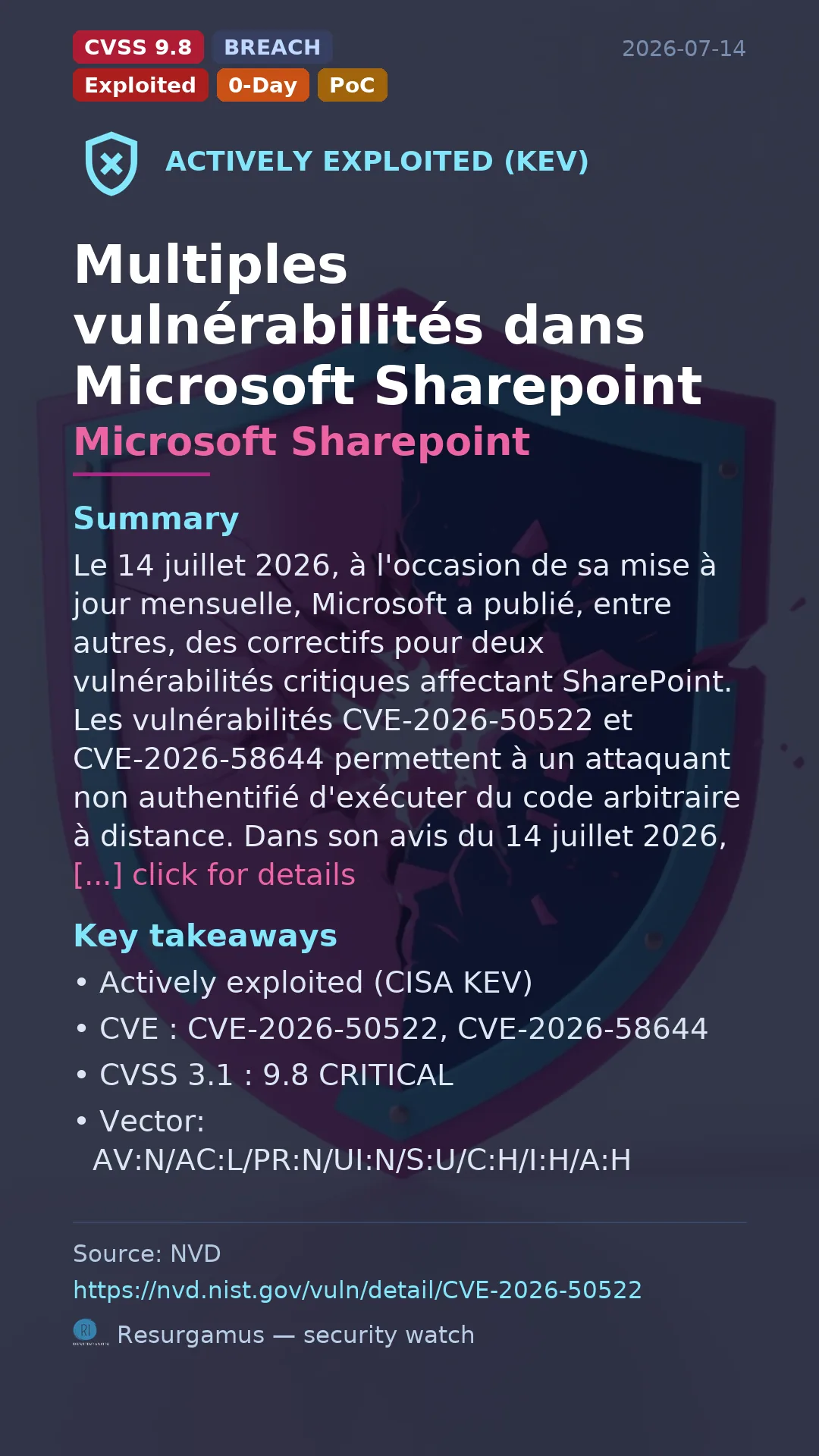
CVE-2026-50522 — Microsoft Sharepoint · CVSS 9.8 · KEV Le 14 juillet 2026, à l'occasion de sa mise à jour mensuelle, Microsoft a publié, entre autres, des correctifs pour deux vulnérabilités critiques affectant SharePoint. Les vulnérabilités CVE-2026-50522 et CVE-2026-58644 permettent à un attaquant non authentifié d'exécuter du code arbitraire à distance. Dans son avis du 14 juillet 2026, Microsoft a indiqué que la vulnérabilité CVE-2026-58644 est activement exploitée. Dans une communication en date du 21 juillet 2026, l'entreprise de sécurité informatique watchTowr déclare avoir connaissance d'une preuve de concept publique, ainsi que d'exploitations actives de la vulnérabilité CVE-2026-50522. Le CERT-FR recommande donc l'application des correctifs dans les plus brefs délais. En cas de soupçons de compromission, le CERT-FR recommande également le changement des secrets, incluant la rotation des clés de machine ASP.NET du SharePoint Server. En effet, le vol de ces secrets peut permettre à l'attaquant de revenir après l'application de la mise à jour. | Actively exploited (CISA KEV) | CVE : CVE-2026-50522, CVE-2026-58644 | CVSS 3.1 : 9.8 CRITICAL | Vector: AV:N/AC:L/PR:N/UI:N/S:U/C:H/I:H/A:H
CVE-2026-15410 — SonicWall SMA1000 Appliances · CVSS 7.2 · KEV SonicWall SMA1000 Appliances contain a code injection vulnerability which in specific conditions could potentially enable a remote authenticated attacker as administrator to execute arbitrary OS commands. | Actively exploited (CISA KEV) - patch before 2026-07-17 | CVSS 3.1 : 7.2 HIGH | Vector: AV:N/AC:L/PR:H/UI:N/S:U/C:H/I:H/A:H
CVE-2026-15409 — SonicWall SMA1000 Appliances · CVSS 10 · KEV SonicWall SMA1000 Appliances contain a server-side request forgery vulnerability that could allow a remote unauthenticated attacker to potentially cause the appliance to make requests to unintended location. | Actively exploited (CISA KEV) - patch before 2026-07-17 | CVSS 3.1 : 10.0 CRITICAL | Vector: AV:N/AC:L/PR:N/UI:N/S:C/C:H/I:H/A:H
CVE-2026-56164 — Microsoft SharePoint Server · CVSS 5.3 · KEV Microsoft SharePoint contains a missing authentication for critical function vulnerability that allows an unauthorized attacker to elevate privileges over a network. | Actively exploited (CISA KEV) - patch before 2026-07-17 | CVSS 3.1 : 5.3 MEDIUM | Vector: AV:N/AC:L/PR:N/UI:N/S:U/C:N/I:L/A:N
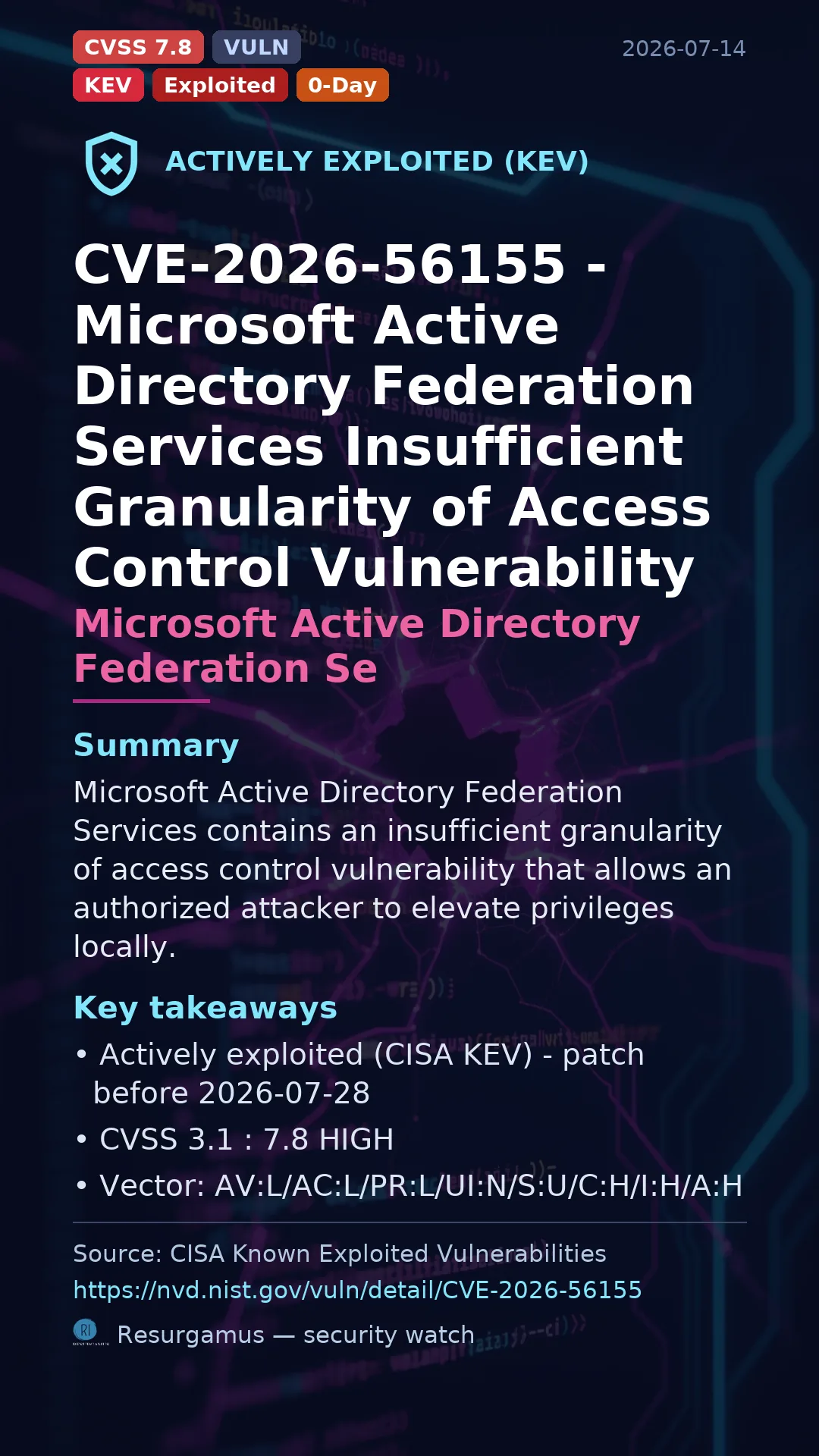
CVE-2026-56155 — Microsoft Active Directory Federation Se · CVSS 7.8 · KEV Microsoft Active Directory Federation Services contains an insufficient granularity of access control vulnerability that allows an authorized attacker to elevate privileges locally. | Actively exploited (CISA KEV) - patch before 2026-07-28 | CVSS 3.1 : 7.8 HIGH | Vector: AV:L/AC:L/PR:L/UI:N/S:U/C:H/I:H/A:H
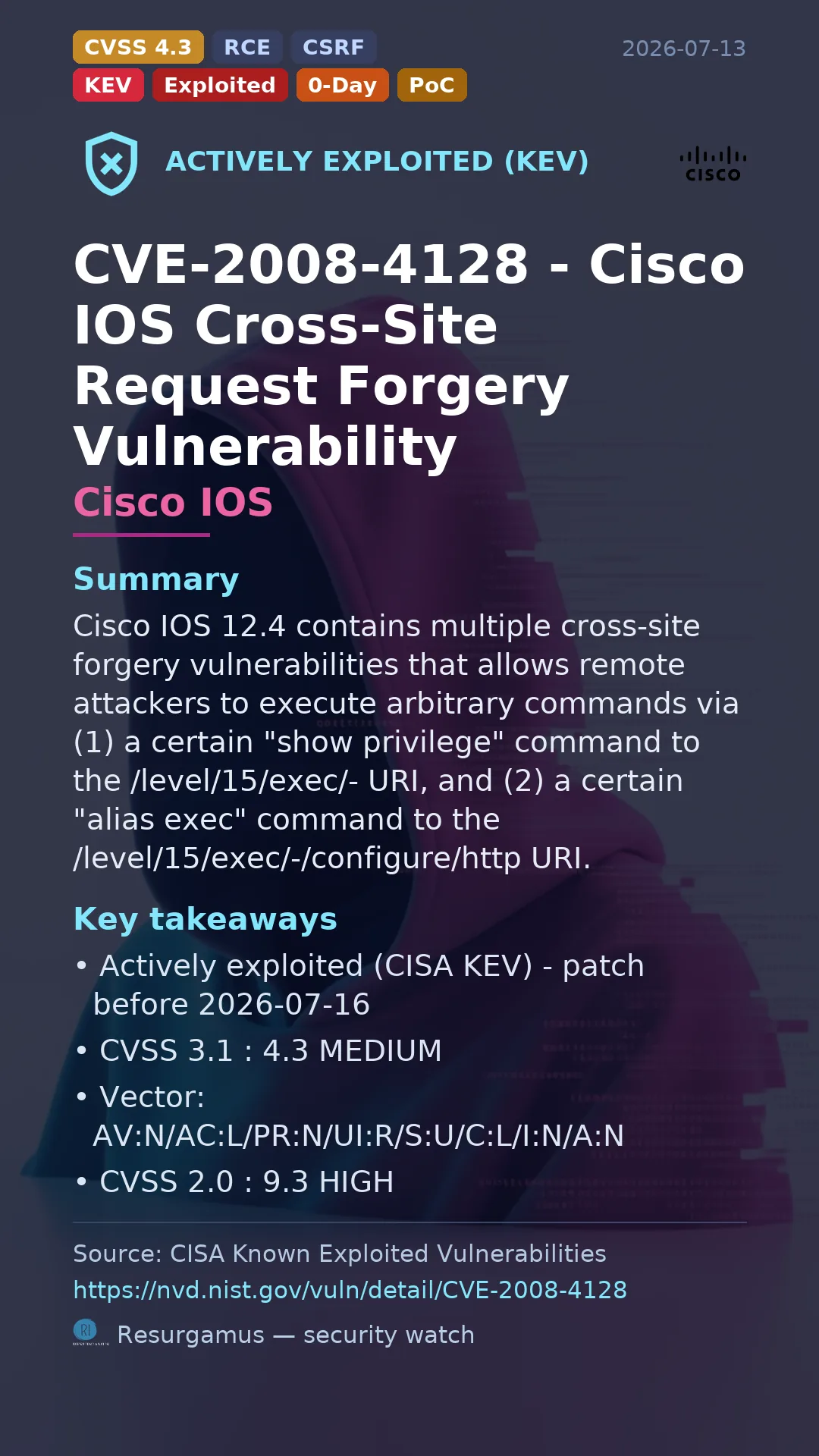
CVE-2008-4128 — Cisco IOS · CVSS 4.3 · KEV Cisco IOS 12.4 contains multiple cross-site forgery vulnerabilities that allows remote attackers to execute arbitrary commands via (1) a certain "show privilege" command to the /level/15/exec/- URI, and (2) a certain "alias exec" command to the /level/15/exec/-/configure/http URI. | Actively exploited (CISA KEV) - patch before 2026-07-16 | CVSS 3.1 : 4.3 MEDIUM | Vector: AV:N/AC:L/PR:N/UI:R/S:U/C:L/I:N/A:N | CVSS 2.0 : 9.3 HIGH
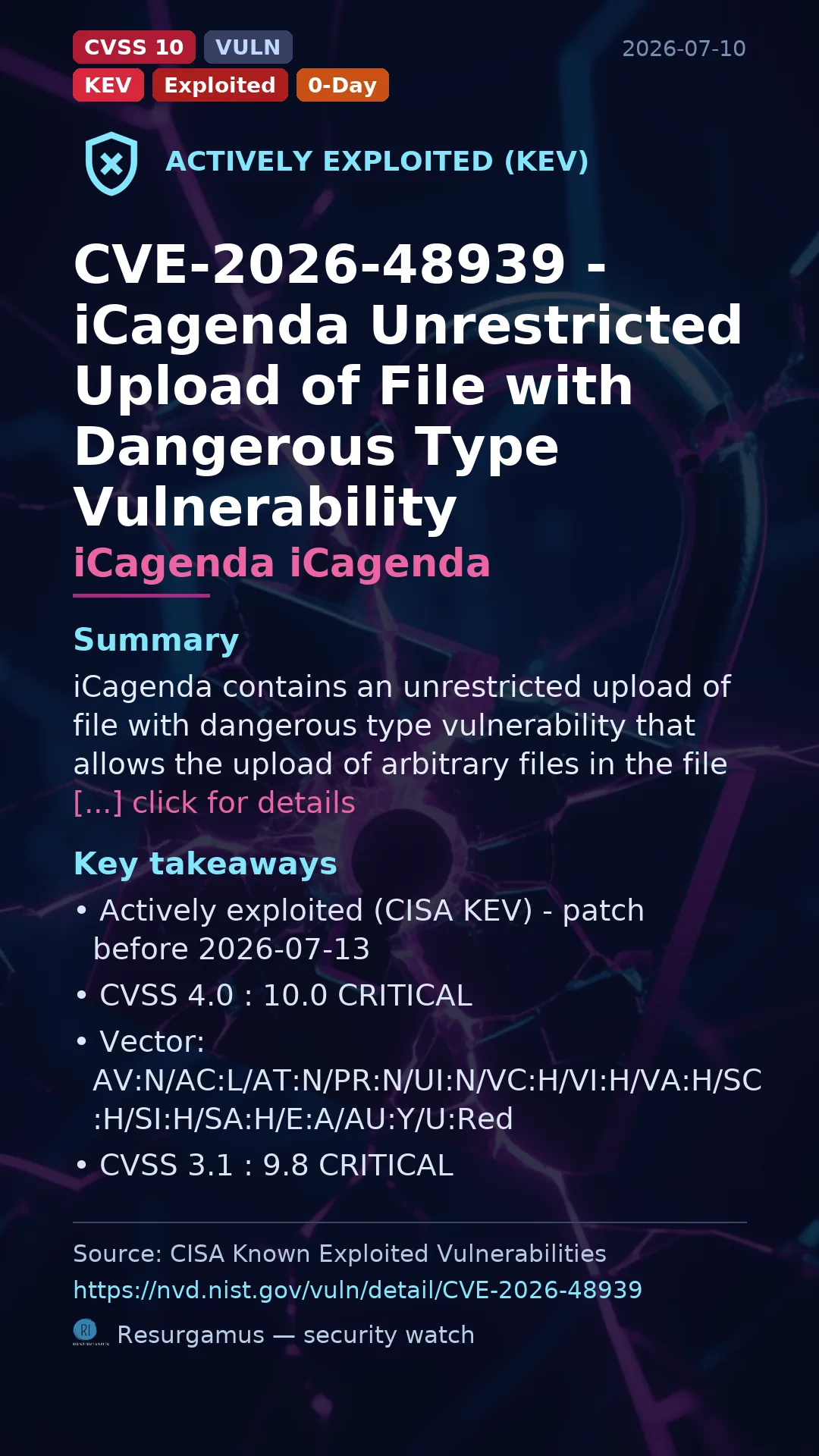
CVE-2026-48939 — iCagenda iCagenda · CVSS 10 · KEV iCagenda contains an unrestricted upload of file with dangerous type vulnerability that allows the upload of arbitrary files in the file attachment feature, ultimately resulting in PHP code upload and execution. | Actively exploited (CISA KEV) - patch before 2026-07-13 | CVSS 4.0 : 10.0 CRITICAL | Vector: AV:N/AC:L/AT:N/PR:N/UI:N/VC:H/VI:H/VA:H/SC:H/SI:H/SA:H/E:A/AU:Y/U:Red | CVSS 3.1 : 9.8 CRITICAL
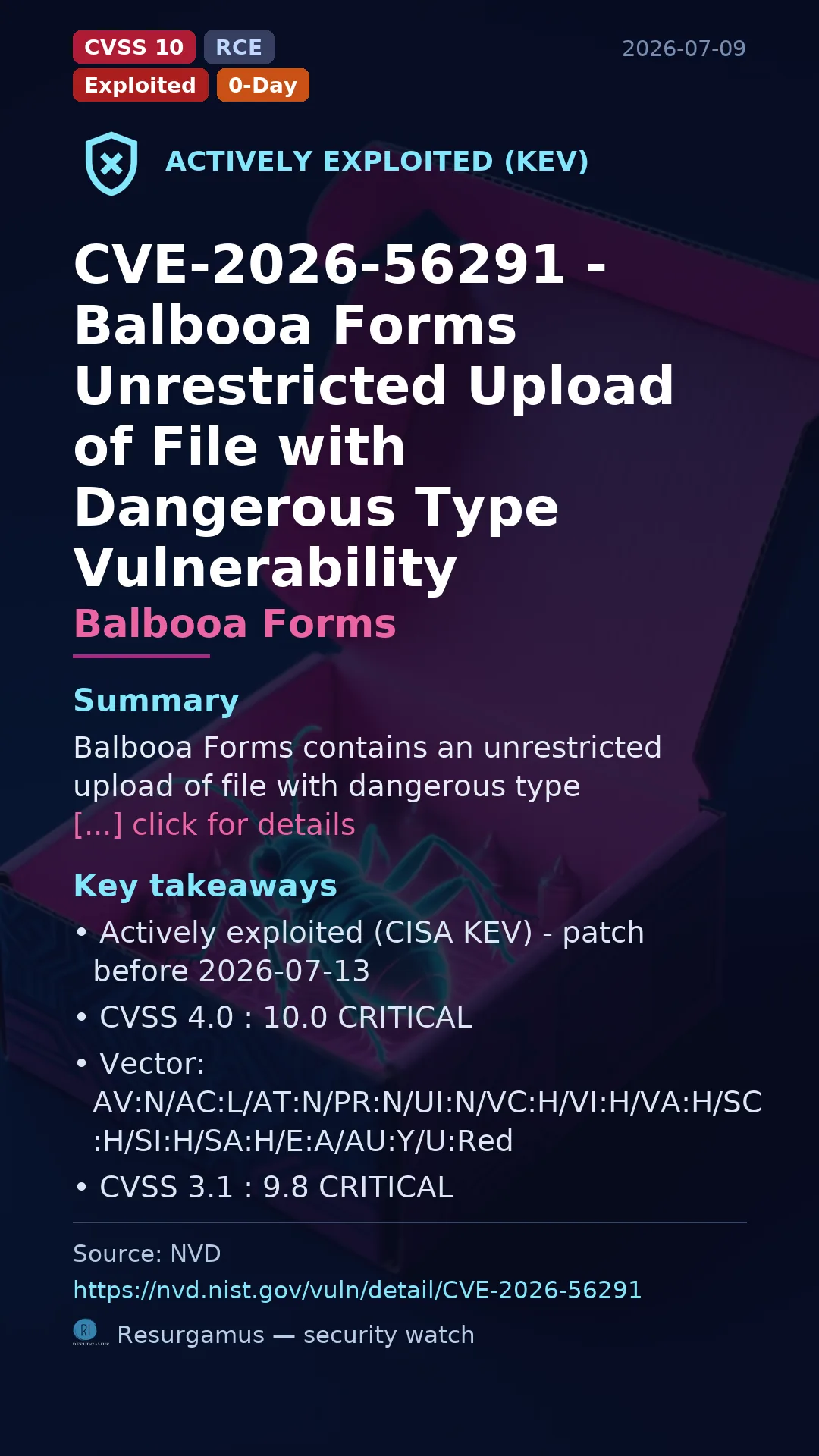
CVE-2026-56291 — Balbooa Forms · CVSS 10 · KEV Balbooa Forms contains an unrestricted upload of file with dangerous type vulnerability that allows an unauthenticated arbitrary file upload which could allow uploading of executable files leading to full RCE. | Actively exploited (CISA KEV) - patch before 2026-07-13 | CVSS 4.0 : 10.0 CRITICAL | Vector: AV:N/AC:L/AT:N/PR:N/UI:N/VC:H/VI:H/VA:H/SC:H/SI:H/SA:H/E:A/AU:Y/U:Red | CVSS 3.1 : 9.8 CRITICAL
CVE-2026-55255 — Langflow Langflow · CVSS 9.9 · KEV Langflow contains an authorization bypass through user-controlled key vulnerability which allows an authenticated attacker to execute any flow belonging to another user by specifying the victim's flow ID in the request. | Actively exploited (CISA KEV) - patch before 2026-07-10 | CVSS 3.1 : 9.9 CRITICAL | Vector: AV:N/AC:L/PR:L/UI:N/S:C/C:H/I:H/A:L
CVE-2026-48908 — JoomShaper SP Page Builder · CVSS 10 · KEV JoomShaper SP Page Builder contains an unrestricted upload of file with dangerous type vulnerability that allows unauthenticated users to upload arbitrary files, ultimately resulting in the upload and execution of PHP code. | Actively exploited (CISA KEV) - patch before 2026-07-10 | CVSS 4.0 : 10.0 CRITICAL | Vector: AV:N/AC:L/AT:N/PR:N/UI:N/VC:H/VI:H/VA:H/SC:H/SI:H/SA:H/E:A/AU:Y/U:Red | CVSS 3.1 : 9.8 CRITICAL
CVE-2026-12569 — PTC Windchill PDMLink · CVSS 9.3 · KEV PTC Windchill and FlexPLM contains an improper input validation vulnerability allowing an unauthenticated, remote attacker to execute arbitrary code by sending a malicious request to the network. | Actively exploited (CISA KEV) - patch before 2026-06-28 | CVSS 4.0 : 9.3 CRITICAL | Vector: AV:N/AC:L/AT:N/PR:N/UI:N/VC:H/VI:H/VA:H/SC:L/SI:L/SA:L/AU:Y/R:U/V:C/U:Red | CVSS 3.1 : 9.8 CRITICAL
CVE-2026-20230 — Cisco Unified Communications Manager · CVSS 8.6 · KEV Cisco Unified Communications Manager (Unified CM) and Cisco Unified Communications Manager Session Management Edition (Unified CM SME) contain a server-side request forgery (SSRF) Vulnerability that could allow an unauthenticated, remote attacker to write files to the underlying operating system that could be used later to elevate to root. | Actively exploited (CISA KEV) - patch before 2026-06-28 | CVSS 3.1 : 8.6 HIGH | Vector: AV:N/AC:L/PR:N/UI:N/S:C/C:N/I:H/A:N
CVE-2025-67038 — Lantronix EDS5000 · CVSS 9.8 · KEV Lantronix EDS5000 contains a code injection vulnerability that could allow attackers to inject arbitrary OS commands into the username parameter. Injected commands are executed with root privileges. | Actively exploited (CISA KEV) - patch before 2026-06-26 | CVSS 3.1 : 9.8 CRITICAL | Vector: AV:N/AC:L/PR:N/UI:N/S:U/C:H/I:H/A:H
CVE-2026-34910 — Ubiquiti Inc UniFi OS Server · CVSS 10 · KEV Ubiquiti UniFi OS contains an improper input validation vulnerability which could allow a malicious actor with access to the network to conduct command injection. | Actively exploited (CISA KEV) - patch before 2026-06-26 | CVSS 3.1 : 10.0 CRITICAL | Vector: AV:N/AC:L/PR:N/UI:N/S:C/C:H/I:H/A:H
CVE-2026-34909 — Ubiquiti Inc UniFi OS Server · CVSS 10 · KEV Ubiquiti UniFi OS contains a path traversal vulnerability which could allow a malicious actor with access to the network to access files on the underlying system that could be manipulated to access an underlying account. | Actively exploited (CISA KEV) - patch before 2026-06-26 | CVSS 3.1 : 10.0 CRITICAL | Vector: AV:N/AC:L/PR:N/UI:N/S:C/C:H/I:H/A:H
CVE-2026-34908 — Ubiquiti Inc UniFi OS Server · CVSS 10 · KEV Ubiquiti UniFi OS contains an improper access control vulnerability which could allow a malicious actor with access to the network to make unauthorized changes to the system. | Actively exploited (CISA KEV) - patch before 2026-06-26 | CVSS 3.1 : 10.0 CRITICAL | Vector: AV:N/AC:L/PR:N/UI:N/S:C/C:H/I:H/A:H
CVE-2026-20253 — Splunk Enterprise · CVSS 9.8 · KEV Splunk Enterprise contains a missing authentication for critical function vulnerability which could allow an unauthenticated user to create or truncate arbitrary files through a PostgreSQL sidecar service endpoint. | Actively exploited (CISA KEV) - patch before 2026-06-21 | CVSS 3.1 : 9.8 CRITICAL | Vector: AV:N/AC:L/PR:N/UI:N/S:U/C:H/I:H/A:H
CVE-2026-48907 — Joomla Content Editor (JCE) extension fo · CVSS 10 · KEV Widget Factory Joomla Content Editor contains an improper access control vulnerability which could allow for upload and execution of PHP code via the creation of new editor profiles for unauthenticated users. | Actively exploited (CISA KEV) - patch before 2026-06-19 | CVSS 4.0 : 10.0 CRITICAL | Vector: AV:N/AC:L/AT:N/PR:N/UI:N/VC:H/VI:H/VA:H/SC:H/SI:H/SA:H/E:A/AU:Y/U:Red | CVSS 3.1 : 9.8 CRITICAL
CVE-2026-54420 — LiteSpeed Technologies cPanel Plugin · CVSS 8.5 · KEV LiteSpeed cPanel plugin contains a UNIX symbolic link (Symlink) following vulnerability that could allow a user with FTP or web shell access on a shared hosting server running CloudLinux/CageFS. | Actively exploited (CISA KEV) - patch before 2026-06-18 | CVSS 3.1 : 8.5 HIGH | Vector: AV:N/AC:H/PR:L/UI:N/S:C/C:H/I:H/A:H
CVE-2026-20262 — Cisco Catalyst SD-WAN Manager · CVSS 6.5 · KEV Cisco Catalyst SD-WAN Manager contains a directory or path traversal vulnerability that could allow an authenticated, remote attacker to create a file or overwrite any file on the filesystem of an affected system. | Actively exploited (CISA KEV) - patch before 2026-06-29 | CVSS 3.1 : 6.5 MEDIUM | Vector: AV:N/AC:L/PR:L/UI:N/S:U/C:N/I:H/A:N
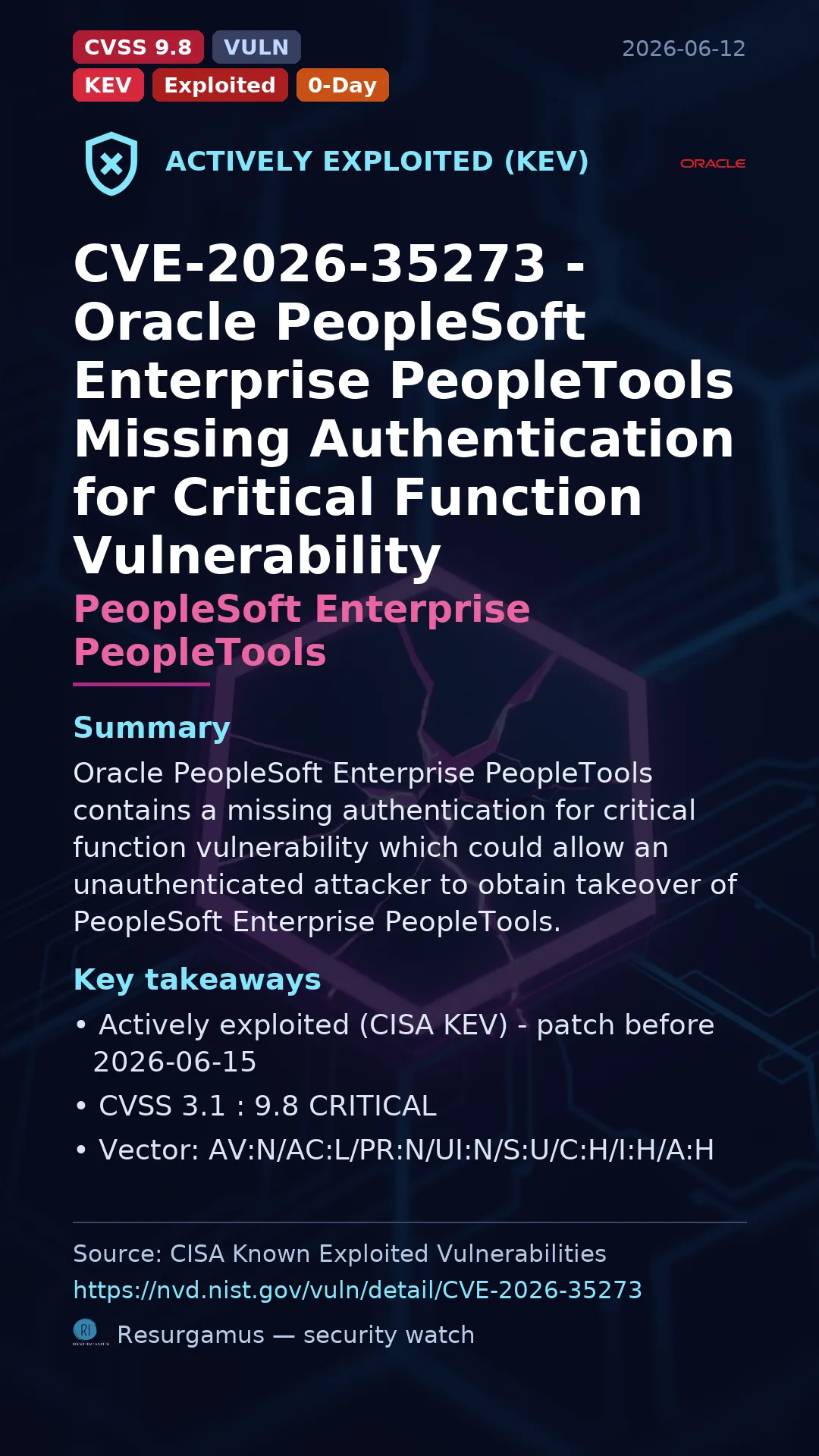
CVE-2026-35273 — PeopleSoft Enterprise PeopleTools · CVSS 9.8 · KEV Oracle PeopleSoft Enterprise PeopleTools contains a missing authentication for critical function vulnerability which could allow an unauthenticated attacker to obtain takeover of PeopleSoft Enterprise PeopleTools. | Actively exploited (CISA KEV) - patch before 2026-06-15 | CVSS 3.1 : 9.8 CRITICAL | Vector: AV:N/AC:L/PR:N/UI:N/S:U/C:H/I:H/A:H
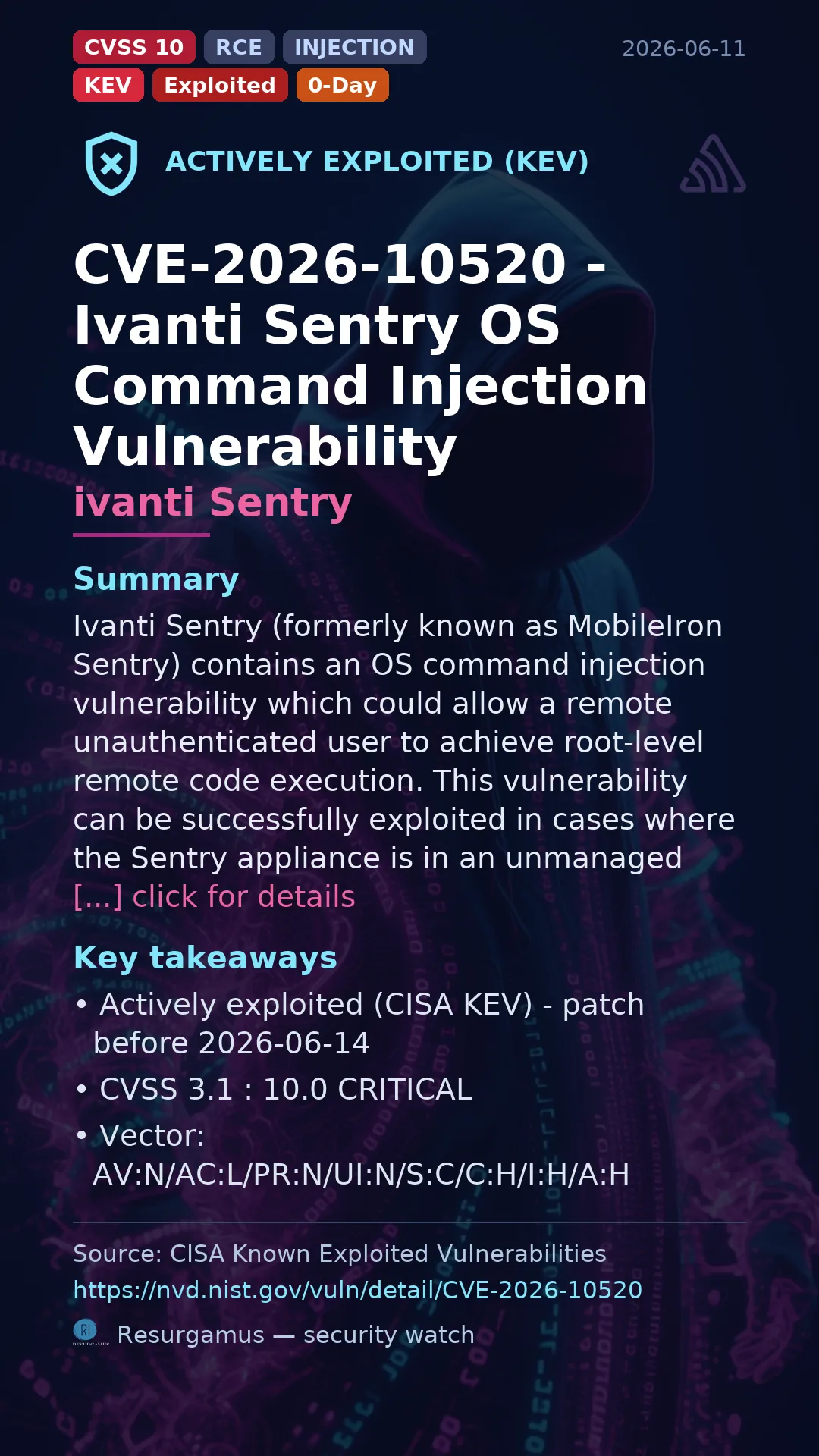
CVE-2026-10520 — ivanti Sentry · CVSS 10 · KEV Ivanti Sentry (formerly known as MobileIron Sentry) contains an OS command injection vulnerability which could allow a remote unauthenticated user to achieve root-level remote code execution. This vulnerability can be successfully exploited in cases where the Sentry appliance is in an unmanaged state with its endpoints externally reachable. The use of mTLS with EPMM or restricted HTTPS access through Neurons for MDM makes interfaces inaccessible to external actors. | Actively exploited (CISA KEV) - patch before 2026-06-14 | CVSS 3.1 : 10.0 CRITICAL | Vector: AV:N/AC:L/PR:N/UI:N/S:C/C:H/I:H/A:H
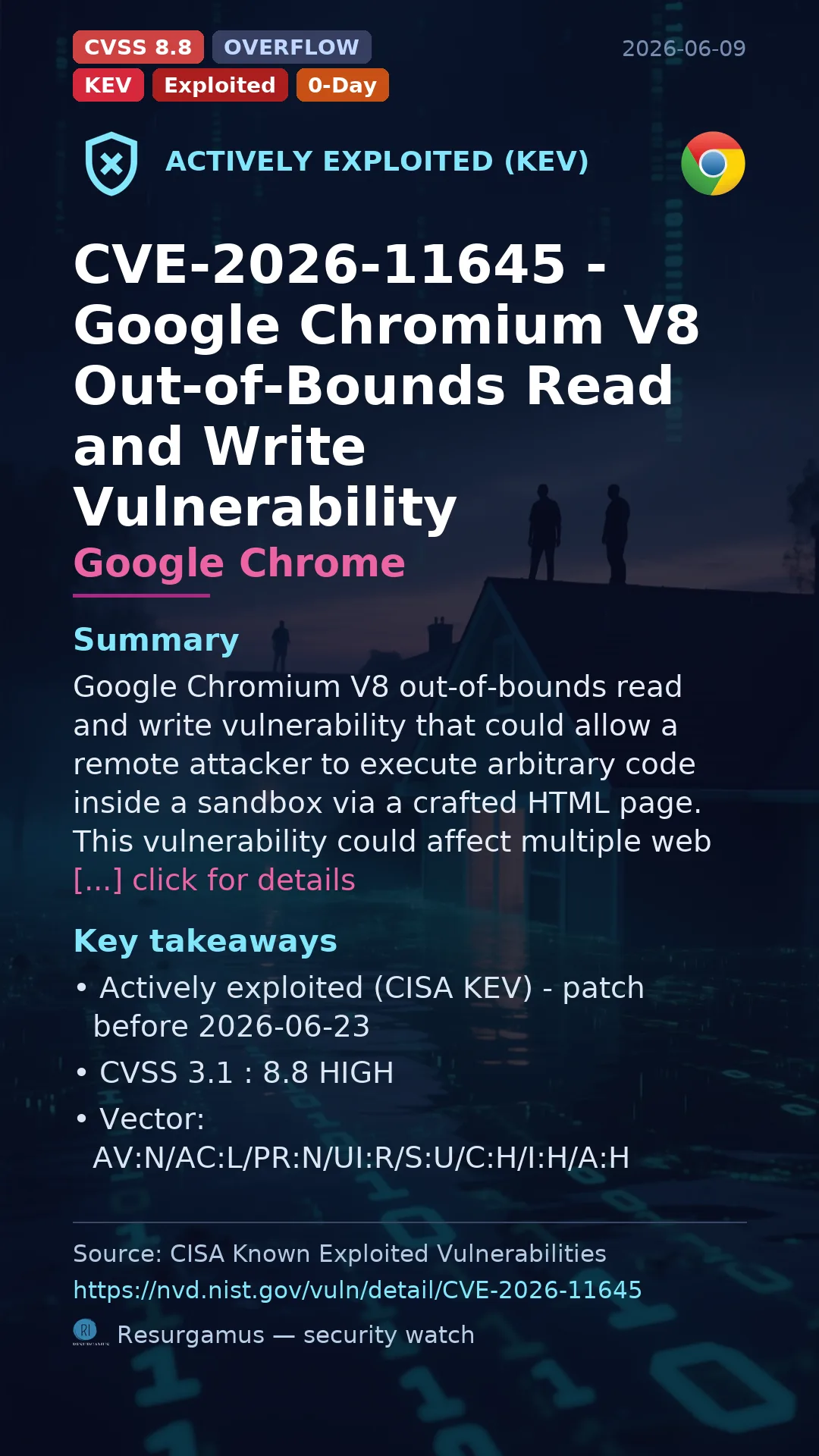
CVE-2026-11645 — Google Chrome · CVSS 8.8 · KEV Google Chromium V8 out-of-bounds read and write vulnerability that could allow a remote attacker to execute arbitrary code inside a sandbox via a crafted HTML page. This vulnerability could affect multiple web browsers that utilize Chromium, including, but not limited to, Google Chrome, Microsoft Edge, and Opera. | Actively exploited (CISA KEV) - patch before 2026-06-23 | CVSS 3.1 : 8.8 HIGH | Vector: AV:N/AC:L/PR:N/UI:R/S:U/C:H/I:H/A:H
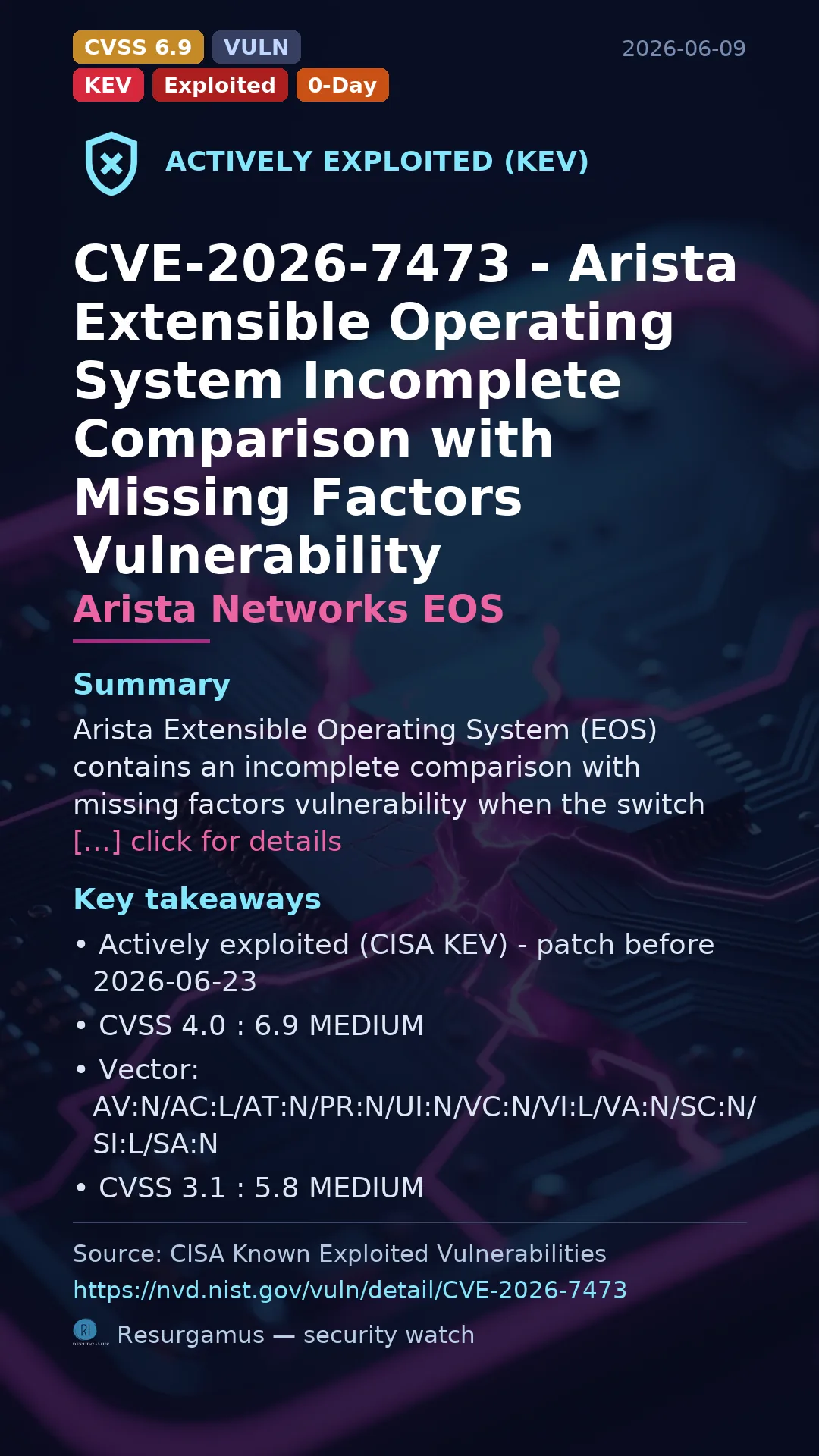
CVE-2026-7473 — Arista Networks EOS · CVSS 6.9 · KEV Arista Extensible Operating System (EOS) contains an incomplete comparison with missing factors vulnerability when the switch incorrectly decapsulate and forwards other unexpected tunneled packet with a destination IP matching its configured decapsulation IP. | Actively exploited (CISA KEV) - patch before 2026-06-23 | CVSS 4.0 : 6.9 MEDIUM | Vector: AV:N/AC:L/AT:N/PR:N/UI:N/VC:N/VI:L/VA:N/SC:N/SI:L/SA:N | CVSS 3.1 : 5.8 MEDIUM
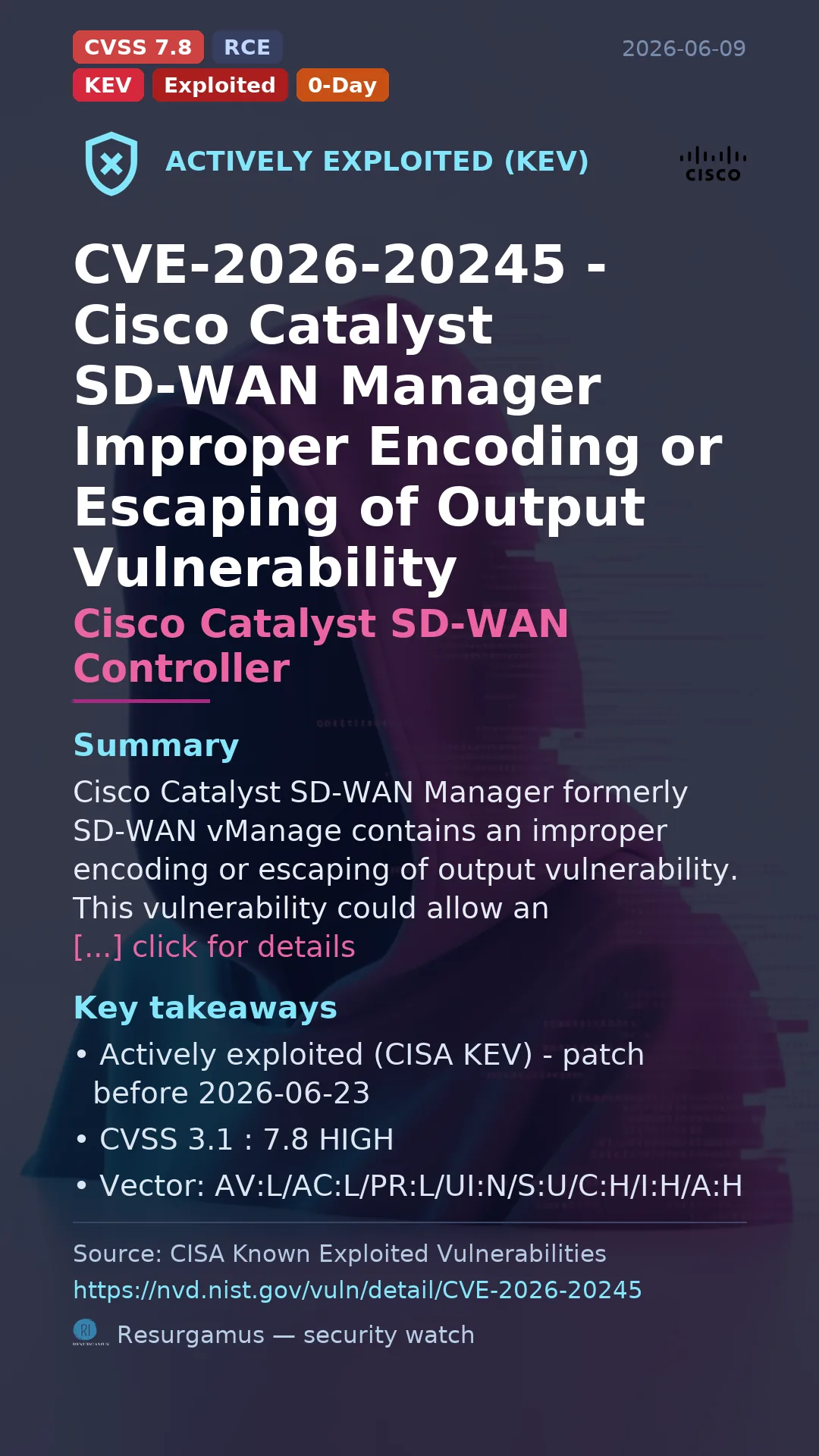
CVE-2026-20245 — Cisco Catalyst SD-WAN Controller · CVSS 7.8 · KEV Cisco Catalyst SD-WAN Manager formerly SD-WAN vManage contains an improper encoding or escaping of output vulnerability. This vulnerability could allow an authenticated, local attacker to execute arbitrary commands as root by supplying a crafted file to the affected system. | Actively exploited (CISA KEV) - patch before 2026-06-23 | CVSS 3.1 : 7.8 HIGH | Vector: AV:L/AC:L/PR:L/UI:N/S:U/C:H/I:H/A:H
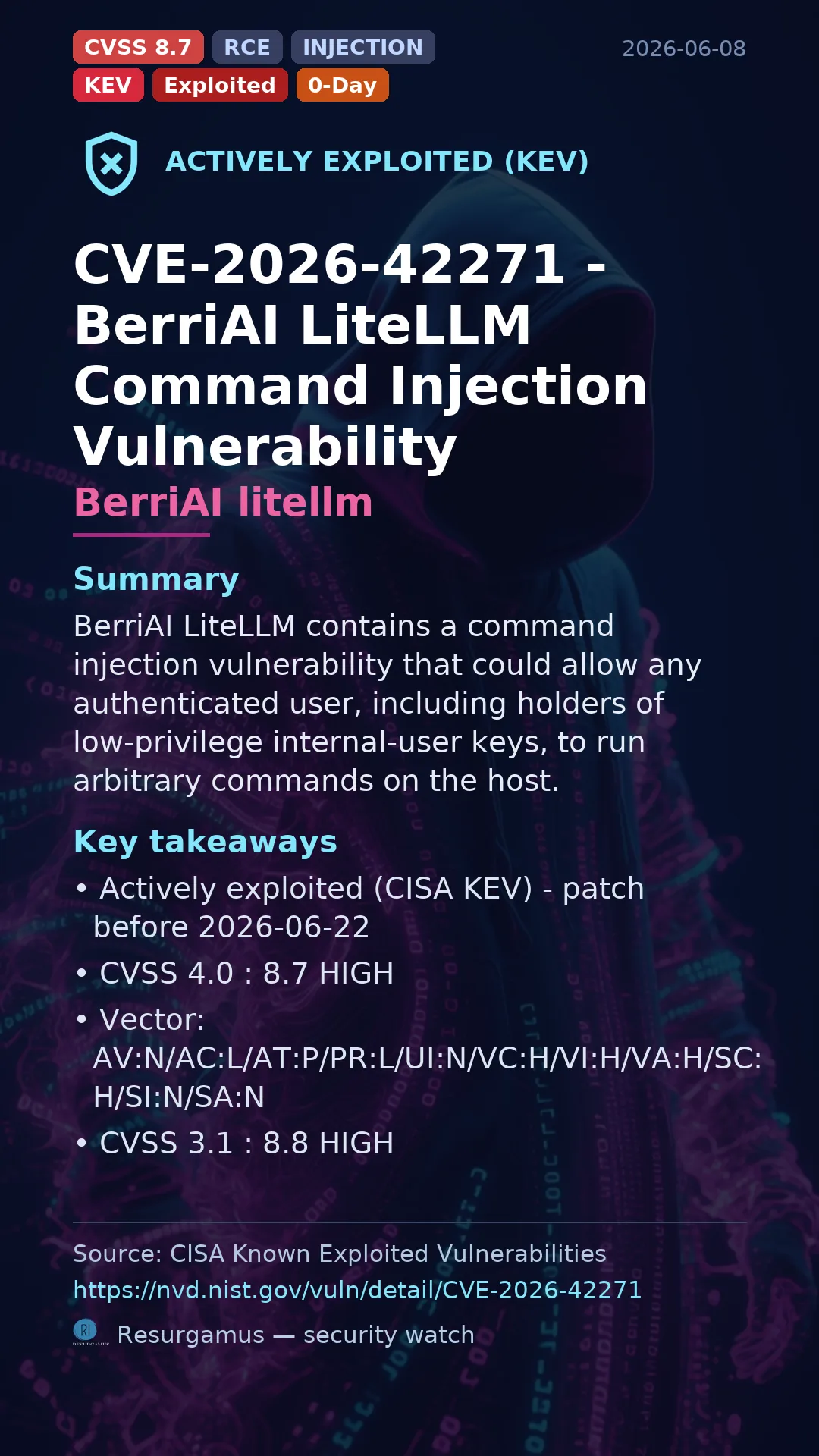
CVE-2026-42271 — BerriAI litellm · CVSS 8.7 · KEV BerriAI LiteLLM contains a command injection vulnerability that could allow any authenticated user, including holders of low-privilege internal-user keys, to run arbitrary commands on the host. | Actively exploited (CISA KEV) - patch before 2026-06-22 | CVSS 4.0 : 8.7 HIGH | Vector: AV:N/AC:L/AT:P/PR:L/UI:N/VC:H/VI:H/VA:H/SC:H/SI:N/SA:N | CVSS 3.1 : 8.8 HIGH
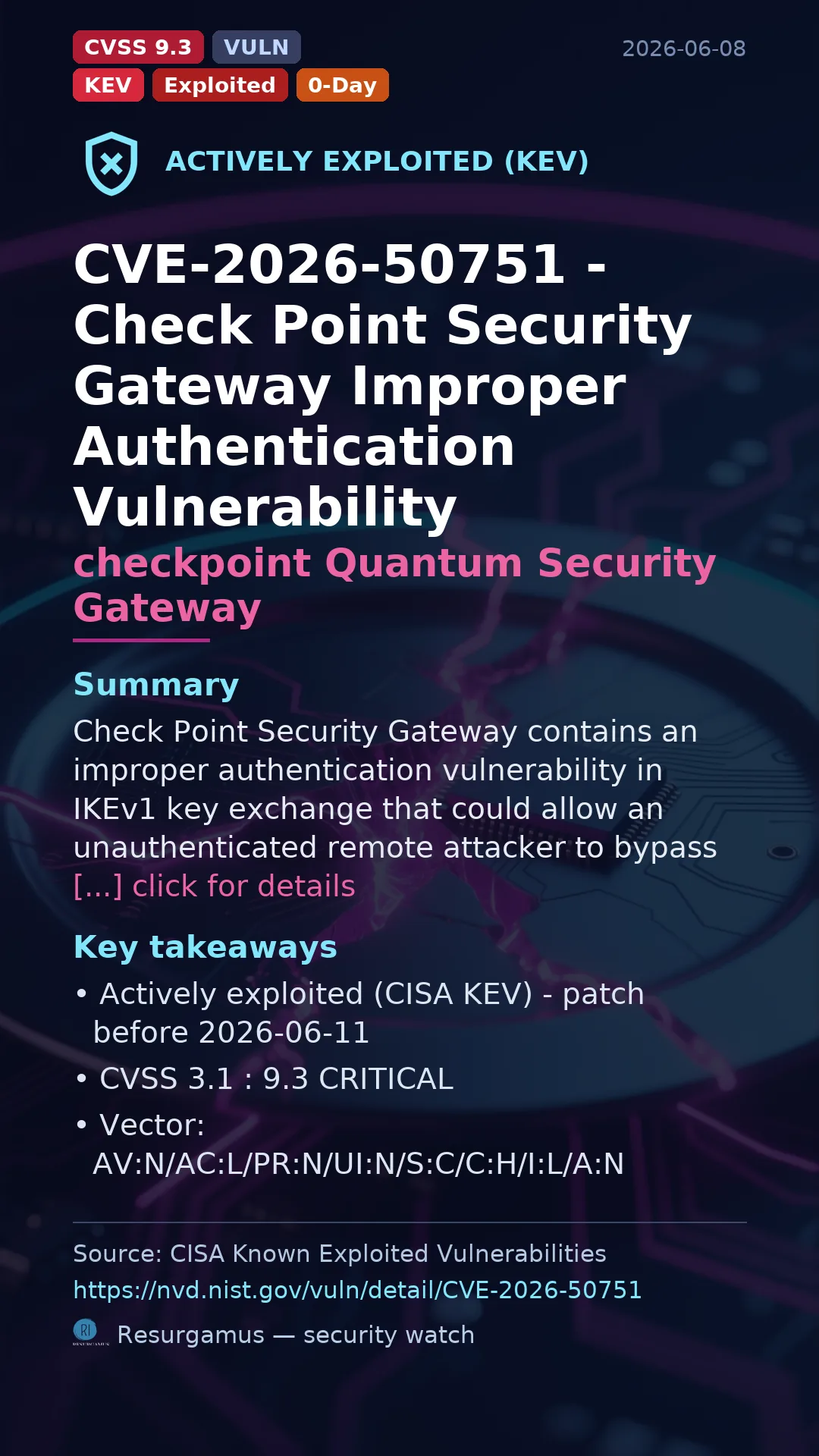
CVE-2026-50751 — checkpoint Quantum Security Gateway · CVSS 9.3 · KEV Check Point Security Gateway contains an improper authentication vulnerability in IKEv1 key exchange that could allow an unauthenticated remote attacker to bypass user authentication and establish a remote access VPN connection without a valid user password. | Actively exploited (CISA KEV) - patch before 2026-06-11 | CVSS 3.1 : 9.3 CRITICAL | Vector: AV:N/AC:L/PR:N/UI:N/S:C/C:H/I:L/A:N
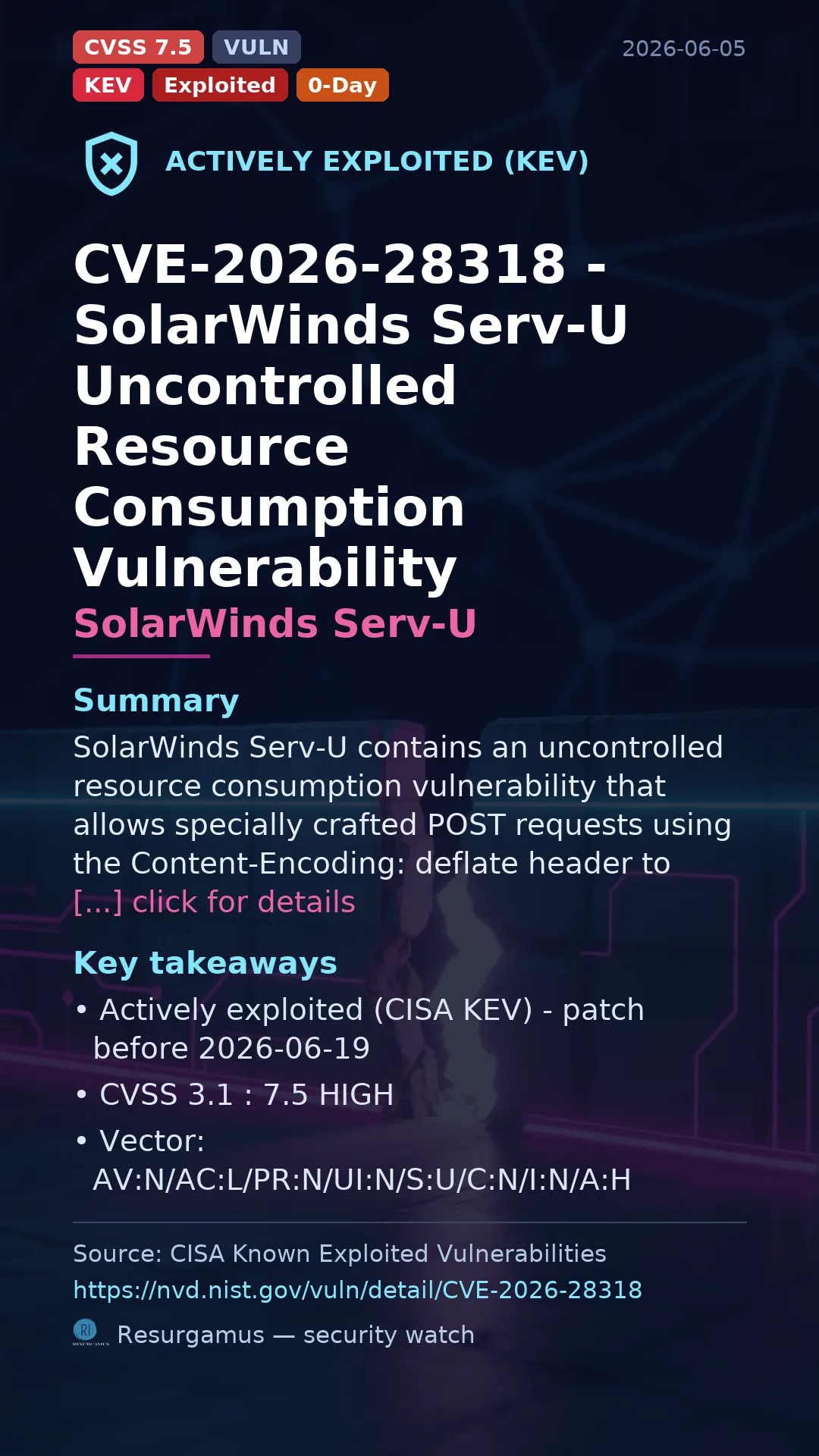
CVE-2026-28318 — SolarWinds Serv-U · CVSS 7.5 · KEV SolarWinds Serv-U contains an uncontrolled resource consumption vulnerability that allows specially crafted POST requests using the Content-Encoding: deflate header to crash the Serv-U service without authentication. | Actively exploited (CISA KEV) - patch before 2026-06-19 | CVSS 3.1 : 7.5 HIGH | Vector: AV:N/AC:L/PR:N/UI:N/S:U/C:N/I:N/A:H