CVE-2026-63313
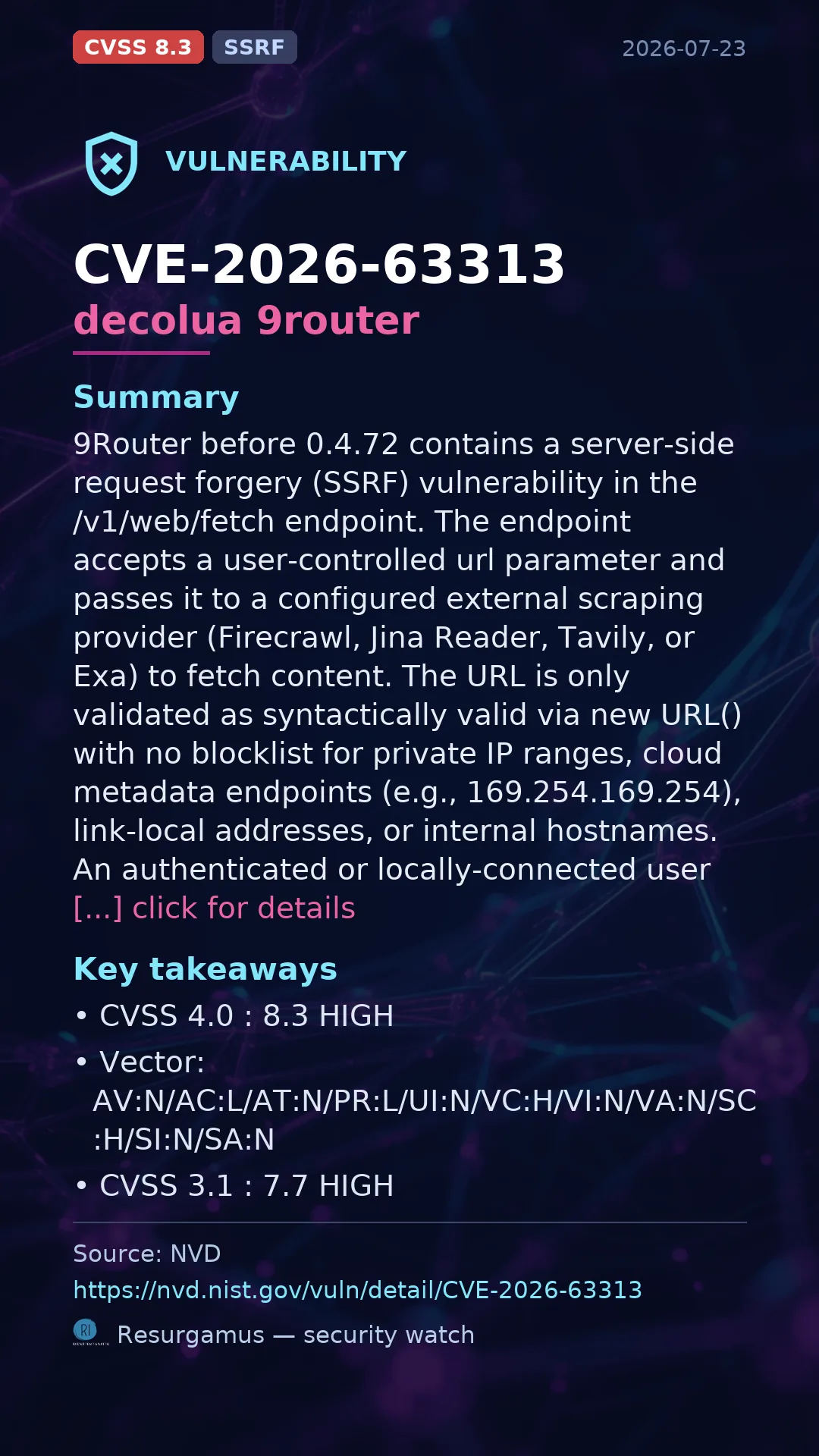
9Router before 0.4.72 contains a server-side request forgery (SSRF) vulnerability in the /v1/web/fetch endpoint. The endpoint accepts a user-controlled url parameter and passes it to a configured external scraping provider (Firecrawl, Jina Reader, Tavily, or Exa) to fetch content. The URL is only validated as syntactically valid via new URL() with no blocklist for private IP ranges, cloud metadata endpoints (e.g., 169.254.169.254), link-local addresses, or internal hostnames. An authenticated or locally-connected user can cause the server to fetch arbitrary internal URLs and have the response content returned, enabling read-access SSRF that can expose cloud metadata credentials, reach internal services, and bypass authentication on localhost endpoints.
No public exploitation has been reported so far. No distribution fix is listed yet; apply vendor mitigations and monitor.
Recommended action: Track your distribution's security tracker and apply the fix as soon as it ships.
Severity metrics
CVSS 4.0 : 8.3 HIGH · CVSS 3.1 : 7.7 HIGH
Vector: AV:N/AC:L/AT:N/PR:L/UI:N/VC:H/VI:N/VA:N/SC:H/SI:N/SA:N
Affected & fixed versions by distribution
Versions are the native distribution strings (backport-aware): RHEL/Debian/SUSE backport fixes, so compare with the distro version comparator (dpkg / rpm / vercmp), not the upstream version.
No affected package in the tracked watchlist yet (Debian, Ubuntu, Arch, SUSE, Red Hat...). Triage may still be pending.