CVE-2026-65623
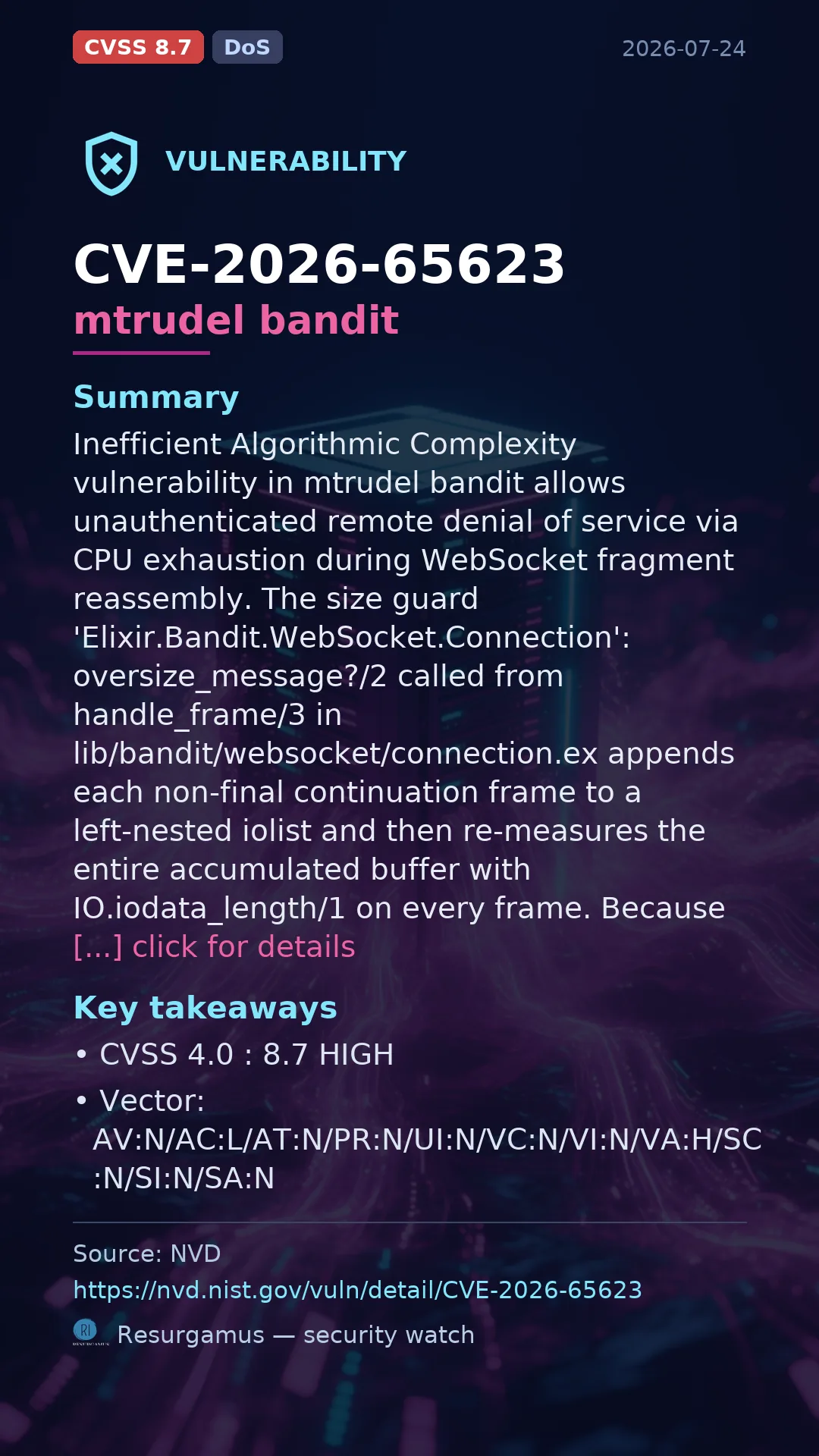
Inefficient Algorithmic Complexity vulnerability in mtrudel bandit allows unauthenticated remote denial of service via CPU exhaustion during WebSocket fragment reassembly. The size guard 'Elixir.Bandit.WebSocket.Connection':oversize_message?/2 called from handle_frame/3 in lib/bandit/websocket/connection.ex appends each non-final continuation frame to a left-nested iolist and then re-measures the entire accumulated buffer with IO.iodata_length/1 on every frame. Because the buffer grows by one element per frame and is fully re-traversed each time, reassembly work is quadratic (O(n^2)) in the number of continuation frames. The max_fragmented_message_size limit (default 8 MB) bounds total bytes but not frame count, and each frame can carry as little as one payload byte, so an attacker can send millions of tiny continuation frames using modest bandwidth to pin a CPU core for minutes to hours. Many concurrent connections can starve the whole server of CPU, denying service to legitimate users. The WebSocket read timeout does not help, because it is an idle timeout evaluated between reads and cannot preempt the synchronous reassembly work spent inside a single callback. This issue affe
No public exploitation has been reported so far. No distribution fix is listed yet; apply vendor mitigations and monitor.
Recommended action: Track your distribution's security tracker and apply the fix as soon as it ships.
Severity metrics
CVSS 4.0 : 8.7 HIGH
Vector: AV:N/AC:L/AT:N/PR:N/UI:N/VC:N/VI:N/VA:H/SC:N/SI:N/SA:N
Affected & fixed versions by distribution
Versions are the native distribution strings (backport-aware): RHEL/Debian/SUSE backport fixes, so compare with the distro version comparator (dpkg / rpm / vercmp), not the upstream version.
No affected package in the tracked watchlist yet (Debian, Ubuntu, Arch, SUSE, Red Hat...). Triage may still be pending.