CVE-2026-11610
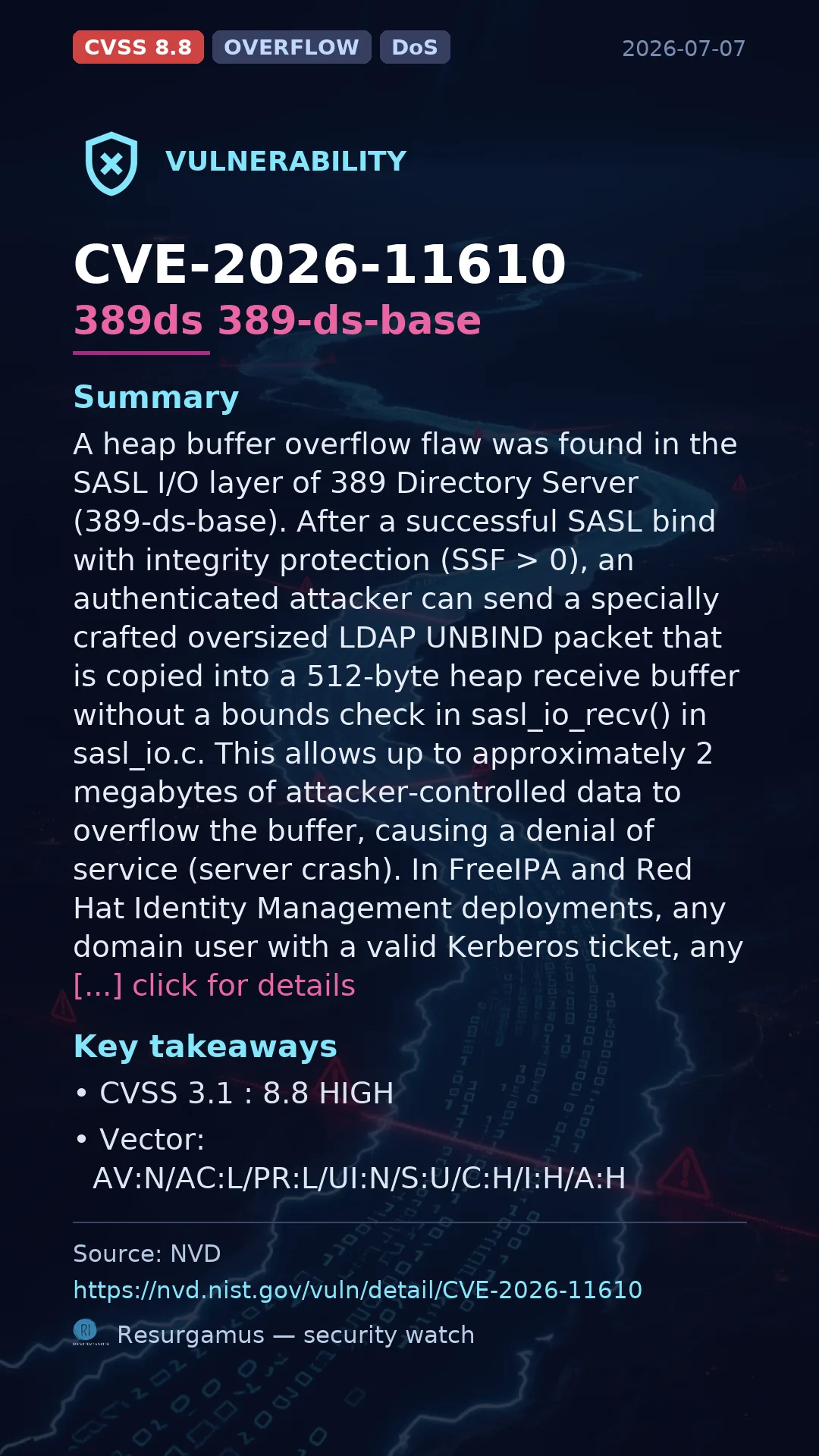
A heap buffer overflow flaw was found in the SASL I/O layer of 389 Directory Server (389-ds-base). After a successful SASL bind with integrity protection (SSF > 0), an authenticated attacker can send a specially crafted oversized LDAP UNBIND packet that is copied into a 512-byte heap receive buffer without a bounds check in sasl_io_recv() in sasl_io.c. This allows up to approximately 2 megabytes of attacker-controlled data to overflow the buffer, causing a denial of service (server crash). In FreeIPA and Red Hat Identity Management deployments, any domain user with a valid Kerberos ticket, any enrolled host, or any service account can trigger this vulnerability over the network after authenticating via GSSAPI. The vulnerable code path has existed since approximately 2013 (389-ds-base 1.3.2) and was not addressed by the CVE-2025-14905 fix, which patched a separate heap overflow in schema.c only.
No public exploitation has been reported so far. No distribution fix is listed yet; apply vendor mitigations and monitor.
Recommended action: Track your distribution's security tracker and apply the fix as soon as it ships.
Severity metrics
CVSS 3.1 : 8.8 HIGH
Vector: AV:N/AC:L/PR:L/UI:N/S:U/C:H/I:H/A:H
Affected & fixed versions by distribution
Versions are the native distribution strings (backport-aware): RHEL/Debian/SUSE backport fixes, so compare with the distro version comparator (dpkg / rpm / vercmp), not the upstream version.
No affected package in the tracked watchlist yet (Debian, Ubuntu, Arch, SUSE, Red Hat...). Triage may still be pending.