CVE-2026-12000
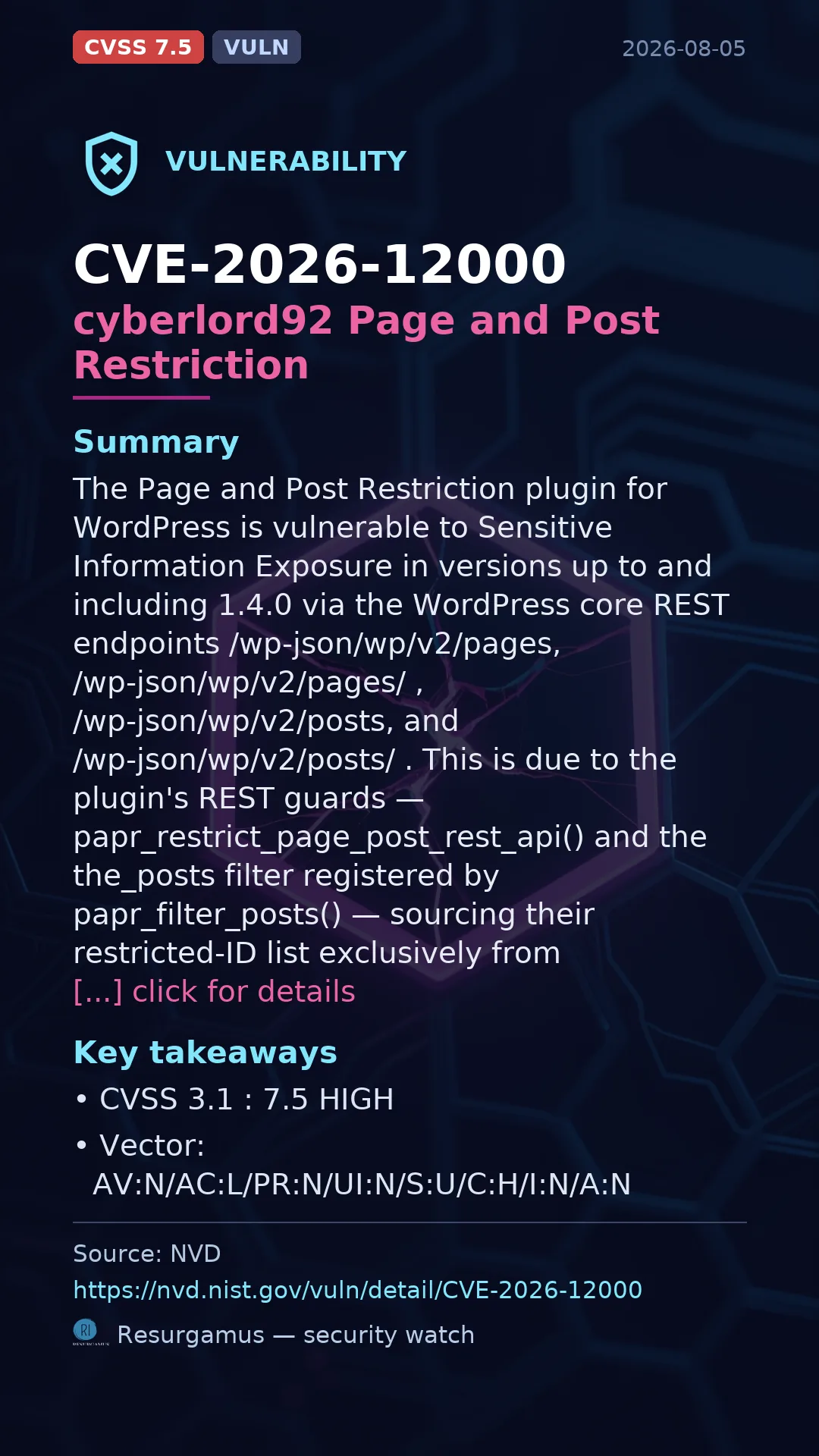
The Page and Post Restriction plugin for WordPress is vulnerable to Sensitive Information Exposure in versions up to and including 1.4.0 via the WordPress core REST endpoints /wp-json/wp/v2/pages, /wp-json/wp/v2/pages/ , /wp-json/wp/v2/posts, and /wp-json/wp/v2/posts/ . This is due to the plugin's REST guards — papr_restrict_page_post_rest_api() and the the_posts filter registered by papr_filter_posts() — sourcing their restricted-ID list exclusively from papr_get_restricted_posts_id(), which only reads the per-page metabox options papr_allowed_redirect_for_pages and papr_allowed_redirect_for_posts and never consults the two global toggles papr_access_for_only_loggedin and papr_access_for_only_loggedin_posts that the plugin's own UI describes as 'Make all Pages Private' / 'Make all Posts Private'. This makes it possible for unauthenticated attackers to read the full rendered content of every published page and post on sites configured with the documented global toggles, bypassing the security boundary enforced on the frontend by papr_restrict_logged_in_users().
No public exploitation has been reported so far. No distribution fix is listed yet; apply vendor mitigations and monitor.
Recommended action: Track your distribution's security tracker and apply the fix as soon as it ships.
Severity metrics
CVSS 3.1 : 7.5 HIGH
Vector: AV:N/AC:L/PR:N/UI:N/S:U/C:H/I:N/A:N
Affected & fixed versions by distribution
Versions are the native distribution strings (backport-aware): RHEL/Debian/SUSE backport fixes, so compare with the distro version comparator (dpkg / rpm / vercmp), not the upstream version.
No affected package in the tracked watchlist yet (Debian, Ubuntu, Arch, SUSE, Red Hat...). Triage may still be pending.