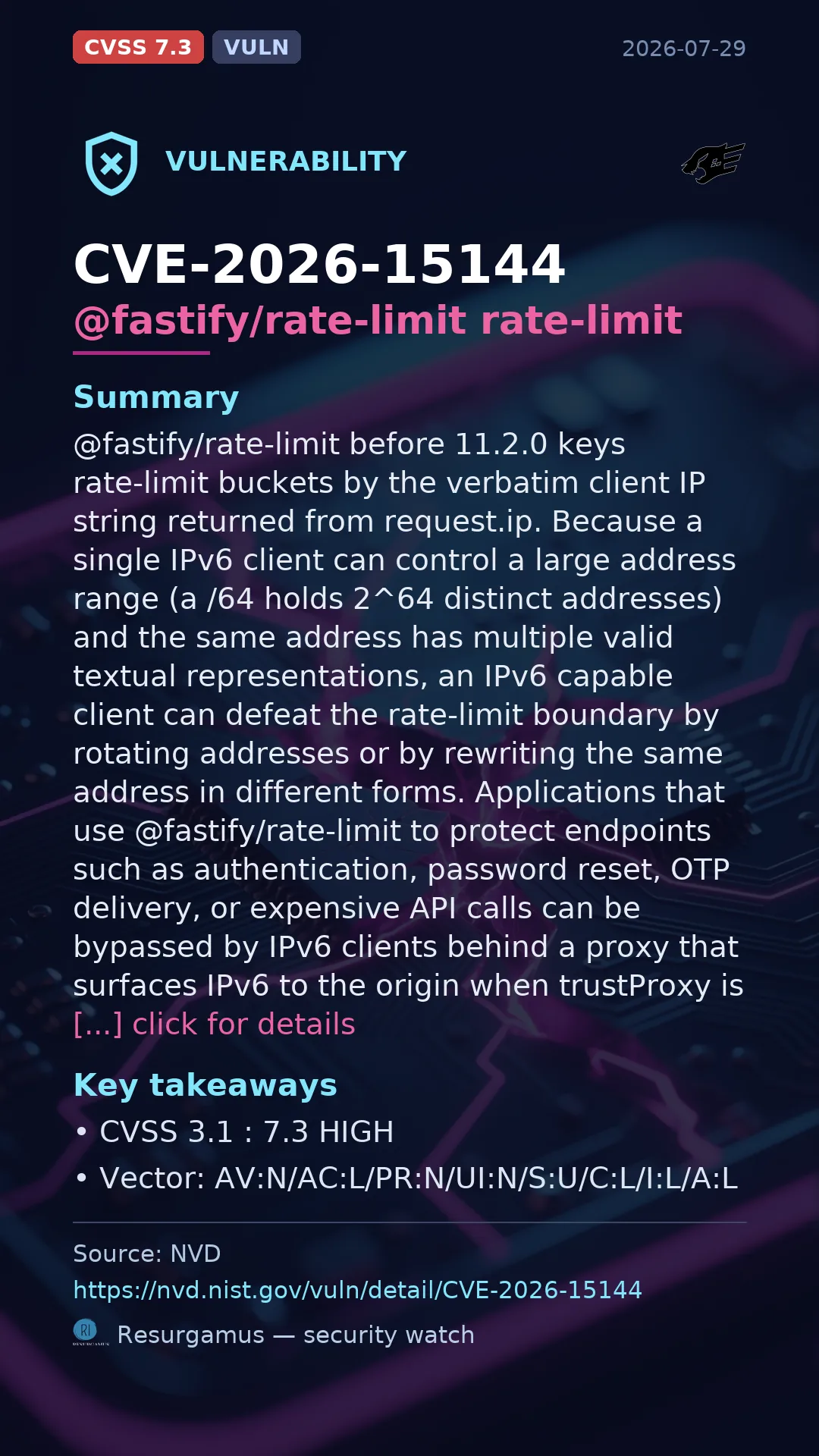
CVE-2026-15144
@fastify/rate-limit before 11.2.0 keys rate-limit buckets by the verbatim client IP string returned from request.ip. Because a single IPv6 client can control a large address range (a /64 holds 2^64 distinct addresses) and the same address has multiple valid textual representations, an IPv6 capable client can defeat the rate-limit boundary by rotating addresses or by rewriting the same address in different forms. Applications that use @fastify/rate-limit to protect endpoints such as authentication, password reset, OTP delivery, or expensive API calls can be bypassed by IPv6 clients behind a proxy that surfaces IPv6 to the origin when trustProxy is enabled. The issue is fixed in @fastify/rate-limit 11.2.0, where the default key generator normalizes IPv6 addresses to their canonical form, collapses IPv4 mapped IPv6 to IPv4, and applies a configurable prefix mask (default /64) via a new ipv6Subnet option.
No public exploitation has been reported so far. No distribution fix is listed yet; apply vendor mitigations and monitor.
Recommended action: Track your distribution's security tracker and apply the fix as soon as it ships.
Severity metrics
CVSS 3.1 : 7.3 HIGH
Vector: AV:N/AC:L/PR:N/UI:N/S:U/C:L/I:L/A:L
Affected & fixed versions by distribution
Versions are the native distribution strings (backport-aware): RHEL/Debian/SUSE backport fixes, so compare with the distro version comparator (dpkg / rpm / vercmp), not the upstream version.
No affected package in the tracked watchlist yet (Debian, Ubuntu, Arch, SUSE, Red Hat...). Triage may still be pending.