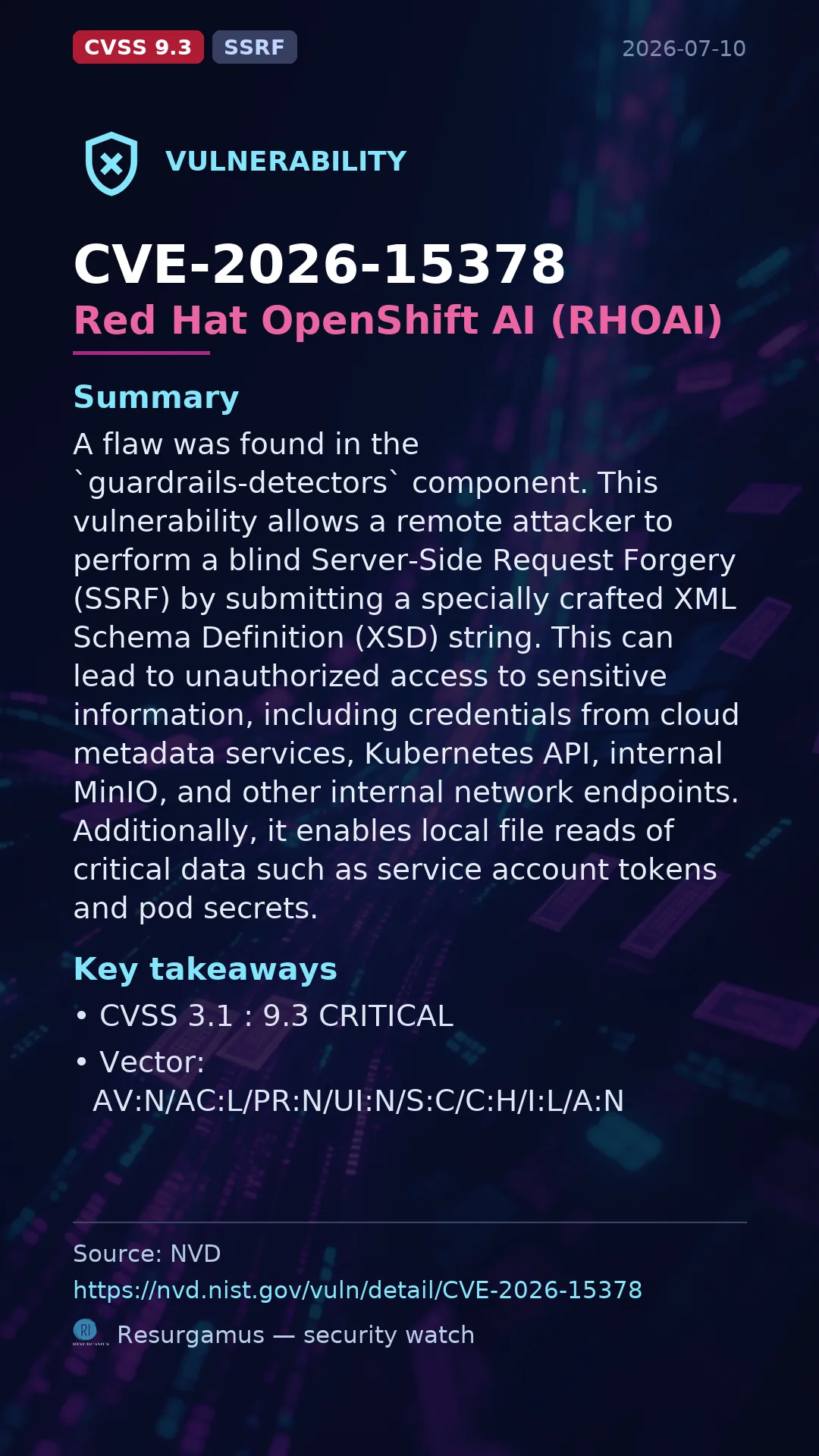
CVE-2026-15378
A flaw was found in the `guardrails-detectors` component. This vulnerability allows a remote attacker to perform a blind Server-Side Request Forgery (SSRF) by submitting a specially crafted XML Schema Definition (XSD) string. This can lead to unauthorized access to sensitive information, including credentials from cloud metadata services, Kubernetes API, internal MinIO, and other internal network endpoints. Additionally, it enables local file reads of critical data such as service account tokens and pod secrets.
No public exploitation has been reported so far. No distribution fix is listed yet; apply vendor mitigations and monitor.
Recommended action: Track your distribution's security tracker and apply the fix as soon as it ships.
Severity metrics
CVSS 3.1 : 9.3 CRITICAL
Vector: AV:N/AC:L/PR:N/UI:N/S:C/C:H/I:L/A:N
Affected & fixed versions by distribution
Versions are the native distribution strings (backport-aware): RHEL/Debian/SUSE backport fixes, so compare with the distro version comparator (dpkg / rpm / vercmp), not the upstream version.
No affected package in the tracked watchlist yet (Debian, Ubuntu, Arch, SUSE, Red Hat...). Triage may still be pending.