CVE-2026-17347
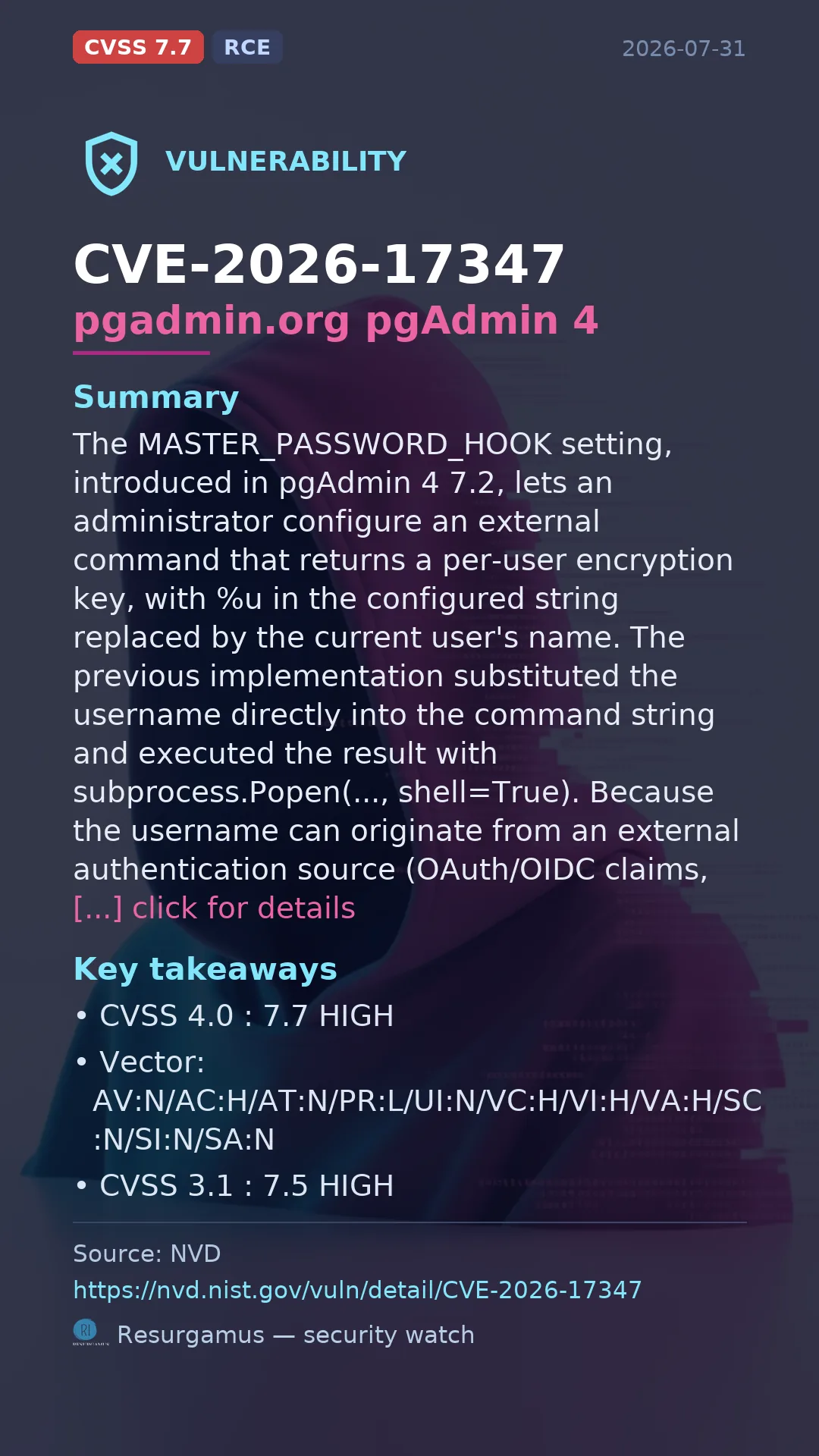
The MASTER_PASSWORD_HOOK setting, introduced in pgAdmin 4 7.2, lets an administrator configure an external command that returns a per-user encryption key, with %u in the configured string replaced by the current user's name. The previous implementation substituted the username directly into the command string and executed the result with subprocess.Popen(..., shell=True). Because the username can originate from an external authentication source (OAuth/OIDC claims, Kerberos, webserver auth) rather than a value pgAdmin fully controls, a username containing shell metacharacters (';', '$()', backticks, pipes, '&&', newlines) allowed an authenticated user to execute arbitrary commands as the pgAdmin service account in any deployment where the configured hook string uses %u. Fix tokenises the trusted, administrator-configured hook string into an argument vector first (using shlex in POSIX-quoting mode, with backslash-escaping disabled so Windows-style paths are not mis-parsed), substitutes the untrusted username into the individual argv elements, and executes with shell=False. The username is therefore always confined to a single argv element; any shell metacharacters it contains are in
No public exploitation has been reported so far. No distribution fix is listed yet; apply vendor mitigations and monitor.
Recommended action: Track your distribution's security tracker and apply the fix as soon as it ships.
Severity metrics
CVSS 4.0 : 7.7 HIGH · CVSS 3.1 : 7.5 HIGH
Vector: AV:N/AC:H/AT:N/PR:L/UI:N/VC:H/VI:H/VA:H/SC:N/SI:N/SA:N
Affected & fixed versions by distribution
Versions are the native distribution strings (backport-aware): RHEL/Debian/SUSE backport fixes, so compare with the distro version comparator (dpkg / rpm / vercmp), not the upstream version.
No affected package in the tracked watchlist yet (Debian, Ubuntu, Arch, SUSE, Red Hat...). Triage may still be pending.