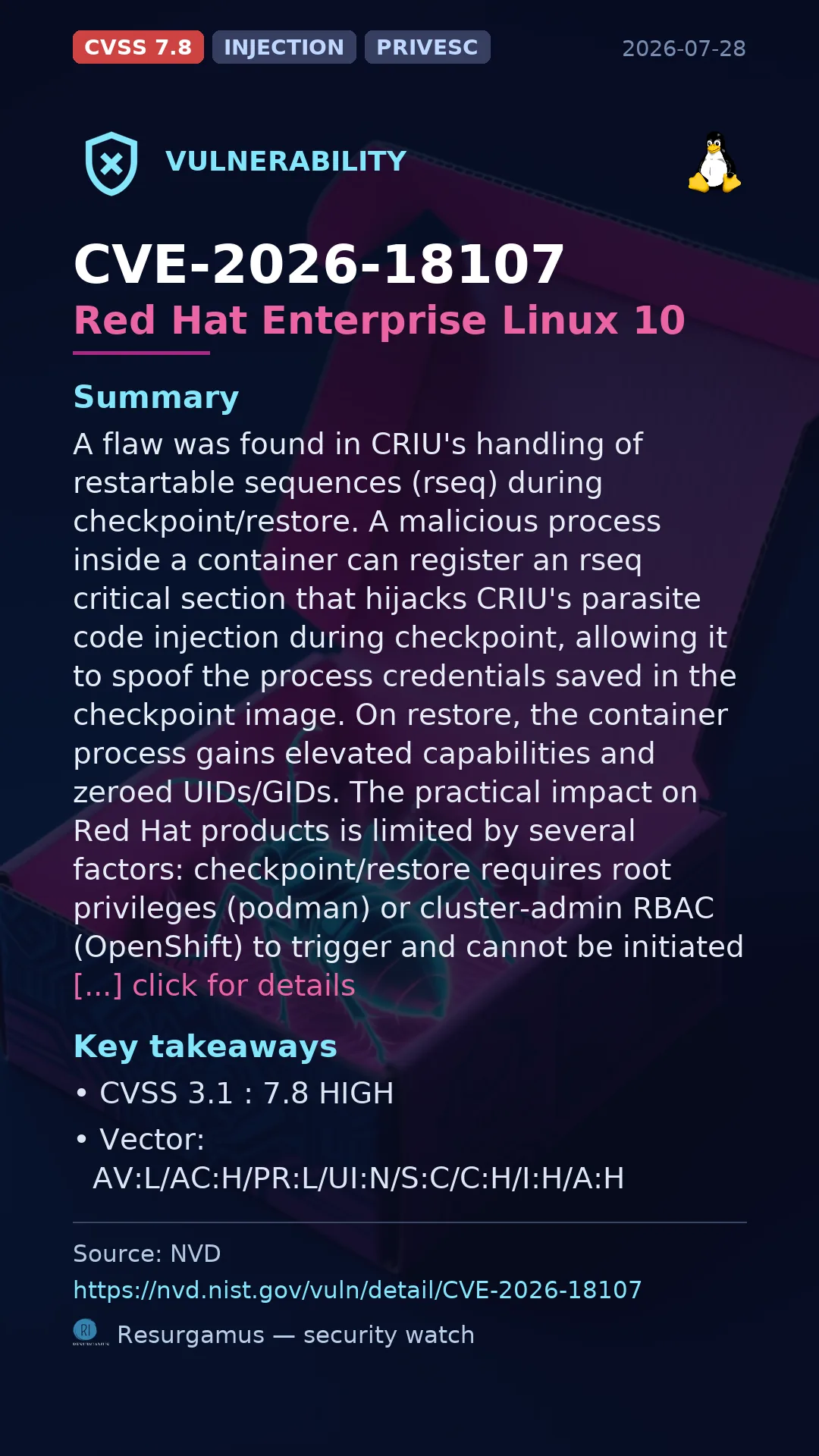
CVE-2026-18107
A flaw was found in CRIU's handling of restartable sequences (rseq) during checkpoint/restore. A malicious process inside a container can register an rseq critical section that hijacks CRIU's parasite code injection during checkpoint, allowing it to spoof the process credentials saved in the checkpoint image. On restore, the container process gains elevated capabilities and zeroed UIDs/GIDs. The practical impact on Red Hat products is limited by several factors: checkpoint/restore requires root privileges (podman) or cluster-admin RBAC (OpenShift) to trigger and cannot be initiated from within the container itself; on OpenShift prior to 4.17 the feature required explicit opt-in, and on 4.17+ the kubelet checkpoint API RBAC is not configured by default; OpenShift enforces user namespaces by default for regular workloads (hostUsers is gated behind admin-only SCCs), which makes the spoofed capabilities namespace-scoped and ineffective for privilege escalation; SELinux type enforcement (container_t) blocks privilege transitions independently of capabilities; seccomp filters persist through checkpoint/restore and cannot be corrupted via the parasite; and kernel mount namespace ownershi
No public exploitation has been reported so far. No distribution fix is listed yet; apply vendor mitigations and monitor.
Recommended action: Track your distribution's security tracker and apply the fix as soon as it ships.
Severity metrics
CVSS 3.1 : 7.8 HIGH
Vector: AV:L/AC:H/PR:L/UI:N/S:C/C:H/I:H/A:H
Affected & fixed versions by distribution
Versions are the native distribution strings (backport-aware): RHEL/Debian/SUSE backport fixes, so compare with the distro version comparator (dpkg / rpm / vercmp), not the upstream version.
No affected package in the tracked watchlist yet (Debian, Ubuntu, Arch, SUSE, Red Hat...). Triage may still be pending.