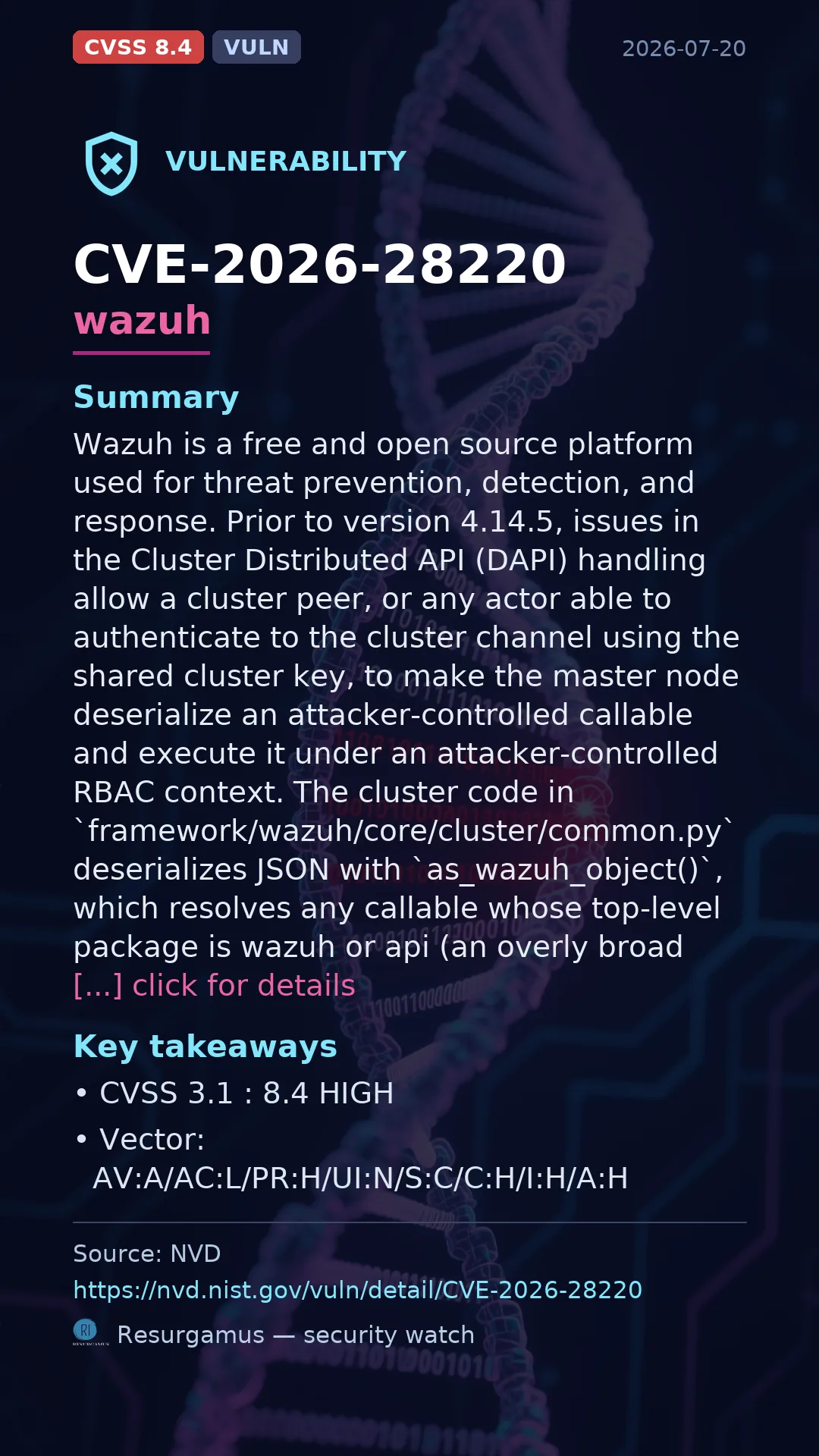
CVE-2026-28220
Wazuh is a free and open source platform used for threat prevention, detection, and response. Prior to version 4.14.5, issues in the Cluster Distributed API (DAPI) handling allow a cluster peer, or any actor able to authenticate to the cluster channel using the shared cluster key, to make the master node deserialize an attacker-controlled callable and execute it under an attacker-controlled RBAC context. The cluster code in `framework/wazuh/core/cluster/common.py` deserializes JSON with `as_wazuh_object()`, which resolves any callable whose top-level package is wazuh or api (an overly broad allowlist controlled only by `ALLOWED_CALLABLES_PACKAGES`), and DAPI requests handled in framework/wazuh/core/cluster/dapi/dapi.py accept a client-supplied rbac_permissions value that `run_local()` applies as the global RBAC context, so supplying an rbac_mode of black causes authorization checks for expose_resources-protected functions to pass without any legitimate permission assignment. Combined, these allow privileged administrative actions on the master node such as arbitrary file writes under WAZUH_PATH, creation of new API users, and tampering with security.yaml, and can be chained into fu
No public exploitation has been reported so far. No distribution fix is listed yet; apply vendor mitigations and monitor.
Recommended action: Track your distribution's security tracker and apply the fix as soon as it ships.
Severity metrics
CVSS 3.1 : 8.4 HIGH
Vector: AV:A/AC:L/PR:H/UI:N/S:C/C:H/I:H/A:H
Affected & fixed versions by distribution
Versions are the native distribution strings (backport-aware): RHEL/Debian/SUSE backport fixes, so compare with the distro version comparator (dpkg / rpm / vercmp), not the upstream version.
No affected package in the tracked watchlist yet (Debian, Ubuntu, Arch, SUSE, Red Hat...). Triage may still be pending.