CVE-2026-44436
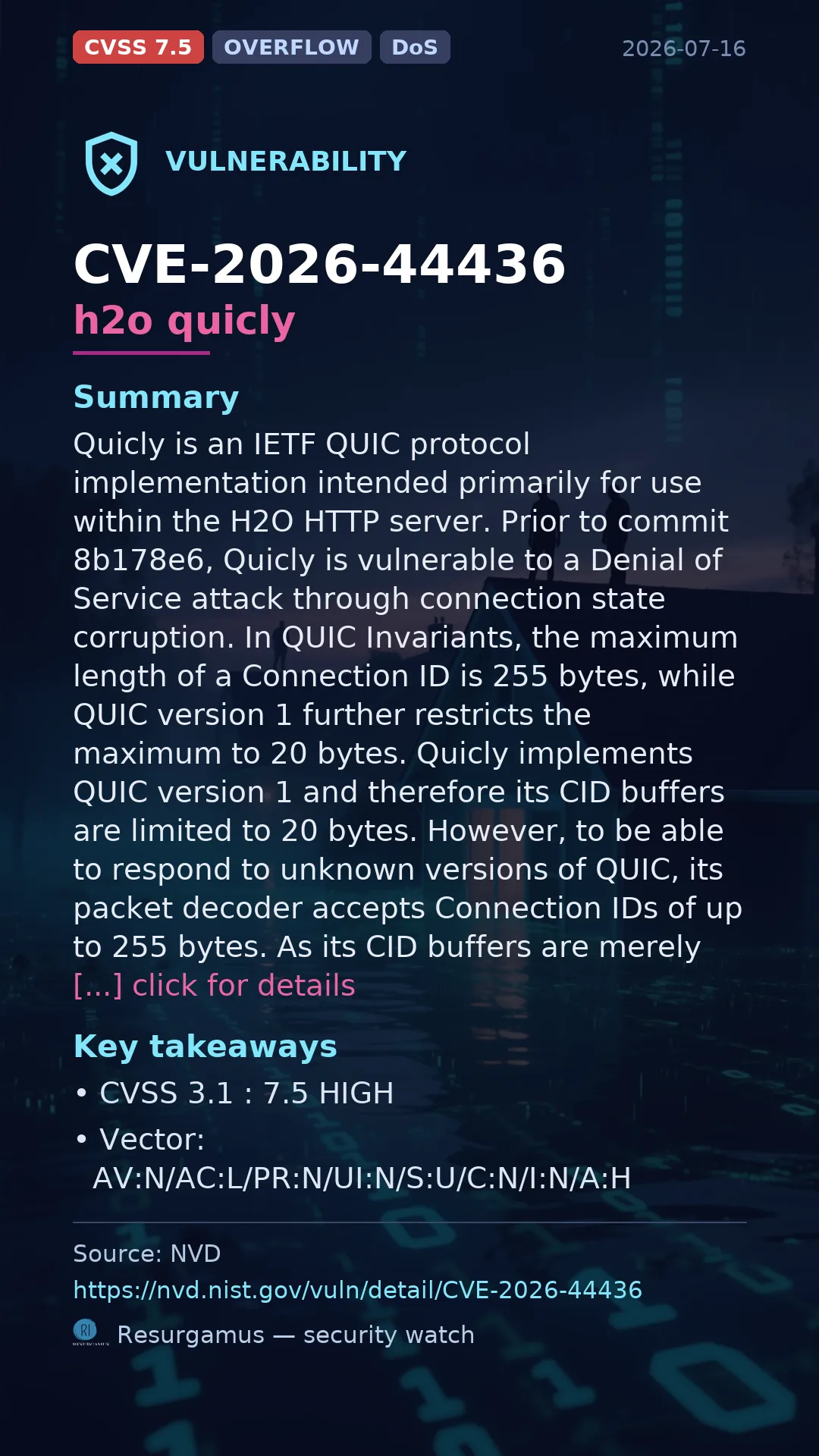
Quicly is an IETF QUIC protocol implementation intended primarily for use within the H2O HTTP server. Prior to commit 8b178e6, Quicly is vulnerable to a Denial of Service attack through connection state corruption. In QUIC Invariants, the maximum length of a Connection ID is 255 bytes, while QUIC version 1 further restricts the maximum to 20 bytes. Quicly implements QUIC version 1 and therefore its CID buffers are limited to 20 bytes. However, to be able to respond to unknown versions of QUIC, its packet decoder accepts Connection IDs of up to 255 bytes. As its CID buffers are merely 20 bytes long, Quicly must reject QUIC version 1 packets with Connection IDs longer than that. The command line tool bundled with Quicly has had that check, however the library itself lacked such enforcement. As a consequence, when used by applications that lack their own enforcement, the connection state becoming inconsistent to buffer overrun. Fortunately, the overflow stops within the allocated chunk of memory, but nevertheless, the bug leads to assertion failures. This issue has been fixed by commit 8b178e6.
No public exploitation has been reported so far. No distribution fix is listed yet; apply vendor mitigations and monitor.
Recommended action: Track your distribution's security tracker and apply the fix as soon as it ships.
Severity metrics
CVSS 3.1 : 7.5 HIGH
Vector: AV:N/AC:L/PR:N/UI:N/S:U/C:N/I:N/A:H
Affected & fixed versions by distribution
Versions are the native distribution strings (backport-aware): RHEL/Debian/SUSE backport fixes, so compare with the distro version comparator (dpkg / rpm / vercmp), not the upstream version.
No affected package in the tracked watchlist yet (Debian, Ubuntu, Arch, SUSE, Red Hat...). Triage may still be pending.