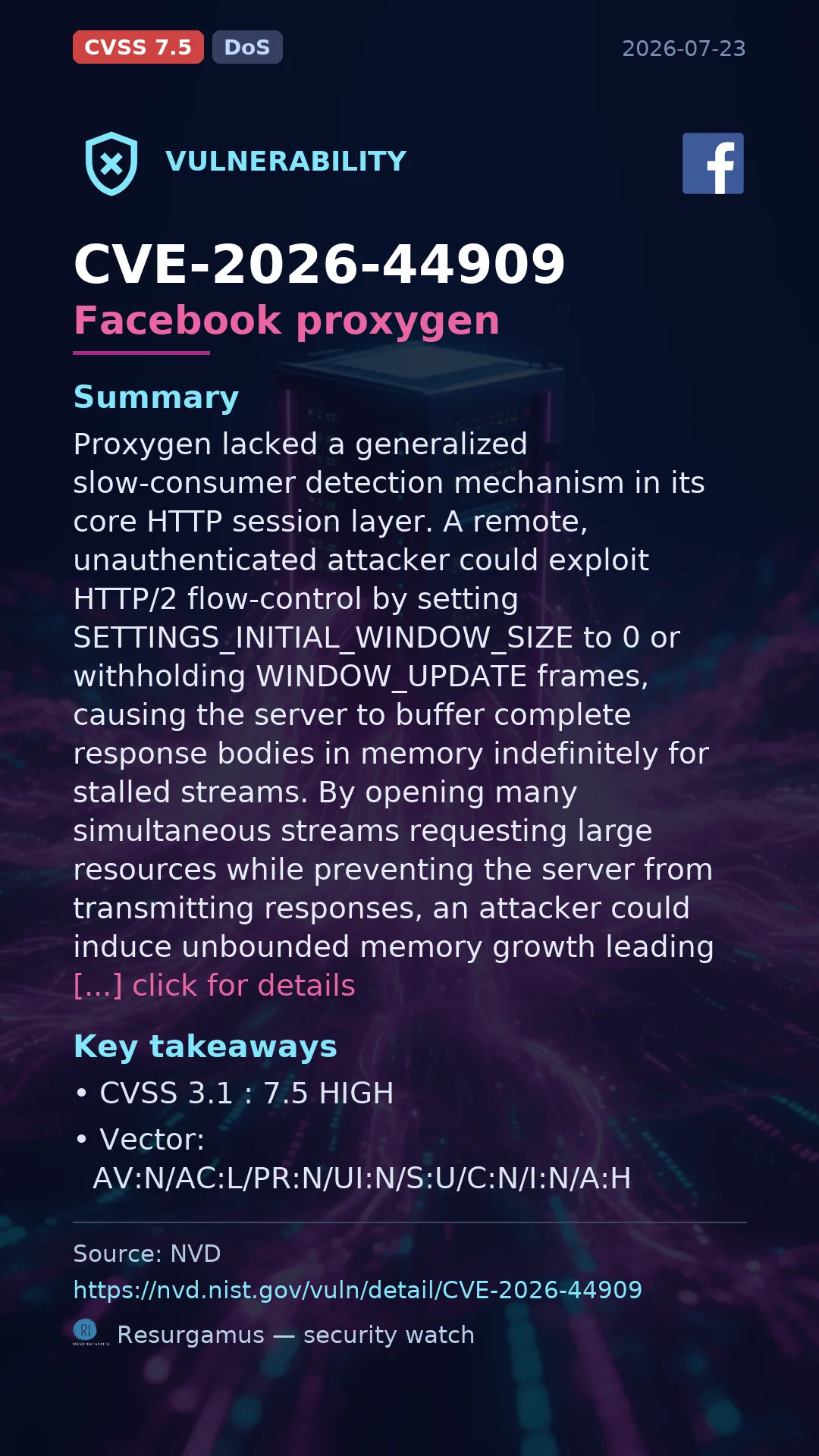
CVE-2026-44909
Proxygen lacked a generalized slow-consumer detection mechanism in its core HTTP session layer. A remote, unauthenticated attacker could exploit HTTP/2 flow-control by setting SETTINGS_INITIAL_WINDOW_SIZE to 0 or withholding WINDOW_UPDATE frames, causing the server to buffer complete response bodies in memory indefinitely for stalled streams. By opening many simultaneous streams requesting large resources while preventing the server from transmitting responses, an attacker could induce unbounded memory growth leading to service degradation, resource exhaustion, or denial of service. Versions v2017.01.16.00 through v2026.07.20.00 are affected.
No public exploitation has been reported so far. No distribution fix is listed yet; apply vendor mitigations and monitor.
Recommended action: Track your distribution's security tracker and apply the fix as soon as it ships.
Severity metrics
CVSS 3.1 : 7.5 HIGH
Vector: AV:N/AC:L/PR:N/UI:N/S:U/C:N/I:N/A:H
Affected & fixed versions by distribution
Versions are the native distribution strings (backport-aware): RHEL/Debian/SUSE backport fixes, so compare with the distro version comparator (dpkg / rpm / vercmp), not the upstream version.
No affected package in the tracked watchlist yet (Debian, Ubuntu, Arch, SUSE, Red Hat...). Triage may still be pending.