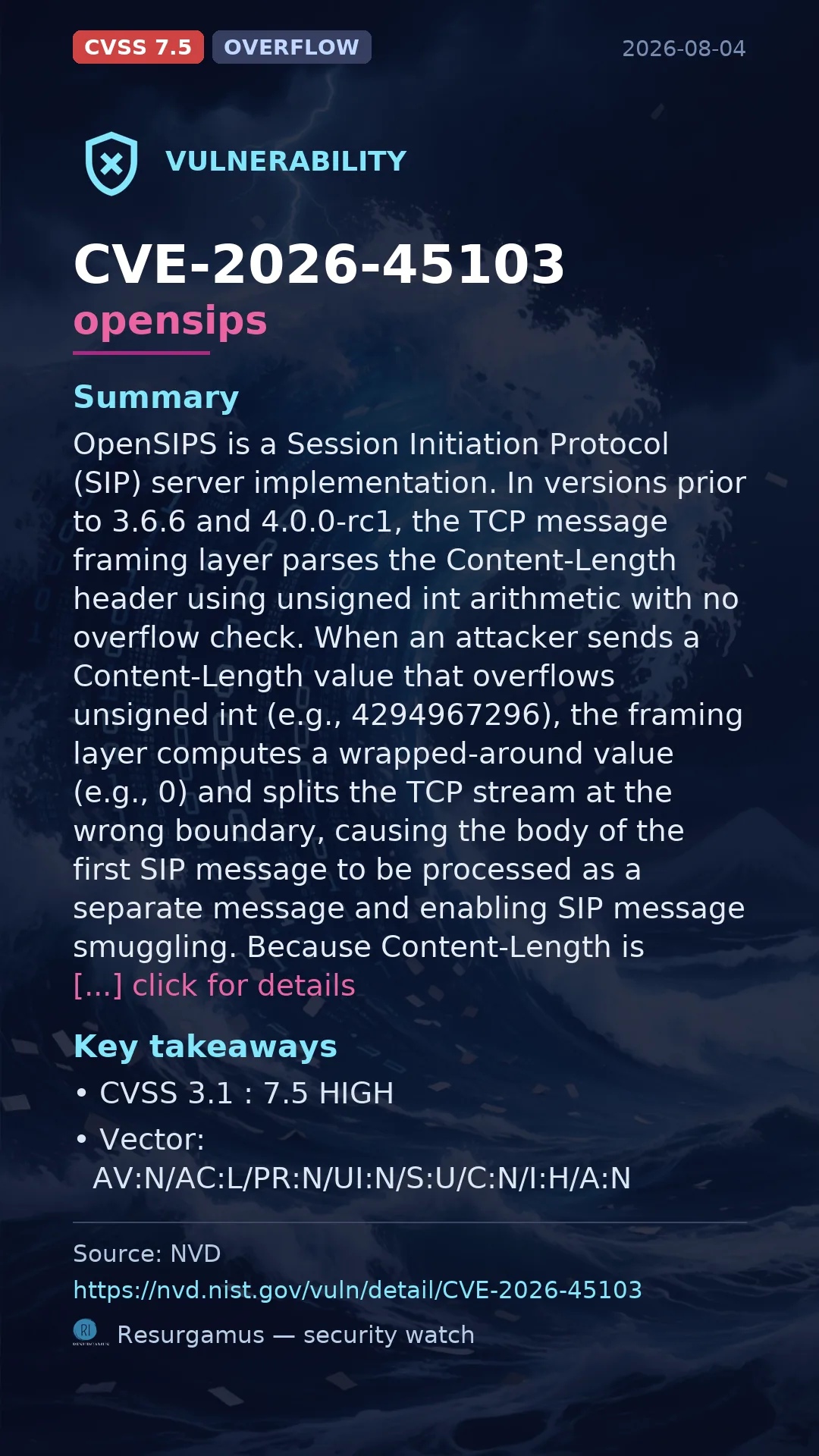
CVE-2026-45103
OpenSIPS is a Session Initiation Protocol (SIP) server implementation. In versions prior to 3.6.6 and 4.0.0-rc1, the TCP message framing layer parses the Content-Length header using unsigned int arithmetic with no overflow check. When an attacker sends a Content-Length value that overflows unsigned int (e.g., 4294967296), the framing layer computes a wrapped-around value (e.g., 0) and splits the TCP stream at the wrong boundary, causing the body of the first SIP message to be processed as a separate message and enabling SIP message smuggling. Because Content-Length is parsed in the transport layer before authentication, an unauthenticated, network-based attacker can smuggle arbitrary SIP messages over any TCP-based transport (proto_tcp, proto_tls, proto_ws, proto_wss) on any instance with TCP enabled, with no routing-script preconditions. This allows smuggled messages to bypass front-end SBC/proxy security policies, inherit the connection's authentication context, and evade rate limiting. This issue has been fixed in versions 3.6.6 and 4.0.0-rc1.
No public exploitation has been reported so far. No distribution fix is listed yet; apply vendor mitigations and monitor.
Recommended action: Track your distribution's security tracker and apply the fix as soon as it ships.
Severity metrics
CVSS 3.1 : 7.5 HIGH
Vector: AV:N/AC:L/PR:N/UI:N/S:U/C:N/I:H/A:N
Affected & fixed versions by distribution
Versions are the native distribution strings (backport-aware): RHEL/Debian/SUSE backport fixes, so compare with the distro version comparator (dpkg / rpm / vercmp), not the upstream version.
No affected package in the tracked watchlist yet (Debian, Ubuntu, Arch, SUSE, Red Hat...). Triage may still be pending.