CVE-2026-47731
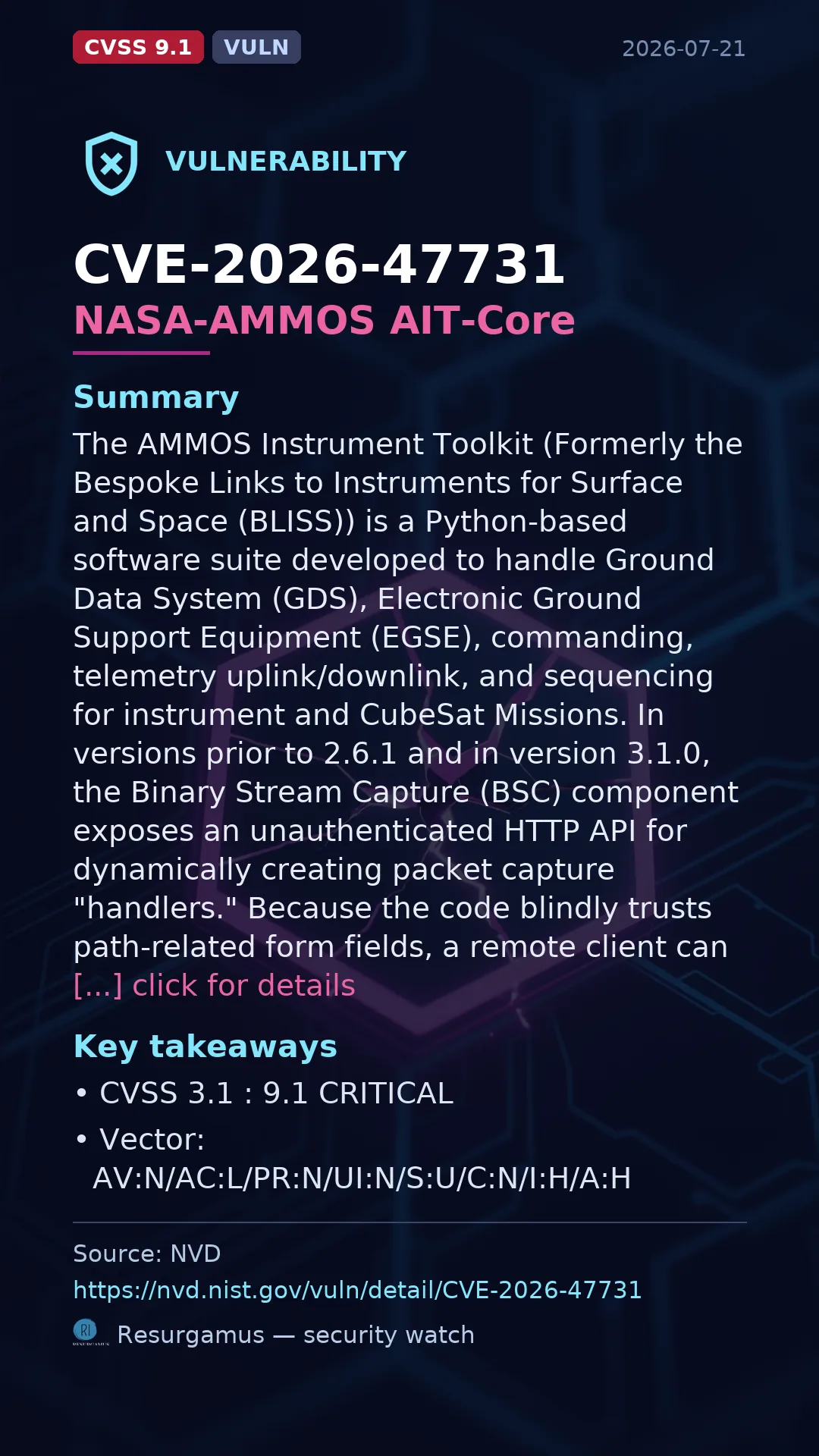
The AMMOS Instrument Toolkit (Formerly the Bespoke Links to Instruments for Surface and Space (BLISS)) is a Python-based software suite developed to handle Ground Data System (GDS), Electronic Ground Support Equipment (EGSE), commanding, telemetry uplink/downlink, and sequencing for instrument and CubeSat Missions. In versions prior to 2.6.1 and in version 3.1.0, the Binary Stream Capture (BSC) component exposes an unauthenticated HTTP API for dynamically creating packet capture "handlers." Because the code blindly trusts path‑related form fields, a remote client can bypass the configured log root and direct BSC to log to arbitrary filesystem paths (path traversal / directory escape), and append attacker‑controlled data to those files, using the privileges of the`ait-bsc` process. There are two ways for a remote attacker to trigger this. First, if the attacker has access to the network where `ait-bsc` is deployed (a reason for that could be that the ports are publicly accessible), the payloads can be directly sent to the server to trigger the arbitrary file append. This type of attack is demonstrated in `python_poc.py`. Second, even if the attacker does not have direct access to th
No public exploitation has been reported so far. No distribution fix is listed yet; apply vendor mitigations and monitor.
Recommended action: Track your distribution's security tracker and apply the fix as soon as it ships.
Severity metrics
CVSS 3.1 : 9.1 CRITICAL
Vector: AV:N/AC:L/PR:N/UI:N/S:U/C:N/I:H/A:H
Affected & fixed versions by distribution
Versions are the native distribution strings (backport-aware): RHEL/Debian/SUSE backport fixes, so compare with the distro version comparator (dpkg / rpm / vercmp), not the upstream version.
No affected package in the tracked watchlist yet (Debian, Ubuntu, Arch, SUSE, Red Hat...). Triage may still be pending.