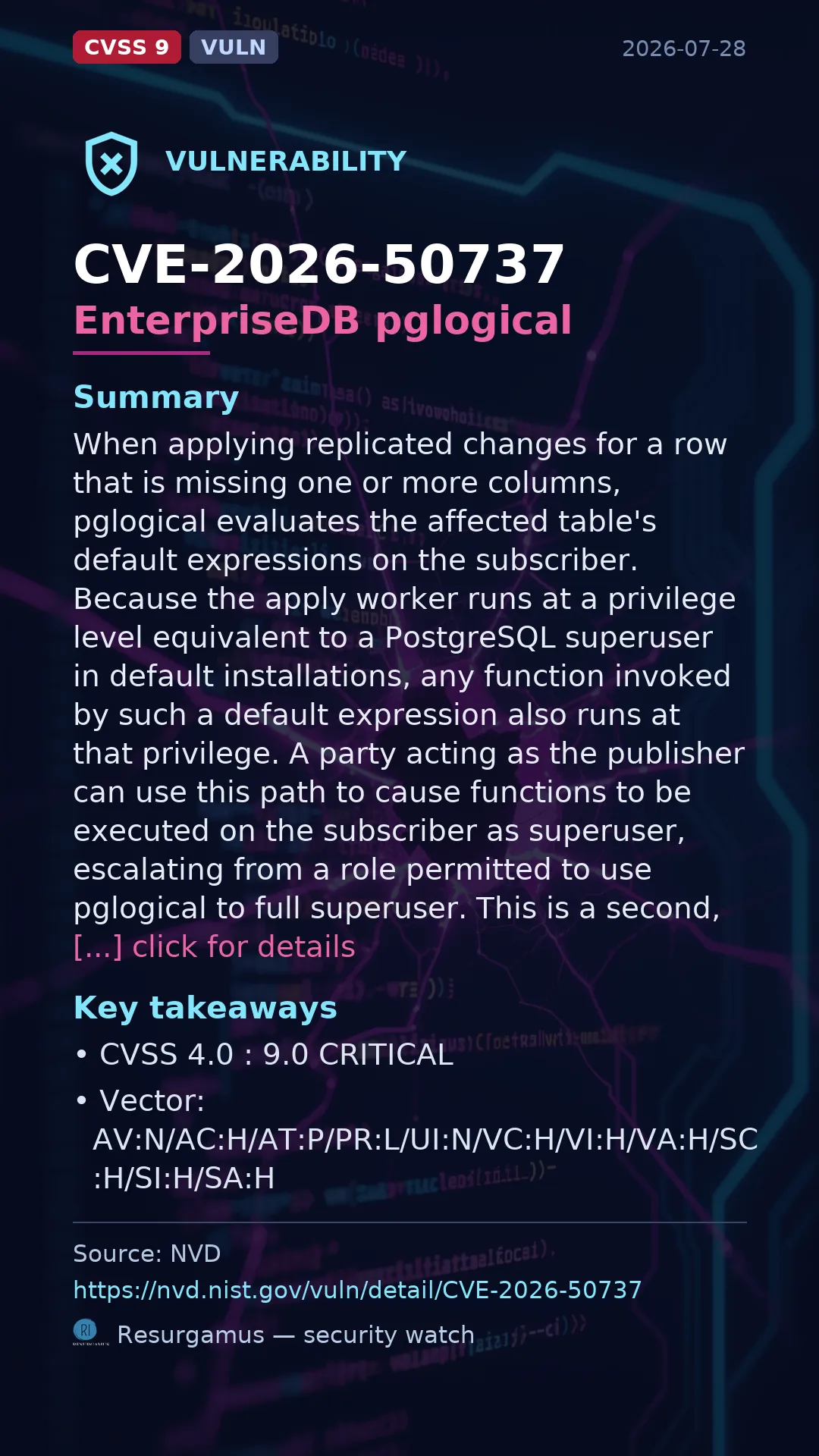
CVE-2026-50737
When applying replicated changes for a row that is missing one or more columns, pglogical evaluates the affected table's default expressions on the subscriber. Because the apply worker runs at a privilege level equivalent to a PostgreSQL superuser in default installations, any function invoked by such a default expression also runs at that privilege. A party acting as the publisher can use this path to cause functions to be executed on the subscriber as superuser, escalating from a role permitted to use pglogical to full superuser. This is a second, independent path to the same superuser escalation tracked under CVE-2026-50736 (the pglogical queue issue). To exploit the issue an attacker must be able to direct a subscription at an endpoint they control. In default installations this requires privileges normally reserved for a superuser, so the issue is most relevant to managed deployments where the ability to create subscriptions has been delegated to non-superuser roles.
No public exploitation has been reported so far. No distribution fix is listed yet; apply vendor mitigations and monitor.
Recommended action: Track your distribution's security tracker and apply the fix as soon as it ships.
Severity metrics
CVSS 4.0 : 9.0 CRITICAL
Vector: AV:N/AC:H/AT:P/PR:L/UI:N/VC:H/VI:H/VA:H/SC:H/SI:H/SA:H
Affected & fixed versions by distribution
Versions are the native distribution strings (backport-aware): RHEL/Debian/SUSE backport fixes, so compare with the distro version comparator (dpkg / rpm / vercmp), not the upstream version.
No affected package in the tracked watchlist yet (Debian, Ubuntu, Arch, SUSE, Red Hat...). Triage may still be pending.