CVE-2026-51603
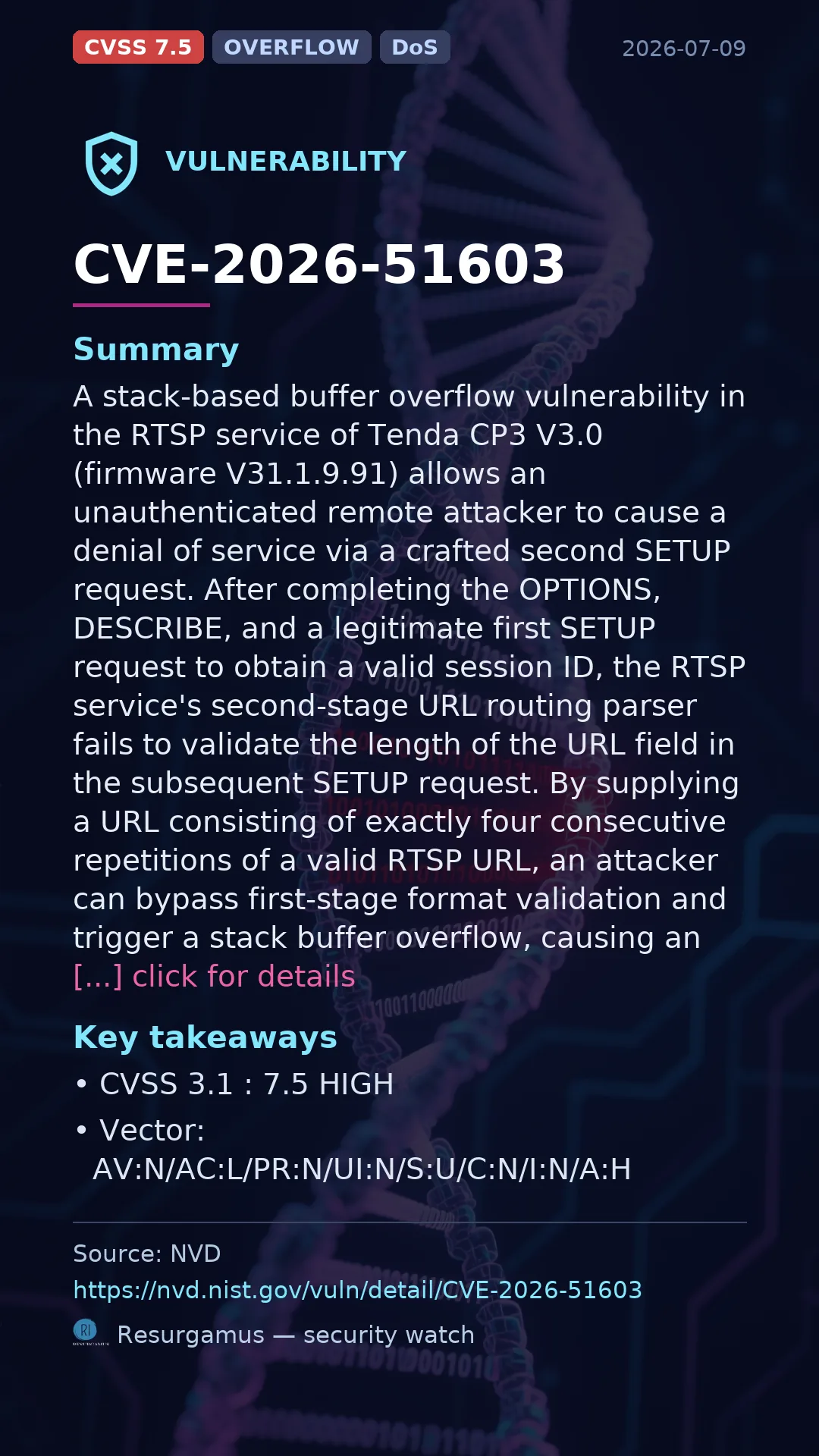
A stack-based buffer overflow vulnerability in the RTSP service of Tenda CP3 V3.0 (firmware V31.1.9.91) allows an unauthenticated remote attacker to cause a denial of service via a crafted second SETUP request. After completing the OPTIONS, DESCRIBE, and a legitimate first SETUP request to obtain a valid session ID, the RTSP service's second-stage URL routing parser fails to validate the length of the URL field in the subsequent SETUP request. By supplying a URL consisting of exactly four consecutive repetitions of a valid RTSP URL, an attacker can bypass first-stage format validation and trigger a stack buffer overflow, causing an immediate crash of the RTSP service process and rendering the device inaccessible to all clients on the local network.
No public exploitation has been reported so far. No distribution fix is listed yet; apply vendor mitigations and monitor.
Recommended action: Track your distribution's security tracker and apply the fix as soon as it ships.
Severity metrics
CVSS 3.1 : 7.5 HIGH
Vector: AV:N/AC:L/PR:N/UI:N/S:U/C:N/I:N/A:H
Affected & fixed versions by distribution
Versions are the native distribution strings (backport-aware): RHEL/Debian/SUSE backport fixes, so compare with the distro version comparator (dpkg / rpm / vercmp), not the upstream version.
No affected package in the tracked watchlist yet (Debian, Ubuntu, Arch, SUSE, Red Hat...). Triage may still be pending.