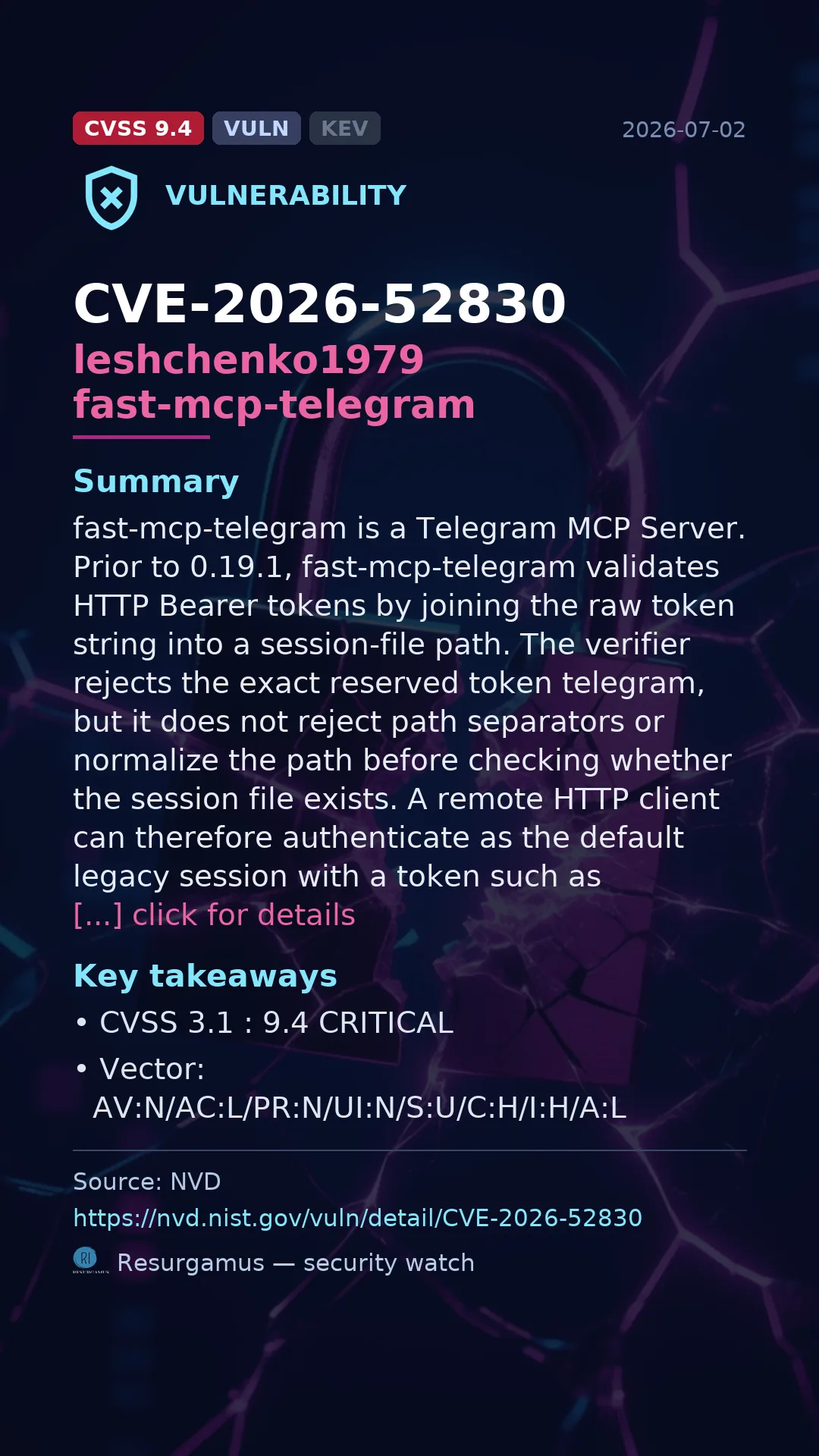
CVE-2026-52830
fast-mcp-telegram is a Telegram MCP Server. Prior to 0.19.1, fast-mcp-telegram validates HTTP Bearer tokens by joining the raw token string into a session-file path. The verifier rejects the exact reserved token telegram, but it does not reject path separators or normalize the path before checking whether the session file exists. A remote HTTP client can therefore authenticate as the default legacy session with a token such as ../fast-mcp-telegram/telegram when the documented default session file ~/.config/fast-mcp-telegram/telegram.session exists. This bypasses the reserved session name control that is intended to prevent HTTP multi-user sessions from colliding with the default stdio or legacy account. With account-prefixed MCP tools enabled, the attacker still sees and calls the prefixed tools for the default account, so the prefix middleware does not stop the session selection bypass. This vulnerability is fixed in 0.19.1.
No public exploitation has been reported so far. No distribution fix is listed yet; apply vendor mitigations and monitor.
Recommended action: Track your distribution's security tracker and apply the fix as soon as it ships.
Severity metrics
CVSS 3.1 : 9.4 CRITICAL
Vector: AV:N/AC:L/PR:N/UI:N/S:U/C:H/I:H/A:L
Affected & fixed versions by distribution
Versions are the native distribution strings (backport-aware): RHEL/Debian/SUSE backport fixes, so compare with the distro version comparator (dpkg / rpm / vercmp), not the upstream version.
No affected package in the tracked watchlist yet (Debian, Ubuntu, Arch, SUSE, Red Hat...). Triage may still be pending.