CVE-2026-53431
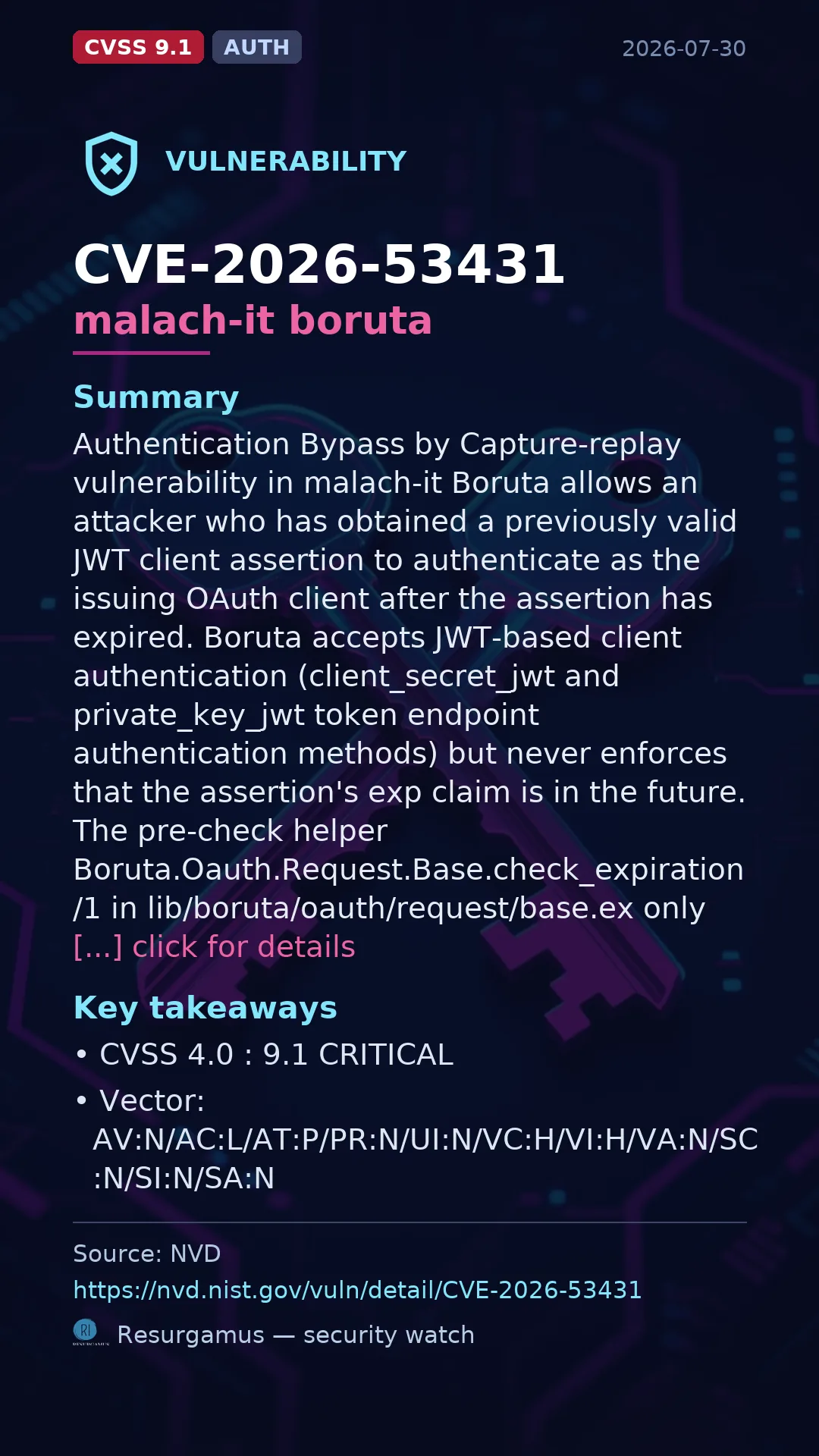
Authentication Bypass by Capture-replay vulnerability in malach-it Boruta allows an attacker who has obtained a previously valid JWT client assertion to authenticate as the issuing OAuth client after the assertion has expired. Boruta accepts JWT-based client authentication (client_secret_jwt and private_key_jwt token endpoint authentication methods) but never enforces that the assertion's exp claim is in the future. The pre-check helper Boruta.Oauth.Request.Base.check_expiration/1 in lib/boruta/oauth/request/base.ex only verifies that an exp claim is present (it pattern-matches on the existence of the key and returns success), and the Joken token configuration used for signature verification, Boruta.Oauth.Authorization.Client.Token.token_config/0 in lib/boruta/oauth/authorization/client.ex, returns an empty map, so Joken's default exp claim validator is not engaged either. Any attacker who obtains a validly-signed client assertion (for example through logs, reverse proxies, browser tooling, or other observability surfaces) can replay it indefinitely to authenticate as the client and obtain access tokens with that client's privileges. This issue affects boruta: from 2.3.0 before 2
No public exploitation has been reported so far. No distribution fix is listed yet; apply vendor mitigations and monitor.
Recommended action: Track your distribution's security tracker and apply the fix as soon as it ships.
Severity metrics
CVSS 4.0 : 9.1 CRITICAL
Vector: AV:N/AC:L/AT:P/PR:N/UI:N/VC:H/VI:H/VA:N/SC:N/SI:N/SA:N
Affected & fixed versions by distribution
Versions are the native distribution strings (backport-aware): RHEL/Debian/SUSE backport fixes, so compare with the distro version comparator (dpkg / rpm / vercmp), not the upstream version.
No affected package in the tracked watchlist yet (Debian, Ubuntu, Arch, SUSE, Red Hat...). Triage may still be pending.