CVE-2026-54695
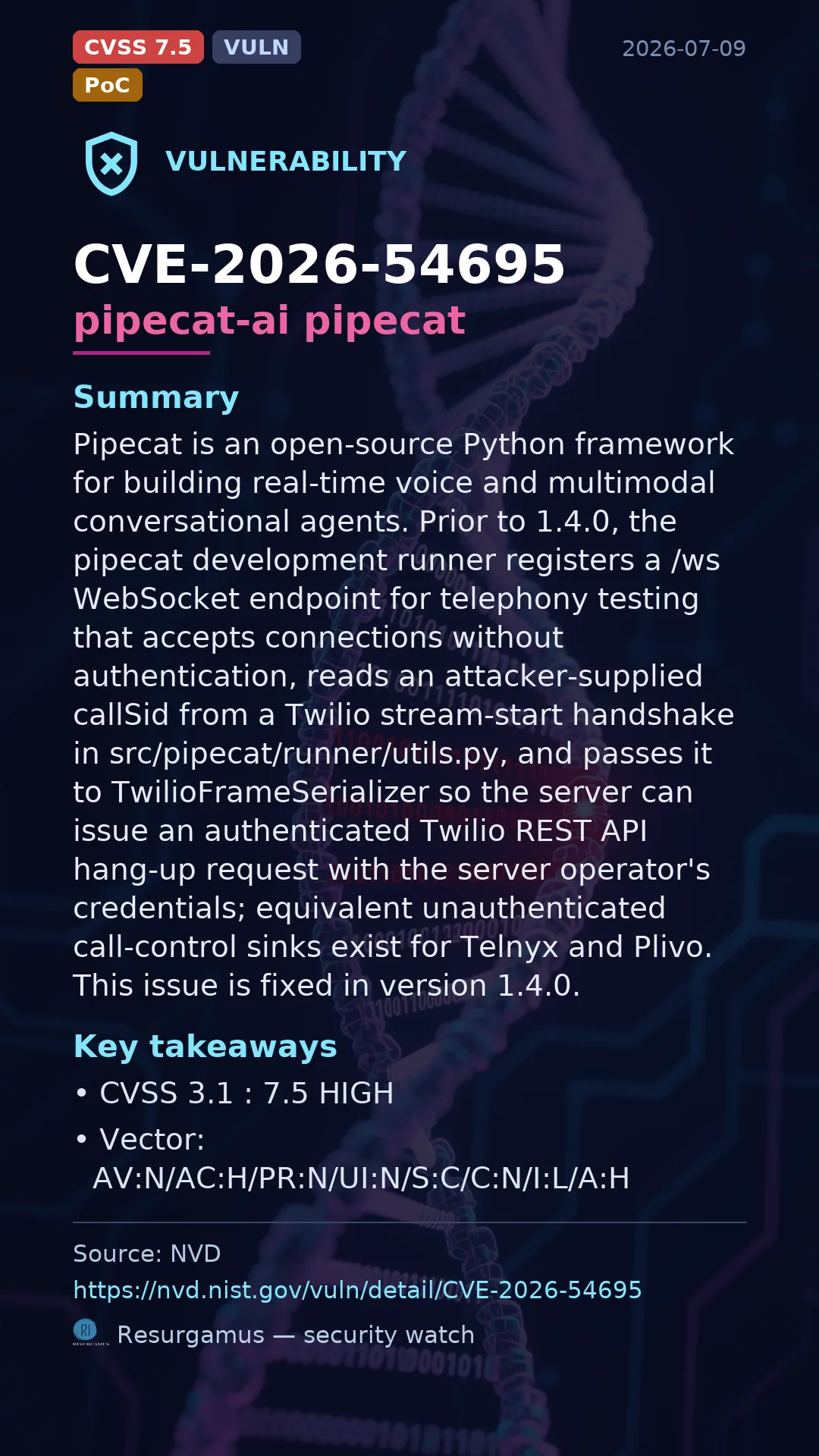
Pipecat is an open-source Python framework for building real-time voice and multimodal conversational agents. Prior to 1.4.0, the pipecat development runner registers a /ws WebSocket endpoint for telephony testing that accepts connections without authentication, reads an attacker-supplied callSid from a Twilio stream-start handshake in src/pipecat/runner/utils.py, and passes it to TwilioFrameSerializer so the server can issue an authenticated Twilio REST API hang-up request with the server operator's credentials; equivalent unauthenticated call-control sinks exist for Telnyx and Plivo. This issue is fixed in version 1.4.0.
A public proof-of-concept or exploit code is available, raising the risk of active exploitation. No distribution fix is listed yet; apply vendor mitigations and monitor.
Recommended action: Track your distribution's security tracker and apply the fix as soon as it ships.
Severity metrics
CVSS 3.1 : 7.5 HIGH
Vector: AV:N/AC:H/PR:N/UI:N/S:C/C:N/I:L/A:H
Affected & fixed versions by distribution
Versions are the native distribution strings (backport-aware): RHEL/Debian/SUSE backport fixes, so compare with the distro version comparator (dpkg / rpm / vercmp), not the upstream version.
No affected package in the tracked watchlist yet (Debian, Ubuntu, Arch, SUSE, Red Hat...). Triage may still be pending.