CVE-2026-55994
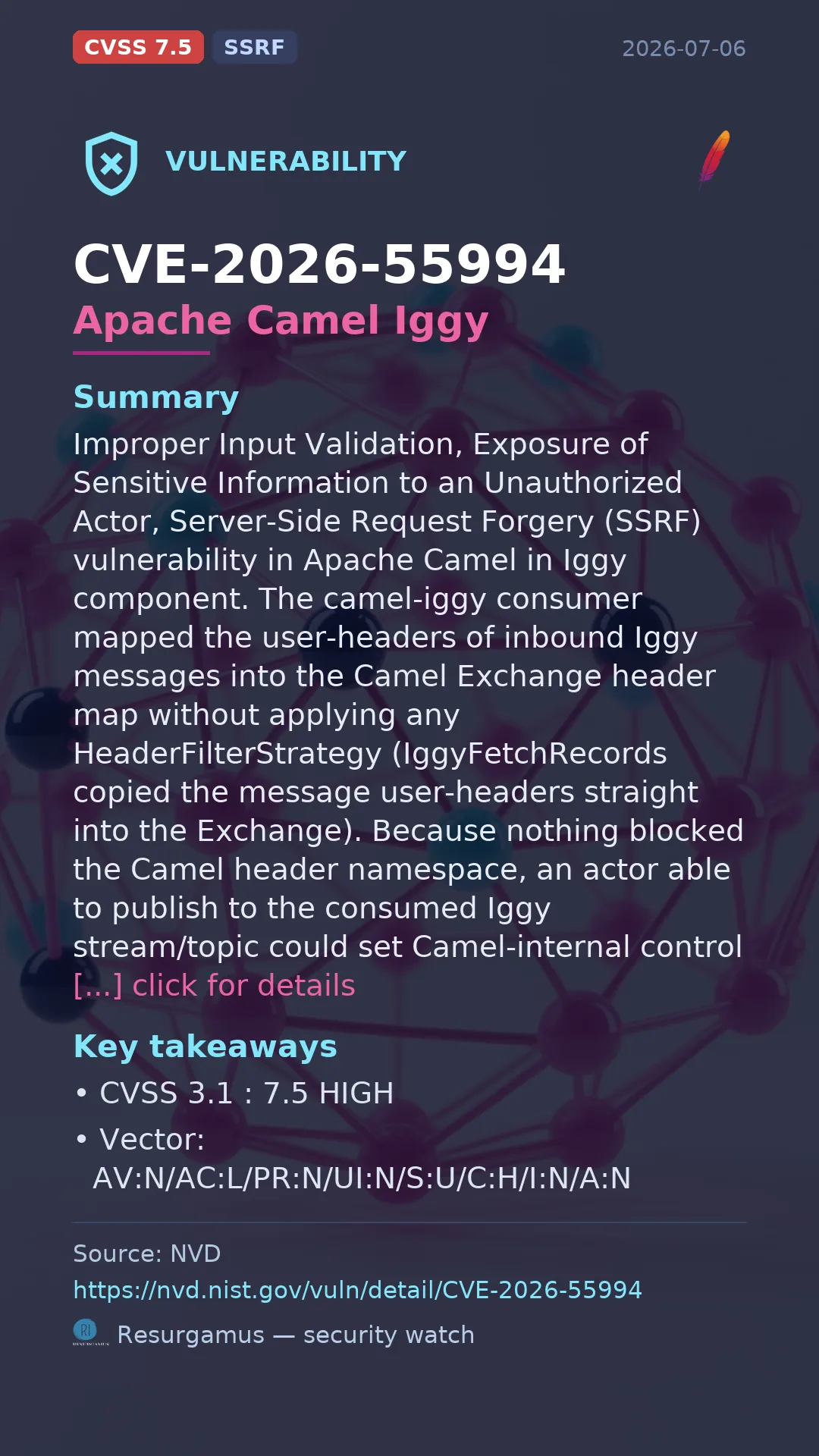
Improper Input Validation, Exposure of Sensitive Information to an Unauthorized Actor, Server-Side Request Forgery (SSRF) vulnerability in Apache Camel in Iggy component. The camel-iggy consumer mapped the user-headers of inbound Iggy messages into the Camel Exchange header map without applying any HeaderFilterStrategy (IggyFetchRecords copied the message user-headers straight into the Exchange). Because nothing blocked the Camel header namespace, an actor able to publish to the consumed Iggy stream/topic could set Camel-internal control headers - including CamelHttpUri (Exchange.HTTP_URI) - simply by supplying them as message user-headers. In a route where the Iggy consumer feeds a downstream HTTP producer, the injected CamelHttpUri redirects the server-side HTTP request to an attacker-chosen destination (server-side request forgery - for example to an internal service or a cloud metadata endpoint). In addition, the HTTP producer resolves Camel property placeholders on the resulting (attacker-controlled) URI, so placeholders embedded in the injected value - such as an environment-variable reference, an application property, or a vault reference - are resolved to their real values
No public exploitation has been reported so far. No distribution fix is listed yet; apply vendor mitigations and monitor.
Recommended action: Track your distribution's security tracker and apply the fix as soon as it ships.
Severity metrics
CVSS 3.1 : 7.5 HIGH
Vector: AV:N/AC:L/PR:N/UI:N/S:U/C:H/I:N/A:N
Affected & fixed versions by distribution
Versions are the native distribution strings (backport-aware): RHEL/Debian/SUSE backport fixes, so compare with the distro version comparator (dpkg / rpm / vercmp), not the upstream version.
No affected package in the tracked watchlist yet (Debian, Ubuntu, Arch, SUSE, Red Hat...). Triage may still be pending.