CVE-2026-58226
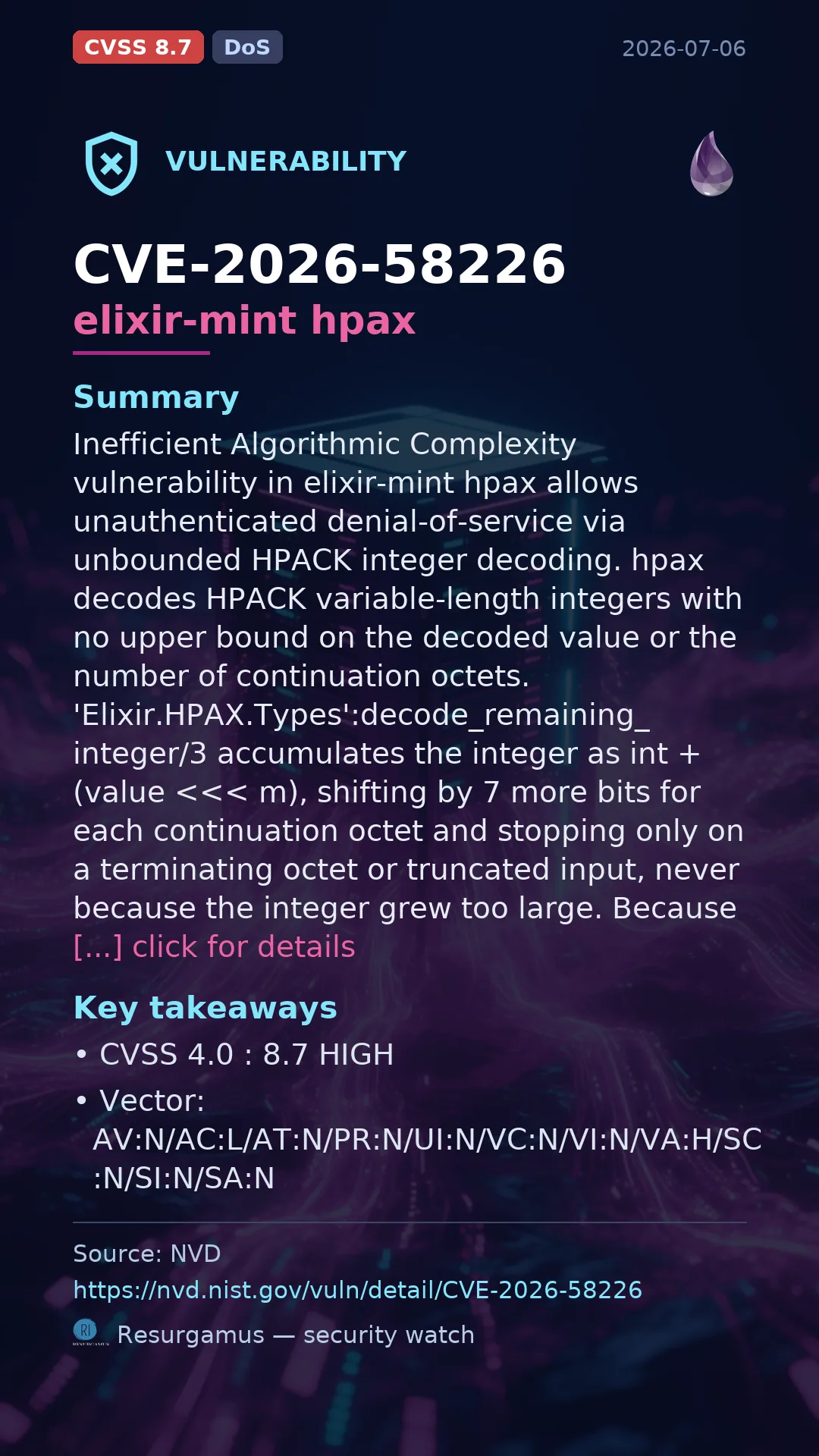
Inefficient Algorithmic Complexity vulnerability in elixir-mint hpax allows unauthenticated denial-of-service via unbounded HPACK integer decoding. hpax decodes HPACK variable-length integers with no upper bound on the decoded value or the number of continuation octets. 'Elixir.HPAX.Types':decode_remaining_integer/3 accumulates the integer as int + (value <<< m), shifting by 7 more bits for each continuation octet and stopping only on a terminating octet or truncated input, never because the integer grew too large. Because BEAM integers are arbitrary precision, a run of N continuation octets builds an O(N)-bit bignum and re-adds into an ever-larger bignum on each step, so the total decoding cost is superlinear (about O(N^2)). An unauthenticated attacker who can send an HTTP/2 header block to a server using this decoder (reached through the 'Elixir.HPAX':decode/2 entry point) can supply a small header block that forces a large, attacker-controlled amount of CPU (and transient memory), a denial-of-service amplification. This issue affects hpax from 0.1.1 before 1.0.4.
No public exploitation has been reported so far. No distribution fix is listed yet; apply vendor mitigations and monitor.
Recommended action: Track your distribution's security tracker and apply the fix as soon as it ships.
Severity metrics
CVSS 4.0 : 8.7 HIGH
Vector: AV:N/AC:L/AT:N/PR:N/UI:N/VC:N/VI:N/VA:H/SC:N/SI:N/SA:N
Affected & fixed versions by distribution
Versions are the native distribution strings (backport-aware): RHEL/Debian/SUSE backport fixes, so compare with the distro version comparator (dpkg / rpm / vercmp), not the upstream version.
No affected package in the tracked watchlist yet (Debian, Ubuntu, Arch, SUSE, Red Hat...). Triage may still be pending.