CVE-2026-59144
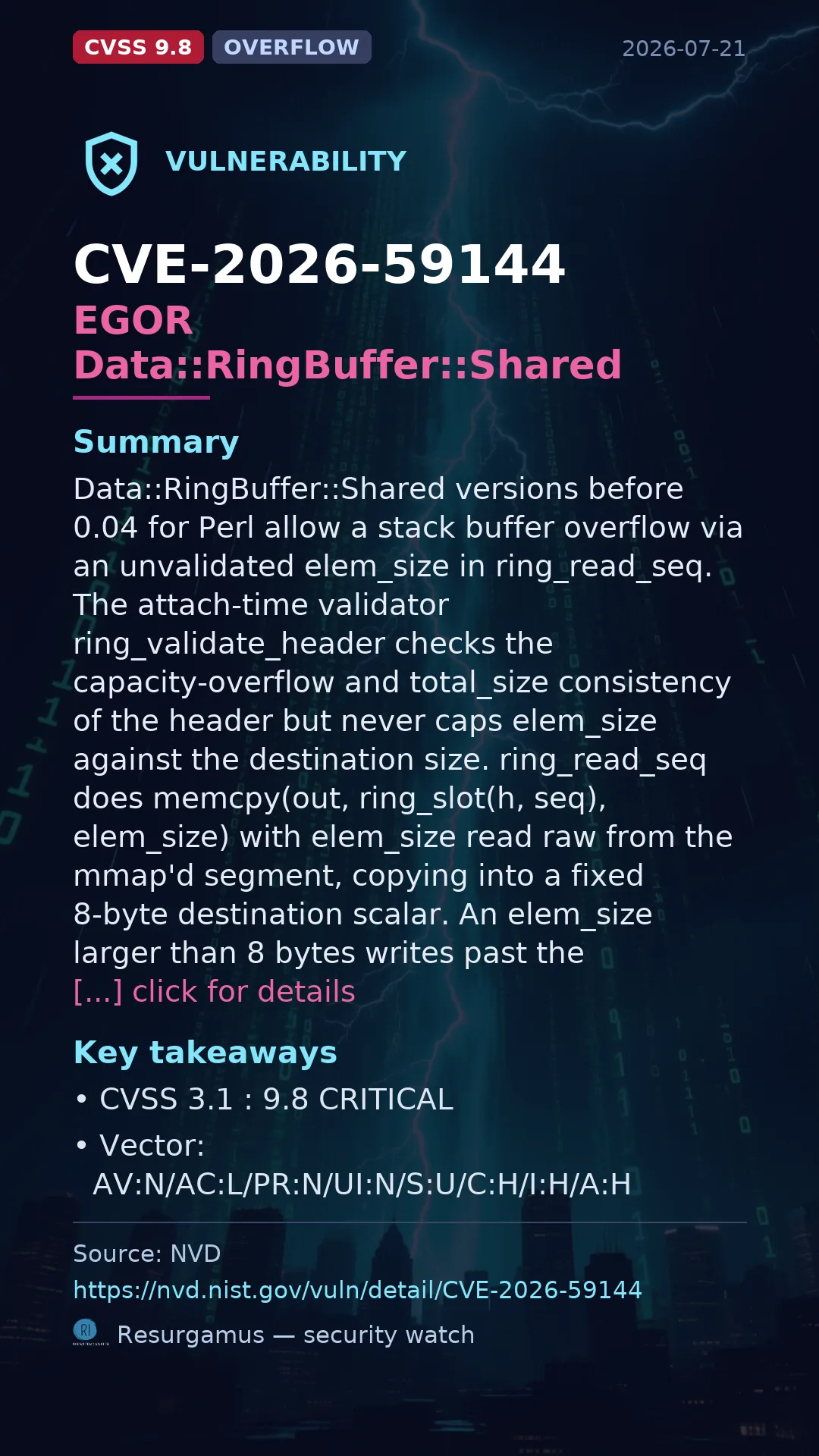
Data::RingBuffer::Shared versions before 0.04 for Perl allow a stack buffer overflow via an unvalidated elem_size in ring_read_seq. The attach-time validator ring_validate_header checks the capacity-overflow and total_size consistency of the header but never caps elem_size against the destination size. ring_read_seq does memcpy(out, ring_slot(h, seq), elem_size) with elem_size read raw from the mmap'd segment, copying into a fixed 8-byte destination scalar. An elem_size larger than 8 bytes writes past the destination. A local peer that can write the backing file can leave the header valid while setting a large elem_size, so the next read copies a file-controlled length into the fixed 8-byte stack buffer, corrupting adjacent stack frames.
No public exploitation has been reported so far. No distribution fix is listed yet; apply vendor mitigations and monitor.
Recommended action: Track your distribution's security tracker and apply the fix as soon as it ships.
Severity metrics
CVSS 3.1 : 9.8 CRITICAL
Vector: AV:N/AC:L/PR:N/UI:N/S:U/C:H/I:H/A:H
Affected & fixed versions by distribution
Versions are the native distribution strings (backport-aware): RHEL/Debian/SUSE backport fixes, so compare with the distro version comparator (dpkg / rpm / vercmp), not the upstream version.
No affected package in the tracked watchlist yet (Debian, Ubuntu, Arch, SUSE, Red Hat...). Triage may still be pending.