CVE-2026-63089
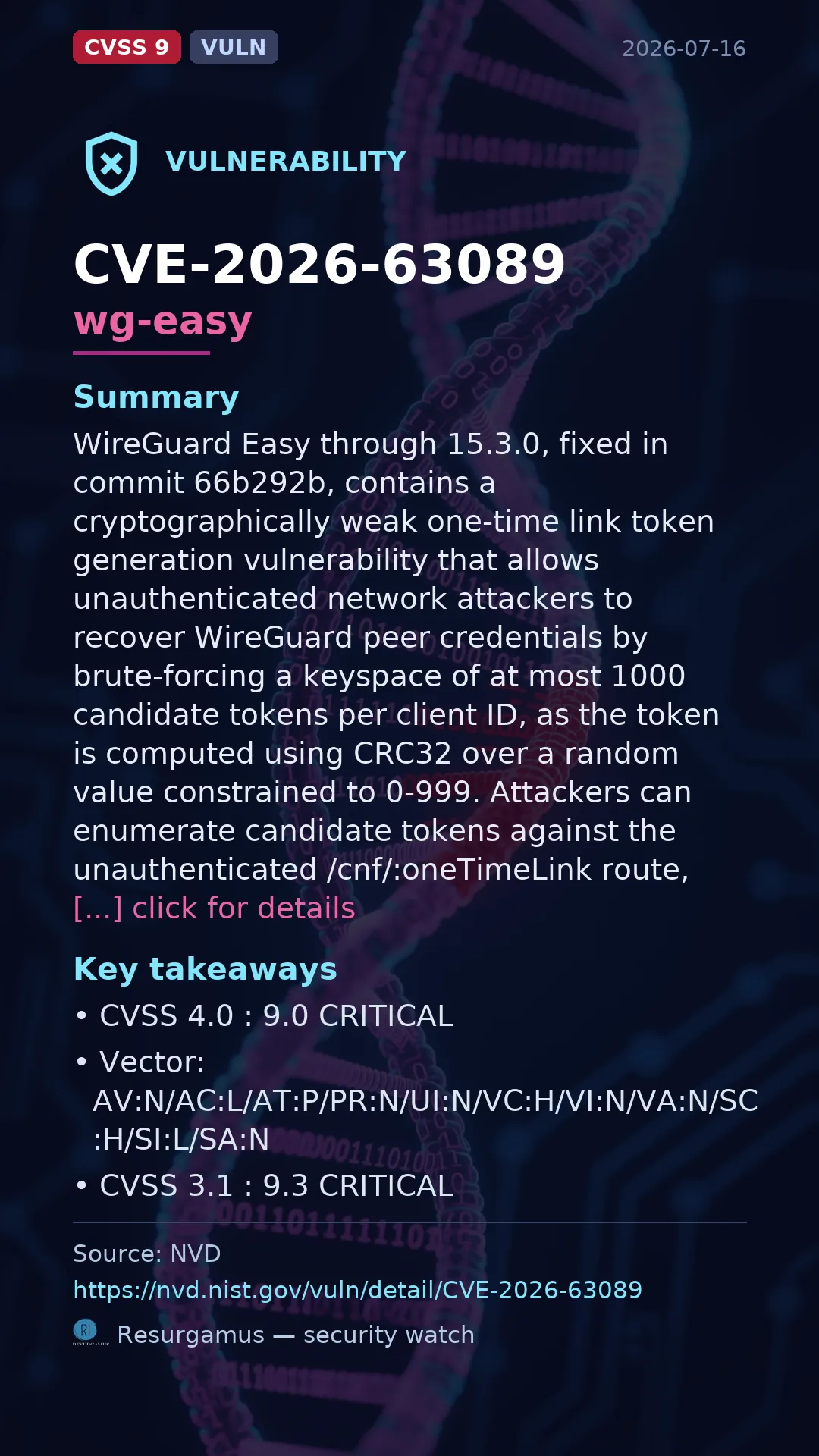
WireGuard Easy through 15.3.0, fixed in commit 66b292b, contains a cryptographically weak one-time link token generation vulnerability that allows unauthenticated network attackers to recover WireGuard peer credentials by brute-forcing a keyspace of at most 1000 candidate tokens per client ID, as the token is computed using CRC32 over a random value constrained to 0-999. Attackers can enumerate candidate tokens against the unauthenticated /cnf/:oneTimeLink route, which lacks rate limiting and does not validate token expiration, to obtain a peer's PrivateKey and PresharedKey and impersonate that peer on the VPN network.
No public exploitation has been reported so far. No distribution fix is listed yet; apply vendor mitigations and monitor.
Recommended action: Track your distribution's security tracker and apply the fix as soon as it ships.
Severity metrics
CVSS 4.0 : 9.0 CRITICAL · CVSS 3.1 : 9.3 CRITICAL
Vector: AV:N/AC:L/AT:P/PR:N/UI:N/VC:H/VI:N/VA:N/SC:H/SI:L/SA:N
Affected & fixed versions by distribution
Versions are the native distribution strings (backport-aware): RHEL/Debian/SUSE backport fixes, so compare with the distro version comparator (dpkg / rpm / vercmp), not the upstream version.
No affected package in the tracked watchlist yet (Debian, Ubuntu, Arch, SUSE, Red Hat...). Triage may still be pending.