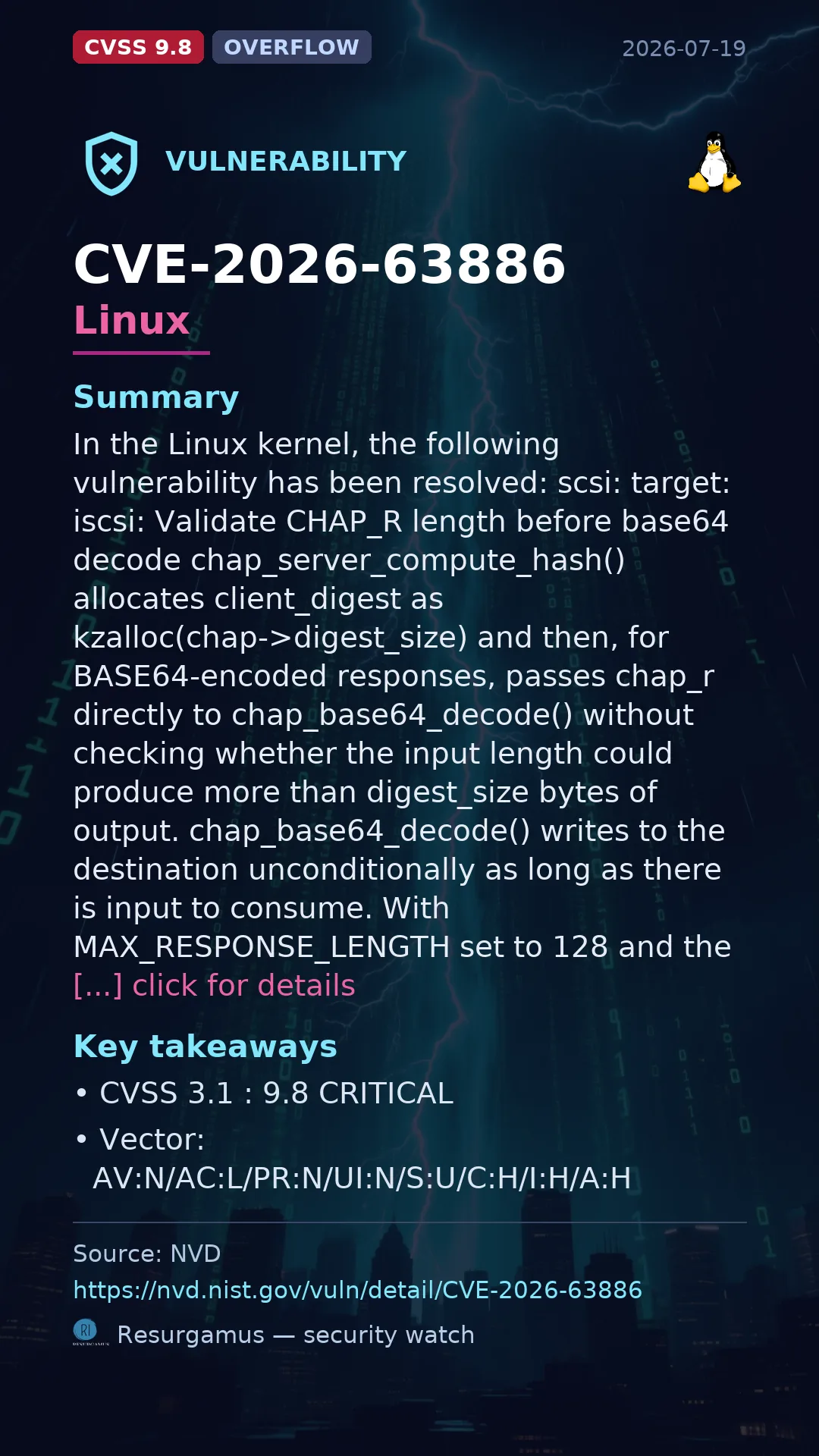
CVE-2026-63886
In the Linux kernel, the following vulnerability has been resolved: scsi: target: iscsi: Validate CHAP_R length before base64 decode chap_server_compute_hash() allocates client_digest as kzalloc(chap->digest_size) and then, for BASE64-encoded responses, passes chap_r directly to chap_base64_decode() without checking whether the input length could produce more than digest_size bytes of output. chap_base64_decode() writes to the destination unconditionally as long as there is input to consume. With MAX_RESPONSE_LENGTH set to 128 and the "0b" prefix stripped by extract_param(), up to 127 base64 characters can reach the decoder. 127 characters decode to 95 bytes. For SHA-256 (digest_size=32) this overflows client_digest by 63 bytes; for MD5 (digest_size=16) the overflow is 79 bytes. The length check at line 344 fires after the write has already happened. The HEX branch in the same switch statement already validates the length up front. Apply the same approach to the BASE64 branch: strip trailing base64 padding characters, then reject any input whose data length exceeds DIV_ROUND_UP(digest_size * 4, 3) before calling the decoder. Stripping trailing '=' before the comparison handle
No public exploitation has been reported so far. No distribution fix is listed yet; apply vendor mitigations and monitor.
Recommended action: Track your distribution's security tracker and apply the fix as soon as it ships.
Severity metrics
CVSS 3.1 : 9.8 CRITICAL
Vector: AV:N/AC:L/PR:N/UI:N/S:U/C:H/I:H/A:H
Affected & fixed versions by distribution
Versions are the native distribution strings (backport-aware): RHEL/Debian/SUSE backport fixes, so compare with the distro version comparator (dpkg / rpm / vercmp), not the upstream version.
No affected package in the tracked watchlist yet (Debian, Ubuntu, Arch, SUSE, Red Hat...). Triage may still be pending.