CVE-2026-63913
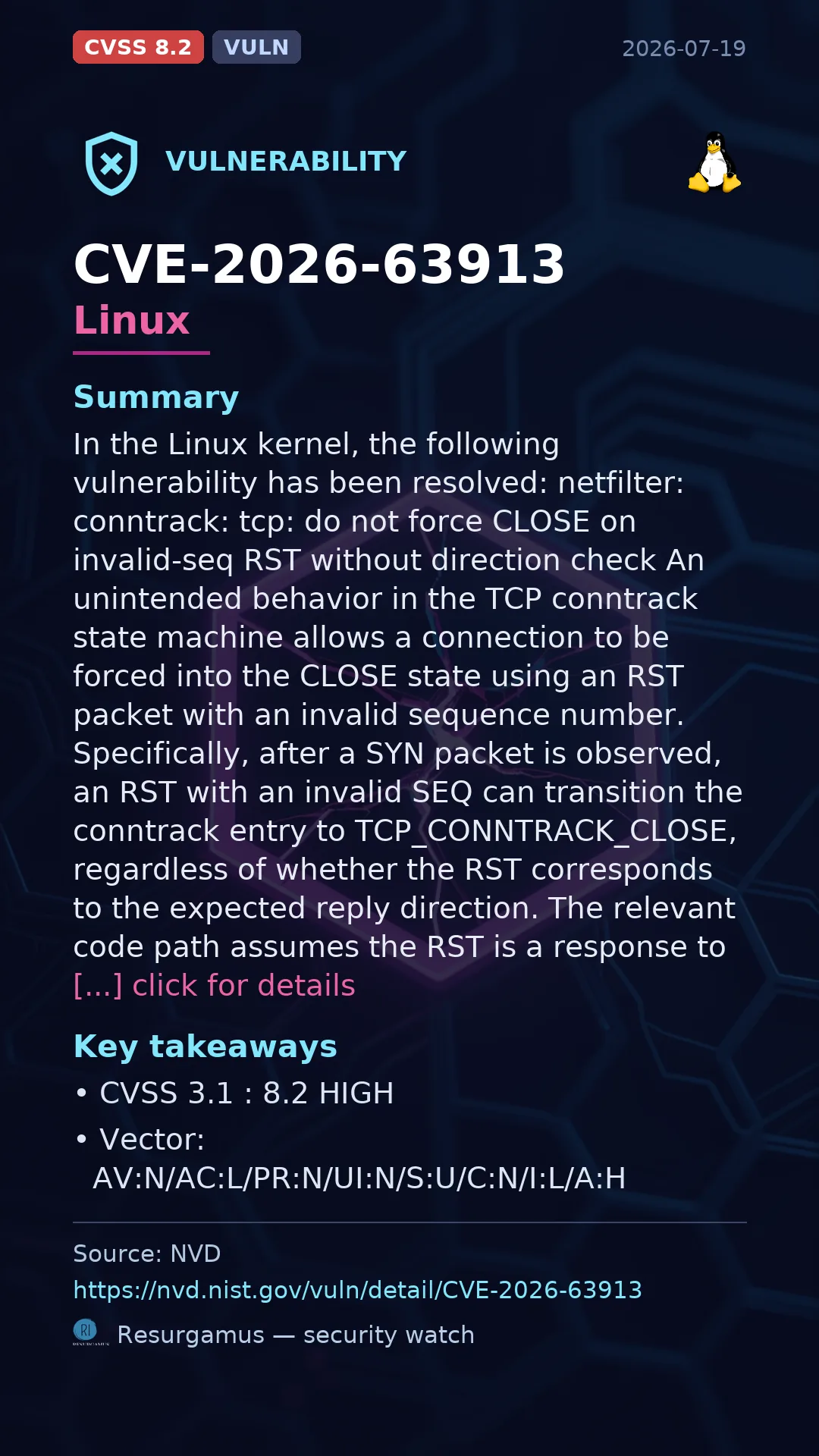
In the Linux kernel, the following vulnerability has been resolved: netfilter: conntrack: tcp: do not force CLOSE on invalid-seq RST without direction check An unintended behavior in the TCP conntrack state machine allows a connection to be forced into the CLOSE state using an RST packet with an invalid sequence number. Specifically, after a SYN packet is observed, an RST with an invalid SEQ can transition the conntrack entry to TCP_CONNTRACK_CLOSE, regardless of whether the RST corresponds to the expected reply direction. The relevant code path assumes the RST is a response to an outgoing SYN, but does not validate packet direction or ensure that a matching SYN was actually sent in the opposite direction. As a result, a crafted packet sequence consisting of a SYN followed by an invalid-sequence RST can prematurely terminate an active NAT entry. This makes connection teardown easier than intended. So, tighten the state transition logic to ensure that RST-triggered CLOSE transitions only occur when the RST is a valid response to a previously observed SYN in the correct direction.
No public exploitation has been reported so far. No distribution fix is listed yet; apply vendor mitigations and monitor.
Recommended action: Track your distribution's security tracker and apply the fix as soon as it ships.
Severity metrics
CVSS 3.1 : 8.2 HIGH
Vector: AV:N/AC:L/PR:N/UI:N/S:U/C:N/I:L/A:H
Affected & fixed versions by distribution
Versions are the native distribution strings (backport-aware): RHEL/Debian/SUSE backport fixes, so compare with the distro version comparator (dpkg / rpm / vercmp), not the upstream version.
No affected package in the tracked watchlist yet (Debian, Ubuntu, Arch, SUSE, Red Hat...). Triage may still be pending.