CVE-2026-64649
Next.js is a React framework for building full-stack web applications. In versions 14.1.1 through 15.5.20 and 16.0.0 through 16.2.10, when a Server Action forwards or redirects a request, an attacker can cause the server to send that outbound request to a malicious host (Server-Side Request Forgery). This requires the attacker's request to control Host-associated headers. In some configurations, it's also possible to obtain internal values that weaken middleware/proxy authorization. Applications that use Server Actions are affected when the incoming host header is not fixed to a trusted value. This typically occurs on custom servers, or on deployments not behind a proxy that pins the host. Managed hosting pins the host upstream and is not affected; next start and standalone output do the same from version 14.2 onward. This issue has been fixed in versions 15.5.21 and 16.2.11.
No public exploitation has been reported so far. No distribution fix is listed yet; apply vendor mitigations and monitor.
Recommended action: Track your distribution's security tracker and apply the fix as soon as it ships.
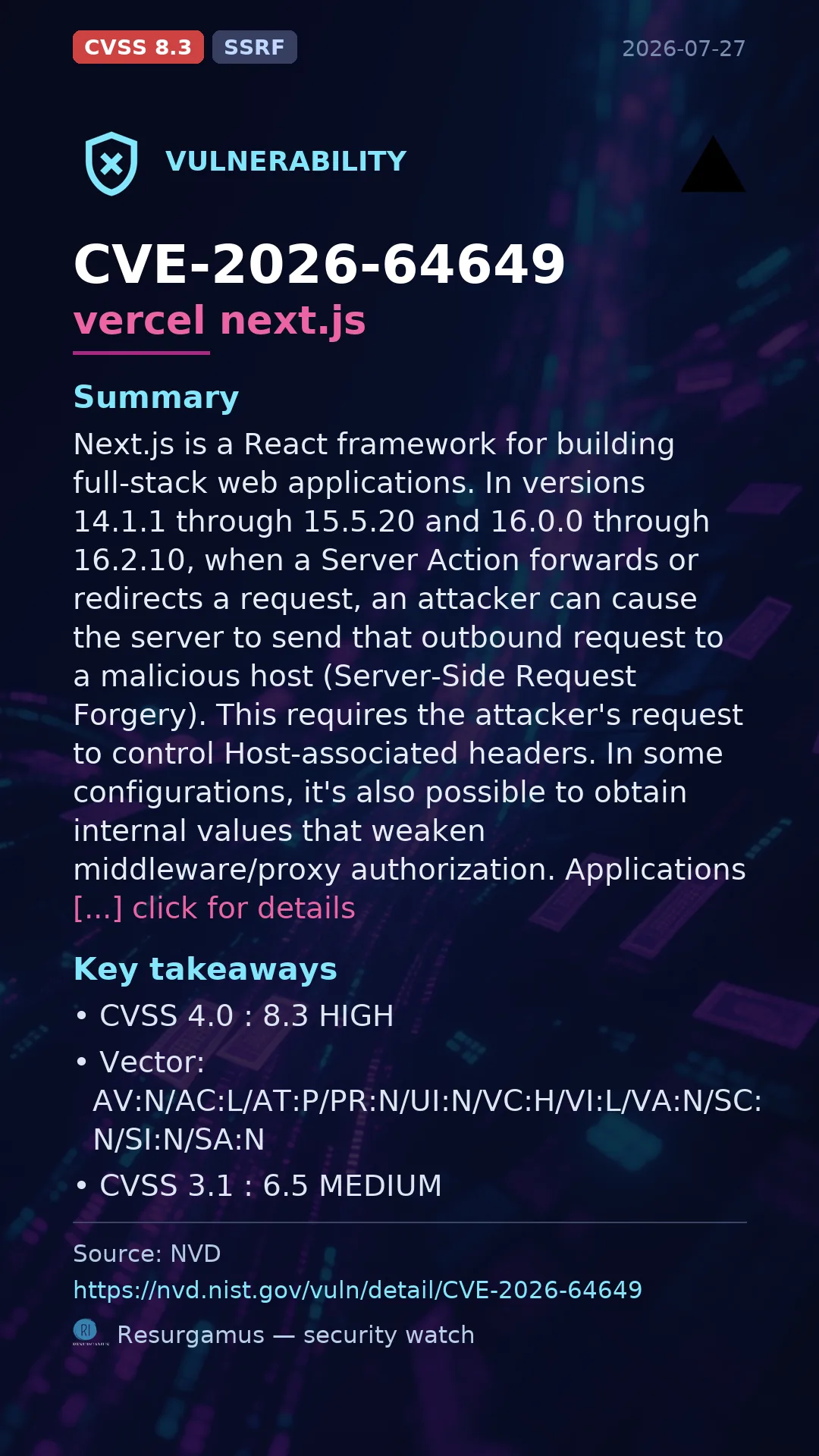
Severity metrics
CVSS 4.0 : 8.3 HIGH · CVSS 3.1 : 6.5 MEDIUM
Vector: AV:N/AC:L/AT:P/PR:N/UI:N/VC:H/VI:L/VA:N/SC:N/SI:N/SA:N
Affected & fixed versions by distribution
Versions are the native distribution strings (backport-aware): RHEL/Debian/SUSE backport fixes, so compare with the distro version comparator (dpkg / rpm / vercmp), not the upstream version.
No affected package in the tracked watchlist yet (Debian, Ubuntu, Arch, SUSE, Red Hat...). Triage may still be pending.