CVE-2026-65700
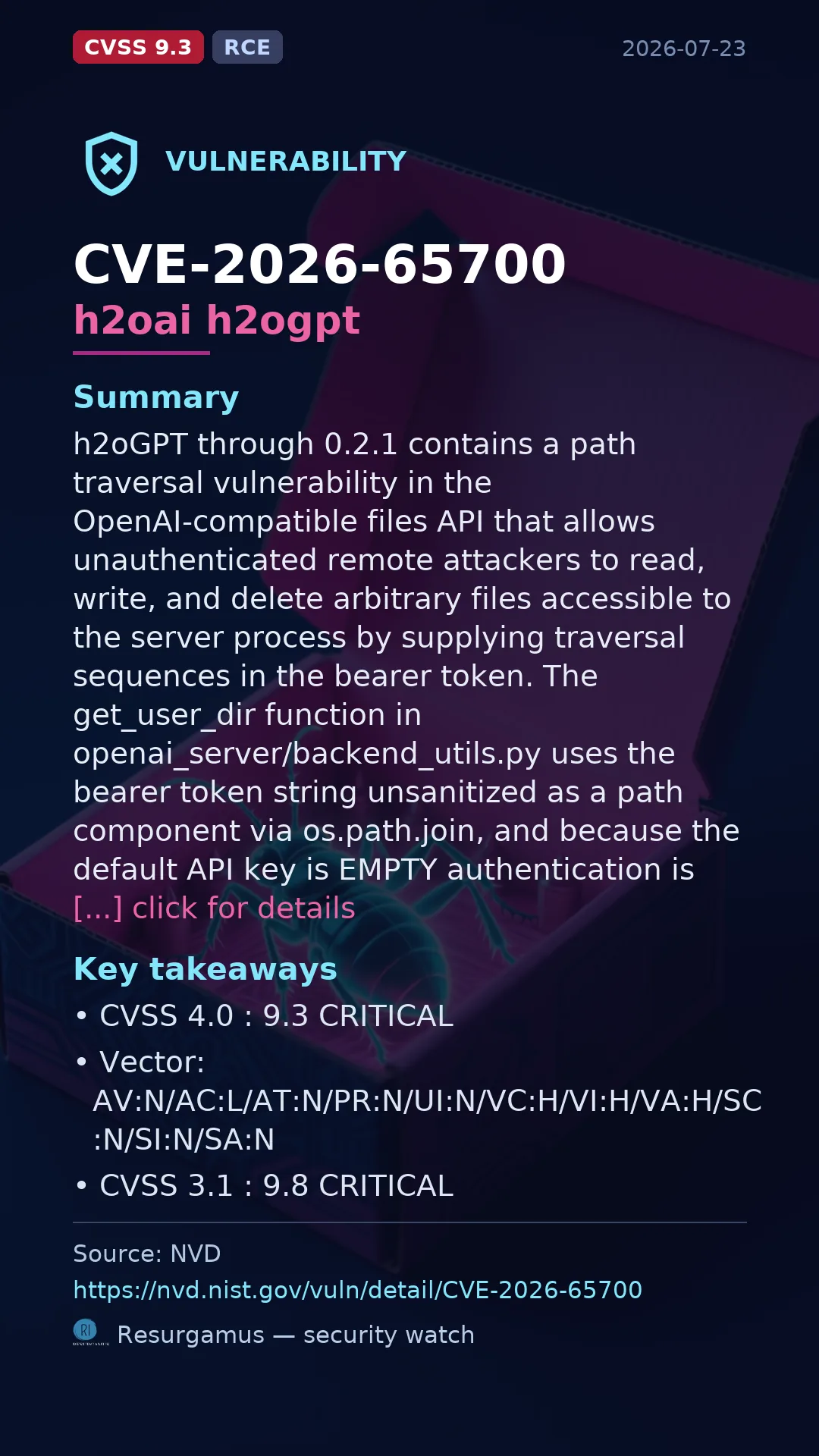
h2oGPT through 0.2.1 contains a path traversal vulnerability in the OpenAI-compatible files API that allows unauthenticated remote attackers to read, write, and delete arbitrary files accessible to the server process by supplying traversal sequences in the bearer token. The get_user_dir function in openai_server/backend_utils.py uses the bearer token string unsanitized as a path component via os.path.join, and because the default API key is EMPTY authentication is bypassed, enabling attackers to traverse outside the intended user directory through the file content, delete, and upload endpoints to achieve remote code execution by writing to startup hooks or application-loaded files.
No public exploitation has been reported so far. No distribution fix is listed yet; apply vendor mitigations and monitor.
Recommended action: Track your distribution's security tracker and apply the fix as soon as it ships.
Severity metrics
CVSS 4.0 : 9.3 CRITICAL · CVSS 3.1 : 9.8 CRITICAL
Vector: AV:N/AC:L/AT:N/PR:N/UI:N/VC:H/VI:H/VA:H/SC:N/SI:N/SA:N
Affected & fixed versions by distribution
Versions are the native distribution strings (backport-aware): RHEL/Debian/SUSE backport fixes, so compare with the distro version comparator (dpkg / rpm / vercmp), not the upstream version.
No affected package in the tracked watchlist yet (Debian, Ubuntu, Arch, SUSE, Red Hat...). Triage may still be pending.