CVE-2026-67320
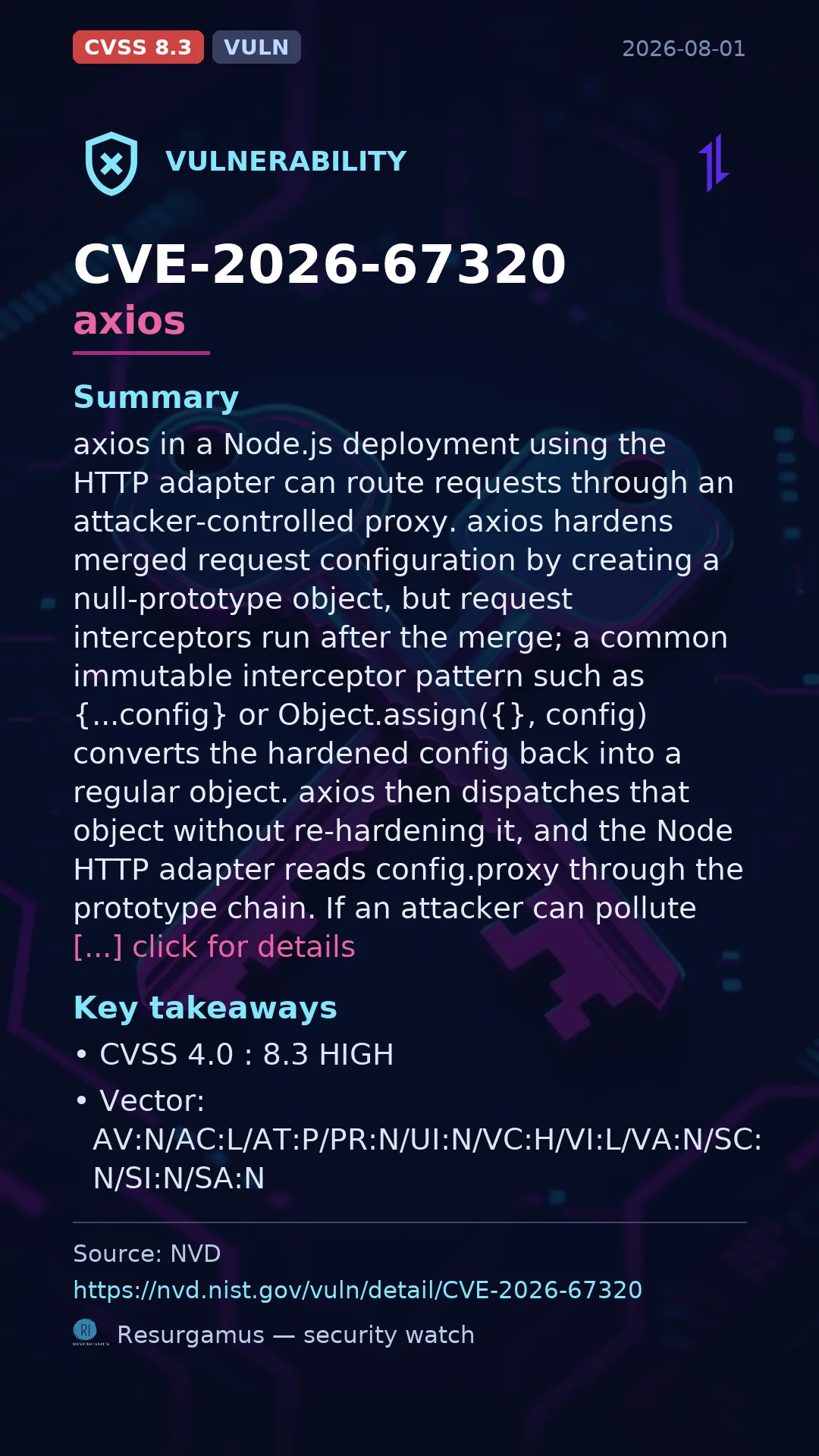
axios in a Node.js deployment using the HTTP adapter can route requests through an attacker-controlled proxy. axios hardens merged request configuration by creating a null-prototype object, but request interceptors run after the merge; a common immutable interceptor pattern such as {...config} or Object.assign({}, config) converts the hardened config back into a regular object. axios then dispatches that object without re-hardening it, and the Node HTTP adapter reads config.proxy through the prototype chain. If an attacker can pollute Object.prototype.proxy, affected requests can be routed through an attacker-controlled proxy. For plaintext HTTP requests, the proxy can observe Authorization headers, Basic auth from config.auth, method, absolute URL, Host, and request body, and can return its own response. This does not establish browser impact or HTTPS header/body disclosure under normal TLS validation. Affected versions are >=0.31.1 (fixed in 0.33.0) and >=1.15.2 (fixed in 1.18.0).
No public exploitation has been reported so far. No distribution fix is listed yet; apply vendor mitigations and monitor.
Recommended action: Track your distribution's security tracker and apply the fix as soon as it ships.
Severity metrics
CVSS 4.0 : 8.3 HIGH
Vector: AV:N/AC:L/AT:P/PR:N/UI:N/VC:H/VI:L/VA:N/SC:N/SI:N/SA:N
Affected & fixed versions by distribution
Versions are the native distribution strings (backport-aware): RHEL/Debian/SUSE backport fixes, so compare with the distro version comparator (dpkg / rpm / vercmp), not the upstream version.
No affected package in the tracked watchlist yet (Debian, Ubuntu, Arch, SUSE, Red Hat...). Triage may still be pending.