CVE-2026-69264
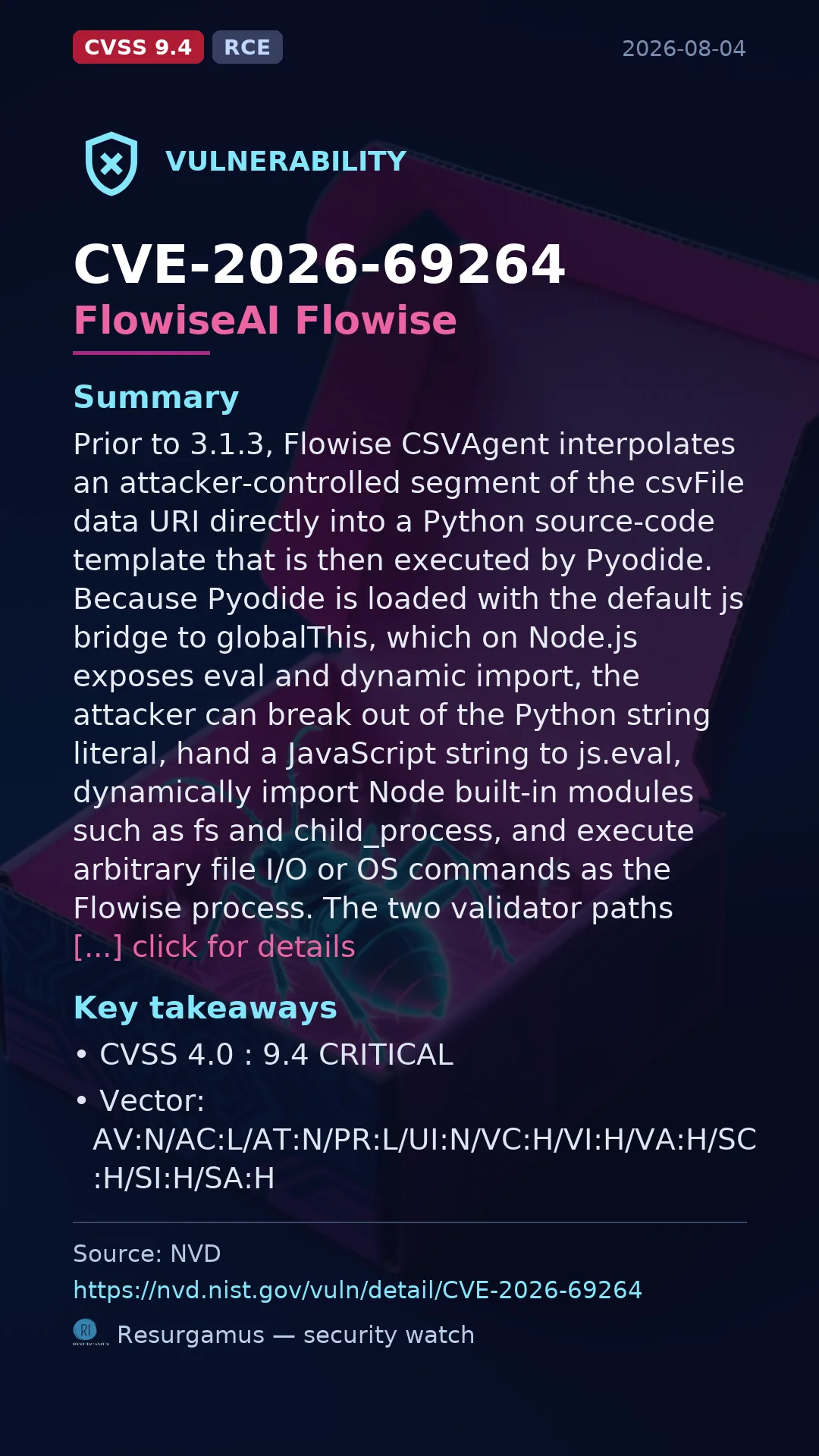
Prior to 3.1.3, Flowise CSVAgent interpolates an attacker-controlled segment of the csvFile data URI directly into a Python source-code template that is then executed by Pyodide. Because Pyodide is loaded with the default js bridge to globalThis, which on Node.js exposes eval and dynamic import, the attacker can break out of the Python string literal, hand a JavaScript string to js.eval, dynamically import Node built-in modules such as fs and child_process, and execute arbitrary file I/O or OS commands as the Flowise process. The two validator paths around this code, validatePythonCodeForDataFrame and validateCustomReadCSVFunction, are never applied to the bootstrap template. A workspace user with chatflows:create or agentflows/chatflows update permission can plant a CSV Agent node with a crafted csvFile; once the chatflow is exposed via POST /api/v1/prediction/:id, any unauthenticated request triggers host remote code execution. This issue is fixed in version 3.1.3.
No public exploitation has been reported so far. No distribution fix is listed yet; apply vendor mitigations and monitor.
Recommended action: Track your distribution's security tracker and apply the fix as soon as it ships.
Severity metrics
CVSS 4.0 : 9.4 CRITICAL
Vector: AV:N/AC:L/AT:N/PR:L/UI:N/VC:H/VI:H/VA:H/SC:H/SI:H/SA:H
Affected & fixed versions by distribution
Versions are the native distribution strings (backport-aware): RHEL/Debian/SUSE backport fixes, so compare with the distro version comparator (dpkg / rpm / vercmp), not the upstream version.
No affected package in the tracked watchlist yet (Debian, Ubuntu, Arch, SUSE, Red Hat...). Triage may still be pending.