CVE-2026-70616
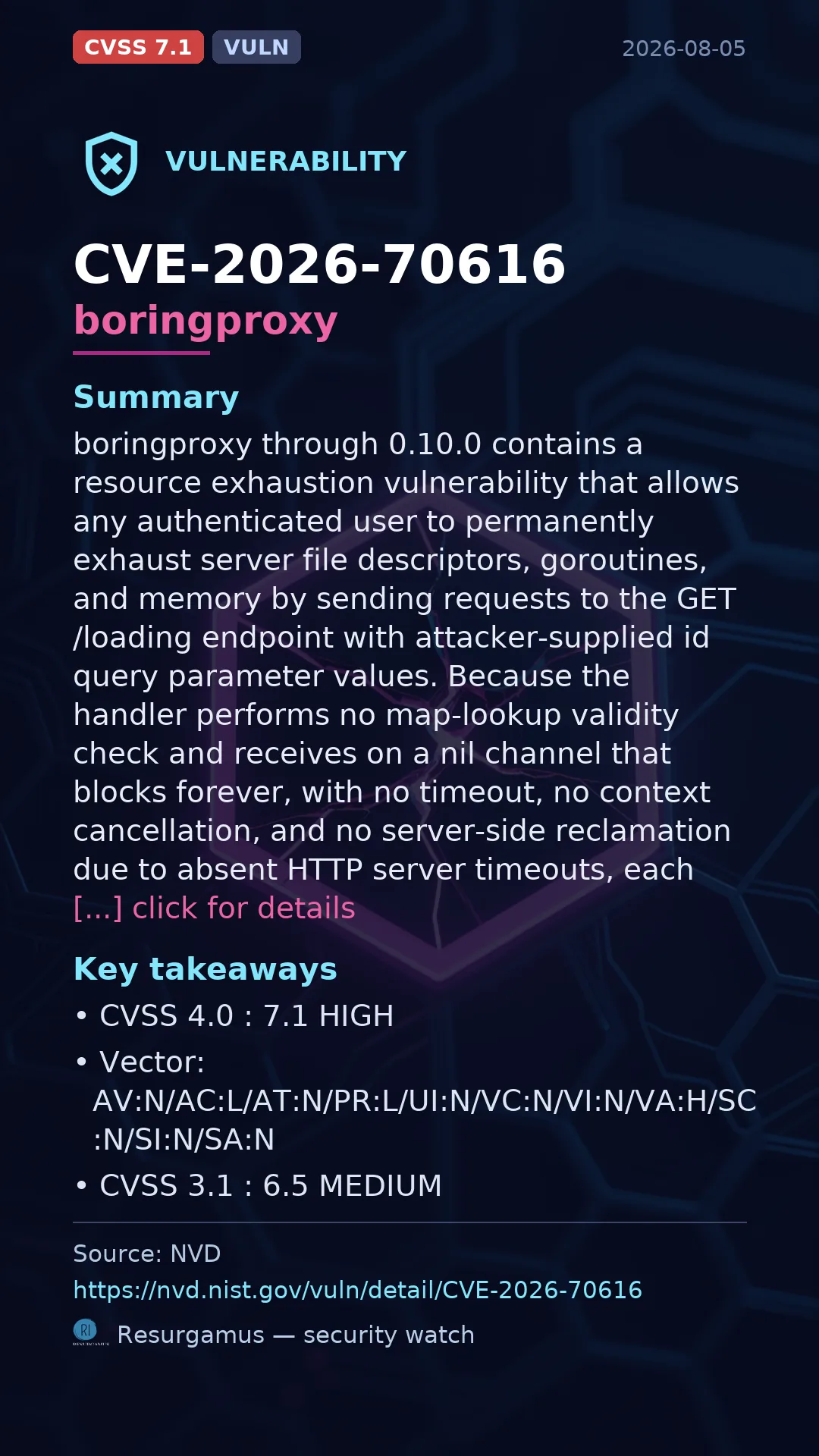
boringproxy through 0.10.0 contains a resource exhaustion vulnerability that allows any authenticated user to permanently exhaust server file descriptors, goroutines, and memory by sending requests to the GET /loading endpoint with attacker-supplied id query parameter values. Because the handler performs no map-lookup validity check and receives on a nil channel that blocks forever, with no timeout, no context cancellation, and no server-side reclamation due to absent HTTP server timeouts, each malicious request permanently holds one goroutine, one file descriptor, and approximately 50 kB of memory until the server's file descriptor limit is reached and listener Accept calls fail, halting all tunnel traffic forwarding for all users.
No public exploitation has been reported so far. No distribution fix is listed yet; apply vendor mitigations and monitor.
Recommended action: Track your distribution's security tracker and apply the fix as soon as it ships.
Severity metrics
CVSS 4.0 : 7.1 HIGH · CVSS 3.1 : 6.5 MEDIUM
Vector: AV:N/AC:L/AT:N/PR:L/UI:N/VC:N/VI:N/VA:H/SC:N/SI:N/SA:N
Affected & fixed versions by distribution
Versions are the native distribution strings (backport-aware): RHEL/Debian/SUSE backport fixes, so compare with the distro version comparator (dpkg / rpm / vercmp), not the upstream version.
No affected package in the tracked watchlist yet (Debian, Ubuntu, Arch, SUSE, Red Hat...). Triage may still be pending.