CVE-2026-71211
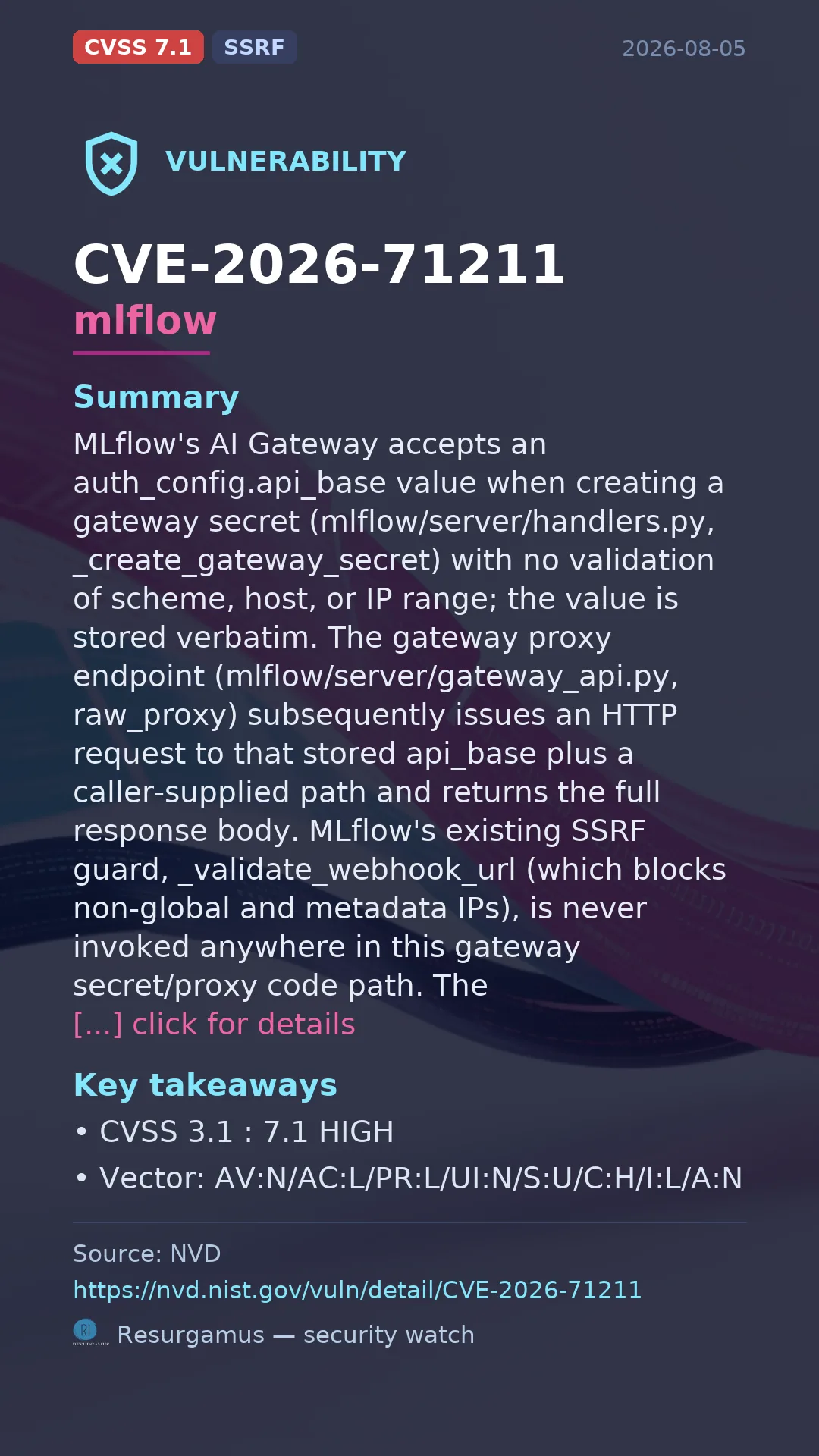
MLflow's AI Gateway accepts an auth_config.api_base value when creating a gateway secret (mlflow/server/handlers.py, _create_gateway_secret) with no validation of scheme, host, or IP range; the value is stored verbatim. The gateway proxy endpoint (mlflow/server/gateway_api.py, raw_proxy) subsequently issues an HTTP request to that stored api_base plus a caller-supplied path and returns the full response body. MLflow's existing SSRF guard, _validate_webhook_url (which blocks non-global and metadata IPs), is never invoked anywhere in this gateway secret/proxy code path. The CreateGatewaySecret action additionally has no entry in the permission-validator map, so it requires only basic authentication rather than any specific scope, meaning any authenticated user — including read-only accounts — can create a secret pointing at an internal address and reach it via the proxy endpoint, potentially exposing cloud-instance IAM credentials via metadata services. This is related to CVE-2026-4035, which addresses a distinct mechanism in the same gateway-secret feature (server-side $ENV_VAR resolution inside the api_key field leaking credentials to the configured upstream); the finding here is a
No public exploitation has been reported so far. No distribution fix is listed yet; apply vendor mitigations and monitor.
Recommended action: Track your distribution's security tracker and apply the fix as soon as it ships.
Severity metrics
CVSS 3.1 : 7.1 HIGH
Vector: AV:N/AC:L/PR:L/UI:N/S:U/C:H/I:L/A:N
Affected & fixed versions by distribution
Versions are the native distribution strings (backport-aware): RHEL/Debian/SUSE backport fixes, so compare with the distro version comparator (dpkg / rpm / vercmp), not the upstream version.
No affected package in the tracked watchlist yet (Debian, Ubuntu, Arch, SUSE, Red Hat...). Triage may still be pending.