CVE-2026-8169
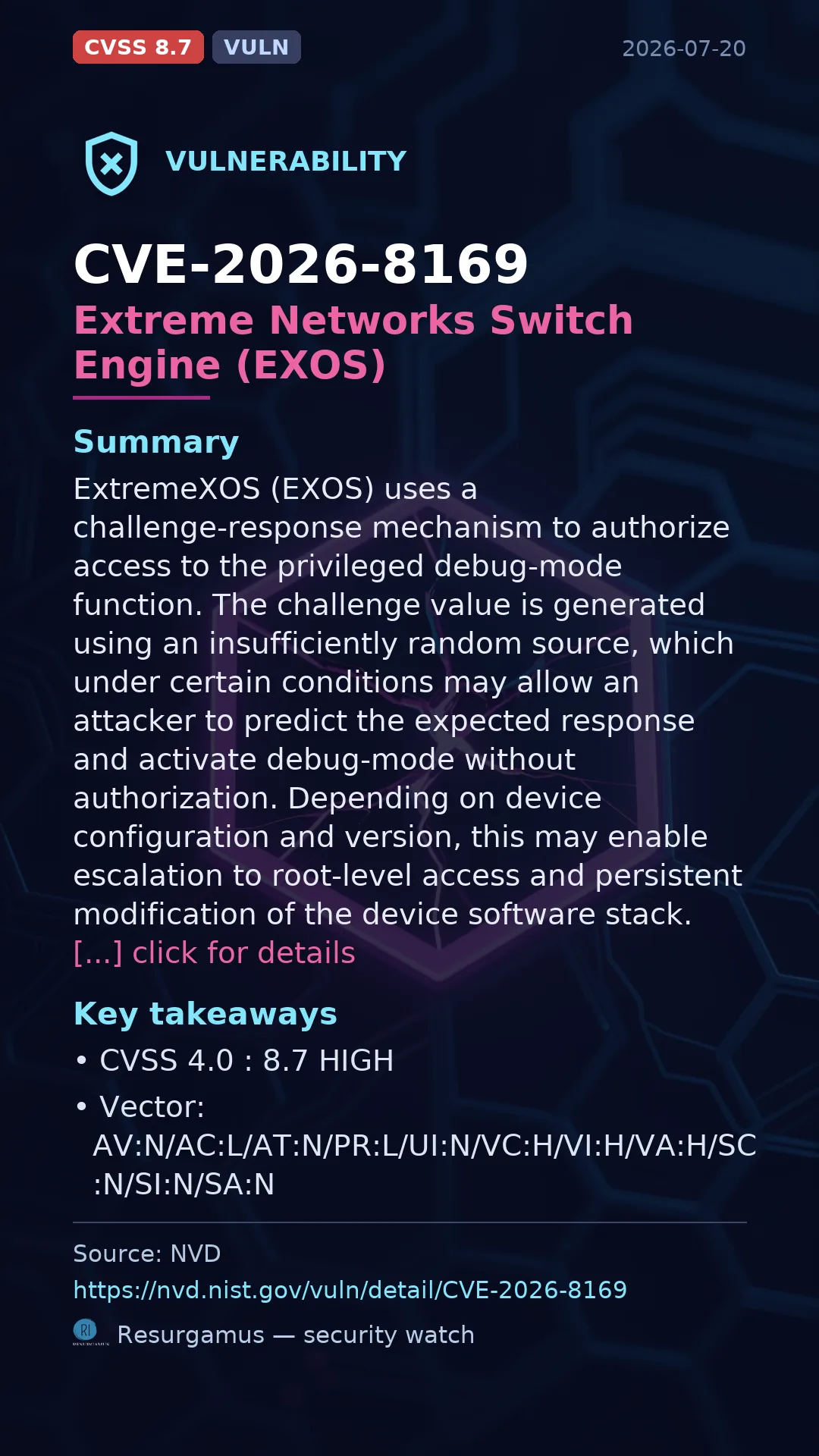
ExtremeXOS (EXOS) uses a challenge-response mechanism to authorize access to the privileged debug-mode function. The challenge value is generated using an insufficiently random source, which under certain conditions may allow an attacker to predict the expected response and activate debug-mode without authorization. Depending on device configuration and version, this may enable escalation to root-level access and persistent modification of the device software stack. Exploitation requires either a valid low-privilege account on the device (remote scenario) or physical serial console access (local scenario). This vulnerability is distinct from CVE-2017-14329, which addressed a different issue involving Python script privileges. Extreme would like to thank Hadrien Barral (Université Gustave Eiffel) and Georges-Axel Jaloyan (French Ministry of the Interior) for responsible disclosure of their findings.
No public exploitation has been reported so far. No distribution fix is listed yet; apply vendor mitigations and monitor.
Recommended action: Track your distribution's security tracker and apply the fix as soon as it ships.
Severity metrics
CVSS 4.0 : 8.7 HIGH
Vector: AV:N/AC:L/AT:N/PR:L/UI:N/VC:H/VI:H/VA:H/SC:N/SI:N/SA:N
Affected & fixed versions by distribution
Versions are the native distribution strings (backport-aware): RHEL/Debian/SUSE backport fixes, so compare with the distro version comparator (dpkg / rpm / vercmp), not the upstream version.
No affected package in the tracked watchlist yet (Debian, Ubuntu, Arch, SUSE, Red Hat...). Triage may still be pending.