CVE-2026-9135
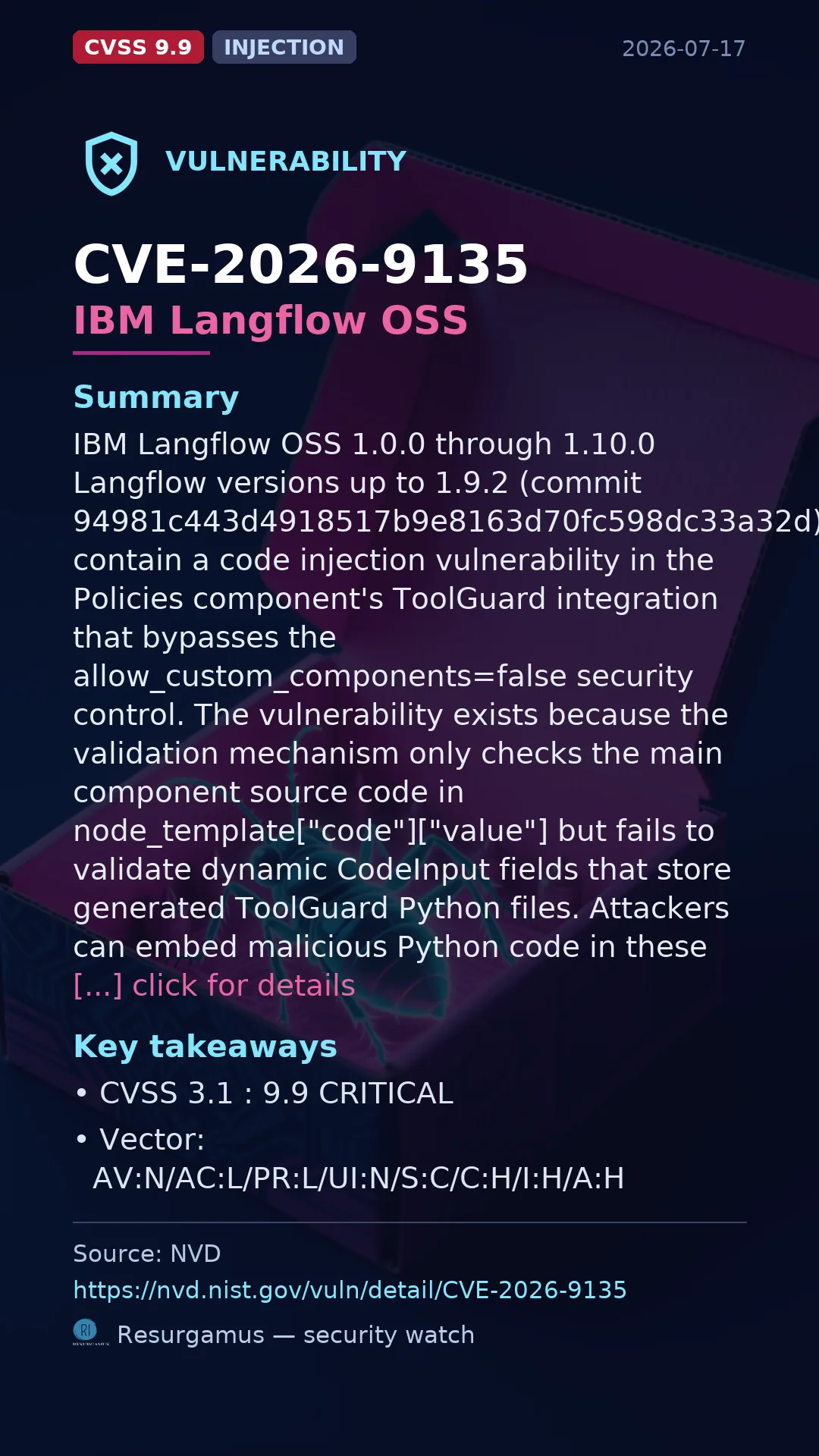
IBM Langflow OSS 1.0.0 through 1.10.0 Langflow versions up to 1.9.2 (commit 94981c443d4918517b9e8163d70fc598dc33a32d) contain a code injection vulnerability in the Policies component's ToolGuard integration that bypasses the allow_custom_components=false security control. The vulnerability exists because the validation mechanism only checks the main component source code in node_template["code"]["value"] but fails to validate dynamic CodeInput fields that store generated ToolGuard Python files. Attackers can embed malicious Python code in these unvalidated dynamic fields, which are persisted in Flow.data and later executed server-side when a guarded tool is invoked through the ToolGuard runtime. This allows authenticated users with flow creation privileges to achieve arbitrary Python code execution on the backend despite custom component restrictions. The vulnerability can be escalated through cross-tenant flow manipulation via the agentic MCP update_flow_component_field tool, which accepts attacker-controlled user_id parameters, enabling attackers to inject malicious code into victim users' flows. When combined with publicly accessible flows and specific misconfigurations (AUTO_LO
No public exploitation has been reported so far. No distribution fix is listed yet; apply vendor mitigations and monitor.
Recommended action: Track your distribution's security tracker and apply the fix as soon as it ships.
Severity metrics
CVSS 3.1 : 9.9 CRITICAL
Vector: AV:N/AC:L/PR:L/UI:N/S:C/C:H/I:H/A:H
Affected & fixed versions by distribution
Versions are the native distribution strings (backport-aware): RHEL/Debian/SUSE backport fixes, so compare with the distro version comparator (dpkg / rpm / vercmp), not the upstream version.
No affected package in the tracked watchlist yet (Debian, Ubuntu, Arch, SUSE, Red Hat...). Triage may still be pending.