CVE-2026-9323
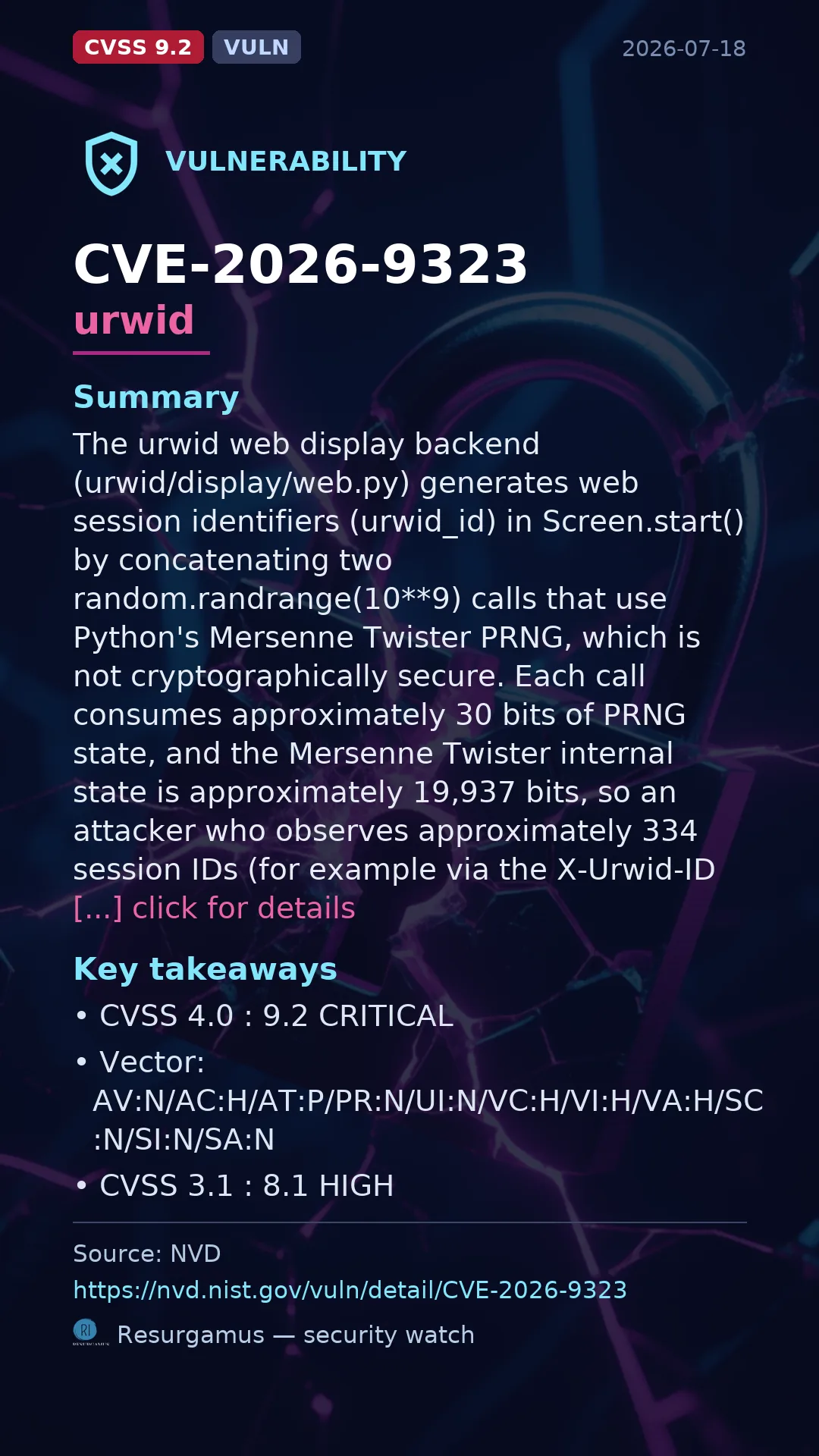
The urwid web display backend (urwid/display/web.py) generates web session identifiers (urwid_id) in Screen.start() by concatenating two random.randrange(10**9) calls that use Python's Mersenne Twister PRNG, which is not cryptographically secure. Each call consumes approximately 30 bits of PRNG state, and the Mersenne Twister internal state is approximately 19,937 bits, so an attacker who observes approximately 334 session IDs (for example via the X-Urwid-ID HTTP response header) can fully reconstruct the internal state and predict all past and future session IDs (Path B). The same identifier is also used as the filename of a FIFO created in the world-listable /tmp directory (for example /tmp/urwid375487765176907690.in), so any local user on the host can list /tmp to enumerate active session tokens directly (Path A). With a valid session ID, an attacker can read the victim's terminal screen via the polling endpoint, inject keystrokes into the victim's session (yielding OS-level code execution with the session owner's privileges if the session runs a shell), and inject exit sequences or flood the FIFO to terminate or crash the session. A prior Bandit S311 warning on this usage was s
No public exploitation has been reported so far. No distribution fix is listed yet; apply vendor mitigations and monitor.
Recommended action: Track your distribution's security tracker and apply the fix as soon as it ships.
Severity metrics
CVSS 4.0 : 9.2 CRITICAL · CVSS 3.1 : 8.1 HIGH
Vector: AV:N/AC:H/AT:P/PR:N/UI:N/VC:H/VI:H/VA:H/SC:N/SI:N/SA:N
Affected & fixed versions by distribution
Versions are the native distribution strings (backport-aware): RHEL/Debian/SUSE backport fixes, so compare with the distro version comparator (dpkg / rpm / vercmp), not the upstream version.
No affected package in the tracked watchlist yet (Debian, Ubuntu, Arch, SUSE, Red Hat...). Triage may still be pending.