CVE-2026-47249
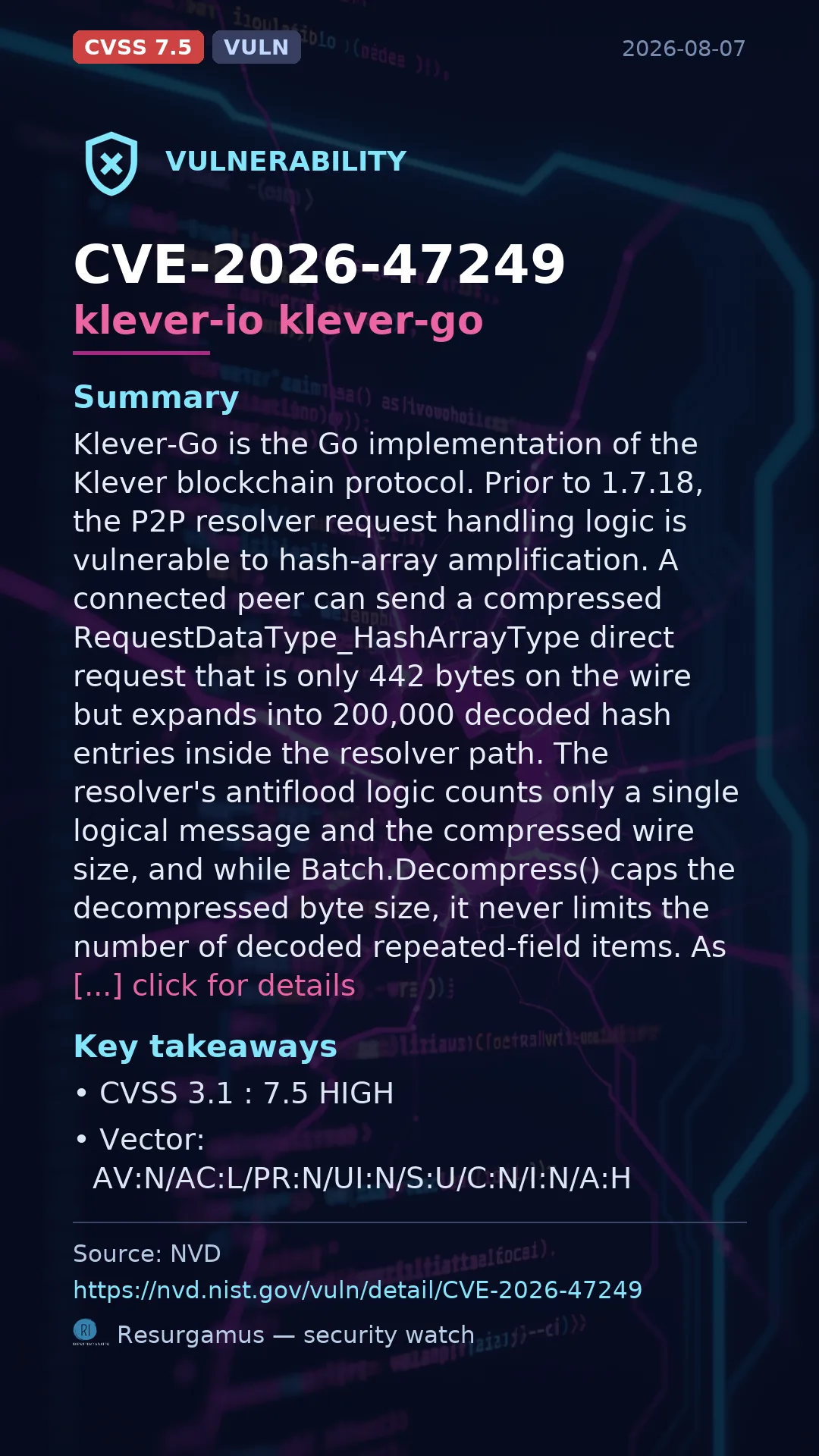
Klever-Go is the Go implementation of the Klever blockchain protocol. Prior to 1.7.18, the P2P resolver request handling logic is vulnerable to hash-array amplification. A connected peer can send a compressed RequestDataType_HashArrayType direct request that is only 442 bytes on the wire but expands into 200,000 decoded hash entries inside the resolver path. The resolver's antiflood logic counts only a single logical message and the compressed wire size, and while Batch.Decompress() caps the decompressed byte size, it never limits the number of decoded repeated-field items. As a result, both TxResolver and TrieNodeResolver preallocate and iterate over the entire unchecked set of decoded hashes, causing remote memory and CPU amplification against any node that accepts P2P peer connections. This issue is fixed in version 1.7.18.
No public exploitation has been reported so far. No distribution fix is listed yet; apply vendor mitigations and monitor.
Recommended action: Track your distribution's security tracker and apply the fix as soon as it ships.
Severity metrics
CVSS 3.1 : 7.5 HIGH
Vector: AV:N/AC:L/PR:N/UI:N/S:U/C:N/I:N/A:H
Affected & fixed versions by distribution
Versions are the native distribution strings (backport-aware): RHEL/Debian/SUSE backport fixes, so compare with the distro version comparator (dpkg / rpm / vercmp), not the upstream version.
No affected package in the tracked watchlist yet (Debian, Ubuntu, Arch, SUSE, Red Hat...). Triage may still be pending.