CVE-2026-52879
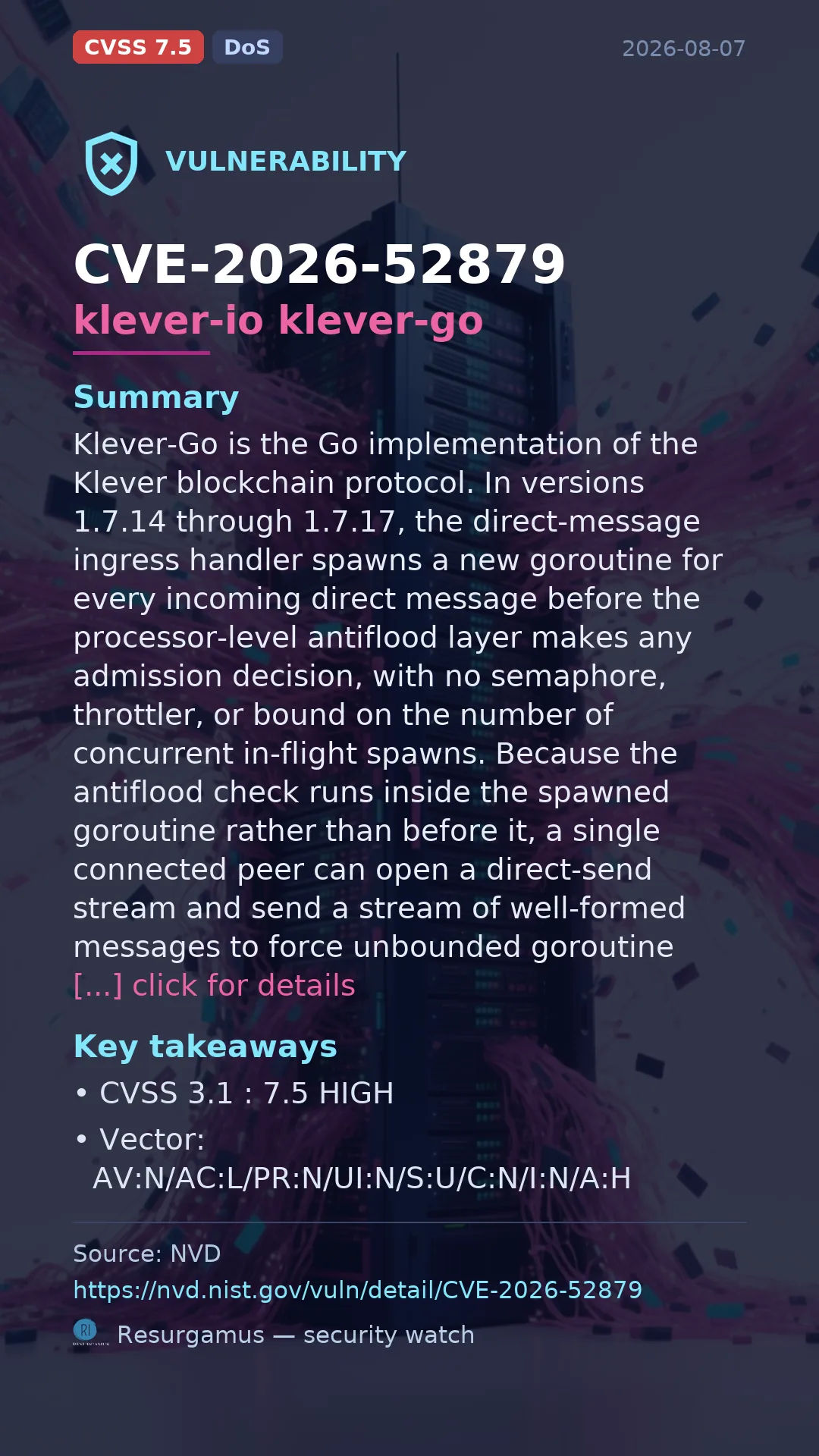
Klever-Go is the Go implementation of the Klever blockchain protocol. In versions 1.7.14 through 1.7.17, the direct-message ingress handler spawns a new goroutine for every incoming direct message before the processor-level antiflood layer makes any admission decision, with no semaphore, throttler, or bound on the number of concurrent in-flight spawns. Because the antiflood check runs inside the spawned goroutine rather than before it, a single connected peer can open a direct-send stream and send a stream of well-formed messages to force unbounded goroutine creation, where each goroutine allocates its own stack and holds a message reference until processing completes, adding scheduler and garbage-collection pressure faster than the runtime can drain it. This lets one peer degrade the node's availability and its ability to process legitimate traffic, resulting in a remotely triggerable denial of service. The issue is fixed in 1.7.18.
No public exploitation has been reported so far. No distribution fix is listed yet; apply vendor mitigations and monitor.
Recommended action: Track your distribution's security tracker and apply the fix as soon as it ships.
Severity metrics
CVSS 3.1 : 7.5 HIGH
Vector: AV:N/AC:L/PR:N/UI:N/S:U/C:N/I:N/A:H
Affected & fixed versions by distribution
Versions are the native distribution strings (backport-aware): RHEL/Debian/SUSE backport fixes, so compare with the distro version comparator (dpkg / rpm / vercmp), not the upstream version.
No affected package in the tracked watchlist yet (Debian, Ubuntu, Arch, SUSE, Red Hat...). Triage may still be pending.