CVE-2026-69253
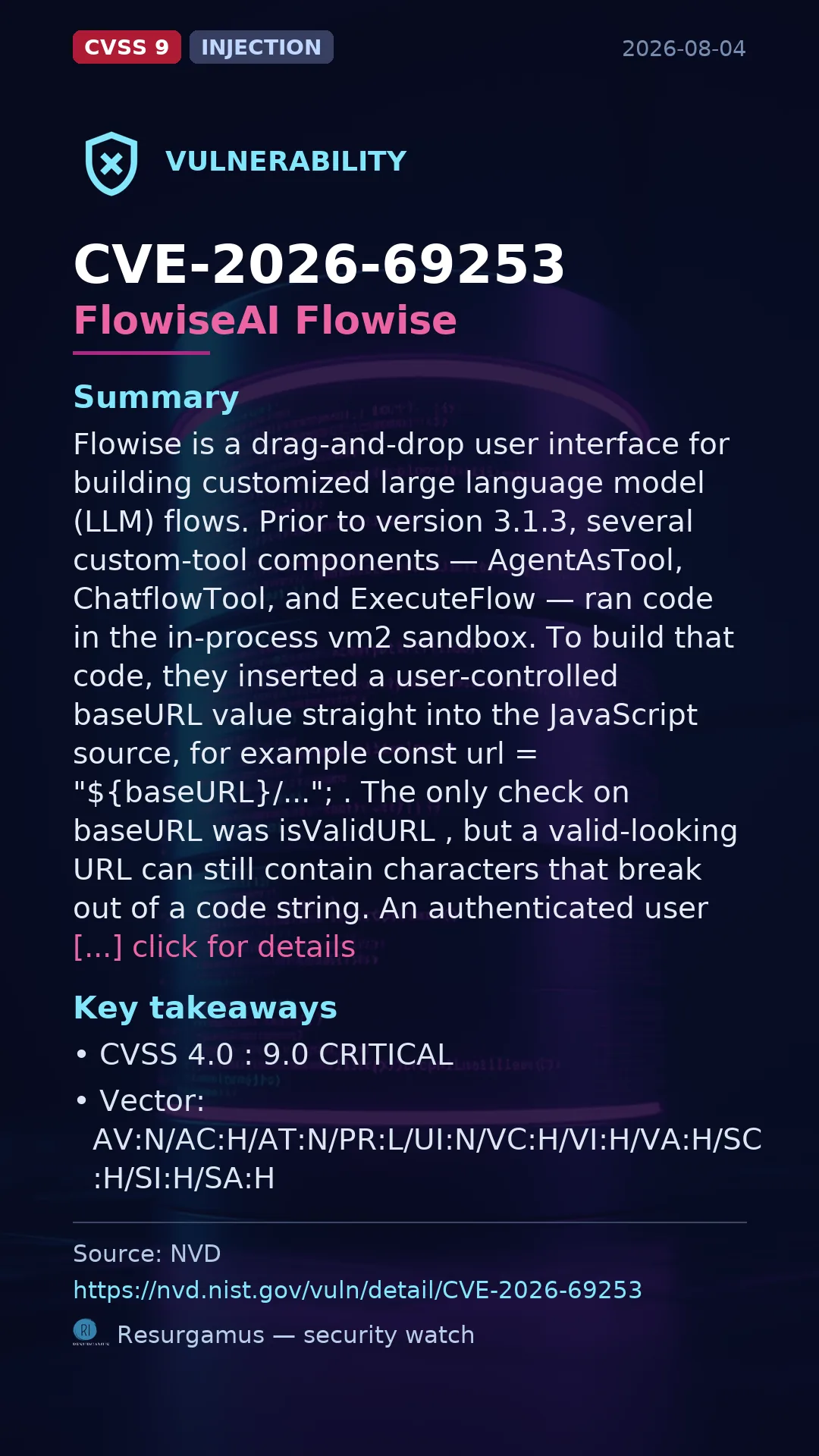
Flowise is a drag-and-drop user interface for building customized large language model (LLM) flows. Prior to version 3.1.3, several custom-tool components — AgentAsTool, ChatflowTool, and ExecuteFlow — ran code in the in-process vm2 sandbox. To build that code, they inserted a user-controlled baseURL value straight into the JavaScript source, for example const url = "${baseURL}/..."; . The only check on baseURL was isValidURL , but a valid-looking URL can still contain characters that break out of a code string. An authenticated user could craft a baseURL that passed this check, closed the surrounding string, and injected their own JavaScript into the sandboxed script (code injection, CWE-94). The vm2 sandbox runs in the same Node.js process as Flowise and exposes risky dependencies. As a result, the injected code could escape the sandbox and run arbitrary code on the Flowise server as the Flowise process user. Exploitation only requires an authenticated session. The issue is fixed in version 3.1.3, which passes the URL to the sandbox as data instead of inserting it into code and adds stricter URL validation.
No public exploitation has been reported so far. No distribution fix is listed yet; apply vendor mitigations and monitor.
Recommended action: Track your distribution's security tracker and apply the fix as soon as it ships.
Severity metrics
CVSS 4.0 : 9.0 CRITICAL
Vector: AV:N/AC:H/AT:N/PR:L/UI:N/VC:H/VI:H/VA:H/SC:H/SI:H/SA:H
Affected & fixed versions by distribution
Versions are the native distribution strings (backport-aware): RHEL/Debian/SUSE backport fixes, so compare with the distro version comparator (dpkg / rpm / vercmp), not the upstream version.
No affected package in the tracked watchlist yet (Debian, Ubuntu, Arch, SUSE, Red Hat...). Triage may still be pending.